
0 ITEMS

Cash-on-Cash Yield: A Key to Buy-and-Hold Investing

Cash-on-cash yield is a key metric for evaluating income-producing real estate and long-term investments.
- It measures annual cash return relative to the actual cash invested, focusing on short-term income efficiency.
- Investors can use ratio comparisons to select properties with higher cash-on-cash returns and align investments with financial goals.
- Understanding the differences between cash-on-cash yield and IRR helps in choosing the right metric for specific strategies.
- Regularly analyzing and adjusting the yield ensures sustained profitability and optimized portfolio performance.
This article covers practical methods to leverage cash-on-cash yield for smarter buy-and-hold investing decisions.
What Does Cash-on-Cash Yield Mean?
Cash-on-cash yield (CoC Yield) measures how much cash an investor earns per year on average compared to the cash they invested. It focuses on the actual cash flow rather than total investment returns, making it useful for analyzing income-generating properties or assets. It offers a quick way to determine how well an asset generates income. By dividing annual cash flow by the initial cash investment, you get a straightforward estimate of profitability.
Annual Cash-on-cash yield shows the relationship between the cash you receive and the cash you put in. The ratio is a percentage because it simplifies comparisons and helps investors quickly assess performance across different investments. This metric allows investors to analyze cash flow efficiency in real-time. It highlights whether an income-generating property or asset meets financial expectations, helping guide investment decisions. So, it is the best metric for measuring returns in buy-and-hold investing. It provides a clear, simple snapshot of profitability for staying invested into an asset and without having to make any assumptions about exit. Cash on Cash Yields focuses on the annual cash generation ability, excluding non-cash factors like depreciation.
The Key Difference Between Cash-on-Cash Yield and the Internal Rate of Return
Cash-on-Cash Yield (CoC Yield) and Internal Rate of Return (IRR) are both key financial metrics for understanding the return of an inestment. However, they serve different purposes depending on investment strategies.
Focus: Cash-on-cash yield measures annual cash returns as a percentage of the initial investment, focusing on short-term income. In contrast, IRR calculates total returns over time, factoring in cash flows and time value. While cash-on-cash yield helps investors assess yearly income, IRR provides a broader view of long-term profitability. Investors use cash-on-cash yield for quick comparisons and IRR for deeper financial analysis.
Investment Scenario: While both evaluate profitability, CoC Yield focuses on annual cash returns, making it ideal for buy-and-hold strategies where steady income is the goal. In contrast, IRR measures the total return over the entire investment lifecycle, including cash flows and the eventual sale, making it more suited for buy-and-sell strategies. Understanding how these metrics relate and differ helps investors choose the right tool for their specific goals.
Investment Period: Cash-on-cash yield measures returns indefinitely, while IRR evaluates performance over 5-7 years. In project finance, IRR is often calculated over 30 years, making it appear small. Investors should also calculate the average annual cash-on-cash yield to get a clearer picture. Since the decision to buy and hold or buy and exit is not always clear, using both metrics helps make better financial decisions.
Reinvestment Assumption: The CoC yield measures returns without assuming reinvestment, focusing only on cash received. IRR, however, assumes all cash flows are reinvested at the same rate, impacting the final return. This key difference makes cash-on-cash yield a simpler metric for income-focused investors, while IRR provides a broader view of long-term growth.
Time Value of Money Effect: Cash-on-cash yield ignores the time value of money, treating all cash flows equally. IRR accounts for it by discounting future cash flows to reflect their true value today. This makes IRR a better tool for comparing long-term investments, while cash-on-cash yield is more useful for assessing short-term cash returns.
When evaluating the profitability of a solar energy investment, understanding the distinction between Cash-on-Cash Yield and Internal Rate of Return (IRR) is crucial, as both metrics offer unique insights into financial performance and investor returns.
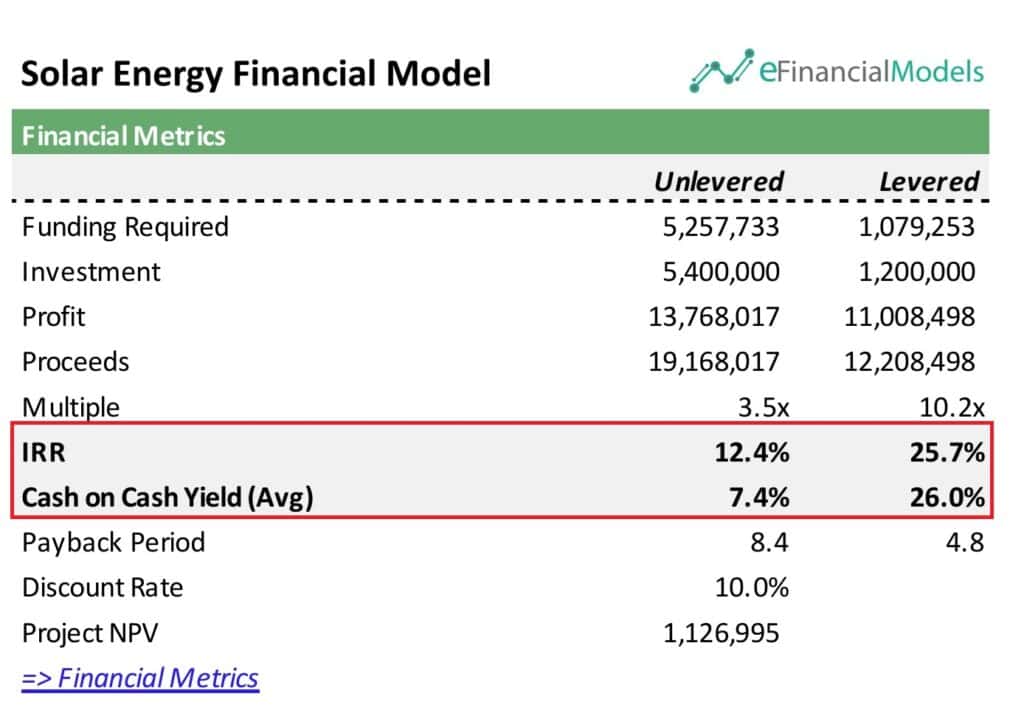
The chart above shows the financial metrics of a Solar Energy Financial Model under unlevered and levered scenarios. Two key measures are the Internal Rate of Return (IRR) and Cash on Cash Yield (COC). The IRR exceeds the discount rate of 10%, which shows the project’s profitability over time. The positive cash-on-cash yields of 26% and 7.4% demonstrate solid annual cash returns. They indicate that investors receive a significant portion of their investment back yearly.
Furthermore, the unleveraged CoC Yield (7.4%) is lower than the leveraged CoC Yield (26.0%), highlighting how financing can amplify annual returns. The unleveraged annual CoC Yield is lower due to the natural decline in solar panel capacity over time. While initial cash returns are higher, they decrease as the project progresses. This declining trend suggests that selling the solar park earlier in its lifecycle could maximize returns instead of holding it long-term and watching cash returns dwindle.
Simple Cash-on-Cash Yield Calculation Guide
Understanding the cash-on-cash yield calculation is essential for anyone evaluating long-term investments. This key financial metric reveals how much cash return an investor earns compared to the cash they put into a deal. It’s a quick, straightforward way to measure profitability and assess whether an investment aligns with financial goals. Focusing on cash flow rather than overall project value helps investors gauge real-time performance and make smarter investment decisions.
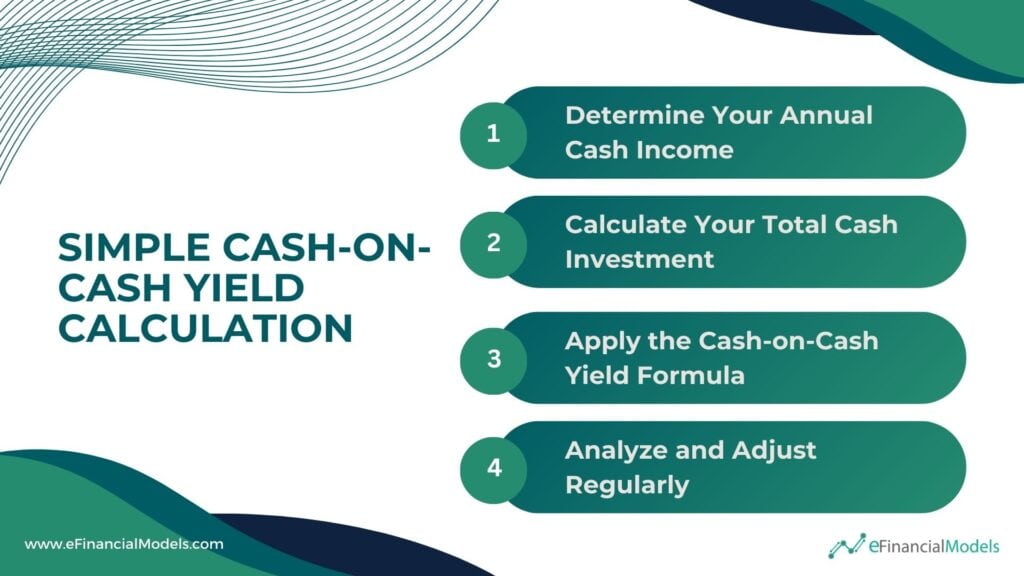
Step 1 – Determine Your Annual Cash Income: Identify the total cash flow your investment generates annually. It includes rental income, dividends, or other revenue directly tied to the asset. Deduct all operating expenses such as maintenance, management fees, or utilities to calculate your net cash income. Use this figure as the foundation for further calculations.
Step 2 – Calculate Your Total Cash Investment: Add up all the cash you’ve invested in the asset. This includes the down payment, closing costs, renovation expenses, and any other upfront costs directly associated with acquiring the investment. Exclude borrowed funds or financing is essential to ensure you only consider your cash contribution. Remember, cash-on-cash yield calculation measures the return on your actual cash investment, not the total property value or financed amount.
Step 3 – Apply the Cash-on-Cash Yield Formula: The formula for cash-on-cash yield calculation is:
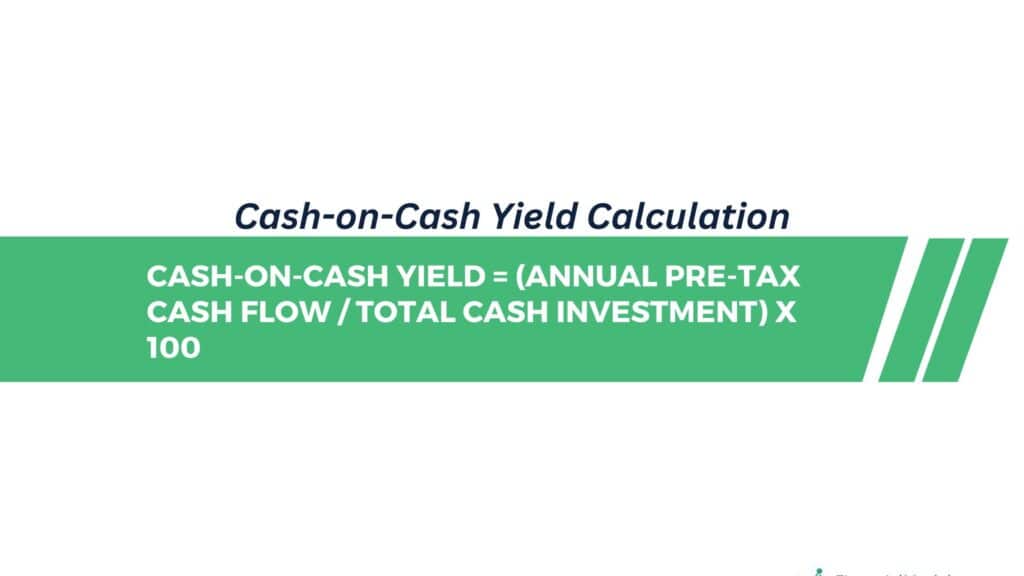
Where:
- The Annual Pre-Tax Cash Flow is the cash generated by the investment after deducting all operating expenses, such as maintenance, property management fees, and utilities.
- Total Cash Investment is the total amount of your personal cash contribution, including the down payment, closing costs, and any upfront expenses.
This percentage reflects how efficiently your investment generates cash returns.
Step 4 – Analyze and Adjust Regularly: Review your CoC yield periodically to account for changes in income or expenses. Rising costs, additional investments, or fluctuating revenue can impact your returns. A higher yield suggests that your investment generates a good return on the cash you’ve put in. If the yield is lower than expected, consider improving your cash income, such as increasing revenues or reducing expenses through better operational management. Use this analysis to identify opportunities for improvement and ensure your investment remains aligned with your financial goals.























































Cash-on-Cash Yield Calculation Example
Let us say you purchase a rental property with a yearly rental income of $24,000 and annual operating expenses of $8,000. Your total cash investment includes a $50,000 down payment, $5,000 closing costs, and $10,000 renovations. First, we subtract the annual operating expenses from the yearly rental income, resulting in an annual pre-tax cash flow of $16,000. Then, we add the down payment, closing costs, and renovations, a total cash investment of $65,000. Now, we can use the cash-on-cash yield calculation formula:
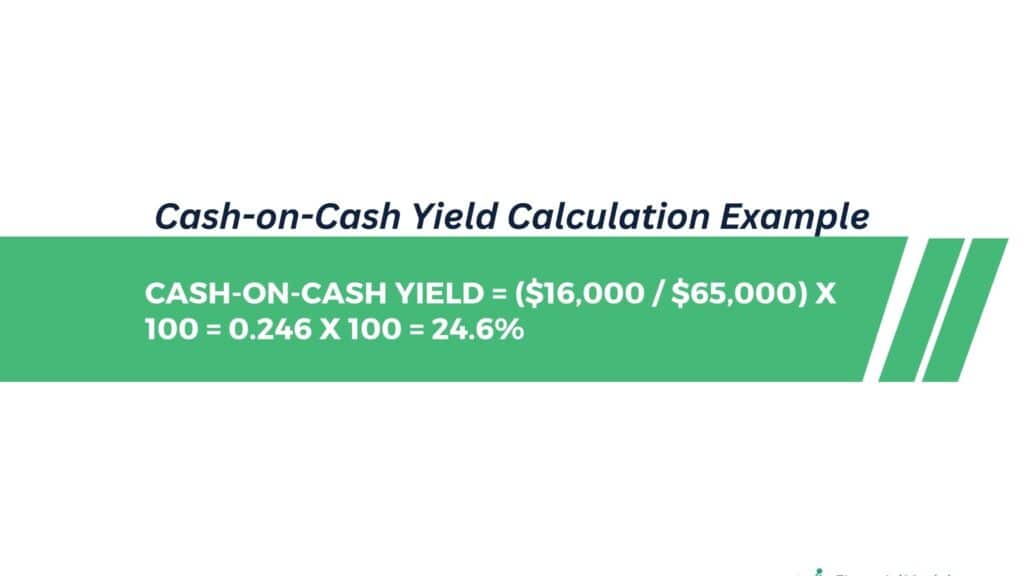
The above cash-on-cash yield calculation shows a 24.6% return on the investor’s cash investment. This means that the investor earns approximately 25 cents in annual cash income for every dollar of cash invested. Such a yield is highly profitable, indicating a strong return compared to typical real estate investment benchmarks, which often range between 7% and 15%. However, profitability depends on the investor’s goals, risk tolerance, and market conditions.
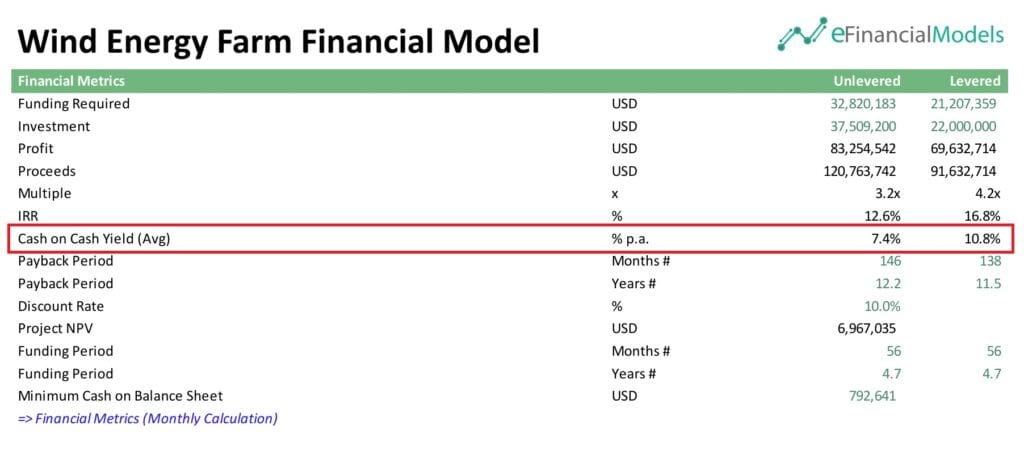
In the above Wind Energy Farm Financial Model, the levered CoC Yield of 10.8% highlights the enhanced cash flow returns achieved through financing strategies, surpassing the unlevered 7.4%. This insight helps investors prioritize liquidity alongside profitability metrics like IRR, ensuring a balanced financial strategy.
How to Leverage Cash-on-Cash Yield as a Buy-and-Hold Investing Strategy
A buy-and-hold investing strategy is a long-term investment approach where individuals purchase assets and hold onto them for an extended period, regardless of market fluctuations. It relies on the belief that, over time, the value of well-chosen investments will grow, benefiting from compound annual growth rate (CAGR) and overall market growth. Instead of reacting to short-term market changes, a buy-and-hold investing strategy focuses on steady wealth building and often aims to minimize transaction costs and taxes. It’s grounded in patience and confidence in the broader economic trends. The CoC yield is a pivotal metric for a buy-and-hold investing strategy. This key performance indicator offers a clear snapshot of annual cash flow relative to the initial cash investment, enabling investors to gauge profitability without relying solely on speculative appreciation. By leveraging the CoC yield effectively, buy-and-hold investors can make informed decisions, improve cash flow management, and strategically expand their portfolios.
Evaluate Immediate Returns for Long-Term Viability
A strong cash-on-cash yield ensures the property can cover its expenses and still provide returns. You can make informed decisions about holding the asset long-term for sustainable growth by evaluating returns early. Focus on understanding the immediate cash flow an investment generates compared to the initial cash you put in. This helps you identify whether the property can support itself and grow your wealth as a buy-and-hold investing strategy.
Imagine you invest $200,000 as a down payment on a small apartment complex that costs $1 million. After covering mortgage payments, property management fees, maintenance, and other expenses, the property generates $25,000 in annual net cash flow. The CoC yield is calculated as $25,000 divided by your $200,000 investment, equaling a 12.5% return. This strong yield indicates that the property supports its expenses and provides a healthy income. By evaluating this early, you can decide if the asset aligns with your long-term financial goals, such as building equity, increasing cash flow, or growing your real estate portfolio.
Compare Investment Opportunities for Optimization
Use cash-on-cash yield to compare multiple investment options side by side. It reveals which asset delivers higher returns for every dollar invested. This buy-and-hold investing strategy metric simplifies decision-making by focusing on cash flow instead of potential appreciation. Prioritizing investments with better cash-on-cash returns can help you optimize your portfolio for a steady income and strong performance.
Suppose you are evaluating two investment opportunities: retail and office spaces. The retail space requires a $150,000 investment and generates $18,000 in annual net cash flow, resulting in a 12% CoC yield. On the other hand, the office space requires a $200,000 investment and produces $20,000 in annual net cash flow, yielding 10%. Comparing these yields, the retail space offers a higher return per dollar invested. By choosing the retail space, you optimize your portfolio for better cash flow, ensuring steady income while still maintaining flexibility for future investments.
Assess and Enhance Operational Performance Regularly
Keep track of the investment’s cash-on-cash yield to spot areas for improvement. Review income streams and expenses regularly to maximize profitability. Small changes, like increasing rent or reducing unnecessary costs, can significantly improve returns. By staying proactive, you can maintain or even boost the investment’s performance, ensuring it remains a valuable part of your buy-and-hold investing strategy.
Let’s say you own a 10-unit multi-family rental property with a CoC yield of 8%. After reviewing your expenses, you notice high utility bills caused by old appliances. You invest in energy-efficient upgrades, reducing utility costs by $2,000 annually. At the same time, you gradually increase rent by $50 per unit due to rising demand, adding $6,000 in additional annual income. These adjustments raise your total net cash flow by $8,000. This improvement increases your CoC yield to 10%, ensuring the property remains a strong performer and a valuable long-term asset in your portfolio.

It is essential to note that cash-on-cash yield has its downsides. It focuses only on annual cash flow and ignores other factors like property appreciation or tax benefits. This narrow view can lead to overlooking investments with strong overall returns but lower initial cash flow. It also doesn’t account for financing effects, making it less useful for leveraged investments. Additionally, it fails to consider future changes in income or expenses, which can impact profitability. While helpful for quick evaluations, relying solely on this metric can lead to missed opportunities or incomplete analyses.
Simplify Cash-on-Cash Yield Calculation Through Financial Modeling
Cash-on-cash yield is the linchpin of a successful buy-and-hold investing strategy. It offers a straightforward way to measure returns on cash invested. This metric provides clarity in identifying profitable opportunities, ensuring investments align with long-term financial goals. By leveraging cash-on-cash yield, you can make informed decisions, optimize your portfolio, and achieve sustainable growth.
Simplifying Cash-on-Cash Yield calculations through financial modeling. Transform complex decision-making into a seamless process. Financial models allow investors to automate calculations, visualize outcomes, and assess various scenarios with precision. These tools enable real-time cash flow, expenses, and returns tracking, ensuring a clear understanding of profitability. Whether comparing multiple investments or analyzing changes in operating costs, financial modeling empowers you to stay proactive and strategic.













































You might also like:
- How to Write a Killer Mobile App Business Plan
- Understanding What is Yield to Maturity and Why It Matters
- Cash Flow Analysis in Excel
- 10 Tips to Develop a First Class Business Valuation Report
- Cash Flow Statement: Streamline Financial Success
- 10 Main Elements of a Business Plan
- How to Prepare a Financial Plan for a Chicken Egg Farm?
- Financial Planning Retirement Tips
- 10 Ideas to Increase Average Revenue Per User
- 5 Best Practices for Managing Days Receivables
- Tourism Project Financial Model Template
- Understanding the Debt Service Coverage Ratio: An Essential Metric for Financial Analysis
- Commercial Real Estate Valuation Approaches, Metrics, and Financial Model Templates
- Financial Model Templates Easy to Use
- 5 Practical Tips to Help Raise Funds For Startups
- How to Value a Business Using a Discounted Cash Flow Model
- Financial Ratios Analysis and Its Importance
- 7 Key Tips: How to Best Work With a Financial Model Template
- The Benefits of Managing Days Inventory Outstanding Efficiently
- How to Grow an Event Organizer Business