0 ITEMS

Business Valuation Services: CVA & ASA Experts, $5K–$50K+

Yes, you can hire a certified expert to value your business, and the credential they hold determines whether that valuation holds up in court, with the IRS, or in an M&A negotiation.
Key Takeaways
- EFM’s network includes CVA, ASA, and ABV-credentialed professionals covering 3 service tiers from $5,000 to $50,000+.
- The SMB tier ($5,000–$15,000) covers businesses under $5M revenue; the Mid-Market tier ($15,000–$35,000) covers $5M–$50M; the Enterprise tier ($35,000–$50,000+) handles complex or high-revenue engagements.
- Formal valuations typically take 2–6 weeks from engagement to final report, depending on documentation completeness and business complexity.
- At least 6 distinct use cases require a formal, credentialed valuation: M&A transactions, estate and gift tax, shareholder disputes, SBA loans, 409A equity compensation, and divorce proceedings.
- Big 4 valuation engagements typically cost $50,000–$250,000+, making EFM’s model-backed approach a credible mid-market alternative.
- USPAP (Uniform Standards of Professional Appraisal Practice) compliance is required for IRS and court-admissible reports; non-compliant reports carry rejection risk.
- Verifying a valuation expert’s credentials takes under 10 minutes using NACVA’s public directory or the ASA’s online member search.
What Certified Business Valuation Experts Actually Do
A certified business valuation expert determines the economic value of a business interest using documented methodologies, professional standards, and defensible assumptions. They don’t just apply a revenue multiple; they analyze cash flows, normalize earnings, assess risk, benchmark against comparable transactions, and produce a written report that can withstand scrutiny from the IRS, a judge, or an opposing M&A advisor.
You need one when the stakes are high enough that a wrong number has legal, tax, or financial consequences. Internal planning can often rely on a well-built financial model. But the moment a transaction, a tax filing, a court proceeding, or a regulatory requirement enters the picture, a credentialed valuation professional is not optional.
Specific triggers include:
- Selling or acquiring a business (buy-side or sell-side M&A)
- Estate planning or gift tax filings requiring IRS Form 706 or 709 support
- Shareholder buyouts, disputes, or oppression claims
- SBA 7(a) or 504 loan applications for business acquisitions
- 409A valuations for startup equity compensation plans
- Divorce proceedings involving business interests
- Litigation support and expert witness testimony

Six distinct legal and financial contexts require a credentialed valuation report. Using the wrong report type for any of these can result in IRS penalties or court rejection.
EFM’s Valuation Professional Network: Credentials That Matter
Not all valuation credentials carry equal weight in every context. EFM’s network includes professionals holding three primary designations, each with distinct exam requirements, experience thresholds, and professional standards.
CVA (Certified Valuation Analyst): Issued by the National Association of Certified Valuators and Analysts (NACVA), the CVA requires a CPA license, completion of a 5-day training program, a comprehensive exam, and ongoing continuing education. CVAs follow NACVA’s professional standards and are well-recognized in litigation, M&A, and tax contexts.
ASA (Accredited Senior Appraiser): Issued by the American Society of Appraisers, the ASA designation requires at least 5 years of full-time appraisal experience, a peer-reviewed demonstration report, and passage of a rigorous exam. ASA holders are required to comply with USPAP, the Uniform Standards of Professional Appraisal Practice, which is the standard most courts and the IRS recognize for formal appraisals. According to the American Society of Appraisers, there are approximately 4,000 ASA members across all disciplines in the United States.
ABV (Accredited in Business Valuation): Issued by the American Institute of CPAs (AICPA), the ABV requires an active CPA license, 150 hours of business valuation education, and passage of a comprehensive exam. ABV holders are particularly strong in tax-related valuations and financial reporting contexts.
Why credentials matter: the IRS requires that estate and gift tax valuations be performed by a “qualified appraiser” as defined under Treasury Regulation 1.170A-17, which specifies education and experience requirements that uncredentialed providers cannot meet. Courts applying the Daubert standard for expert testimony, as governed by Federal Rule of Evidence 702, evaluate whether the expert’s methodology is scientifically valid and peer-reviewed, which credentialed professionals can demonstrate and uncredentialed ones typically cannot.
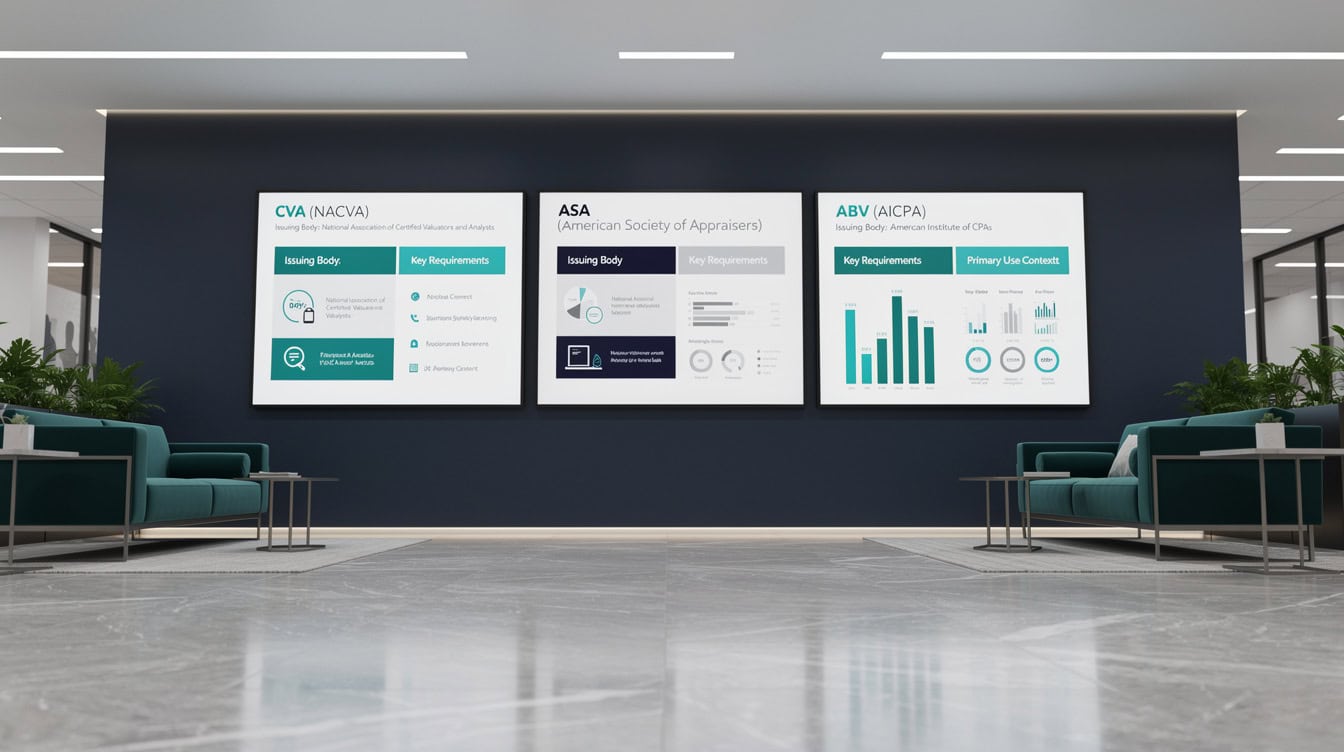
CVA, ASA, and ABV credentials each have distinct exam requirements and use-case strengths. ASA is the most widely recognized in IRS and court contexts due to mandatory USPAP compliance.
Service Tiers and Transparent Pricing
EFM structures valuation engagements into three tiers based on business revenue, complexity, and intended use. Every engagement begins with a free 30-minute scoping call to confirm the right tier before any fee is quoted.
SMB Tier: $5,000–$15,000
For businesses with under $5M in annual revenue. This tier covers owner-operated businesses, professional practices, and small companies preparing for a first sale or SBA loan. Deliverables include a formal valuation report, normalized earnings analysis, and a primary methodology (typically a capitalization of earnings or market approach using guideline transactions). Timeline: 2–3 weeks with complete documentation.
Mid-Market Tier: $15,000–$35,000
For businesses with $5M–$50M in annual revenue. This tier applies to companies with multiple revenue streams, management teams, or complex capital structures. Deliverables include a full appraisal report with DCF analysis, comparable company benchmarking, and a reconciled conclusion of value. Timeline: 3–5 weeks.
Enterprise Tier: $35,000–$50,000+
For businesses above $50M revenue or those with high complexity: multi-entity structures, intellectual property, international operations, or litigation contexts. Deliverables include a comprehensive appraisal report with multiple methodologies, sensitivity analysis, and expert witness support if required. Timeline: 4–6 weeks or longer for highly complex engagements.
For context, Big 4 accounting firms (Deloitte, PwC, EY, KPMG) typically charge $50,000–$250,000+ for comparable valuation work, with minimum engagement sizes that exclude most SMB and mid-market companies.

EFM’s three service tiers cover businesses from under $5M to $50M+ in revenue, with fixed-fee pricing quoted after a free scoping call.
Model-Backed Valuation Methodologies
EFM’s financial modeling expertise directly enhances traditional valuation work. Most valuation firms apply standard methodologies; EFM’s professionals build the underlying financial models that make those methodologies more defensible and more useful to the client.
The four primary approaches used across EFM engagements:
DCF (Discounted Cash Flow): Projects future free cash flows and discounts them to present value using a risk-adjusted discount rate (WACC, or Weighted Average Cost of Capital). The DCF is the most theoretically rigorous method and the most sensitive to assumptions. EFM builds explicit 5-year projection models with scenario analysis, so clients understand how value changes under different growth and margin assumptions.
Comparable Company Analysis: Benchmarks the subject company against publicly traded peers using valuation multiples such as EV/EBITDA, EV/Revenue, and P/E. According to S&P Global Market Intelligence, industry EBITDA multiples vary significantly: software companies have historically traded at 10–20x EBITDA, while manufacturing businesses typically trade at 4–7x EBITDA.
Precedent Transactions: Analyzes actual acquisition prices paid for comparable private companies. This method captures control premiums and is particularly relevant for sell-side M&A engagements.
Asset-Based Methods: Values the business based on the fair market value of its net assets. Most applicable for holding companies, asset-heavy businesses, or liquidation scenarios.
A reconciled conclusion of value weighs all applicable methods and explains the reasoning, which is what distinguishes a professional appraisal report from a back-of-envelope calculation.
Worked Example: DCF for a $3M Revenue SaaS Business
Here’s the math for a simplified DCF on a SaaS company with $3M revenue, 25% EBITDA margin, and 15% projected growth:
- Year 1 Free Cash Flow: $750,000 (25% of $3M)
- Year 2: $862,500 (15% growth)
- Year 3: $991,875
- Year 4: $1,140,656
- Year 5: $1,311,754
- Terminal Value (at 3% perpetuity growth, 18% discount rate): $1,311,754 × (1.03) / (0.18 – 0.03) = $9,014,037
- PV of Terminal Value (discounted 5 years at 18%): $9,014,037 / (1.18)^5 = $3,940,000
- PV of Cash Flows (Years 1–5 at 18% discount rate): approximately $2,890,000
- Indicated Enterprise Value: approximately $6,830,000
This is a simplified illustration. A formal engagement adjusts for working capital, capex, debt, and applies a discount for lack of marketability (DLOM) for private companies, which, as documented in Valuing a Business, typically ranges from 15%–35% depending on company-specific factors.
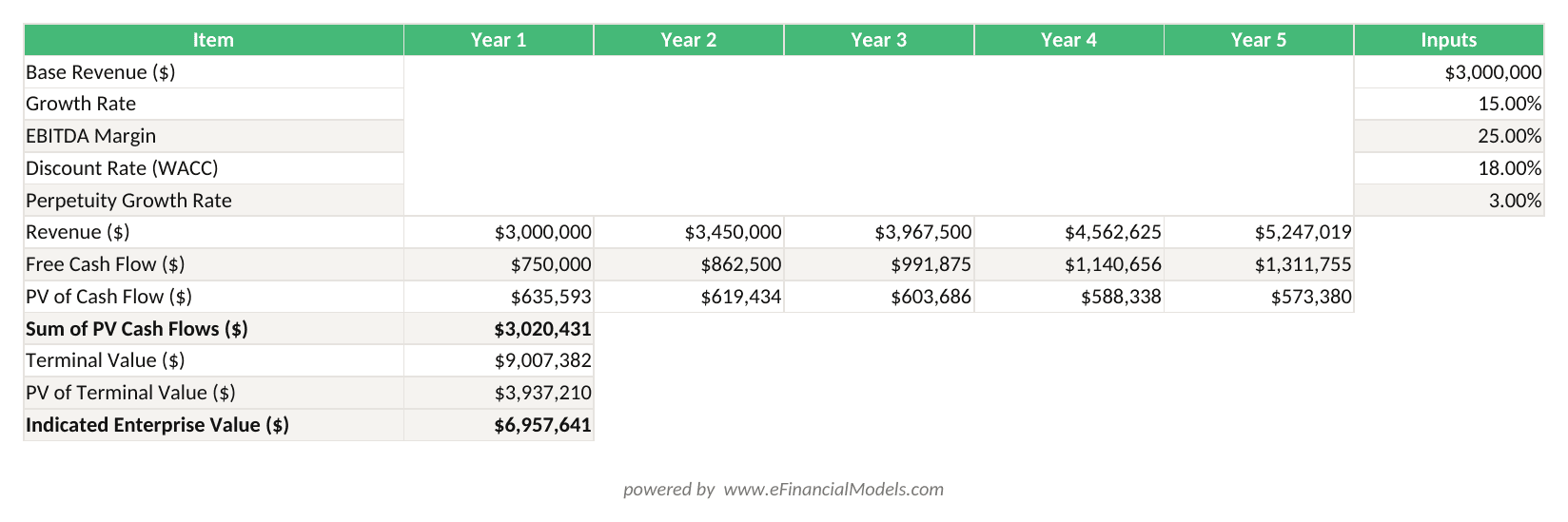
DCF model: $3M SaaS, 25% EBITDA margin, 15% growth, 18% WACC. Indicated enterprise value ~$6.83M before DLOM adjustment.
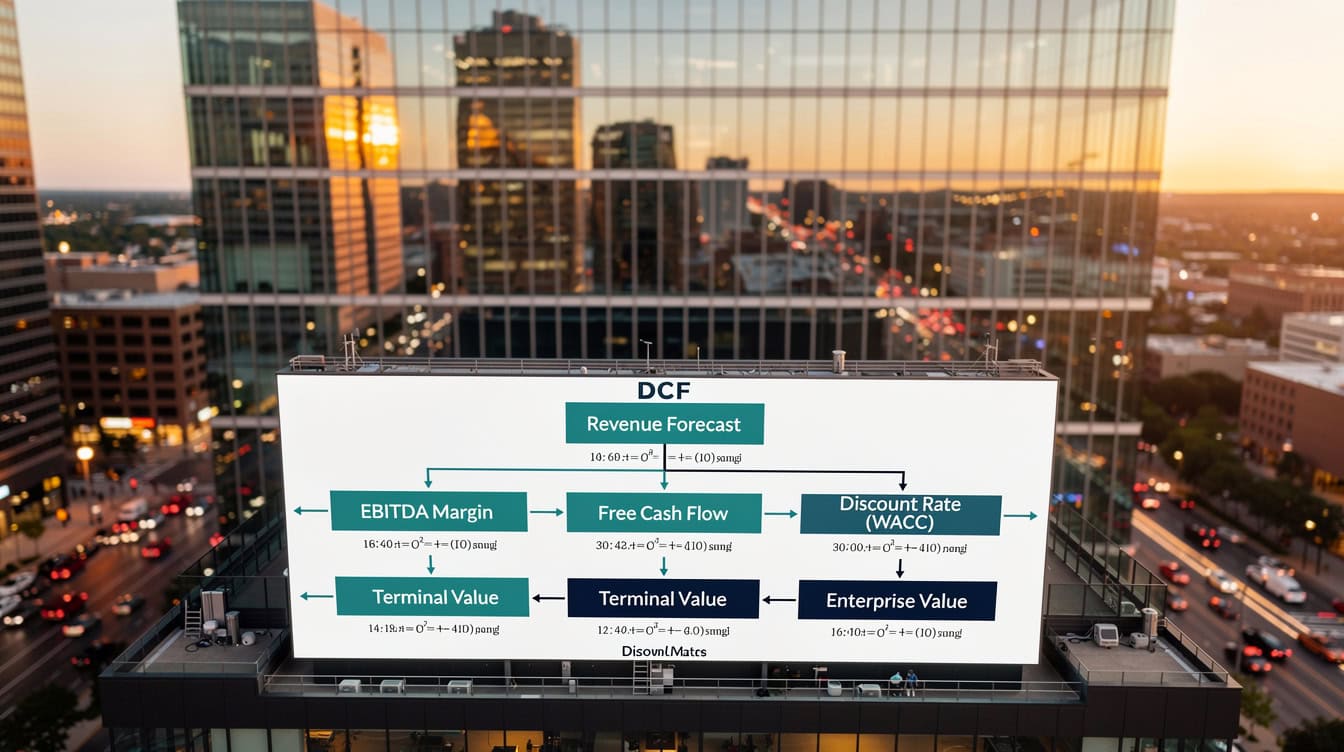
A DCF model discounts projected free cash flows and a terminal value back to present value using WACC. Small changes in the discount rate or growth assumption can shift enterprise value by 20–40%.
Common Use Cases: M&A, Tax, Litigation, SBA, and 409A
Different use cases demand different report types and standards. Using the wrong report type for a specific purpose is one of the most common and costly mistakes business owners make.
M&A Transactions: Both buy-side and sell-side advisors need a credentialed valuation to anchor negotiations, support financing, and satisfy buyer due diligence. A formal appraisal report strengthens the seller’s position and reduces renegotiation risk after LOI.
Estate and Gift Tax: The IRS requires a qualified appraisal attached to Form 706 (estate tax) or Form 709 (gift tax) when transferring business interests. Penalties for substantial valuation misstatements can reach 40% of the underpayment under IRC Section 6662.
Shareholder Disputes and Litigation: Courts require expert testimony that meets the Daubert standard—codified in Federal Rule of Evidence 702—which evaluates whether the methodology is testable, peer-reviewed, and generally accepted in the relevant professional community. Only credentialed experts with documented methodologies consistently meet this bar.
SBA Loans: The SBA requires an independent business valuation for acquisition loans above $250,000 when the buyer and seller have a relationship, and for all loans above $500,000 regardless of relationship (SBA Standard Operating Procedure 50 10 7). The valuation must be performed by a qualified source.
409A Valuations: Startups granting stock options must establish fair market value of common stock under IRS Section 409A. A safe harbor valuation performed by a qualified independent appraiser protects the company from IRS challenge. Employees whose options are granted below fair market value face a 20% additional penalty tax on the spread. Source
Divorce Proceedings: Business interests are marital assets in most jurisdictions. Courts require a credentialed valuation expert, and opposing counsel will challenge any report that doesn’t meet professional standards.

409A valuations protect startups from IRS penalties on stock options; estate valuations protect families from 40% misstatement penalties under IRC Section 6662.
Case Studies: Real Valuation Engagements
These are sanitized examples drawn from EFM engagement types. Specific client details are confidential.
Case Study 1: HVAC Business Sale, $4.2M Revenue (SMB Tier)
A second-generation HVAC contractor engaged EFM ahead of a planned sale to a regional PE-backed roll-up. The challenge: the owner had been running personal expenses through the business, depressing reported EBITDA. EFM’s CVA-credentialed analyst normalized earnings by adding back $280,000 in non-recurring and personal expenses, applied a market approach using 5 guideline transactions, and produced a formal appraisal report. The normalized EBITDA multiple supported a sale price 34% higher than the buyer’s initial offer. Engagement cost: $9,500. Timeline: 3 weeks.
Case Study 2: SaaS Platform, $18M ARR (Mid-Market Tier)
A founder preparing for a Series B raise needed a 409A valuation and a separate enterprise value opinion for investor negotiations. EFM deployed an ASA-credentialed analyst who built a full DCF model with three scenarios (base, upside, downside), applied a backsolve method using the most recent preferred stock financing round, and reconciled to a concluded common stock value. The 409A report met IRS safe harbor requirements. The enterprise value opinion supported the founder’s negotiating position in term sheet discussions. Engagement cost: $22,000. Timeline: 4 weeks.
Case Study 3: Manufacturing Company Estate Plan, $31M Revenue (Mid-Market/Enterprise Tier)
A family-owned manufacturer needed a valuation for a gifting program transferring minority interests to the next generation. The engagement required USPAP compliance, a discount for lack of control (DLOC), and a discount for lack of marketability (DLOM). EFM’s ASA analyst applied all three standard approaches, reconciled to a concluded value, and produced a qualified appraisal report attached to IRS Form 709. The report withstood an IRS audit inquiry without adjustment. Engagement cost: $28,500. Timeline: 5 weeks.
A typical EFM valuation engagement runs 2–6 weeks. Documentation completeness at Stage 2 is the single biggest driver of timeline variance.
The Valuation Engagement Process: Timeline and Documentation
A typical EFM valuation engagement follows five stages from kickoff to final report delivery.
Stage 1: Scoping Call (Day 1): Free 30-minute call to confirm use case, report type, credential requirements, and tier. EFM provides a fixed-fee engagement letter within 48 hours.
Stage 2: Documentation Collection (Days 2–10): The client provides the required documentation package. Incomplete documentation is the single most common cause of timeline delays.
Required documentation for all tiers:
- 3 years of financial statements (income statement, balance sheet, cash flow)
- Most recent interim financial statements
- Federal tax returns for 3 years
- Customer concentration data (top 10 customers as % of revenue)
- Key contracts (leases, supplier agreements, customer contracts)
- Organizational chart and management bios
- List of assets (equipment, IP, real estate)
- Any prior valuations or offers received
Additional for Mid-Market and Enterprise tiers:
- 5-year financial projections or management forecast
- Capitalization table (for equity-related valuations)
- Details of any related-party transactions
- Pending litigation or contingent liabilities
Stage 3: Analysis and Modeling (Days 10–25): The assigned analyst builds the financial model, normalizes earnings, applies methodologies, and drafts the report.
Stage 4: Internal Review (Days 25–30): A second credentialed reviewer checks the report for methodology consistency, calculation accuracy, and standards compliance.
Stage 5: Final Report Delivery (Days 30–42): The client receives a bound appraisal report in PDF and, where applicable, the underlying financial model in Excel.
A formal appraisal report includes a concluded value, methodology reconciliation, and credential documentation. This is the deliverable that satisfies IRS, SBA, and court requirements.
EFM vs. Big 4 vs. Local CPA vs. Online Tools
Choosing the right provider depends on your use case, budget, and the credibility requirements of the audience receiving the report.
| Provider | Typical Cost | Credentials | USPAP Compliant | Best For |
|---|---|---|---|---|
| Big 4 Firms | $50K–$250K+ | CVA/ASA/ABV | Yes | Large M&A, public co. |
| EFM Network | $5K–$50K+ | CVA/ASA/ABV | Yes | SMB to mid-market |
| Regional CPA | $3K–$20K | CPA (may lack CVA) | Sometimes | Tax prep, basic needs |
| Online Tools | $0–$500 | None | No | Internal planning only |
Online calculators and rule-of-thumb multiples are appropriate for internal planning and early-stage thinking. They are not appropriate for any use case where the report will be reviewed by the IRS, a court, an SBA lender, or an opposing M&A advisor.
Local CPAs often provide excellent accounting services but may lack the specific valuation credentials and USPAP training required for formal appraisals. Always ask whether your CPA holds a CVA, ASA, or ABV before engaging them for a formal valuation.
Big 4 firms provide the highest-credibility reports but price most SMB and mid-market companies out of their minimum engagement thresholds. EFM’s model-backed approach delivers comparable methodological rigor at a fraction of the cost.
Big 4 firms charge $50K–$250K+ for valuations that EFM delivers at $5K–$50K with equivalent credentials. Online tools are appropriate only for internal planning.
How to Verify Valuation Expert Credentials and Avoid Low-Quality Providers
Verifying credentials takes under 10 minutes and protects you from reports that fail IRS or court scrutiny.
CVA verification: Search NACVA’s public member directory at nacva.com. Enter the professional’s name and confirm active status and any disciplinary history.
ASA verification: Use the American Society of Appraisers’ online member search at appraisers.org. Confirm the discipline (Business Valuation) and active membership.
ABV verification: Search the AICPA’s credential verification tool at aicpa.org. Confirm the CPA license is active in the relevant state.
Red flags to watch for:
- No verifiable credential in CVA, ASA, or ABV
- Refusal to confirm USPAP compliance for IRS or court-related work
- No peer review or quality control process described
- Report delivered in under 1 week for a complex business (insufficient time for proper analysis)
- Engagement letter that doesn’t specify the standard of value (fair market value, fair value, investment value) or the premise of value (going concern vs. liquidation)
- Pricing that seems too low: a $500 “valuation” for a $10M business is not a valuation, it’s a calculation report at best, and it will not survive IRS or legal scrutiny
The distinction between a calculation report (limited procedures, lower cost, not suitable for IRS or court use) and a detailed appraisal report (full procedures, USPAP-compliant, defensible) is critical. Always confirm which type you’re receiving before signing an engagement letter.
Frequently Asked Questions
How much does a business valuation cost for a small business?
For a small business with under $5M in annual revenue, a formal credentialed valuation typically costs between $5,000 and $15,000. This range reflects the SMB tier at EFM and is consistent with market rates for CVA or ABV-credentialed professionals. The cost depends on business complexity, the number of entities involved, the intended use of the report (SBA loan vs. estate planning vs. M&A), and documentation completeness. A calculation report (limited procedures) costs less but is not suitable for IRS or court use. Always confirm the report type before engaging.
What is the difference between a CVA, ASA, and ABV?
All three are recognized business valuation credentials, but they differ in issuing body, requirements, and typical use contexts. The CVA (Certified Valuation Analyst) is issued by NACVA and requires a CPA license plus a comprehensive exam. The ASA (Accredited Senior Appraiser) is issued by the American Society of Appraisers, requires 5 years of experience and USPAP compliance, and is the most widely recognized credential in court and IRS contexts. The ABV (Accredited in Business Valuation) is issued by the AICPA and is particularly strong for tax and financial reporting valuations. For litigation and estate tax work, ASA is generally the strongest credential.
Does the SBA require a formal business valuation for acquisition loans?
Yes. The SBA Standard Operating Procedure 50 10 7 requires an independent business valuation for acquisition loans above $250,000 when the buyer and seller have a pre-existing relationship, and for all acquisition loans above $500,000 regardless of relationship. The valuation must be performed by a qualified source, which the SBA defines as a certified valuation professional or a licensed business broker with demonstrated valuation expertise. A report from an uncredentialed provider will not satisfy SBA lender requirements and will delay or kill the loan approval.
What is a 409A valuation and why does my startup need one?
A 409A valuation establishes the fair market value of a private company’s common stock for purposes of setting stock option exercise prices under IRS Section 409A. If options are granted below fair market value, employees face immediate income tax plus a 20% penalty tax on the spread, plus interest. A safe harbor valuation performed by a qualified independent appraiser protects the company from IRS challenge. The IRS defines a qualified appraiser as someone with verifiable education and experience in business valuation. Source Startups should obtain a 409A valuation before each option grant and refresh it at least every 12 months or after a material event such as a new financing round.
How long does a business valuation take?
Timeline depends on business complexity and documentation completeness. SMB engagements (under $5M revenue) typically take 2–3 weeks from complete documentation receipt to final report. Mid-Market engagements ($5M–$50M) take 3–5 weeks. Enterprise engagements ($50M+ or high complexity) take 4–6 weeks or longer. The most common cause of delays is incomplete documentation from the client. Providing 3 years of financial statements, tax returns, customer concentration data, and key contracts at the start of the engagement is the single most effective way to keep the timeline on track.
Can I use a business valuation report for multiple purposes?
Sometimes, but not always. A valuation report prepared for one purpose (for example, an SBA loan) may not be appropriate for a different purpose (for example, estate tax filing) because the standard of value, premise of value, and required procedures differ. Fair market value (the standard for IRS purposes) and fair value (the standard in many shareholder dispute contexts) are legally distinct concepts that can produce different numbers for the same business. Always disclose the intended use to your valuation professional at the start of the engagement so the report is structured correctly.
What happens if the IRS challenges my business valuation?
If the IRS challenges a valuation attached to an estate or gift tax return, the burden of proof initially rests with the taxpayer to show the valuation is correct. A USPAP-compliant report prepared by a credentialed ASA or CVA significantly strengthens the taxpayer’s position. If the IRS and taxpayer cannot agree, the case may go to Tax Court, where the judge evaluates the credibility and methodology of each side’s expert. Substantial valuation misstatements—values understated by 65% or more of correct value—trigger a 40% penalty under IRC Section 6662. A credentialed, USPAP-compliant report is the primary defense against both the challenge and the penalty.
Conclusion
Business valuation is not a commodity. The credential behind the report, the methodology applied, and the standards followed determine whether your valuation holds up when it matters most: in a negotiation, before the IRS, or in a courtroom. EFM’s network of CVA, ASA, and ABV-credentialed professionals delivers formal, defensible appraisal reports at three transparent price points, from $5,000 for SMB engagements to $50,000+ for enterprise complexity, without the Big 4 price tag or the credibility gap of an uncredentialed local provider.
I recommend scheduling a free 30-minute consultation with an EFM valuation specialist to confirm which tier matches your business size, transaction type, and credibility requirements. You can also explore EFM’s business valuation templates and resources to understand the financial modeling foundation behind every engagement, or review our professional services and advisory models for additional context on how EFM structures complex financial engagements.