0 ITEMS

How to Choose a Business Valuation Firm: 7 Key Criteria

The valuation firm you hire shapes whether your transaction closes, survives an IRS audit, or holds up in court — so the selection decision deserves the same rigor you apply to the deal itself.
Key Takeaways
- Big Four valuation engagements typically cost $75,000–$150,000+, while regional independent firms handle mid-market assignments for $15,000–$40,000, and national boutiques fall in the $40,000–$80,000 range.
- USPAP compliance is legally required for ESOP, SBA-loan, and most U.S. tax-purpose valuations; IVS applies to cross-border M&A and IFRS reporting contexts.
- The 5 most recognized credentials are ASA (Accredited Senior Appraiser), ABV (Accredited in Business Valuation), CVA (Certified Valuation Analyst), CBA (Certified Business Appraiser), and CFA — each signals different depth of methodology training.
- A standard mid-market valuation engagement runs 4–8 weeks; complex multi-entity or litigation-support assignments routinely exceed 12 weeks.
- The income approach (DCF) suits high-growth or intangible-heavy businesses; the market approach fits industries with robust comparable transaction data; the asset-based approach applies primarily to holding companies and asset-intensive businesses.
- 3 hard red flags disqualify a firm immediately: contingency-based fees tied to valuation outcome, no named credentialed appraiser on the engagement, and inability to provide litigation-support references.
- Preparing your financial data before engagement — 3 years of audited financials, a capitalization table, and a customer concentration analysis — can cut engagement time by 2–3 weeks and reduce fees by up to 15%.
Why Valuation Firm Selection Determines Transaction Outcomes
The firm you choose directly determines whether your valuation is accepted by the IRS, your counterparty’s advisors, or a court. A credible, defensible valuation report is not a commodity — it is a professional judgment exercise that reflects the appraiser’s methodology, credentials, and industry knowledge.
The stakes are concrete. The IRS challenges estate and gift tax valuations aggressively: according to the American Society of Appraisers, valuation-related penalties under IRC Section 6662 can reach 40% of the underpayment when a “gross valuation misstatement” is found. Choosing a firm without USPAP-compliant methodology or without a credentialed appraiser signing the report creates direct financial exposure. For ESOP transactions, the Department of Labor requires an independent, qualified appraiser under ERISA Section 3(18) — a requirement that disqualifies many generalist accounting firms according to the U.S. Department of Labor. Selecting the right firm is not a preference; for many transaction types, it is a legal requirement.
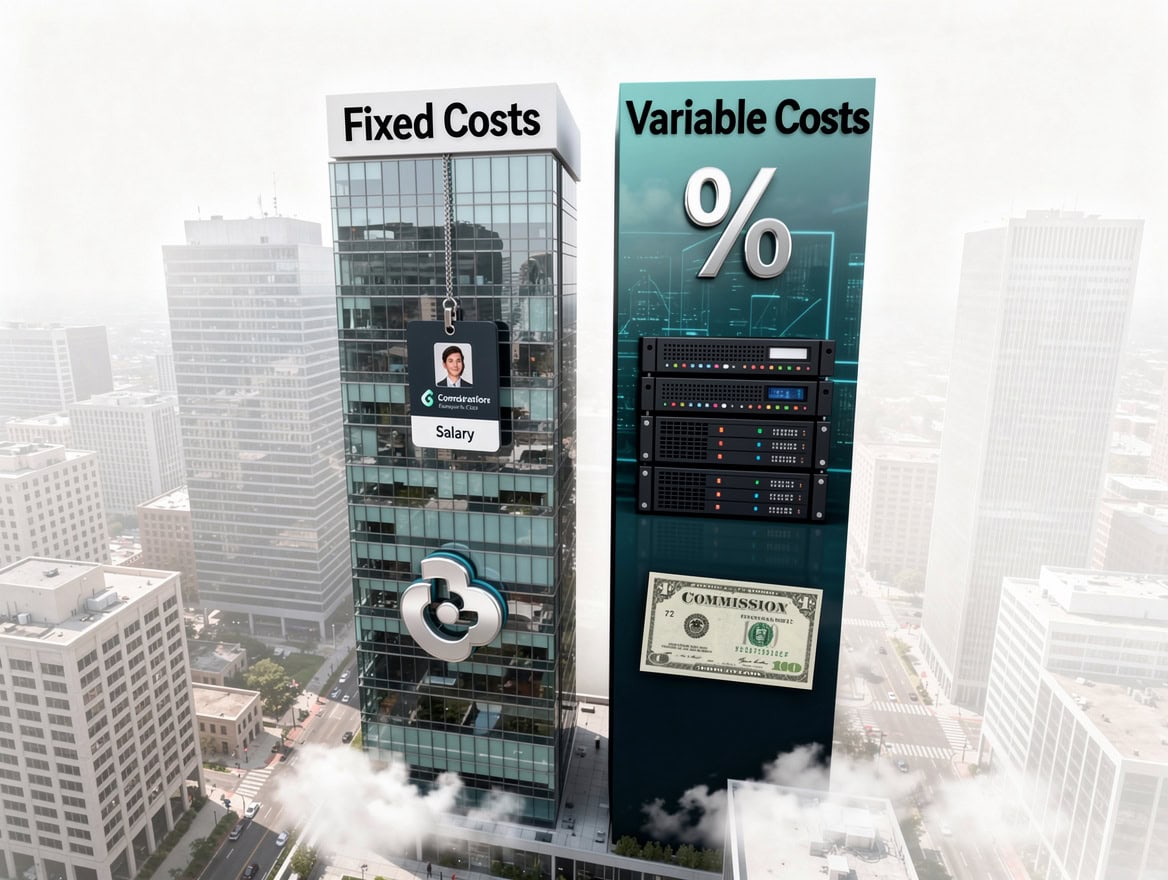
Firm tier determines both cost and credibility level — Big Four engagements run $75K–$150K+ while regional independents handle most mid-market assignments for $15K–$40K.
Types of Business Valuation Firms: Big Four, Boutiques, and Independents
Three firm categories serve the mid-market, and each fits a different set of use cases, budgets, and credibility requirements.
Big Four valuation practices (Deloitte, PwC, EY, KPMG) offer the broadest service scope: fairness opinions, purchase price allocations, complex litigation support, and cross-border engagements. Their brand carries weight with audit committees and international counterparties. Typical engagement fees run $75,000–$150,000+ for a mid-market full valuation. The tradeoff is cost and partner attention — mid-market clients often work with senior managers rather than partners.
National boutiques such as Kroll (formerly Duff & Phelps), Houlihan Lokey, and Stout occupy the middle tier. They combine deep valuation methodology expertise with industry specialization and are frequently retained for fairness opinions in transactions between $50M and $500M. Fees typically range from $40,000 to $80,000 for a full valuation engagement, with fairness opinions priced separately based on transaction size.
Regional and independent firms serve the largest volume of mid-market valuations. A credentialed independent appraiser or a regional CPA firm with a dedicated valuation practice can deliver USPAP-compliant reports for $15,000–$40,000. These firms are appropriate for 409A valuations, estate and gift tax, buy-sell agreement support, and smaller M&A transactions. The critical variable is credential verification — firm size does not substitute for individual appraiser qualifications.
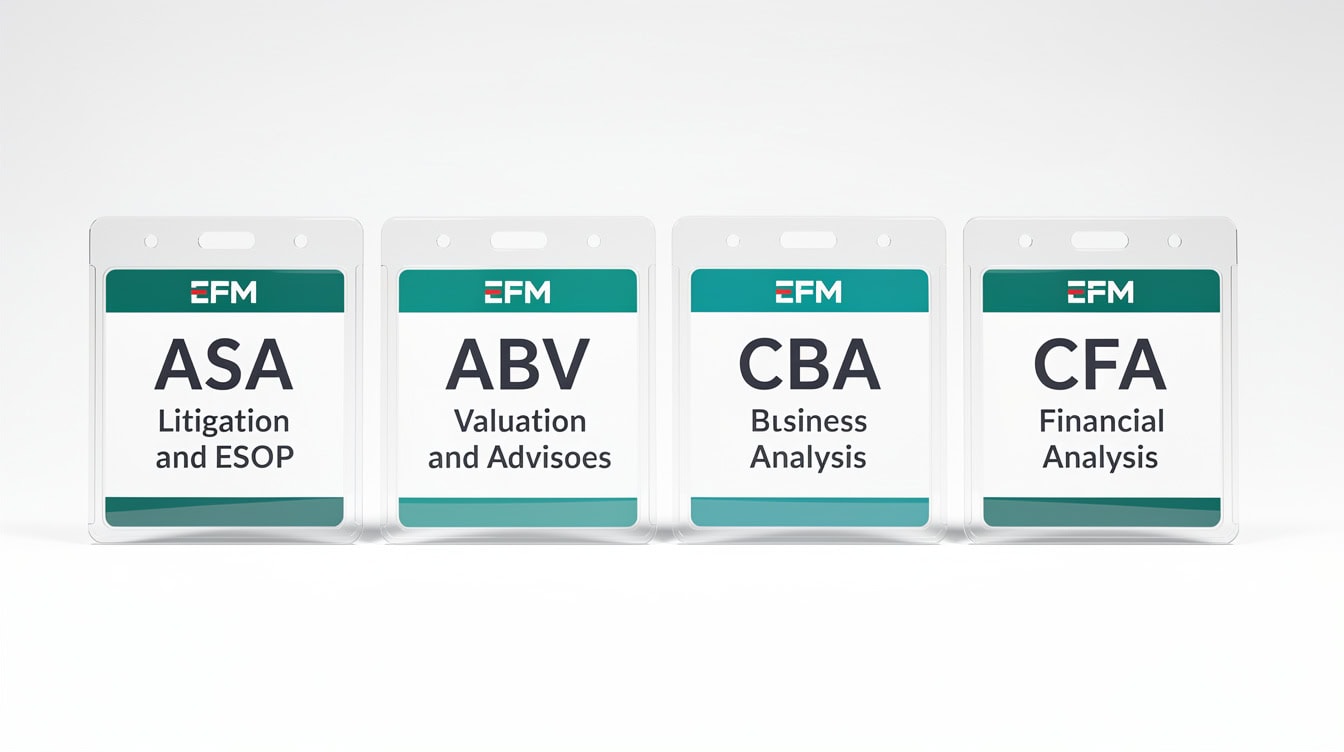
Credential selection should match engagement purpose: ASA for litigation and ESOP, ABV for tax, CVA for mid-market M&A planning.
Valuation Service Types Compared: Full Reports, Fairness Opinions, and Calculation Engagements
Not every engagement requires a full appraisal report, and understanding the differences saves both time and money. The table below maps service type to appropriate use case, deliverable standard, and relative cost.
| Service Type | Standard | Typical Use Case | Relative Cost | Defensibility |
|---|---|---|---|---|
| Full Valuation (Conclusion of Value) | USPAP/IVS | ESOP, estate/gift tax, litigation, M&A | High ($25K–$150K+) | Highest |
| Fairness Opinion | FINRA/firm standard | Board fiduciary duty, related-party transactions | High ($50K–$200K) | High |
| Calculation Engagement | SSVS No. 1 | Internal planning, preliminary M&A | Low–Medium ($8K–$25K) | Limited |
| Limited-Scope Valuation | Firm-defined | Buy-sell triggers, benchmarking | Low ($5K–$15K) | Low |
| 409A Valuation | IRC 409A/USPAP | Startup equity compensation | Low–Medium ($5K–$20K) | Moderate |
A conclusion of value (the full appraisal) requires the appraiser to perform all procedures necessary to support the opinion and is the only deliverable that fully withstands IRS audit, litigation, or regulatory scrutiny. A calculation engagement — defined under AICPA’s Statement on Standards for Valuation Services No. 1 — applies only the methods agreed upon with the client and explicitly states it cannot be used for tax or litigation purposes. Confusing the two is one of the most common and costly mistakes business owners make.

Methodology selection is not discretionary — the income approach suits intangible-heavy businesses while the asset-based approach applies to holding companies.
Understanding Valuation Standards: USPAP vs. IVS
USPAP (Uniform Standards of Professional Appraisal Practice) and IVS (International Valuation Standards) are the two dominant frameworks, and they are not interchangeable. USPAP, published by The Appraisal Foundation, governs U.S. appraisal practice and is legally required for federally related transactions, ESOP valuations under ERISA, SBA-loan collateral appraisals, and most IRS tax purposes. IVS, published by the International Valuation Standards Council, applies to cross-border M&A, IFRS financial reporting, and international arbitration contexts.
The practical difference: USPAP imposes strict independence, competency, and scope-of-work requirements on the individual appraiser. IVS focuses more on asset-class definitions and reporting principles and is less prescriptive about appraiser conduct. For any U.S. domestic transaction with tax or regulatory implications, USPAP compliance is the baseline. For a European acquirer conducting due diligence on a U.S. target, the valuation report may need to satisfy both frameworks — a complexity that favors national boutiques or Big Four firms with cross-border experience.
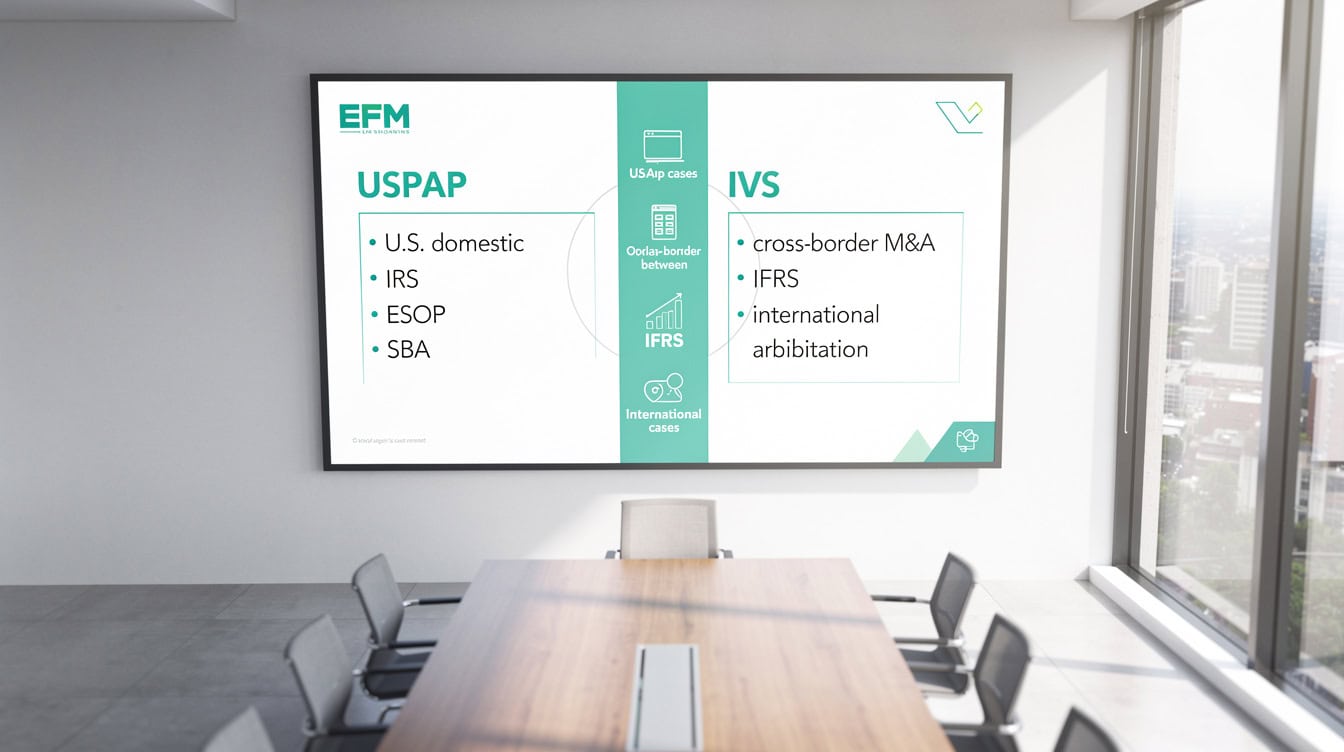
USPAP governs U.S. domestic and tax-purpose valuations; IVS applies to cross-border and IFRS reporting contexts — they are not interchangeable.
Professional Credentials Decoded: ASA, ABV, CVA, CBA, and CFA
Credentials signal methodology training, ethical obligations, and peer accountability. Here is what each designation actually means for your engagement.
- ASA (Accredited Senior Appraiser): Awarded by the American Society of Appraisers. Requires demonstrated experience, a comprehensive exam, and adherence to USPAP. The ASA in Business Valuation is the most rigorous credential for complex or litigation-bound engagements.
- ABV (Accredited in Business Valuation): Awarded by the AICPA to CPAs who pass a dedicated exam and meet experience requirements. Strong for tax-purpose valuations and financial reporting; the CPA foundation adds accounting depth.
- CVA (Certified Valuation Analyst): Awarded by the National Association of Certified Valuators and Analysts (NACVA). Widely held among regional practitioners; appropriate for most mid-market engagements.
- CBA (Certified Business Appraiser): Awarded by the Institute of Business Appraisers. Focuses on small to mid-size business valuation; less common in complex litigation contexts.
- CFA (Chartered Financial Analyst): Awarded by CFA Institute. Signals deep financial analysis and capital markets expertise but does not specifically certify business appraisal methodology. Most valuable when paired with ASA or ABV for investment-context valuations.
For ESOP and estate/gift tax engagements, prioritize ASA or ABV. For 409A valuations, CVA or ABV is standard. For litigation support, ASA with prior expert witness experience is the strongest credential combination.
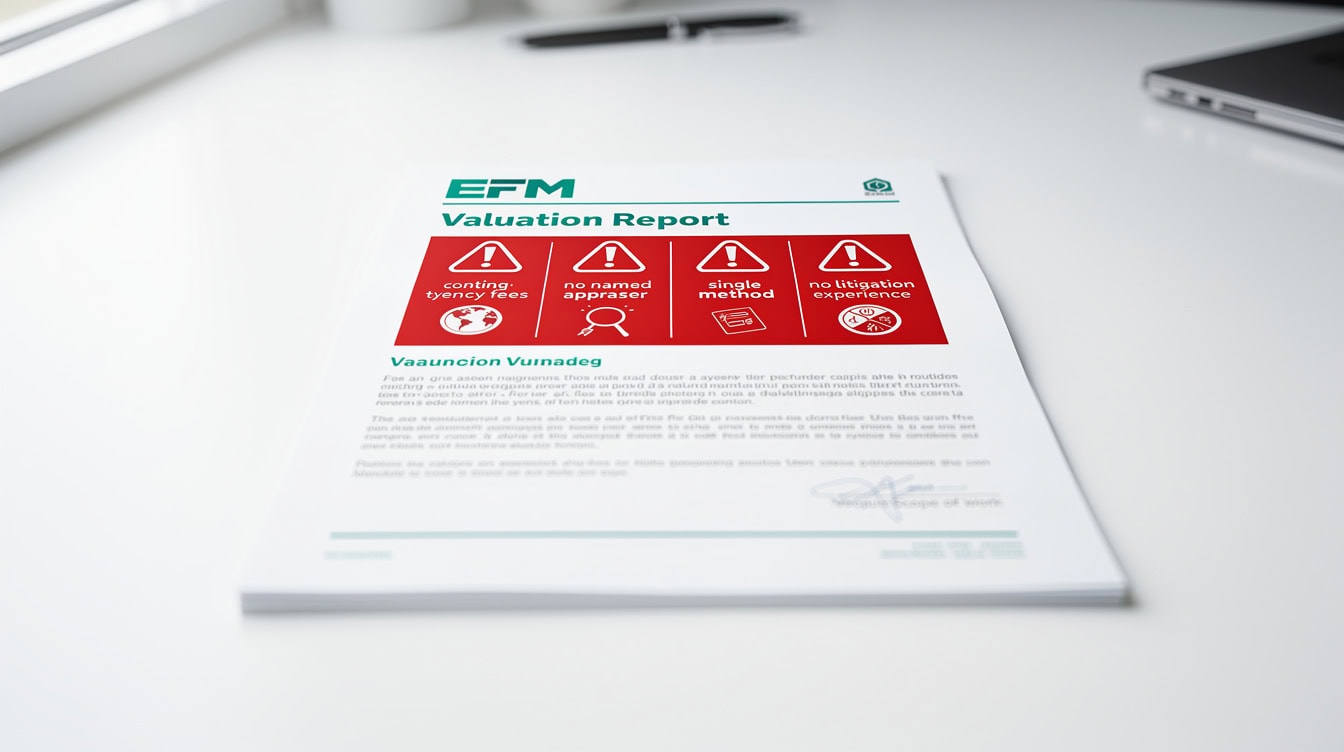
Contingency fees tied to valuation outcome violate USPAP Ethics Rule and immediately disqualify a firm for tax and regulatory purposes.
Matching Valuation Methodology to Your Business
The three primary valuation approaches — income, market, and asset-based — are not equally appropriate for every business, and a qualified firm will explain which combination applies to your situation and why.
Income approach (DCF): The discounted cash flow method (DCF) projects future free cash flows and discounts them to present value using a risk-adjusted discount rate (the weighted average cost of capital, or WACC). DCF is most appropriate for businesses with predictable, growing cash flows: SaaS companies, healthcare practices, and professional services firms. For a SaaS business, appraisers typically build a 5-year revenue forecast, apply a terminal growth rate of 2–4%, and cross-check the result against revenue multiples from comparable public companies.
Market approach: This approach uses pricing multiples derived from comparable public companies (guideline public company method) or recent M&A transactions (guideline transaction method) in the same industry. It works best when robust comparable data exists — manufacturing, distribution, and consumer products businesses with clear industry peers. According to the American Society of Appraisers, the market approach is the most commonly applied primary method in mid-market M&A valuations.
Asset-based approach: This approach values the business by adjusting the book value of assets and liabilities to fair market value. It applies primarily to holding companies, real estate entities, and asset-intensive businesses where earnings do not reflect the underlying asset value. It is rarely appropriate as a standalone method for operating businesses.
Most credible valuations apply at least two approaches and reconcile the results — a single-method report is a red flag.

Clients who deliver complete financial data in Week 1 compress the overall engagement timeline by 2–3 weeks and reduce fees by up to 15%.
Worked Example: DCF Valuation for a Mid-Market SaaS Business
Here is the math for a simplified DCF on a SaaS company with $5M in annual recurring revenue (ARR), 20% free cash flow margin, and 25% projected growth:
Step 1: Project Free Cash Flows
- Year 1 Free Cash Flow: $5M × 20% = $1.0M
- Year 2: $6.25M × 20% = $1.25M
- Year 3: $7.81M × 20% = $1.56M
- Year 4: $9.77M × 20% = $1.95M
- Year 5: $12.21M × 20% = $2.44M
Step 2: Calculate Terminal Value
- Terminal Value (Gordon Growth, 3% terminal rate, 18% WACC): $2.44M × 1.03 / (0.18 – 0.03) = $16.76M
Step 3: Discount Terminal Value to Present
- PV of Terminal Value (discounted 5 years at 18%): $16.76M / (1.18)^5 = $7.33M
Step 4: Discount Year 1–5 Cash Flows
- PV of FCF Years 1–5 (at 18% WACC): approximately $5.18M
Step 5: Calculate Enterprise Value
- Enterprise Value: $5.18M + $7.33M = $12.51M
A market approach cross-check using a 2.5x ARR multiple on $5M ARR yields $12.5M — strong convergence that a qualified appraiser would note as corroborating evidence.
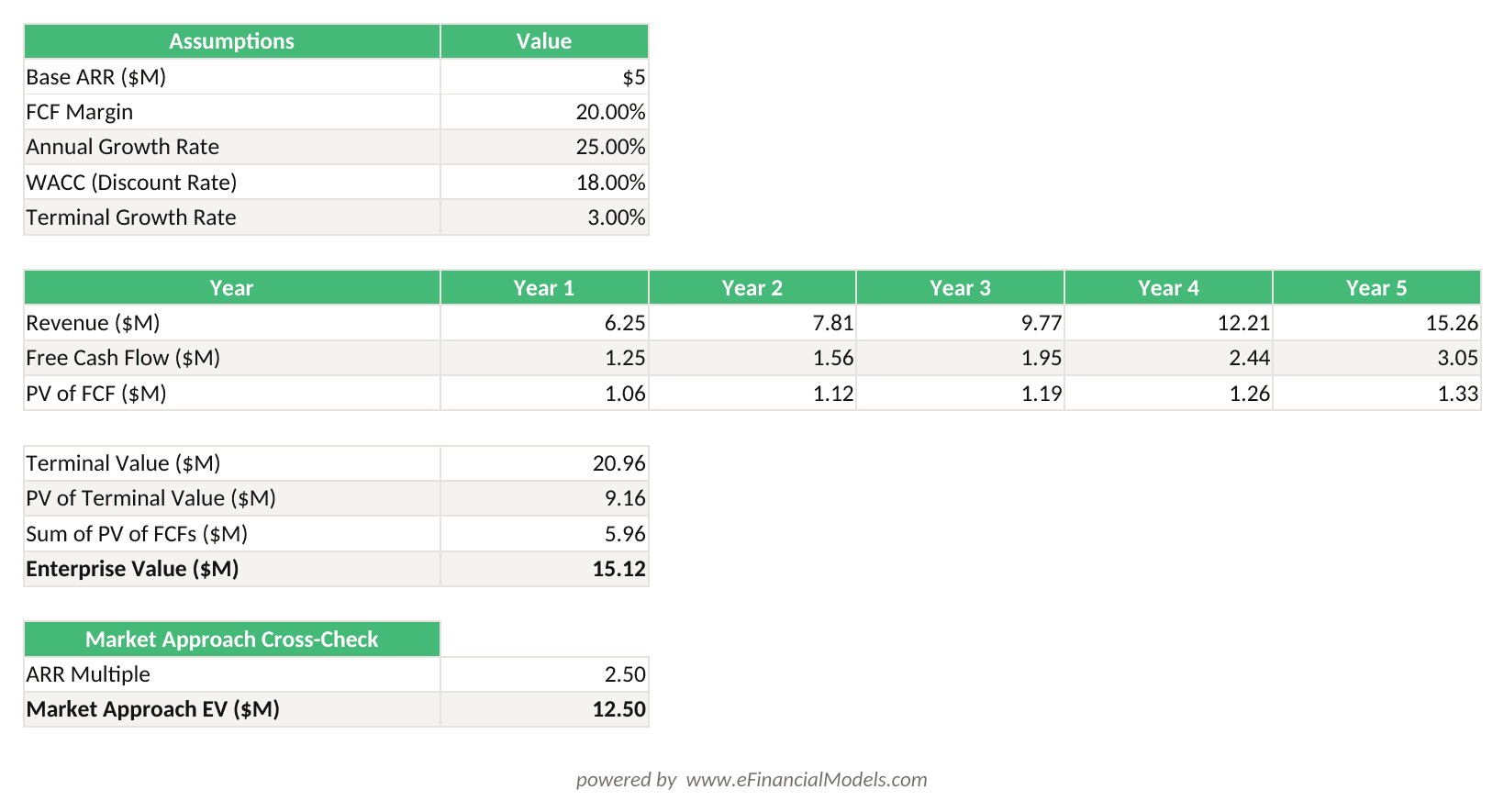
DCF Enterprise Value = PV of FCF Years 1–5 + PV of Terminal Value. At 18% WACC and 3% terminal growth, this SaaS business yields ~$12.51M EV, corroborated by a 2.5x ARR market approach cross-check.
Red Flags and Due Diligence: Questions to Ask Before Signing an Engagement Letter
Several warning signs disqualify a firm before the engagement begins. Watch for these specific red flags.
- Contingency fees tied to valuation outcome. USPAP Ethics Rule prohibits appraisers from accepting fees contingent on a predetermined value. Any firm offering this arrangement is disqualified for tax and regulatory purposes.
- No named credentialed appraiser. The engagement letter must identify the credentialed appraiser who will sign the report. A firm that cannot name this person before engagement is a red flag.
- No litigation support experience. Even if you don’t anticipate litigation, a firm that has never defended a report under cross-examination may produce work that doesn’t survive scrutiny.
- Single-method reports. As noted above, a credible valuation reconciles at least two approaches. A firm that defaults to one method without explanation lacks methodology rigor.
- Vague scope-of-work documentation. USPAP requires a written scope of work before the engagement begins. If the firm cannot produce a clear scope document, its process controls are inadequate.
Ask every candidate firm: “Can you provide references from engagements where your report was reviewed by the IRS or opposing counsel?” A qualified firm will answer yes.
Under IRC Section 6662, a gross valuation misstatement — defined as a reported value that is 200% or more of the correct value — triggers a penalty equal to 40% of the resulting tax underpayment. This makes credential verification a direct financial safeguard.
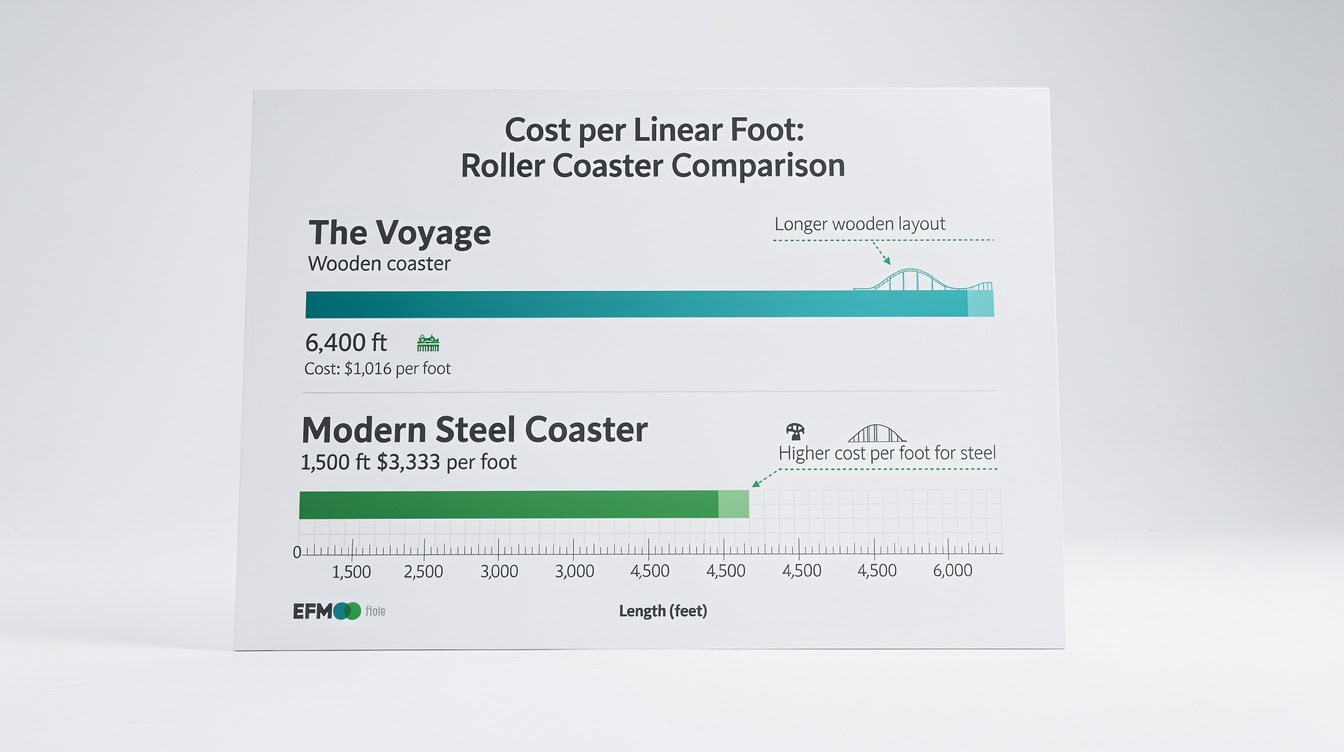
Valuation fees span $5,000 for a simple 409A to $200,000+ for a board-level fairness opinion — engagement type is the primary cost driver.
The Valuation Engagement Process: Timeline and Client Responsibilities
A standard mid-market valuation engagement follows a predictable sequence, and your preparation at each stage directly affects timeline and cost.
- Week 1–2: Scoping and data request. The firm issues an engagement letter and a data request list. Typical requests include 3 years of financial statements, tax returns, a capitalization table, customer concentration data, and management projections. Clients who deliver complete data in Week 1 compress the overall timeline by 2–3 weeks.
- Week 2–5: Analysis and draft preparation. The appraiser builds the financial model, selects comparables, and drafts the report. Client availability for a management interview (typically 2–4 hours) is required during this phase.
- Week 5–7: Draft review. The client reviews the draft for factual accuracy — not to negotiate the conclusion. Requesting changes to the valuation conclusion rather than factual errors is a red flag on the client side.
- Week 7–8: Final report delivery. The signed report is delivered. For ESOP or tax-purpose reports, the appraiser’s signature and certification language must comply with USPAP Standards Rule 10-3.
Complex engagements — multi-entity structures, international operations, or litigation support — routinely run 12–16 weeks. Budget the timeline accordingly when planning a transaction close date.

A complete data package delivered on Day 1 is the single highest-ROI preparation step — it compresses timelines and reduces engagement fees.
Cost Drivers and Realistic Budget Ranges
Valuation fees reflect four variables: firm tier, business complexity, data availability, and report purpose. Here is a realistic budget framework for mid-market businesses with enterprise values between $10M and $500M.
- 409A valuation (startup, simple cap structure): $5,000–$12,000
- Estate/gift tax valuation (operating business, single entity): $15,000–$35,000
- ESOP valuation (initial): $25,000–$60,000
- M&A full valuation (mid-market, $50M–$200M EV): $40,000–$100,000
- Fairness opinion (board-level, $100M+ transaction): $75,000–$200,000+
- Litigation support/expert witness engagement: $50,000–$150,000+ (hourly billing common)
Business complexity adds cost in predictable ways: each additional legal entity adds approximately $5,000–$10,000 to the engagement fee. Businesses with significant intangible assets (patents, customer relationships, brand) require separate intangible asset analyzes that add $10,000–$30,000. Poor data availability — missing financial records, unaudited statements, or inconsistent management accounts — adds both time and cost.
For business valuation purposes, preparing your financial model and documentation before engaging a firm is the single highest-ROI step you can take. Firms that receive complete, organized data packages consistently deliver faster and at lower cost. The IRS defines a “qualified appraisal” under Treasury Regulation 1.170A-17 as one conducted no earlier than 60 days before the contribution date and no later than the due date of the return. This timing constraint makes early firm selection essential for tax-driven transactions.

A credible final valuation report reflects the appraiser’s methodology, credentials, and industry knowledge — not just a number on a page.
Frequently Asked Questions
Can I hire an expert to value my business, or do I need a specific type of firm?
Yes, you can hire a qualified business appraiser for virtually any valuation purpose, but the type of firm and credential required depends on your specific use case. For IRS estate and gift tax purposes, the appraiser must meet the “qualified appraiser” definition under Treasury Regulation 1.170A-17, which requires demonstrated education and experience in business valuation. For ESOP transactions, ERISA Section 3(18) requires an “independent qualified appraiser” — a standard that excludes the company’s own accountant or any advisor with a financial interest in the transaction. For 409A valuations, the IRS safe harbor requires a “qualified independent appraiser” with at least 5 years of relevant experience. A regional CPA firm with a CVA or ABV credential meets these standards for most mid-market purposes; a Big Four firm is not required unless the transaction involves a public company audit committee or cross-border complexity.
What is the difference between USPAP and IVS, and which one applies to my transaction?
USPAP (Uniform Standards of Professional Appraisal Practice) is the U.S. domestic standard published by The Appraisal Foundation and is legally required for federally related transactions, ESOP valuations, SBA-loan appraisals, and IRS tax purposes. IVS (International Valuation Standards) is published by the International Valuation Standards Council and governs cross-border M&A, IFRS financial reporting, and international arbitration. If your transaction is entirely domestic and has tax or regulatory implications, USPAP is your baseline. If your buyer or counterparty is based outside the U.S. or if the target company reports under IFRS, the valuation report may need to satisfy both frameworks. Ask any candidate firm directly: “Is your report USPAP-compliant, and can it also satisfy IVS requirements if needed?” A firm that cannot answer this question clearly lacks the cross-border experience for international transactions.
How long does a business valuation take from start to finish?
A standard mid-market valuation engagement runs 4–8 weeks from signed engagement letter to final report delivery, assuming the client delivers complete financial data within the first week. Complex engagements — multi-entity structures, significant intangible assets, litigation support, or international operations — routinely run 12–16 weeks. The single biggest client-controlled variable is data readiness. Firms that receive 3 years of audited financials, tax returns, a capitalization table, and management projections on Day 1 consistently close engagements 2–3 weeks faster than clients who deliver data piecemeal. If you have a transaction close date, work backward from that date and add at least 2 weeks of buffer for draft review and final report revisions.
Which valuation credential matters most: ASA, ABV, CVA, or CFA?
The answer depends on your use case. For ESOP, estate/gift tax, and litigation support, the ASA (Accredited Senior Appraiser) in Business Valuation is the strongest credential because it requires demonstrated experience, a comprehensive exam, and strict USPAP adherence. For tax-purpose valuations where accounting depth matters, the ABV (Accredited in Business Valuation) from the AICPA is equally strong and adds CPA-level financial statement expertise. For most mid-market M&A and planning engagements, a CVA (Certified Valuation Analyst) from NACVA is widely accepted and held by the largest number of regional practitioners. The CFA designation signals capital markets and financial analysis depth but does not specifically certify business appraisal methodology — it is most valuable when paired with ASA or ABV. For litigation, always ask whether the credentialed appraiser has prior expert witness experience and has been qualified as an expert in federal or state court.
What are the biggest mistakes business owners make when selecting a valuation firm?
Five mistakes appear repeatedly. First, selecting a firm based on price alone without verifying credentials — a $5,000 report from an uncredentialed preparer has no IRS safe-harbor protection and may be rejected outright. Second, confusing a calculation engagement with a full appraisal — calculation engagements explicitly cannot be used for tax or litigation purposes, and using one in those contexts creates legal exposure. Third, failing to check for conflicts of interest — any firm that has a financial relationship with the buyer, seller, or lender in your transaction is disqualified under USPAP ethics rules. Fourth, not asking about litigation support capability — even if you don’t anticipate a dispute, a firm that has never defended a report under cross-examination may produce work that doesn’t survive IRS scrutiny. Fifth, engaging a firm without industry-specific experience — a generalist appraiser valuing a SaaS company without understanding ARR, churn, and net revenue retention will produce a report that sophisticated buyers or their advisors will challenge immediately.
How do I know if a valuation firm has adequate quality control processes?
Ask three specific questions before signing an engagement letter. First: “Does a second credentialed appraiser review the report before delivery?” A firm with a formal second-reviewer process catches methodology errors before they reach the client. Second: “Do you maintain a documented scope-of-work policy consistent with USPAP Standards Rule 10-1?” USPAP requires a written scope of work; firms that cannot produce this document lack basic process controls. Third: “Can you provide a sample table of contents from a comparable engagement?” A well-structured report includes an executive summary, business description, economic and industry analysis, financial analysis, methodology selection rationale, valuation calculations, and a signed certification. A firm that cannot show you a sample structure is unlikely to deliver a defensible report. For valuation services that will face regulatory or litigation scrutiny, quality control is non-negotiable.
What financial data should I prepare before engaging a valuation firm?
Preparing the right data package before your first meeting compresses the engagement timeline and reduces fees. The standard data request from any credentialed firm includes: 3–5 years of financial statements (audited preferred, reviewed acceptable), 3–5 years of federal tax returns, a current capitalization table showing all equity classes and ownership percentages, a customer concentration analysis (top 10 customers as a percentage of revenue), management projections for 3–5 years with key assumptions documented, a list of all tangible and intangible assets, any existing buy-sell agreements or shareholder agreements, and prior valuation reports if available. For business valuation engagements involving intangible assets — patents, customer relationships, trade names — also prepare a description of each asset and its estimated remaining useful life. Firms that receive this package on Day 1 consistently deliver final reports 2–3 weeks faster.
Conclusion
Choosing a business valuation firm is a strategic decision with direct financial, legal, and transaction consequences. Match the firm tier to your transaction size and credibility requirements, verify individual appraiser credentials rather than relying on firm brand alone, confirm USPAP compliance for any U.S. tax or regulatory purpose, and eliminate any firm that cannot name a credentialed appraiser, provide litigation references, or produce a clear scope-of-work document.
I recommend downloading the Business Valuation readiness resources at EFM to organize your financial data and documentation before engaging a firm — a prepared client consistently receives faster turnaround and lower fees, and the checklist ensures you ask the right questions during firm selection interviews.