
0 ITEMS

Risk-Adjusted NPV
Risk-Adjusted Net Present Value (NPV), also known as Expected/Expanded Net Present Value (ENPV) is a method of investment appraisal that adjusts the traditional NPV for the risk associated with future cash flows. Our financial model templates include tools to calculate and analyze risk-adjusted NPV, providing a more nuanced view of investment attractiveness.
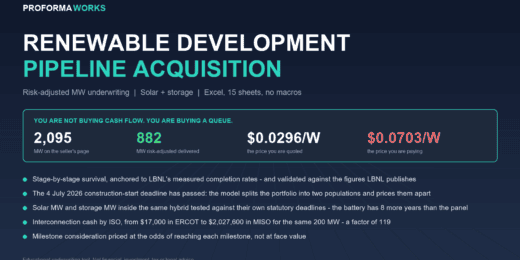

Converts a seller's nameplate megawatts into risk-adjusted delivered megawatts through…


Premium 30-year Oil & Gas Upstream and Downstream Financial Model…

🔥 Premium Tokenomics & Web3 Token Launch Financial Model A…

🚀 Premium eVTOL / Urban Air Mobility Financial Model A…

A premium Nuclear Fusion Project Finance Model designed for evaluating…

🚘 Premium Autonomous Vehicle / Robotaxi Fleet Operations Financial Model…

A specialized Excel valuation model for longevity and anti-aging biotechnology…

An institutional-style, fully editable model for probability-adjusted pharmaceutical valuation, commercial…


FinModelAI Biotech rNPV Valuation Model Pro is a purpose-built Excel…

This Excel model is built for a hybrid P2P +…

A complete, editable Veterinary Clinic Financial Model Pro built for…

A professional Excel-based IFRS 9 Expected Credit Loss model designed…

⚡ Premium Voluntary Carbon Market (VCM) Project Developer Financial Model,…

Poultry Farm Financial Model – 10-Year Forecast, Valuation, Feasibility &…

🚀 AI GPU-as-a-Service / AI Compute Data Center Financial Model…

A professional Solar + Battery Energy Storage System (BESS) financial…

A professional 8-12 MTPA Liquefied Natural Gas (LNG) Financial and…


A ready-to-use Excel Solar Farm + BESS Financial Model Template…


Helios Nexum is a professional Excel-based financial simulation model purpose-built…


A professional multi-industry financial model allowing up to 1680 project,…


This NVIDIA Financial Model Template in Excel has been built…


Financial Model analyzing a Biopharmaceutical Company using a Risk-Adjusted NPV…


The Pharma Biotech Valuation Model Template calculates the risk-adjusted DCF…
Financial Planning Insights for Risk-Adjusted NPV Success
 In today's dynamic business environment, making informed financial decisions is paramount for success, particularly for ventures involving substantial capital investments and inherent uncertainties. One tool that stands out in aiding such decisions is the Risk-Adjusted Net Present Value (rNPV) / Expected Net Present Value (eNPV) approach. In this article, we delve into financial planning insights for achieving success with rNPV, exploring the nuances of this financial metric and highlighting its pivotal role across various industries. Whether you're in the pharmaceuticals sector bracing for drug development risks or navigating the volatile waters of real estate investments, understanding and applying rNPV can significantly bolster your strategic planning.
Understanding the Importance of Risk-Adjusted NPV
Risk-Adjusted NPV serves as a refined metric for appraising investment opportunities, accounting for various risk elements that could impact projected cash inflows. Unlike the standard Net Present Value (NPV) calculation, which focuses solely on the intrinsic value of future cash flows, rNPV integrates risk by adjusting these cash flows to reflect potential uncertainties. The comprehensive nature of rNPV makes it indispensable for robust financial planning strategies, allowing stakeholders to align their investment decisions with realistic risk assessments.A Primer on Risk-Adjusted NPV Methodologies
Risk-Adjusted NPV (rNPV) is a sophisticated version of the traditional Net Present Value metric that incorporates risk into present value calculations. Its importance lies in providing a more realistic financial forecast for projects by acknowledging the uncertainties associated with future cash flows. While standard NPV offers a static view by discounting known cash flows, rNPV enriches this perspective by incorporating probability-weighted scenarios, offering a dynamic financial narrative that resonates well with industries entwined in uncertainties such as pharmaceuticals and real estate. Utilizing rNPV is crucial for sectors with unpredictable outcomes. In the pharmaceutical industry, for instance, drug development is fraught with high failure rates due to regulatory hurdles and clinical trial failures. Here, rNPV can identify projects with the strongest adjusted projections, enabling companies to optimize their portfolios strategically. Similarly, in real estate, rNPV can address market volatility by adjusting expected cash flows to reflect varying economic conditions. Such adjustments are vital in presenting a project's true financial viability, fostering informed investment decisions.Essential KPIs for Accurate rNPV Analysis
To effectively harness rNPV, businesses must focus on key performance indicators (KPIs) that underpin this analysis. A critical KPI is the discount rate, which must reflect risk factors pertinent to the project's unique circumstances. Employing a risk-based discount rate ensures that cash flows are accurately adjusted, providing a more authentic representation of a project's net worth. Similarly, calculating probability-weighted cash flows involves estimating different scenarios to assign probabilities, thereby refining cash flow forecasts. The project's time horizon and its staging also play a decisive role in rNPV assessments by defining the temporal context and phases of cash flow realization. These parameters must be meticulously planned to match realistic project timelines. Moreover, sensitivity analysis helps in navigating the impacts of varied risk variables on rNPV outcomes, offering insights into the resilience of financial projections against different risk scenarios. Such analyses are instrumental in identifying critical factors that bear influence over project valuations, ensuring adaptive strategies for potential shifts.Crafting Robust Financial Plans for rNPV
The journey towards robust financial planning for rNPV begins with meticulous data collection and forecasting. Accurate and comprehensive data form the bedrock of reliable projections, offering a clearer vision of potential risks and returns. This preparation must be complemented by scenario analysis, where multiple scenarios are crafted to assess varied risk levels. By simulating diverse conditions, planners gain a holistic view of potential challenges and opportunities, enabling proactive strategies. Integrating risk management strategies into financial models is key to mitigating identified risks. This inclusion transforms models from mere financial calculators into strategic decision-making tools, embedding a resilience that is responsive to emerging uncertainties. Additionally, financial plans must allow for ongoing monitoring and adjustments, reflecting the dynamic nature of risk profiles. Regular reviews and updates to financial models ensure they remain aligned with current realities, providing a tactical advantage in fast-evolving markets.Advantages of Using MS Excel Templates in rNPV Modeling
Deploying MS Excel templates for crafting rNPV financial models presents numerous advantages, starting with flexibility and customization. Excel’s adaptability allows for tailoring templates to cater to specific industry requirements, enhancing relevancy and precision. Additionally, its user-friendly interface democratizes access to financial modeling, accommodating users across varied expertise levels, from novices to seasoned analysts. Excel also boasts robust collaboration features, facilitating seamless teamwork through integrated sharing options. Such features are particularly advantageous in collaborative environments, ensuring synchronized efforts across departments. At eFinancialModels, our range of Excel templates is specifically designed to enhance rNPV analysis, boasting functionality and adaptability that address diverse industry needs. These templates serve as both a springboard for confident financial planning and a testament to the sophistication bespoke models can achieve.Conclusion: Leveraging eFinancialModels Templates for Enhanced rNPV Analysis
Achieving success in rNPV financial planning hinges on a blend of accurate forecasting, adaptive strategies, and comprehensive risk adjustments. The use of structured financial models streamlines decision-making processes, providing a framework that enhances both precision and insight. By employing eFinancialModels' diverse selection of customizable financial modeling templates, businesses can elevate their risk-adjusted NPV analysis, ensuring a fortified approach to financial planning. With such resources at your disposal, honing your strategies to navigate uncertainties becomes a tangible possibility. We invite you to explore the comprehensive range of templates and tools available at eFinancialModels, designed to equip you with the capabilities to transform financial planning challenges into opportunities for value creation.Frequently Asked Questions About Risk-Adjusted NPV
- What is Risk-Adjusted NPV (rNPV)? Risk-Adjusted NPV (rNPV) is an advanced financial metric that incorporates risk into the present value calculations of expected cash flows, creating a more realistic forecast by accounting for uncertainties.
- How does rNPV differ from standard NPV? Unlike standard NPV, which discounts future cash flows without accounting for uncertainty, rNPV adjusts these flows using probability-weighted scenarios to better reflect risks, providing a dynamic financial outlook.
- Why is rNPV important for industries like pharmaceuticals and real estate? rNPV is crucial for sectors with high unpredictability, such as pharmaceuticals and real estate, as it helps incorporate risk factors like development failures and market volatility into cash flow projections, offering a truer assessment of a project’s viability.
- What role does the discount rate play in rNPV analysis? The discount rate in rNPV analysis reflects the risk premium required for the project, effectively adjusting the cash flows to account for associated uncertainties and ensuring a fair valuation.
- How can MS Excel templates aid in rNPV financial planning? MS Excel templates offer flexibility, customization, and collaboration features essential for building accurate and industry-specific rNPV models, catering to users at all expertise levels for sophisticated financial planning.