
0 ITEMS

Autonomous Vehicle / Robotaxi Fleet Operations Financial Model – RAM, Safety Driver Phase-Out, Geofence Expansion, Fleet Utilization & Liability Stress Test
🚘 Premium Autonomous Vehicle / Robotaxi Fleet Operations Financial Model A professional financial model built for autonomous vehicle operators, robotaxi fleets, AV startups, mobility platforms, fleet investors, hard-tech analysts, transport strategists, infrastructure teams and venture finance professionals. This model helps forecast the full economics of a robotaxi fleet operation, including autonomous mile revenue, teleoperated mile economics, safety driver phase-out, geofence expansion costs, deadhead miles, fleet utilization, insurance premiums, software licensing, fleet ownership, robotaxi-as-a-service economics, collision liability and reserve requirements. ✅ Revenue per autonomous mile by autonomy level ✅ Teleoperated mile economics ✅ Safety driver phase-out timeline ✅ Cost savings vs fallback infrastructure investment ✅ Geofence ODD expansion cost by city and weather type ✅ Fleet utilization: revenue miles vs deadhead miles ✅ Dead mileage cost analysis ✅ Per-vehicle annual insurance premium by autonomy level ✅ L3, L4 and L5 operating assumptions ✅ Software licensing vs fleet ownership toggle ✅ Robotaxi-as-a-service scenario logic ✅ Collision rate × liability exposure sensitivity ✅ Reserve requirement stress test ✅ Fleet P&L, cash flow, valuation, dashboards and audit checks ⚡ Built for a high-growth hard-tech category where generic transport, SaaS or ride-hailing templates do not capture the real operating economics of autonomous fleets.
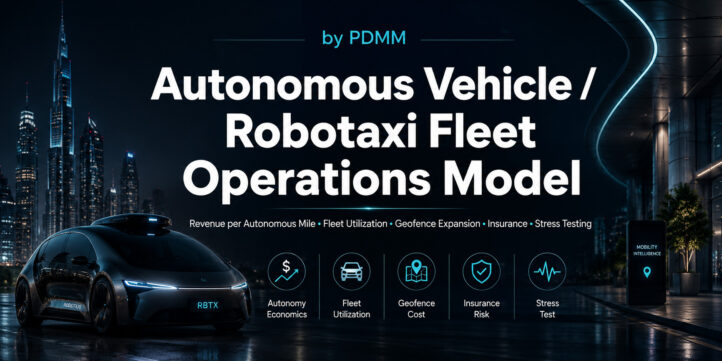


🚘 Autonomous Vehicle / Robotaxi Fleet Operations Financial Model
This premium financial model is built for one of the most complex and capital-intensive mobility categories: autonomous vehicle and robotaxi fleet operations.
Robotaxi economics are very different from traditional ride-hailing, car rental, logistics, SaaS or automotive manufacturing models.
A robotaxi operator must evaluate:
- 🚗 Revenue per autonomous mile
- 🕹️ Teleoperated mile economics
- 👨✈️ Safety driver phase-out costs
- 🧠 Fallback infrastructure investment
- 🗺️ Geofence and ODD expansion
- 🌦️ Weather-specific operating limitations
- ⚙️ Fleet utilization and deadhead miles
- 🛡️ Insurance premiums by autonomy level
- 💻 Software licensing vs owned-fleet economics
- ⚠️ Collision liability and reserve requirements
- 📊 Cash flow, valuation and risk sensitivity
This workbook brings those moving pieces into one structured, editable and decision-ready financial model.
What This Model Is Used For
This model helps users forecast, analyze and stress-test the financial performance of an autonomous vehicle / robotaxi fleet operation.
It can be used for:
✅ Robotaxi fleet business planning
✅ Autonomous mobility startup forecasting
✅ Fleet deployment strategy
✅ AV unit economics analysis
✅ Revenue per autonomous mile modeling
✅ Safety driver phase-out planning
✅ Teleoperation cost analysis
✅ Geofence expansion budgeting
✅ City launch feasibility
✅ Weather and ODD cost planning
✅ Fleet utilization and deadhead analysis
✅ Insurance and liability risk forecasting
✅ Software licensing vs fleet ownership comparison
✅ Investor fundraising and valuation support
✅ Scenario and sensitivity analysis
This model is especially useful where a normal transportation or ride-hailing model is not enough because it captures the unique operating economics of autonomous fleets.
Key Model Modules
🚗 1. Revenue per Autonomous Mile Model
The model forecasts revenue per autonomous mile across autonomy levels and operating modes.
It helps users analyze:
- Autonomous miles
- Teleoperated miles
- Revenue per autonomous mile
- Revenue per teleoperated mile
- Autonomy level assumptions
- L3, L4 and L5 economics
- Pricing and revenue mix
- Revenue yield per mile
This is important because robotaxi revenue depends heavily on how many miles can be operated autonomously versus how many require teleoperation, support or human intervention.
🕹️ 2. Teleoperated Mile Economics
Robotaxi operations may require remote assistance, teleoperation or fallback support.
The model includes logic for:
✅ Teleoperated mile percentage
✅ Teleoperation cost per mile
✅ Remote operator support cost
✅ Fallback infrastructure cost
✅ Impact on margin per mile
✅ Transition from assisted to autonomous operation
This helps users evaluate how long the fleet remains dependent on human support and how that affects profitability.
👨✈️ 3. Safety Driver Phase-Out Timeline
A major feature of the model is the safety driver phase-out schedule.
The workbook compares:
- Safety driver cost savings
- Remaining assisted-operation cost
- Fallback infrastructure investment
- Transition timing
- Margin improvement from driver removal
- Operating cost reduction by year
This is critical because robotaxi economics improve materially when safety drivers are removed, but the company may need to invest in remote support, monitoring, safety systems and fallback operations.
🗺️ 4. Geofence ODD Expansion Cost
Autonomous vehicles are constrained by their Operational Design Domain.
The model includes geofence expansion cost by:
- City
- Launch phase
- Weather type
- Clear weather
- Rain conditions
- Snow conditions
- Fog / low visibility
- Mapping and validation burden
- Operational complexity
This helps users understand the true cost of expanding from one city to multiple operating zones.
A robotaxi fleet may be profitable in one restricted geography but face much higher costs when expanding into more complex weather or traffic environments.
⚙️ 5. Fleet Utilization and Deadhead Miles
The model includes a fleet utilization engine that separates revenue-generating miles from deadhead miles.
It analyzes:
✅ Revenue miles
✅ Deadhead miles
✅ Deadhead ratio
✅ Empty repositioning miles
✅ Fleet utilization rate
✅ Miles per vehicle per day
✅ Cost per dead mile
✅ Margin impact from non-revenue miles
This is important because a fleet can show strong gross demand but still suffer from poor utilization if vehicles spend too much time repositioning, charging, waiting or driving without passengers.
🛡️ 6. Insurance Premium by Autonomy Level
The model includes per-vehicle annual insurance premium assumptions by autonomy level.
It supports:
- L3 insurance assumptions
- L4 insurance assumptions
- L5 insurance assumptions
- Fleet-level insurance cost
- Premium reduction or increase by autonomy maturity
- Risk-adjusted cost forecasting
Insurance is a major cost category for autonomous fleets because liability, safety performance and regulatory treatment can change materially across autonomy levels.
💻 7. Business Model Toggle
The workbook includes a toggle-style structure to compare different business models.
Included models:
✅ Software licensing
✅ Fleet ownership
✅ Robotaxi-as-a-service
This allows users to compare operating economics under different commercialization strategies.
For example:
- Software licensing may require lower CapEx but lower per-mile revenue.
- Fleet ownership may capture more margin but requires more vehicles, operations and risk exposure.
- Robotaxi-as-a-service may sit between infrastructure-light and fleet-heavy models.
⚠️ 8. Collision Liability and Reserve Requirement Sensitivity
The model includes a collision rate × liability exposure sensitivity table.
It helps users evaluate:
- Collision rate per million miles
- Liability exposure per incident
- Reserve requirement
- Insurance reserve burden
- Downside risk scenarios
- Sensitivity to safety performance
This is essential because even low collision rates can create large financial exposure when fleet miles scale into millions or billions of miles.
Dashboards and Outputs
📊 The workbook includes professional dashboards and output sheets designed for fast decision-making.
Key outputs include:
✅ Cover
✅ Index
✅ How To Use
✅ Control Panel
✅ Revenue per Autonomous Mile
✅ Teleoperated Mile Economics
✅ Safety Driver Phase-Out
✅ Fallback Infrastructure
✅ Geofence Expansion
✅ ODD Cost by City
✅ Weather Cost Assumptions
✅ Fleet Utilization
✅ Revenue Miles vs Deadhead Miles
✅ Dead Mileage Cost
✅ Insurance Premium by Autonomy Level
✅ Software Licensing Scenario
✅ Fleet Ownership Scenario
✅ Robotaxi-as-a-Service Scenario
✅ Collision Liability Sensitivity
✅ Reserve Requirement Analysis
✅ Fleet P&L
✅ Cash Flow Forecast
✅ Valuation
✅ Scenario Summary
✅ Sensitivity Analysis
✅ KPI Dashboard
✅ Executive Dashboard
✅ Risk Dashboard
✅ Audit Checks
✅ Disclaimer
✅ Glossary
How to Use the Model
1️⃣ Start with the Control Panel
Update assumptions for fleet size, miles, utilization, autonomy level, pricing, cost per mile, geofence expansion, insurance, liability and business model structure.
2️⃣ Review Revenue per Autonomous Mile
Analyze autonomous revenue miles, teleoperated miles and revenue yield by autonomy level.
3️⃣ Analyze Safety Driver Phase-Out
Review cost savings from removing safety drivers and compare them with fallback infrastructure investment.
4️⃣ Review Geofence Expansion
Model city-level ODD expansion costs and weather-related deployment complexity.
5️⃣ Analyze Fleet Utilization
Review revenue miles, deadhead miles, utilization rate and dead mileage cost.
6️⃣ Review Insurance and Liability
Check insurance premiums by autonomy level and reserve requirements under collision-risk scenarios.
7️⃣ Compare Business Models
Analyze software licensing, fleet ownership and robotaxi-as-a-service economics.
8️⃣ Use Dashboards and Valuation
Review KPIs, cash flow, scenario outputs, valuation and sensitivity analysis.
9️⃣ Check the Audit Sheet
Use audit checks to review model integrity before using the outputs.
Who Should Buy This Model
This model is ideal for:
✅ Autonomous vehicle startups
✅ Robotaxi operators
✅ AV fleet companies
✅ Mobility platforms
✅ Hard-tech founders
✅ Venture capital investors
✅ Corporate development teams
✅ Transport and infrastructure analysts
✅ Fleet operations teams
✅ Strategic finance teams
✅ Consultants and advisors
✅ Smart city mobility planners
✅ Automotive strategy teams
✅ Insurance and risk analysts
✅ Private equity and infrastructure investors
Why This Model Is Valuable
Most transportation models are built for ride-hailing, taxis, logistics or rental fleets.
This model is different because it focuses specifically on autonomous vehicle and robotaxi operations.
It includes AV-specific economics such as:
🚗 Revenue per autonomous mile
🕹️ Teleoperated mile economics
👨✈️ Safety driver phase-out
🧠 Fallback infrastructure investment
🗺️ Geofence ODD expansion
🌦️ Weather-specific launch cost
⚙️ Deadhead mile cost
🛡️ Insurance by autonomy level
💻 Business model toggle
⚠️ Collision liability reserves
This makes the model useful for serious robotaxi planning, investor review, market-entry analysis and hard-tech financial strategy.
It helps answer practical questions such as:
- What is the revenue per autonomous mile?
- How much does teleoperation reduce margin?
- When does safety driver phase-out improve profitability?
- How expensive is geofence expansion by city?
- How much dead mileage is the fleet absorbing?
- Which business model produces better unit economics?
- How much reserve is needed for collision liability?
- Can the fleet become profitable at scale?
Similar ProductsOther customers were also interested in...


 eFinancialModels
Electric Vehicle (EV) Charging Station Financial M...
With this comprehensive 5- or 10-year monthly tool, investors can assess the viability of setting up... Read more

Financial Model for Mobile App | Mobile App Busine...
The Mobile App Financial Plan Template in Excel allows you to develop financial projections when lau... Read more

 HenrySheykin
Food Truck Financial Model Excel Template
The Food Truck Financial Model helps entrepreneurs, founders, business owners, consultants, and anal... Read more

Green Hydrogen Production from Wind Energy Financi...
The Green Hydrogen from Wind Financial Model aims to comprehensively forecast a horizon of 40 years ... Read more

Simple Mutual Non-Disclosure Agreement Template
Protect your business secrets with ease using our Simple Mutual Non-Disclosure Agreement Template. S... Read more

Solar Energy Financial Model
The Solar Energy Financial Model Spreadsheet Template in Excel assists you in preparing a sophistica... Read more

 Peter Graf
The Customer-Centric Financial Model for Restauran...
Starting a restaurant without a financial plan is like driving a car blindfolded. You wouldn´t do i... Read more
You must log in to submit a review.