
0 ITEMS

Pro-Forma
Pro-forma financial statements are forward-looking projections used to forecast a company's future financial performance. These statements are based on assumptions about future events, such as sales growth, market conditions, and operational changes. Pro-forma statements often include projected income statements, balance sheets, and cash flow statements, providing stakeholders with a hypothetical snapshot of a company's financial health under certain conditions. Our financial model templates come equipped with tools to create detailed pro-forma statements, allowing businesses to explore various scenarios, plan for potential challenges, and prepare for future opportunities. Whether you're a startup seeking investment, a company considering a merger, or a business planning for expansion, our templates offer a structured approach to crafting insightful pro-forma financial statements.
Financial models sometime use pro forma financial statement (e.g. in merger situations, spin-offs, etc.)
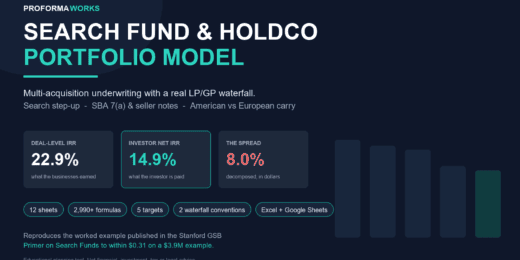

A portfolio of acquisitions is not the sum of five…
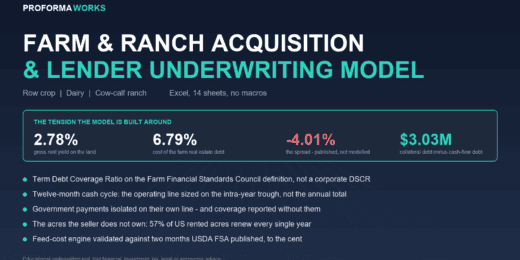
The collateral will support a loan this big - can…
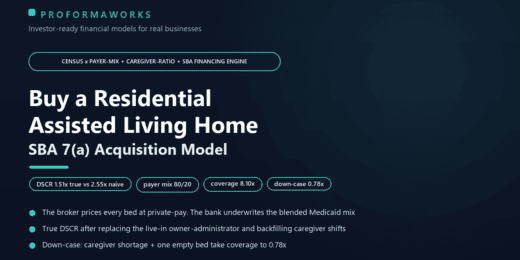
Acquisition & SBA underwriting model for a single residential assisted…
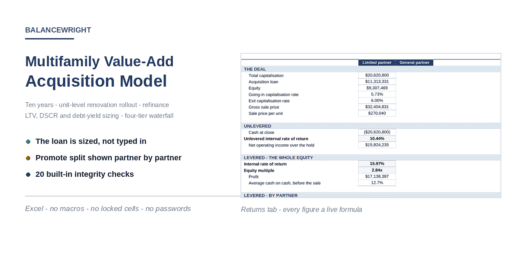

Underwrite an apartment value-add deal end to end. The loan…


⚡ Model the grid-connection decision before delay, network upgrades, deposits,…

🔥 Premium AI / LLM Company Valuation Financial Model A…
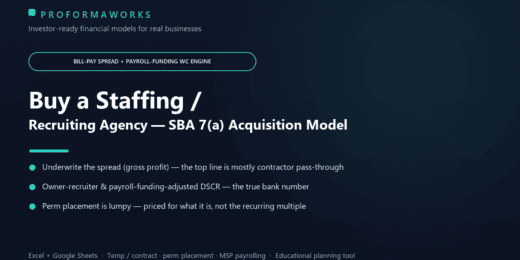
A lender-ready 5-year model for buying an independent staffing /…
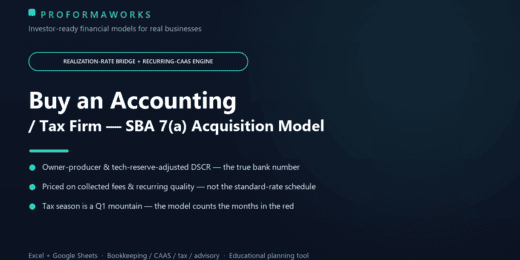
A 5-year, SBA-lender-ready model for buying an independent accounting /…
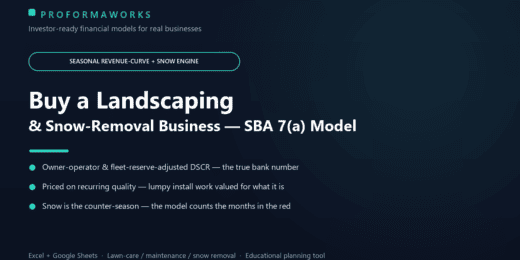
A 5-year, SBA-lender-ready model for buying a single-branch landscaping /…
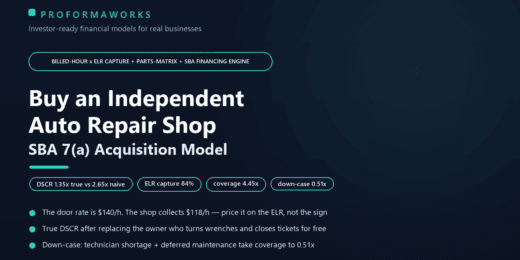
Underwrite the acquisition of a single independent auto repair shop…
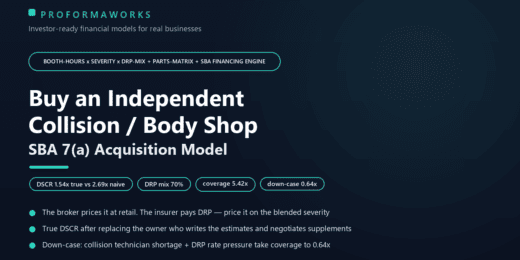
Underwrite a collision / auto body shop acquisition the way…
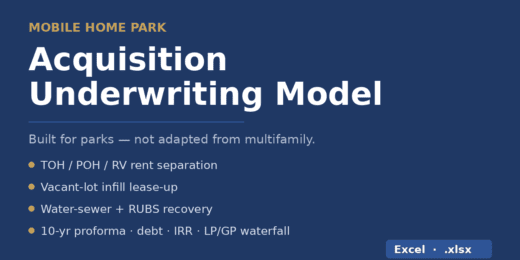

Underwrite a mobile home park deal in minutes: a model…
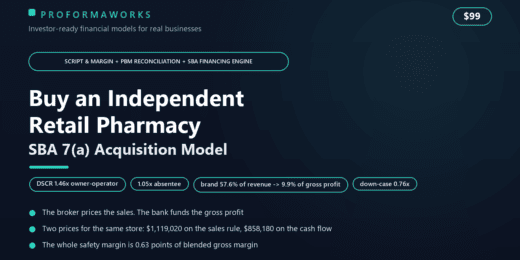
Underwrite the purchase of an independent retail pharmacy the way…
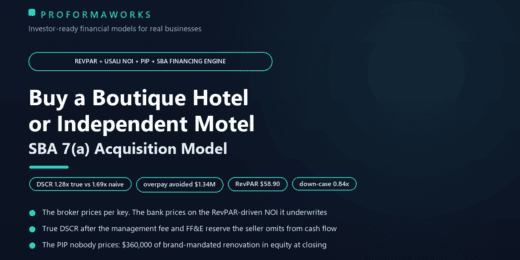
Underwrite a hotel/motel acquisition the way an SBA lender does:…


Underwrite multifamily deals the way institutional buyers do — without…

Premium Private School & University Financial Model designed for integrated…

Premium 30-year Oil & Gas Upstream and Downstream Financial Model…

Premium TCFD / ISSB Physical Climate Risk Financial Model designed…

🔥 Premium Tokenomics & Web3 Token Launch Financial Model A…

Premium Green Hydrogen Production Levelized Cost of Hydrogen model for…
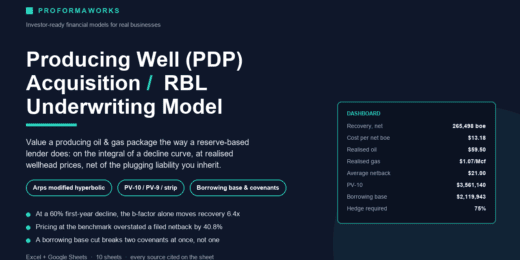
Underwrite a producing oil and gas package the way a…

A specialized Excel valuation model for longevity and anti-aging biotechnology…
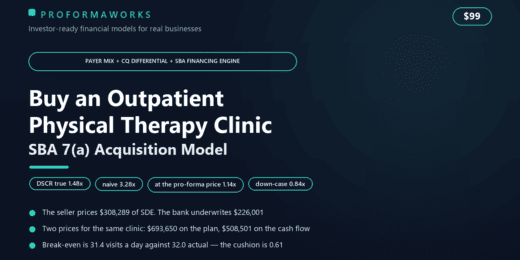
Underwrite the purchase of an outpatient physical therapy clinic the…

Build, compare and stress-test five major Sukuk structures in one…

A professional Excel and Google Sheets financial model built for…

A professional Excel and Google Sheets financial model built for…
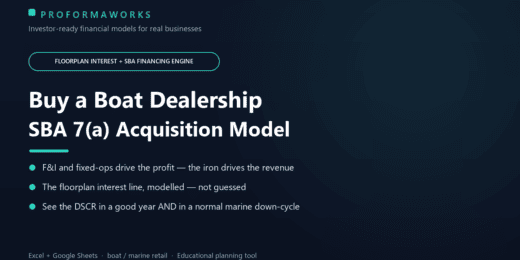
A professional Excel and Google Sheets financial model built for…

A professional Excel and Google Sheets financial model built for…

A professional Excel and Google Sheets financial model built for…

A professional Excel and Google Sheets financial model built for…
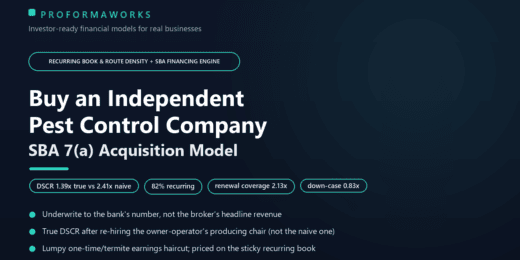
A professional Excel and Google Sheets financial model built for…

A professional Excel and Google Sheets financial model built for…

A professional Excel and Google Sheets financial model built for…

A professional Excel and Google Sheets financial model built for…

A professional Excel and Google Sheets financial model built for…
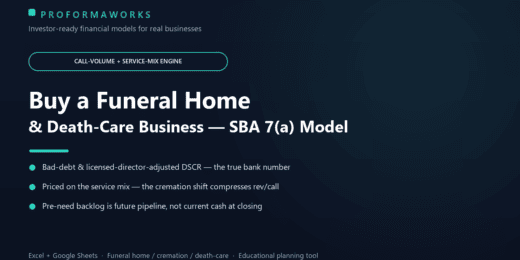
A professional Excel and Google Sheets financial model built for…

A professional Excel financial model for residential building development projects…

A professional Excel-based IFRS 9 Expected Credit Loss model designed…

A professional Excel and Google Sheets financial model built for…

🚀 Premium Creator Economy Multi-Platform Revenue Financial Model, A professional…

Poultry Farm Financial Model – 10-Year Forecast, Valuation, Feasibility &…

🚀 AI GPU-as-a-Service / AI Compute Data Center Financial Model…
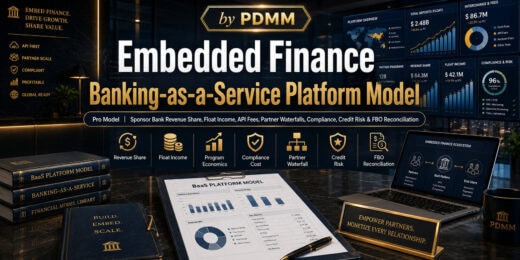
🚀 Premium Embedded Finance / Banking-as-a-Service Platform Financial Model. A…

A premium Excel financial model bundle created by PDMM for…

A professional PFAS Water Treatment & Remediation Financial Model created…

Direct Air Capture Financial Model – Carbon Removal Credits, MRV, Offtake, Storage & Project Finance
A professional Direct Air Capture financial model built for durable…


Value a mining company the way the market does -…


Institutional-grade multi-tranche debt schedule in Excel: Revolver, Term Loan A/B,…

A professional Excel financial model for planning, forecasting, valuing, and…

A professional Excel financial model for commercial airline planning, aircraft…

A professional Solar + Battery Energy Storage System (BESS) financial…

A professional 5-year integrated financial statements Excel model designed for…

A premium salary-based microfinance lending financial model package built for…

Value an upstream E&P company the way the market does…

Value any multi-property REIT the way institutional analysts actually do…



A bottom‑up, operator-focused projection model that turns warehouse sizing +…


A professional multi-industry financial model allowing up to 1680 project,…


A streamlined, Excel-based financial model built to evaluate the economics…

A practical, Excel-based financial model designed to evaluate the economics…
Smart Financial Planning for Pro-Forma Success

In the ever-evolving landscape of business, entrepreneurs and financial professionals persistently seek methodologies to anticipate future trends and make informed decisions. Pro-forma financial statements emerge as pivotal tools in this analytical quest, offering a blueprint for strategic planning and foresight. These projections help businesses navigate the uncertainties of startups, acquisitions, and investment strategies. By presenting hypothetical scenarios, pro-forma statements enable businesses to test plans and allocate resources efficiently. They stand as essential components of smart financial planning, allowing businesses to visualize future opportunities and risks.
While traditional financial statements provide a historical view of financial performance, pro-forma financial statements focus on projections and forecasts. These forward-looking documents provide critical insights, assisting businesses in aligning their strategies with future goals. They facilitate vital decisions in varied scenarios, such as evaluating the viability of new ventures, understanding the implications of potential mergers, and assessing investment opportunities. As such, pro-forma statements are indispensable tools in the arsenal of any business looking to thrive in an unpredictable market landscape.
Understanding Pro-Forma Financial Statements
To fully grasp the significance of pro-forma financial statements, it is crucial to understand what they entail. Pro-forma financial statements are forward-looking financial reports that project the future financial performance of a business using hypothetical scenarios. Unlike traditional financial statements, which offer a historical overview, pro-forma statements present forecasts based on certain assumptions and events, such as market expansions, product launches, or investment activities. As a result, they are critical in strategic planning, helping businesses anticipate future prospects and challenges.
The primary distinction between pro-forma and traditional financial statements lies in their temporal focus. Traditional statements reflect past activities and are crucial for retrospective analysis. In contrast, pro-forma statements guide future actions by providing a projected snapshot based on potential business directions. This difference makes pro-forma statements a strategic tool for startups planning their initial operations, companies considering acquisitions, and businesses evaluating investment opportunities. Incorporating pro-forma statements into decision-making processes can significantly enhance the precision and efficacy of business strategies.
Key Performance Indicators (KPIs) for Pro-Forma Analysis
Interpreting pro-forma statements effectively depends on identifying and analyzing relevant Key Performance Indicators (KPIs). These KPIs provide valuable insights into a company's future financial health and operational efficiency. Key KPIs to consider in pro-forma analysis include projected cash flow, break-even analysis, projected Return on Investment (ROI), Customer Acquisition Cost (CAC), Lifetime Value (LTV), and revenue growth rate trends. These indicators highlight the financial impact of business decisions and inform future planning.
Projected cash flow stands out as a crucial KPI, offering a detailed forecast of future cash positions, which influences decision-making. Accurate cash flow predictions enable companies to manage their working capital, invest wisely, and preemptively identify potential liquidity issues. Similarly, a break-even analysis helps businesses understand the balance between fixed and variable costs and identify the point at which the company will cover its expenses. Projected ROI further aligns financial goals with investment objectives, offering insights into expected returns from future investments.
Customer metrics, such as CAC and LTV, are essential for understanding profitability drivers. Companies can model these metrics to optimize customer acquisition strategies and ensure long-term profitability. Lastly, tracking revenue growth rate trends through predictive analysis empowers companies to identify growth opportunities and adapt their strategies to sustain their competitive edge. These KPIs collectively provide a comprehensive view of a company's financial trajectory, enhancing the effectiveness of pro-forma analysis.
Components of a Comprehensive Pro-Forma Financial Plan
Crafting a thorough pro-forma financial plan requires careful consideration of several components. A critical element is the establishment of realistic assumptions and scenario planning, which are foundational to creating accurate future projections. Assuming realistic conditions ensures that the forecasts are credible and relevant to the business's current operational environment. Additionally, scenario planning allows businesses to explore multiple future paths and prepare for various potential outcomes.
Sensitivity analysis is another vital component, permitting businesses to assess the impact of different scenarios on pro-forma outcomes. By understanding the potential effects of variables such as market conditions or operational changes, companies can devise contingency plans to mitigate risks. Budgeting for variance analysis enables businesses to track their performance against projections, ensuring they remain aligned with their strategic objectives. Regularly reviewing variances between actual and projected figures helps identify discrepancies and informs necessary adjustments.
Integration across departments is crucial for ensuring cohesive pro-forma planning. Collaboration between finance, sales, operations, and other key departments allows for a comprehensive view of the company's strategic direction. This integration ensures that all aspects of the business are aligned with financial projections, improving the accuracy and reliability of the pro-forma financial plan.
Advantages of Using Excel Spreadsheet Templates for Pro-Forma Financial Planning
Excel spreadsheet templates play a significant role in enhancing the financial modeling process for pro-forma planning. These templates offer several advantages that streamline the development and analysis of financial models. Flexibility and customization are paramount, allowing businesses to tailor templates to meet specific scenarios and requirements. This adaptability ensures that templates remain relevant and applicable to the business's current and future needs.
The ease of use of Excel templates is another major advantage. They are accessible to both financial professionals and non-experts, promoting widespread adoption across various departments. The integration features of Excel templates enable seamless connection with other financial systems and tools, facilitating efficient data management and analysis. Furthermore, using these templates streamlines repetitive tasks and reduces preparation time, enhancing time efficiency in financial planning.
Scalability is a noteworthy benefit of Excel templates, as they can be adapted and expanded as the organization grows and evolves. This scalability ensures that the templates remain valuable as the business's financial landscape changes over time. By leveraging the advantages of Excel spreadsheet templates, businesses can significantly enhance their pro-forma financial planning efforts.
Conclusion: The Path to Successful Pro-Forma Plans
In conclusion, smart financial planning is essential for achieving pro-forma success. Pro-forma financial statements provide businesses with the tools to anticipate future opportunities and challenges, enabling informed decision-making. By understanding key performance indicators and incorporating them into pro-forma analysis, businesses can gain insights into their financial and operational trajectories, enhancing their strategic planning efforts.
Moreover, utilizing specialized Excel spreadsheet templates can significantly improve the efficiency and effectiveness of pro-forma financial planning. These templates provide flexibility, ease of use, integration capabilities, time efficiency, and scalability, enhancing the overall financial modeling process. As businesses strive for success in an ever-changing market landscape, exploring eFinancialModels' extensive library of financial modeling templates can elevate pro-forma financial planning and drive informed decision-making. Embrace the future of financial planning with confidence and precision, ensuring a prosperous path forward in the dynamic world of business finance.
Frequently Asked Questions about Pro-Forma Financial Planning
- What are pro-forma financial statements? Pro-forma financial statements are forward-looking reports that project a business's future financial performance based on hypothetical scenarios and assumptions.
- How do pro-forma statements differ from traditional financial statements? Traditional financial statements offer a historical overview, while pro-forma statements focus on future projections and potential scenarios.
- Why are Key Performance Indicators (KPIs) important in pro-forma analysis? KPIs provide insights into future financial health and operational efficiency, helping businesses make informed strategic decisions.
- How can Excel spreadsheet templates enhance pro-forma financial planning? Excel templates offer flexibility, ease of use, integration capabilities, and scalability, streamlining the financial modeling process and making it accessible to all departments.
- What are the advantages of using sensitivity analysis in pro-forma planning? Sensitivity analysis helps businesses assess the impact of various scenarios, allowing for contingency planning and risk mitigation.