
0 ITEMS

Independent Collision / Auto Body Shop Acquisition & SBA Underwriting Financial Model – Booth Capacity, DRP Mix, Severity, DSCR (Excel + Google Sheets)
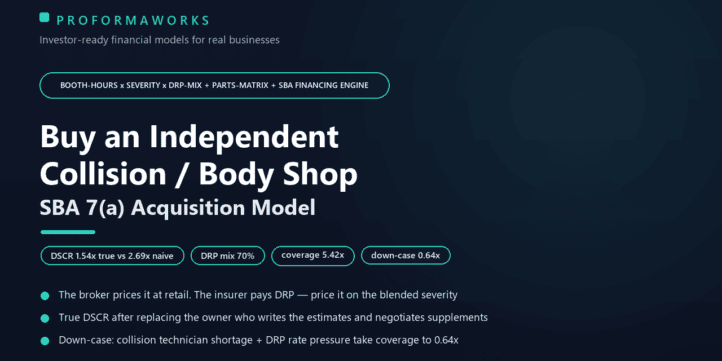
Underwrite a collision / auto body shop acquisition the way an SBA lender will: booth capacity, DRP-vs-retail mix, severity, a parts matrix, an owner-estimator add-back and a DSCR gate. The retail pro-forma price sits next to the real one, the true DSCR next to the naive one, plus a technician-shortage down-case. 11 sheets, Excel + Google Sheets.
| Car Services, Financial Model, Retail, Service Businesses |
| 5-year Financial Projections, Business Valuation, Cash Flow Projections, Debt Service Coverage, Excel, Financial Model, Loans, Pro-Forma |


The broker prices this collision shop at retail. Most collision revenue is priced by the insurer through a Direct Repair Program, not by the customer: the insurer pays labor at a discounted rate, caps materials, expects operations given away as a value-add, and disputes supplements. Present the shop as if every car were customer-pay retail and you overstate SDE. This is the model a searcher or ETA buyer hands the SBA lender – not a startup forecast, an acquisition underwrite for a single independent body shop.
The booth/cycle-time throughput engine manufactures revenue from physical capacity, not a typed-in number: 460 repair orders at a $4,710 blended severity (a 70/30 DRP-to-retail mix of $4,500 and $5,200). The binding constraint is the paint booth, running at 69.7% utilization; a second booth is unfunded capex, not free growth.
Two prices sit side by side. The retail pro-forma price is $1,036,414; the real, DRP-blended price is $806,452 at 2.60x SDE. Overpay avoided: $229,962, or 28.5%. At the pro-forma price the DSCR falls to 1.23x, below the 1.25x floor – declined. The DSCR is shown true versus naive: 1.54x on the cash flow a lender accepts, after hiring an $85,000 estimator/blueprinter to replace the owner who writes the estimates and negotiates the supplements and reserving $30,000 a year for ADAS calibration, scan tools and the booth, versus the 2.69x a broker’s add-back sheet implies. The gap is the owner’s own labor.
The down-case is the documented sector risk number one: the collision technician pipeline fills only about 42% of demand, turnover runs 60.7%, and TechForce counts 73,354 techs needed 2025-2029. Repair orders down 9% plus a 3% rate cut drive the DSCR to 0.64x. Severity cuts both ways – it lifts the ticket but pushes total-loss frequency to a record 23.1%, one car in four written off rather than repaired. The supplement write-off is an explicit line, not an add-back.
Inside: an 11-tab Excel workbook (Google Sheets compatible, no macros or add-ins), a parts matrix (OEM, aftermarket, recycled), labor+refinish gross-profit coverage of 5.42x, debt yield, break-even severity, cash-on-cash and a 5-year MOIC (leverage-amplified, flagged; no live IRR by design), plus a PDF guide with sources and three profiles (Retail-Forward, Balanced DRP, DRP-Volume).
Honest by design: SDE 14.3% and Adjusted EBITDA 9.0%, deliberately below a mechanical shop because the DRP compresses the margin. The first acquisition-underwriting model for collision and auto body shops – not the first collision model; startup forecasts already exist. Educational planning tool, not financial, lending or legal advice.
Similar ProductsOther customers were also interested in...



 eFinancialModels
Electric Vehicle (EV) Charging Station Financial M...
With this comprehensive 5- or 10-year monthly tool, investors can assess the viability of setting up... Read more

Financial Model for Mobile App | Mobile App Busine...
The Mobile App Financial Plan Template in Excel allows you to develop financial projections when lau... Read more

 HenrySheykin
Food Truck Financial Model Excel Template
The Food Truck Financial Model helps entrepreneurs, founders, business owners, consultants, and anal... Read more

Green Hydrogen Production from Wind Energy Financi...
The Green Hydrogen from Wind Financial Model aims to comprehensively forecast a horizon of 40 years ... Read more

Simple Mutual Non-Disclosure Agreement Template
Protect your business secrets with ease using our Simple Mutual Non-Disclosure Agreement Template. S... Read more

Solar Energy Financial Model
The Solar Energy Financial Model Spreadsheet Template in Excel assists you in preparing a sophistica... Read more

 Peter Graf
The Customer-Centric Financial Model for Restauran...
Starting a restaurant without a financial plan is like driving a car blindfolded. You wouldn´t do i... Read more
You must log in to submit a review.