0 ITEMS

The Anatomy of a Trustworthy Financial Model: Five Parts

A trustworthy financial model is one whose assumptions, formulas and checks can be inspected and tested by another person, and polished formatting adds nothing to that. Five parts make up its anatomy: clear assumptions, consistent logic, built-in checks, traceable documentation and independent review.
Key Takeaways
- A reliable model lets a second person see where every number comes from and test whether it is right; good looks prove neither.
- Clear assumptions sit in labelled input cells with units and sources, and no formula hides a typed-in number.
- Consistent logic means one formula pattern per row, one sign convention, one unit scale, and statements that agree with each other.
- Built-in checks, summed into one master check, turn silent errors into visible failures before a reader finds them.
- A reviewer who did not build the model should trace inputs, recheck totals and flex assumptions before anyone relies on the results.
What makes a financial model reliable and not just good-looking?
Reliability means a reader can see where each number comes from and can test whether it is right. Clean fonts and colored headers say nothing about either. A model can look excellent and still be wrong. Raymond R. Panko’s spreadsheet audits page, covers the “Core 5” studies, which it says used strong methodologies, and states: “These studies collectively examined 55 spreadsheets. They found important errors in 91% of them.” The page compiles earlier audits, so the figure is not a current error rate, but it explains why structure deserves more attention than style.
Newer reporting points the same way. A 2024 study reported by Phys.org found that 94% of spreadsheets used in business decision-making contain errors.
Spreadsheets also remain the main tool in many finance teams. The CFO reported in November 2024 on a Rossum survey of finance leaders in the UK, the US and Germany, stating that 58% of finance leaders still rely on spreadsheets as their primary automation tool. The report comes from a software vendor and says nothing about error rates, so it shows how widely spreadsheets are used and not how often they fail.
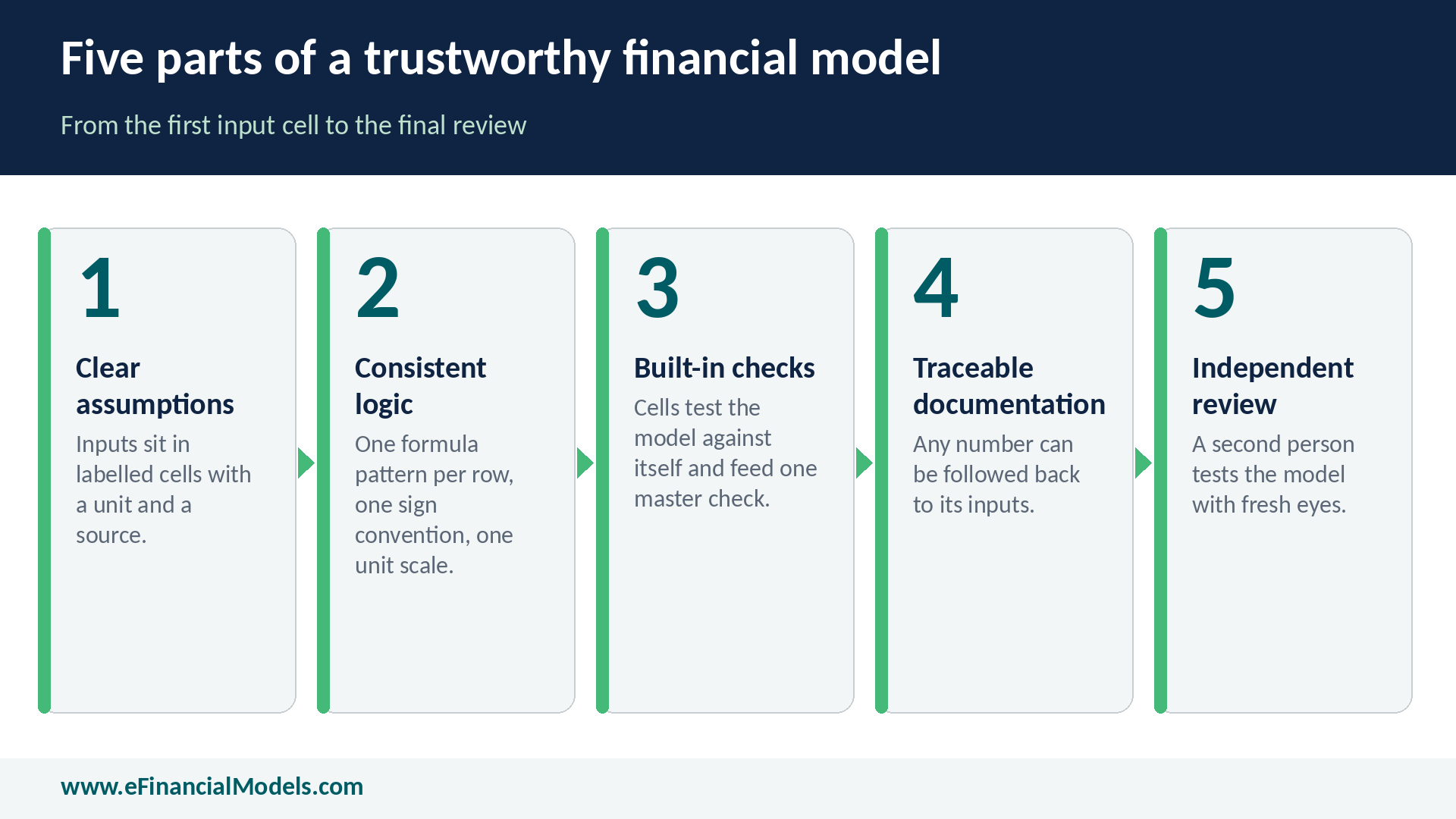
The five parts of a trustworthy model, from the first input cell to the final review.
Why do clear assumptions come first?
Clear assumptions are inputs that live in one labelled place, each with a unit, a source and an owner. Every formula then points to an input and never hides a number inside itself. A growth rate typed into a revenue formula cannot be found, challenged or changed, while the same rate in an input cell can be changed in seconds and seen by everyone.
A simple rule keeps this tidy: one input, one cell, one label, one unit. A short assumptions list also lets a reader judge whether the model’s story is plausible before reading a single formula, which is the fastest test of whether the numbers deserve trust.
How does logical consistency show up in a model?
Logical consistency means the same calculation is built the same way everywhere it appears. A row of monthly revenue should use one formula copied across every column, costs should follow one sign convention, and units such as thousands or millions should not change halfway down a sheet.
Consistency also covers the links between statements. Profit on the income statement should flow into equity on the balance sheet, and the cash on the balance sheet should equal the closing cash on the cash flow statement. The three statement model listings on eFinancialModels show this linked structure in finished form.
What should built-in checks and auditability include?
Checks are cells that test the model against itself and report pass or fail. Useful examples are a balance sheet that balances, a cash tie-out between statements, totals that equal the sum of their parts, and a cash line that never turns negative unless the plan intends it.
A master check is one cell at the top of the model that sums all the individual checks and turns red when any of them fails, which makes the model’s health visible at a glance. Auditability adds tracing: the ability to follow a number back to its inputs. Microsoft’s support page for its Spreadsheet Inquire tool states: “Analyzing a workbook provides a comprehensive analysis of its logic structure and error status.” The Spreadsheet Inquire page explains what the tool reports.
Worked example: a check that catches a quiet error
In this hypothetical example, a start-up model repays a 50,000 USD loan instalment. Cash falls by 50,000 USD, but the loan line is not reduced. Without a check, every statement still looks tidy. The balance check, which subtracts liabilities and equity from total assets, exposes the gap.
| Line | Before the error | After the error |
|---|---|---|
| Total assets | 1,250,000 USD | 1,200,000 USD |
| Liabilities | 700,000 USD | 700,000 USD |
| Equity | 550,000 USD | 550,000 USD |
| Balance check (assets minus liabilities minus equity) | 0 USD | -50,000 USD |
Total assets after the error are 1,250,000 – 50,000 = 1,200,000 USD. The balance check then reads 1,200,000 – 700,000 – 550,000 = -50,000 USD. Before the error it reads 1,250,000 – 700,000 – 550,000 = 0 USD. A nonzero check is the signal to stop and trace the repayment, and the fix is to reduce the loan line by 50,000 USD.
What do real model failures teach?
Real failures show which weaknesses the five parts are meant to prevent. The 2013 report of the US Senate Permanent Subcommittee on Investigations on JPMorgan Chase’s 2012 “London Whale” trades describes a risk model “requiring error-prone manual data entry and incorporating formula and calculation errors.” The same Senate report says that by the end of 2012 the trading losses “reached at least $6.2 billion.” The model was one element of a broader case history, so that figure is not the cost of the model errors alone.
In England, Public Health England reported in October 2020 about delayed reporting of cases of coronavirus disease 2019, saying: “we have identified that 15,841 cases between 25 September and 2 October were not included.” The agency’s statement on delayed reporting is a reminder that a simple reconciliation check, comparing records received with records published, is a basic control for any data-driven model.
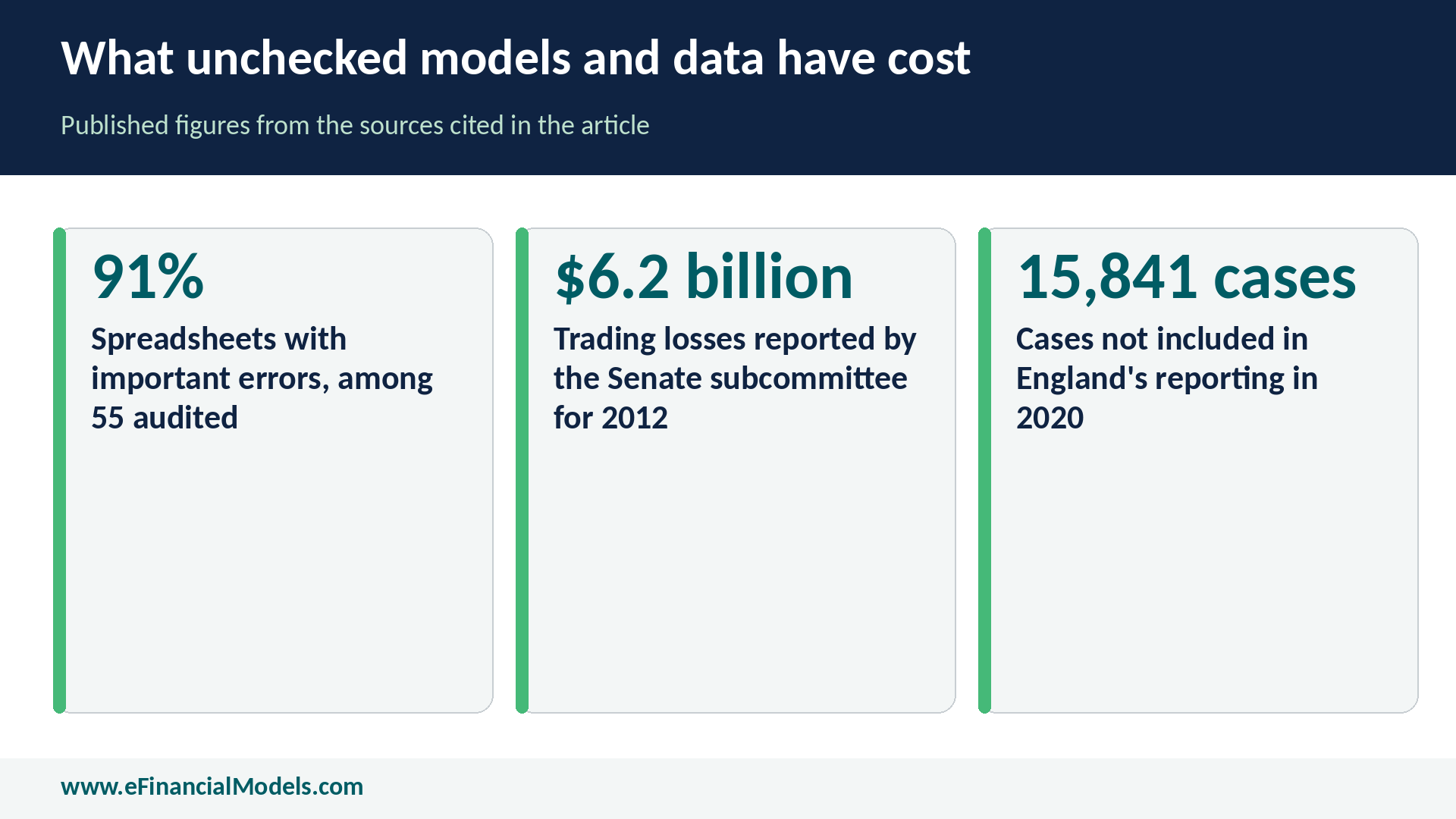
Three published figures linked to spreadsheet errors, model weaknesses and data gaps, each from the sources cited above.
How does independent review fit in?
Independent review means a second person, who did not build the model, tests it with fresh eyes. The builder knows what the model is supposed to do and tends to read what was intended, while a reviewer reads what is actually there. A review works best as a short, repeatable routine, and scenario analysis, which runs the model with a downside and an upside set of inputs, helps show whether outputs move in sensible directions. The scenario analysis collection on eFinancialModels lists models that include this feature, and the custom financial modeling services collection lists offers for outside reviewers and modelers.
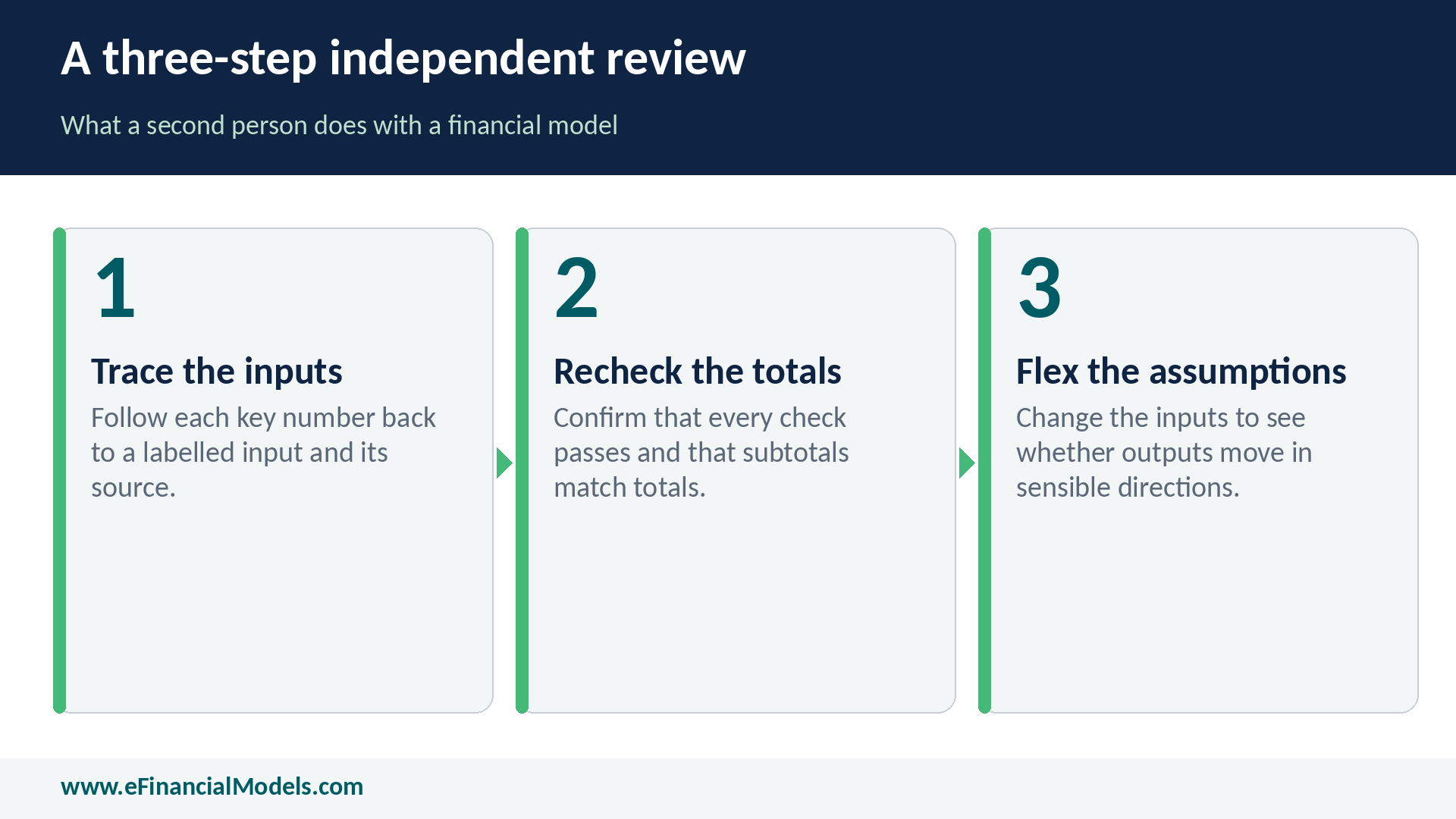
A three-step independent review that a second person can run on any model.
Conclusion
A trustworthy model shows its assumptions, applies its logic consistently, tests itself with checks and invites review. Readers who want a linked structure to inspect can open the Free Three Statement Financial Model from eFinancialModels, a ready-made three statement template. Every model also deserves a second pair of eyes before anyone relies on it.
Frequently Asked Questions
How many checks should a financial model have?
There is no fixed number, but each place where two parts of a model must agree deserves one test. That usually means the balance sheet balance, the cash tie-out, subtotals against totals, and any hard limits such as a loan that cannot be overpaid. Each test should return a plain pass or fail, and all of them should feed a single master cell. Too few checks leave gaps, while dozens of overlapping ones hide the failures that matter.
Who should review a financial model before it is used?
The best reviewer is a person who understands the business but did not build the file, such as a colleague, an accountant or an outside modeler. The reviewer needs the model, the assumptions list and a plain statement of the decision it supports. Reviews are most valuable before money is committed, for example before a model goes to a lender or investor, because errors are cheapest to fix at that point.
Does a longer, more detailed model make it more reliable?
Not by itself. Extra detail adds extra places for mistakes, and each new link has to be checked. A reliable model is detailed enough to answer the decision at hand and no more. A good test is whether a newcomer can explain the main drivers after fifteen minutes with the file. If they cannot, simplifying the layout often improves trust more than adding another sheet.
What is the difference between a model error and a bad assumption?
A model error is a mistake in construction, such as a formula that points at the wrong row, and it can be found and fixed with checks and review. A bad assumption is a faulty belief about the future, such as a growth rate that is too hopeful, and no formula can detect it. Both damage trust, so a reliable model keeps assumptions visible where readers can challenge them, and keeps the formulas simple enough to test.
How often should a financial model be re-tested?
A model should be re-tested whenever its structure changes, whenever new actual results replace forecasts, and before it is shared with someone who will rely on it. A light routine works well: confirm that the master check still passes, compare the latest actuals with the forecast, and note what changed in a short log. Keeping that log lets a future reviewer see why numbers moved without rebuilding the history.