0 ITEMS

The Hidden Costs of Free Financial Templates for Founders

Free financial templates and chatbot-built spreadsheets cost a first-time founder money in three places: hours spent finding and fixing errors, a generic layout that omits what lenders and investors look for, and numbers that nobody has tested. A paid template earns its price when those costs would exceed it, which fits founders with no spare hours and no second reviewer.
Key Takeaways
- Studies summarised in a 2015 spreadsheet-error paper found errors in 94% of the spreadsheets studied, so any spreadsheet needs checking time.
- A generic layout can omit cash timing and industry drivers, which makes the cost-against-revenue comparison that lenders and investors run harder to read.
- A 2023 test saw one chatbot setup miss 81% of financial questions, and a 2025 benchmark’s best model reached 46.8% accuracy, so output needs checking.
- Public spreadsheet failures, such as 15,841 Covid-19 cases left out of England’s daily counts in one week of 2020, show how unchecked errors reach decisions.
- Free options suit learning and rough sanity checks; paying makes sense once a lender, an investor or a co-founder will rely on the numbers.
What do free financial templates really cost a founder?
A free template costs the hours spent checking and repairing it, the opportunities a generic layout misses and the risk of presenting numbers that were never tested.
Spreadsheet research explains the first cost. In a 2015 paper on spreadsheet errors, Raymond Panko of the University of Hawai’i summarised earlier studies of spreadsheets and wrote that “Collectively, these studies found errors in 94% of the spreadsheets studied”. The same paper reports that across 14 laboratory studies of people building spreadsheets the average cell error rate was 3.9%, meaning about 4 of every 100 cells were wrong. Both figures describe spreadsheets in general and come from older data, so they show how common mistakes are, not how many one template contains.
Time makes the cost concrete. In this example, assume a founder values an hour at USD 50 and that filling in the inputs takes the same time on either route, so only the checking and repair hours differ: 12 hours for a free template and 4 hours for a paid template that comes with documentation and a seller to ask. Both hour counts are assumptions, and a paid template can contain errors too. The paid route therefore avoids 12 hours – 4 hours = 8 hours of checking, which at the assumed rate is worth 8 hours x USD 50 = USD 400. A founder should replace these assumed hours with measured ones and compare the result with the template’s price.
How does a generic layout cost a founder opportunities?
A generic layout costs opportunities when it hides the numbers a lender or investor came to see. The U.S. Small Business Administration writes: “Investors and lenders compare expected costs to projected revenue and determine the potential for your business to profit.” in its business plan guide.
Cash timing is a likely gap, and the survey shows why it matters to small firms. In the Federal Reserve Banks’ 2025 Report on Employer Firms, based on a survey of small employer firms fielded in 2024, 56% of firms cited paying operating expenses and 51% cited uneven cash flows as challenges. A template with one yearly revenue line cannot show when cash arrives, so the founder spends hours adding monthly columns and industry drivers such as units sold, seats or bookings. An industry-specific model already contains those drivers, and the financial model category on eFinancialModels lists Excel templates for a variety of industries and business sectors.
Can ChatGPT replace a paid financial template?
Not yet for the model itself. The benchmarks below measure how chatbots answer financial questions, not how they build spreadsheet models, so the step to model building is an inference, though a cautious one. ChatGPT, a general-purpose chatbot from OpenAI, is better used to explain a formula or draft assumption notes than to act as the calculation engine.
The 2023 FinanceBench paper tested 16 model configurations on a sample of 150 cases and reported that one of those configurations, an OpenAI chatbot model paired with a retrieval system for finding passages in filings, incorrectly answered or refused to answer 81% of the questions. Models have improved since 2023, so that figure is a baseline, not today’s accuracy. The 2025 Finance Agent Benchmark set expert-written questions on real financial research tasks and reported that the best-performing model reached only 46.8% accuracy, at an average cost of $3.79 per query. Those tasks are research questions rather than model building, so the result shows the limits of accuracy on financial work in general.
The National Institute of Standards and Technology (NIST) names the underlying problem confabulation, which its 2024 Generative AI Profile lists as “The production of confidently stated but erroneous or false content”.
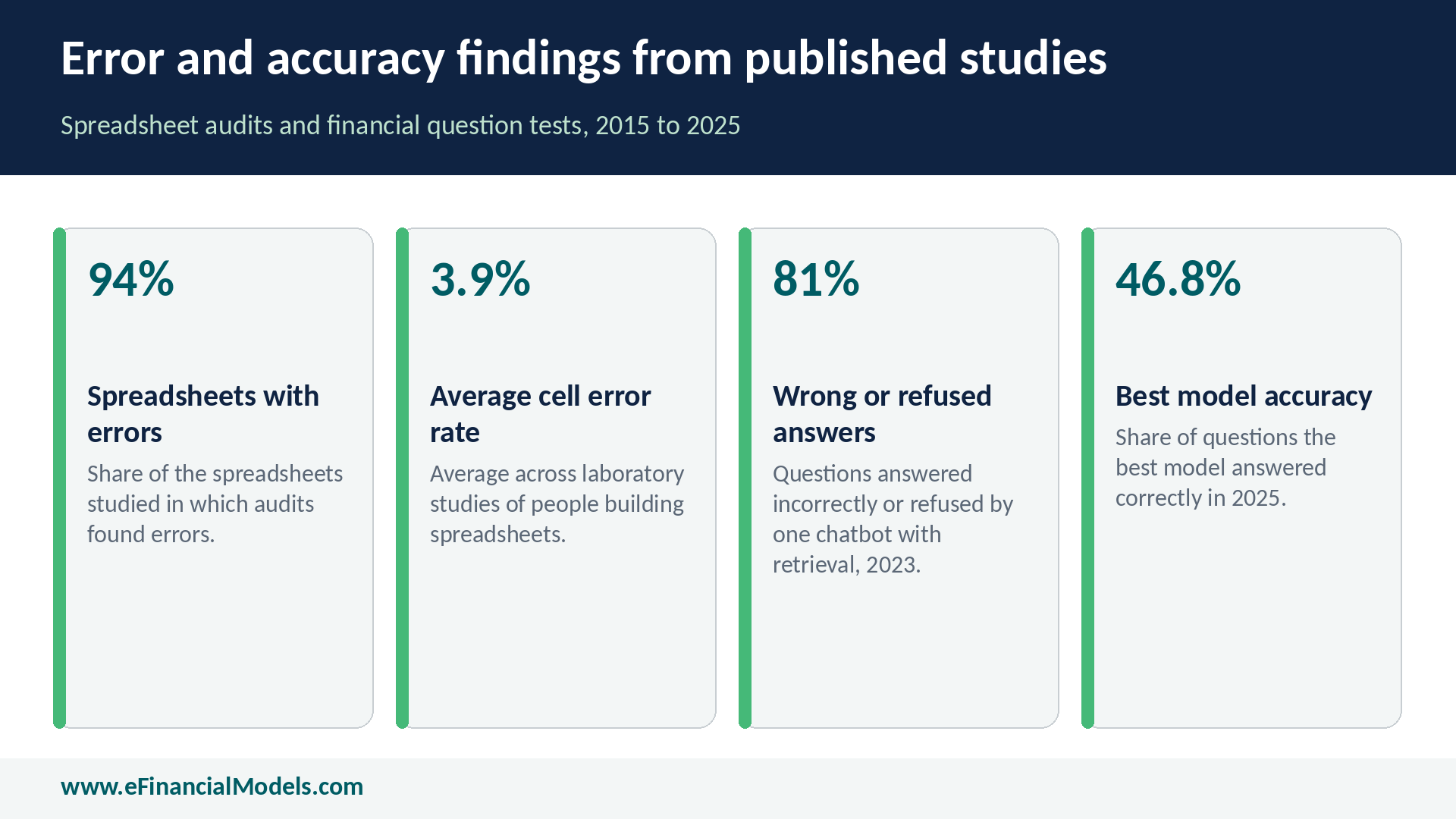
Error and accuracy figures from the Panko spreadsheet review, the FinanceBench paper and the Finance Agent Benchmark paper.
What legal and reputational risks come with free or chatbot-built models?
The main risk is presenting a projection that fails under scrutiny, because the founder, not the template’s author, puts the numbers in front of the reader. Two public cases show how a small spreadsheet fault reaches large decisions.
In October 2020, Public Health England reported that 15,841 cases between 25 September and 2 October had not been included in its daily Covid-19 counts. The Register’s account attributed the gap to test results stored in an older Excel file format that limited the number of rows to 65,536 per spreadsheet.
In 2013, economists re-examining a widely cited economics paper by Carmen Reinhart and Kenneth Rogoff found that its Excel spreadsheet had left out the first five rows, covering five countries. A 2013 report on the spreadsheet error states that average real gross domestic product (GDP) growth for countries with public debt above 90 percent of GDP was actually 2.2%, not the -0.1% as published. A range left out of a calculation was part of the story behind a headline result that later changed sign.
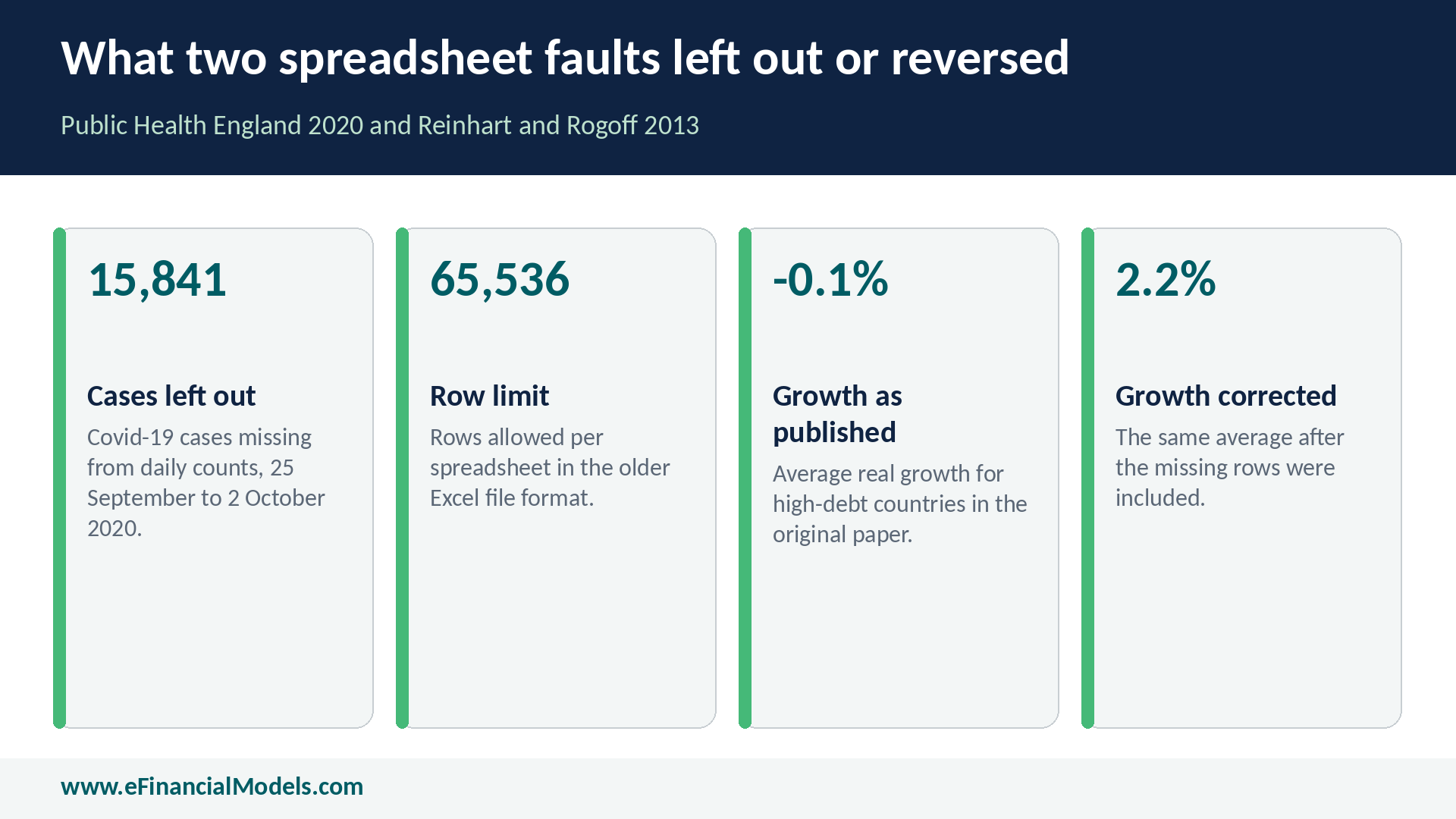
The Public Health England case and the Reinhart and Rogoff correction, with the figures each source reports.
Licence terms add a legal layer. Free downloads can come with terms that restrict reuse or disclaim liability, so a founder who hands a free file to an investor or reuses it in client work should read the licence first. Liability for projections shown to investors or lenders depends on the place and the circumstances and is outside the scope of this article, which is not legal advice, so a lawyer should confirm what a specific licence allows.
When is a free template or a chatbot still enough?
Free options are enough for learning, a first rough sanity check or a single simple product line, and paying makes sense once someone else will rely on the numbers. The free financial model templates collection lists free downloads, which a founder can use as practice files before spending anything.
Four checks turn the decision into a short routine:
- Name who will rely on the model: a lender, an investor, a co-founder or only the founder.
- Price the checking hours at the founder’s own hourly value, as in the earlier example.
- Check industry fit: do the revenue drivers match how the business earns money?
- Test before sharing: change one input, confirm the balance sheet still balances and recompute one period by hand.
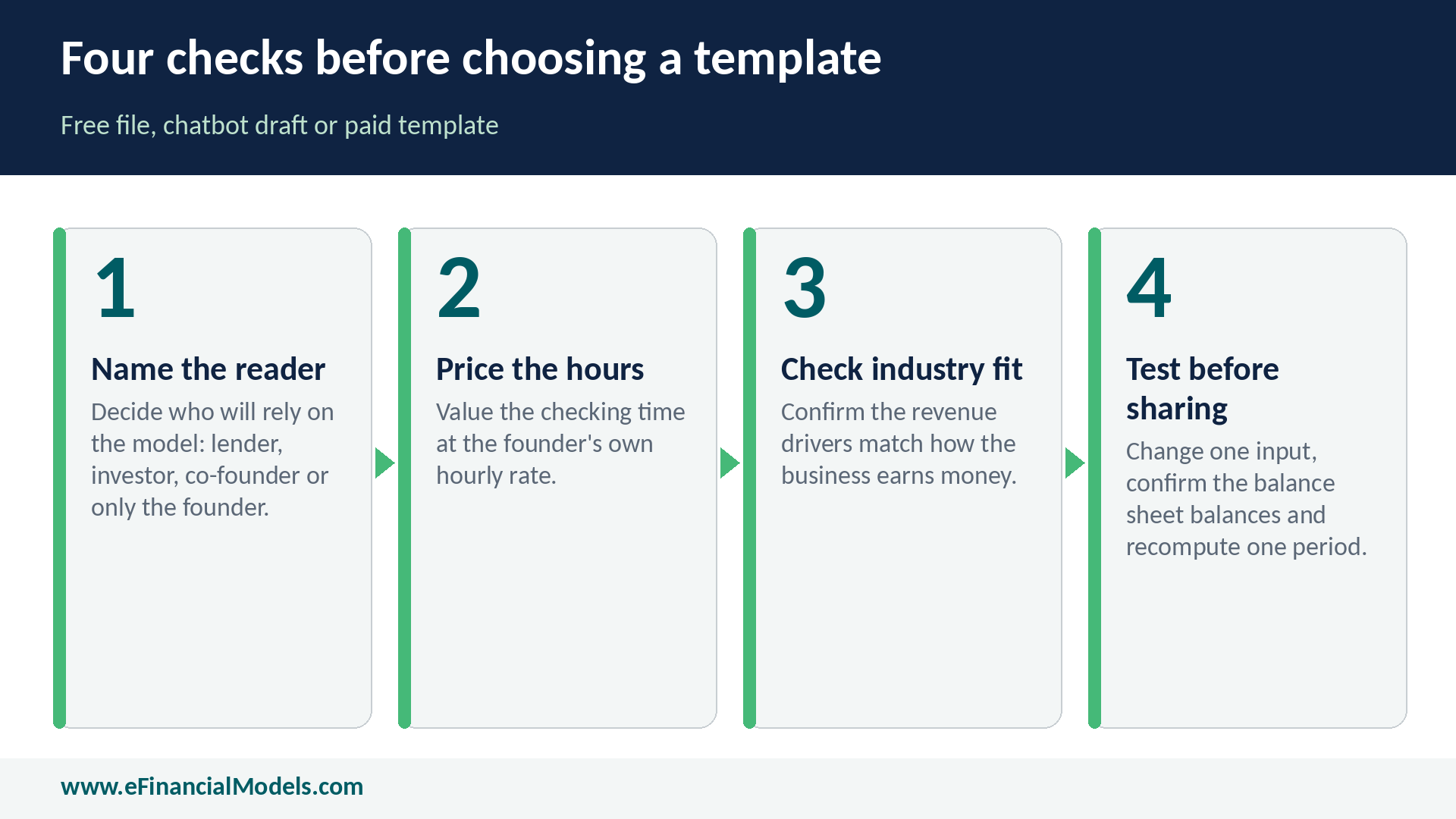
A four-step routine for deciding between a free file, a chatbot draft and a paid template.
Conclusion
Free templates and chatbots are sensible for learning, but they leave the checking, the fit and the accountability with the founder. Founders who will show numbers to a lender or an investor can start from the Simple Fundraising Model from eFinancialModels, which provides a three-statement model with five-year projections of the income statement, balance sheet and cash flow statement, and run the four checks above before sharing it.
Frequently Asked Questions
How can a founder tell whether a free template has been reviewed?
Look for evidence on the file itself: a named author, a version number, a change log and a visible check cell that reports whether the statements balance. If none of these exists, assume nobody has reviewed it and treat the first session as an audit. Open the formulas behind three outputs, follow them back to their inputs and note any hard-coded number sitting inside a calculation, since those are the usual signs of hidden repairs.
Does paying for a template guarantee fewer errors?
No payment guarantees accuracy, but a paid product has a seller whose reputation depends on the file working. That can give the buyer someone to ask when a formula misbehaves, plus documentation and updates, so the buyer should confirm the seller’s support and refund terms before paying. The buyer still owns the assumptions entered into it, so a second person should read the finished model before it reaches any outside reader.
Can ChatGPT help with a template a founder already owns?
Yes, in supporting roles. A chatbot can explain what a formula does, suggest labels for unclear rows, draft the wording of assumption notes and propose scenarios worth testing. It should not rewrite formulas without supervision, because a changed cell can break a link elsewhere without any warning. A sensible habit is to paste the chatbot’s suggestion into a copy of the file, compare outputs before and after, and keep the change only when the totals still reconcile.
What should a founder check in a template’s licence?
Four points matter most: whether commercial use is allowed, whether the file may be shared with outside readers such as investors, whether attribution is required, and whether the terms disclaim responsibility for errors. A licence that is silent on any of these deserves a written question to the author before the model enters a fundraising process. A lawyer can confirm how the terms apply to a particular business.
Is a paid template worth it for a founder with no revenue yet?
Often yes, because a founder without revenue has no actuals to catch structural mistakes and must lean on the model’s logic instead. A pre-built structure supplies the sequence of statements, the scenario switches and the checks that an inexperienced builder would otherwise invent from scratch. The assumptions remain uncertain either way, which is why founders keep them on one clearly marked sheet where investors can challenge them.