0 ITEMS

Why ChatGPT Can’t Replace Expert-Built Financial Models

ChatGPT can draft a financial model in minutes, but it cannot replace an expert-built one, because published tests show chatbots missing many finance and spreadsheet tasks and documented spreadsheet errors have contributed to costly failures. A paid model is worth its price only when its structure, built-in checks and author can be verified before the result drives a decision, which is the checking a chatbot answer does not supply.
Key Takeaways
- The best model in a 2025 benchmark of 537 expert-written finance questions reached only 46.8% accuracy.
- On 912 spreadsheet instructions, a 2024 test found GPT-4o near 17% accuracy and Copilot in Excel near 20%.
- A 2013 US Senate report found that JPMorgan Chase lost at least $6.2 billion in 2012 and documented formula errors in its risk model.
- A chatbot-built file and a free template share one weakness: no independent person has checked the formulas.
- ChatGPT suits drafting and explaining, while an expert-reviewed model should carry any figure that decides money.
How accurate are chatbots on finance and spreadsheet tasks?
Chatbots miss a large share of finance tasks in published tests, so every chatbot answer needs the checking given to any unreviewed draft. Three studies, each using a benchmark (a fixed question set used to score AI models), show the pattern.
The Finance Agent Benchmark, published in 2025, tested models on 537 expert-authored questions and reported that even the best-performing model, OpenAI’s o3, achieved only 46.8% accuracy at an average cost of $3.79 per query, as the Finance Agent Benchmark paper (arXiv, 2025) states.
A separate test focused on spreadsheet tasks. The 2024 SpreadsheetBench test built 912 instructions and 2,729 test cases, and reported that OpenAI’s generative pre-trained transformer (GPT) model GPT-4o scored around 17% in accuracy, in line with Copilot in Excel at roughly 20%, according to the SpreadsheetBench paper (arXiv, 2024).
Retrieval did not fix the problem either. The 2023 FinanceBench study found that GPT-4-Turbo used with a retrieval system, which is software that fetches relevant document passages for the model to read, incorrectly answered or refused to answer 81% of questions, per the FinanceBench paper (arXiv, 2023).
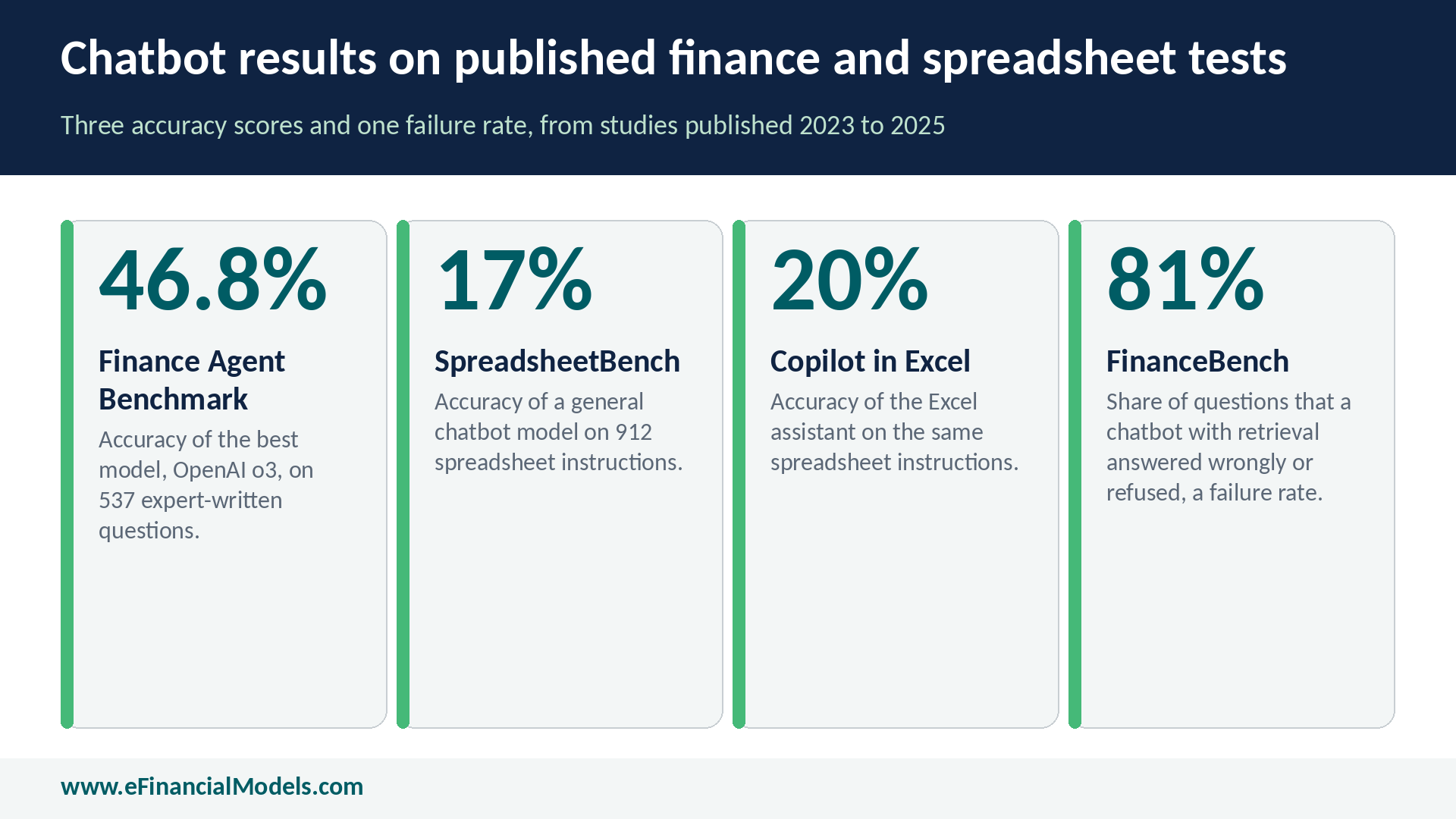
Four published results from 2023 to 2025; three measure accuracy and one measures the share of questions answered wrongly or refused.
These tests score single questions and single tasks, not a finished model, so they show the direction of the risk rather than a correction bill. Models also improve, so each figure describes the test and its date, not today’s best result.
What do spreadsheet errors cost when nobody catches them?
Spreadsheet errors have contributed to costly failures in several documented cases, and several came from human-built spreadsheets, the same kind of file a chatbot can now produce in seconds. Three incidents and one error-rate study give the scale.
A 2013 report by the US Senate Permanent Subcommittee on Investigations found that JPMorgan Chase’s Synthetic Credit Portfolio lost at least $6.2 billion in 2012. The new value at risk (VaR) model, a measure of the loss a portfolio is not expected to exceed over a set period at a set confidence level, immediately lowered the portfolio’s VaR by 50%, and the report states that the bank later determined that the model was improperly implemented, requiring error-prone manual data entry and incorporating formula and calculation errors, according to the Senate report on the London Whale trades (2013).
Academic work was affected too. A 2013 replication by University of Massachusetts Amherst economists reported coding errors, selective exclusion of available data and unconventional weighting of summary statistics in a widely cited study of public debt, and found that the average real growth rate for countries with a public-debt-to-gross-domestic-product (GDP) ratio of over 90 percent is actually 2.2%, a different figure from the one that study published, as the Amherst critique of Reinhart and Rogoff (2013) reports.
Public health reporting suffered a file-format failure. A 2020 report described the under-reporting of 15,841 novel coronavirus cases between 25 September and 2 October in England, with records stored in an older Excel format, known as XLS, that limited the number of rows to 65,536 per spreadsheet, according to The Register’s report (2020).
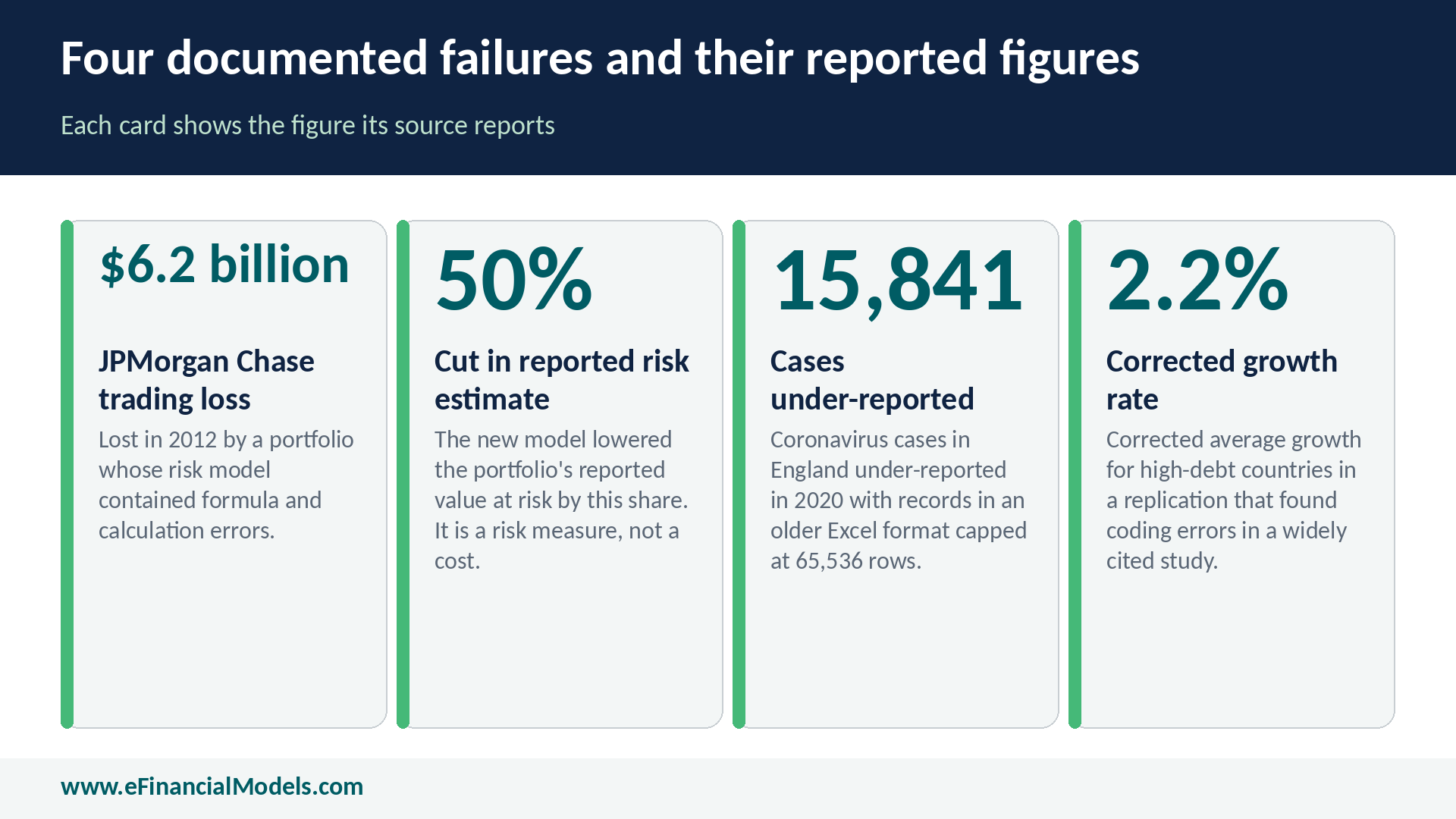
Four documented failures from 2012 to 2020, with the figure each source reports.
Errors are common as well as costly. Raymond Panko’s review of spreadsheet research, presented in 2000, reported that field audits found errors in 24% of the 367 spreadsheets audited and that, across the experiments reviewed, 51% of all spreadsheets contained errors, according to Panko’s spreadsheet error review (2000).
None of these cases involved ChatGPT. They show what an unreviewed spreadsheet can cost, and a chatbot-built file is unreviewed by default. An error caught before a model is used costs a review, while an error caught afterwards costs whatever decisions it shaped.
Why does a chatbot-built or free template carry the same risk?
Both carry the same risk because neither comes with an independent check, so the person using the file inherits the whole job of verifying it. A chatbot produces an answer for the prompt in front of it, and a second prompt can return different formulas for the same request, which leaves the user to find out which version is right.
A free template can be well made, but a download page rarely says who tested it, what was tested or when. A price is not evidence of review either, so the same three questions apply to a paid file. The free financial model templates collection on eFinancialModels shows how wide that range is, from simple trackers to full models, which is why the question to ask of any file, free or paid, is who tested it.
What does an expert-built model add that a chatbot answer lacks?
An expert-built model adds checks inside the file and a named person accountable for them. Four features separate it from a raw chatbot answer.
- Separated layers: inputs, calculations and outputs sit on distinct sheets, which makes it harder to bury an assumption inside a formula.
- Built-in checks: tests such as a balance sheet that must balance in every period help flag a broken link as soon as it appears.
- Sensitivity checks: sensitivity analysis, which changes one input at a time to show which assumptions move the result most, reveals how fragile the answer is.
- Independent review: a second person recomputes one period by hand before anyone relies on the figures.
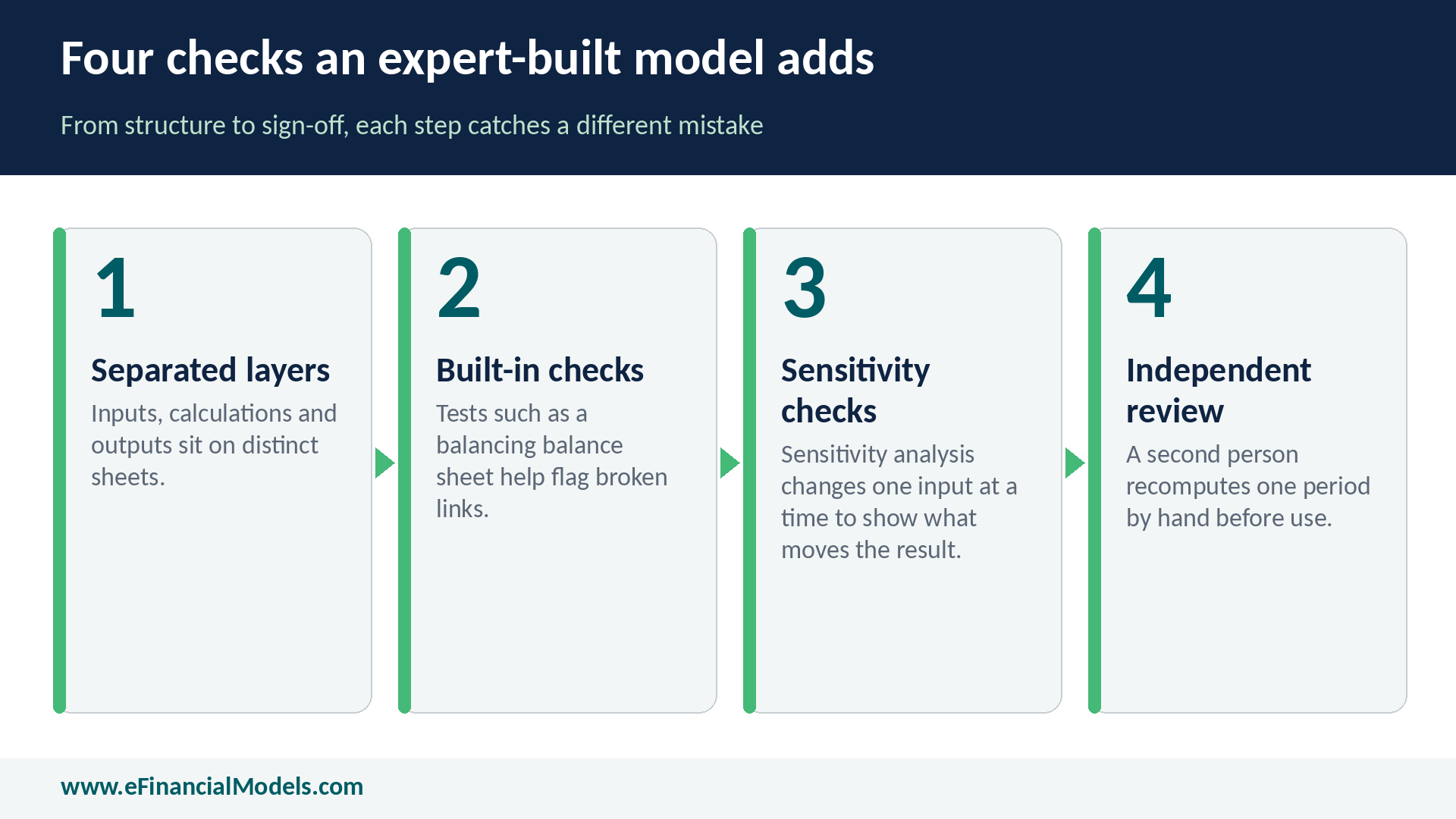
The four checks above, drawn as a sequence from structure to sign-off.
A chatbot can write a balance check when asked, but nothing in the chatbot ensures that the check was asked for, tested or kept when the file was edited later.
When is ChatGPT still the right tool?
ChatGPT is the right tool for drafting, explaining and testing ideas, and the wrong tool for producing the single file that decides money. It can explain what a formula does, suggest a layout, draft an assumptions list and propose test cases for a reviewer to run.
A practical split keeps the speed and removes the risk. Let the chatbot draft the text and the first formulas, place the figures in a structure with separated layers and built-in checks, then recompute one period by hand. The Excel templates collection on eFinancialModels lists ready-made Excel structures across industries, each of which a buyer can test the same way.
Conclusion
ChatGPT is a fast assistant and a poor substitute for a reviewed model: the tests above show frequent misses on finance and spreadsheet tasks, and the cases above show what spreadsheet errors can cost. Buyers who want inputs, calculations and outputs already separated can start from the Three Statement Model collection on eFinancialModels, which lists three-statement Excel templates by industry for a reviewer to test before use.
Frequently Asked Questions
Can ChatGPT build a financial model at all?
It can produce a layout, sample formulas and an assumptions list within minutes, and that output is a useful first draft. The limit is verification: nothing in the reply confirms that totals reconcile, that each reference points to the right row or that the logic holds when a number changes. Treat the draft as unreviewed work, then test it against a hand calculation before any figure leaves the file.
Is a free template safer than a chatbot-built model?
Not automatically. A free template has a fixed structure that can be inspected before use, which gives it one advantage over a fresh chatbot reply, but it may have been tested by nobody. The useful comparison is documentation: a file that lists its assumptions, shows its check cells and names its author gives a reviewer something to work with, while an anonymous file with hidden sheets does not.
How can a ChatGPT draft be checked before anyone relies on it?
Start with three quick tests. Recompute one period from the stated inputs with a calculator, and compare the result to the file. Change a single assumption by a large amount and confirm the outputs move in the expected direction. Then look for hard-coded numbers typed over formulas, which is a common source of silent errors. A second reader who did not build the file should repeat the first test.
Does paying for a template guarantee it is correct?
No. A price can come with a documented structure, a named seller and a way to ask questions, but it is not evidence that the file was tested, and it does not replace testing on the buyer’s own numbers. Sensible buyers open the file, enter their real figures, read the check cells and note any row that needed new logic. A paid model that passes those steps has earned the trust that a free or chatbot file has not yet.
What should stay out of a chatbot prompt?
Anything confidential should stay out unless the tool’s data policy allows it: customer lists, unreleased results, loan terms and investor names. A safer pattern is to describe the structure with placeholder figures, ask for the formulas, and then enter the real numbers inside the local file. That keeps sensitive data in a controlled place and also makes the formulas easier to review, because every input is visible.
Sources
- Finance Agent Benchmark paper (arXiv, 2025)
- SpreadsheetBench paper (arXiv, 2024)
- FinanceBench paper (arXiv, 2023)
- Senate report on the London Whale trades (2013)
- Amherst critique of Reinhart and Rogoff (2013)
- The Register’s report (2020)
- Panko’s spreadsheet error review (2000)