0 ITEMS

How to Choose the Best Financial Model Template for Your Needs

The best financial model template is the one that fits the founder’s purpose, industry and forecast length, and that shows checkable quality signals before any money changes hands. A short needs list, a shortlist of two or three templates and a test of each one turns a crowded catalogue into a clear choice.
Key Takeaways
- Start with the need: who will read the model, which industry it covers and how many years it must forecast.
- Industry-specific templates carry revenue and cost logic that generic ones lack, so a seaweed farm and a software company need different models.
- Quality signals are documented assumptions, a clear structure, built-in checks, a named author and a sample file; reviews add supporting evidence.
- The U.S. Small Business Administration says to supplement a funding request with financial projections, so the template’s forecast must suit the reader of that request.
- Refunds are not offered on eFinancialModels digital products, so a sample file or preview should be tested before paying.
What does a founder need to know before looking at any template?
Four answers narrow the field before a single template is opened: what the model is for, who will read it, which industry it covers and how long the forecast must run. The purpose matters most. A model for a bank loan, an investor pitch and a private budget are built differently, and a template made for one is awkward for the others.
The reader sets the minimum content. The U.S. Small Business Administration (SBA) says in its guide to writing a business plan: “Supplement your funding request with financial projections.” That is guidance for small businesses seeking funding in the United States, so a lender or investor reads the forecast, and a template whose forecast is shorter or thinner than that reader expects may need extra work. A different reader, such as a private investor, may ask for another length, so the reader’s request sets the target. A complete forecast normally carries three core statements: an income statement, which shows profit, a balance sheet, which lists assets and liabilities, and a cash flow statement, which shows cash in and out.
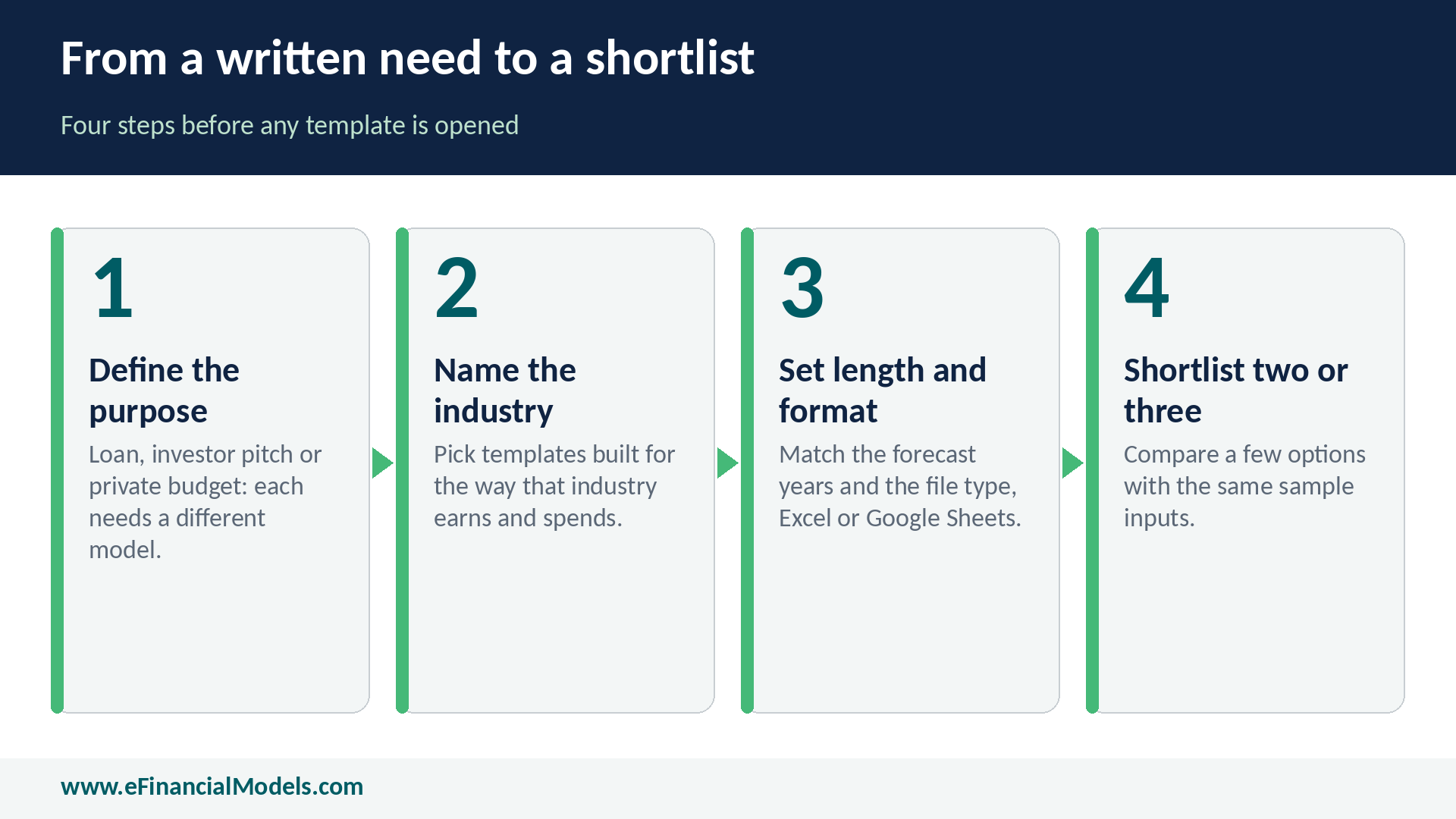
Four steps from a written need to a shortlist of two or three templates.
Why does an industry-specific template beat a generic one?
An industry-specific template starts from the way that industry earns and spends money, so the founder fills in the right inputs instead of rebuilding the logic. A generic model may offer one revenue line, units sold times price, which cannot describe a farm cycle, a plant with a start-up phase or a rental fleet without heavy edits.
Niche models show the difference. The seaweed farming financial model on eFinancialModels, found in the seaweed farming category, lists these sheets: Instructions and Terms, Executive Summary, Detailed Summary, Operating Model, Monthly Budget Allocation, Financials, Debt Schedule and Sensitivity Analysis, a sheet that tests how results change when one input moves. The page says the Financials sheet holds the calculations of a 40-year financial forecast. A debt schedule, which tracks loan balances and repayments, is the kind of sheet a farm lender expects to see next to a sensitivity test.
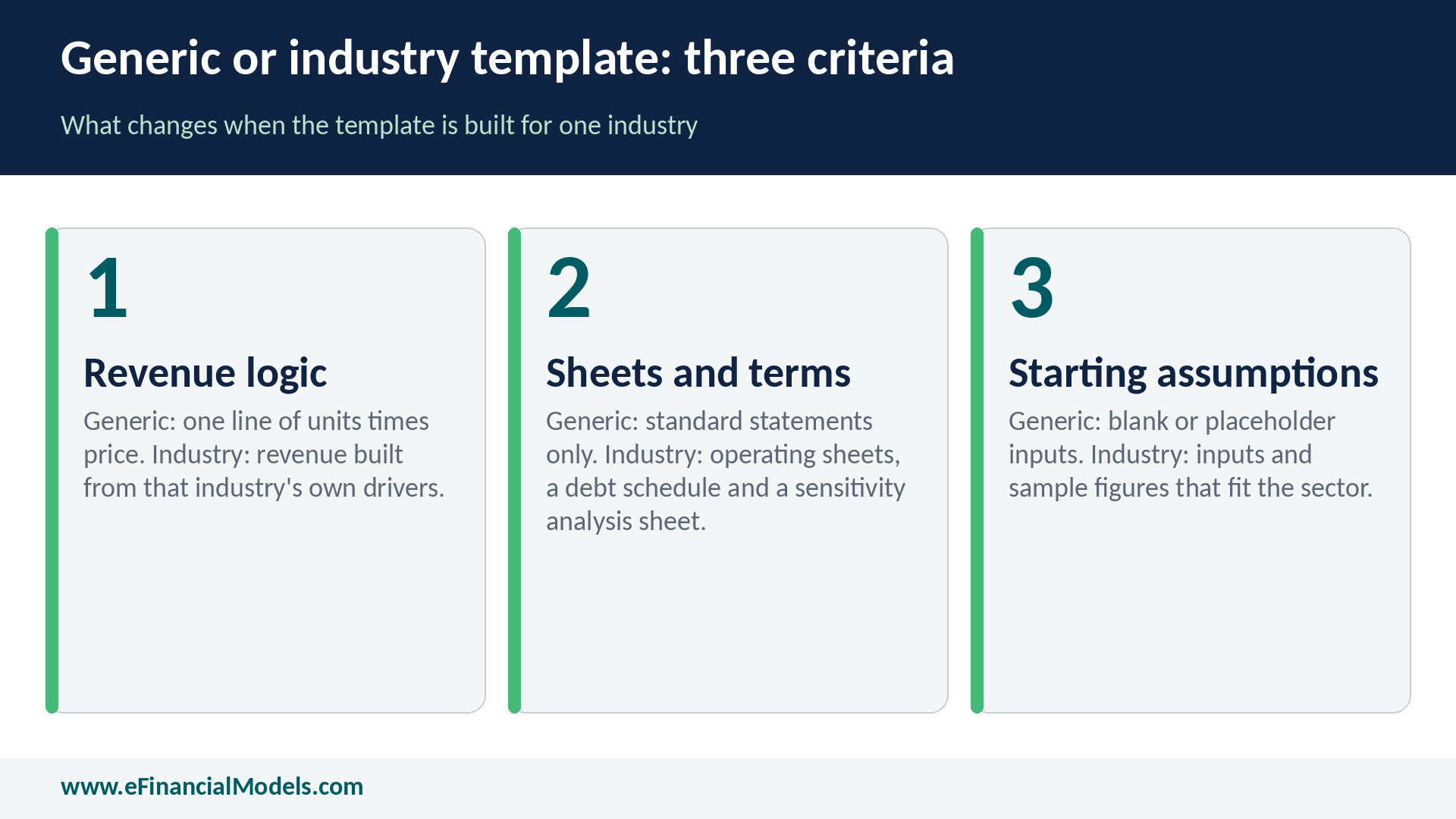
Generic and industry-specific templates compared on revenue logic, sheet structure and starting assumptions.
Founders at the first-company stage can browse the startup financial model collection to see how templates for new businesses are grouped.
Which quality signals separate a good template from a weak one?
Five signals matter: documented assumptions, a visible structure, built-in checks, a named author with relevant experience, and a sample that can be opened before paying. The first four are covered here, and the sample is covered in the testing section below.
Documented assumptions come first. Assumptions are the inputs a forecast rests on, such as prices, volumes and growth rates, and a good template groups them on one sheet with units and notes, so a buyer can see what was assumed instead of hunting through formulas.
Structure comes second. The Institute of Chartered Accountants in England and Wales (ICAEW) describes its Financial Modelling Code in a guide to getting financial models right, which says: “The design should be carefully planned before any construction takes place.” The same guide says: “Including a directory, contents and diagram explaining the logic is recommended.” In template terms, an instructions sheet, a summary sheet and a clear sheet order are visible signs of planning.
Checks come third, because errors are common. ICAEW’s spreadsheet review guide says: “A common statistic quoted about spreadsheets is that as many as 90% contain a mistake.” A good template therefore shows its own tests, such as a balance check, which tests that assets equal liabilities plus equity and reads OK, or a total that must match another total.
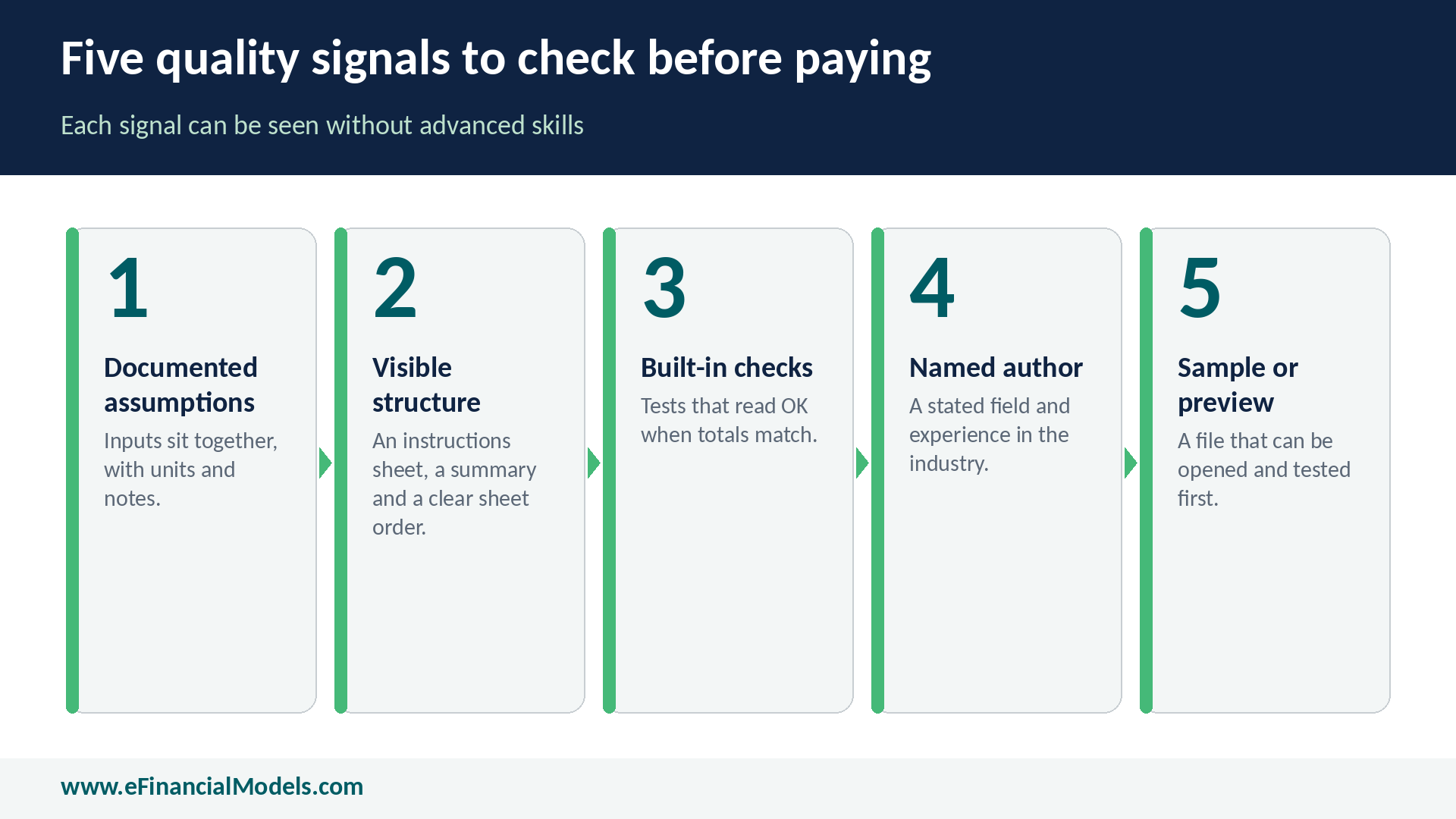
The five quality signals worth checking before paying for a template.
Credentials come fourth, and they are claims to verify, not proof. The eFinancialModels About page says its leadership has experience in corporate finance, mergers and acquisitions, valuation, budget planning and financial analysis across diverse industries. A founder can test such a statement by looking for a named author, a stated field and a track record in the template’s own industry, and by treating an anonymous seller with more caution.
How far can user reviews be trusted?
Reviews are useful evidence, but their value depends on what they describe. Research from the Spiegel Research Center at Northwestern University, on a page dated December 2025, reports: “Our research found that when reviews were displayed for a lower-priced product, the conversion rate increased 190%.” It adds: “However, for a higher-priced product, the conversion rate increased 380%.” The findings are summarised in How Online Reviews Influence Sales. These figures are context on buyer behaviour in general, not evidence about financial templates: shoppers act on reviews, which does not mean reviews guarantee quality.
Reading habits point the same way. The 2025 BrightLocal Local Consumer Review Survey, which polled 1,026 US adult consumers about local businesses, found that “just 4% of consumers say they ‘never’ read online business reviews.” The survey covers local businesses, so it shows how common review reading is, not how templates are bought.
Reviews also need reading with care. A one-line comment that a model is user friendly tells a buyer about ease of use, which matters, but says nothing about accuracy. The most helpful reviews name the task, the industry and the result, and a page with several such reviews says more than one with a single line of praise.
How should a template be tested before paying?
A template should be opened and tested before payment, because the eFinancialModels FAQ states that digital products are not refunded and that models are provided “as is”. Three steps give a fair test in a short session.
First, open the sample. The Seaweed Farming Financial Model page lists an Excel version with sample figures in the assumptions, an Excel null version with no values in the assumption sheet, and a PDF that outlines the model structure. A sample with figures shows how outputs respond, and a blank version shows what the founder must supply.
Second, change one input and follow it through the sheets. A price, a start date or a loan amount should move the statements in a way that makes sense, and the check cells should still read OK.
Third, use a review tool where one exists. Microsoft’s page on Spreadsheet Inquire says that “Analyzing a workbook provides a comprehensive analysis of its logic structure and error status.” The page also notes that the tool is available only in Excel for Windows in Microsoft 365 Apps for enterprise plans and equivalent editions, so not every buyer can use it.
| Check | What good looks like | Warning sign |
|---|---|---|
| Instructions | A sheet that explains inputs, colours and terms | No guidance at all |
| Assumptions | Inputs grouped on one sheet with units | Numbers typed inside formulas |
| Checks | Visible tests that read OK | No test of any kind |
| Forecast length | Covers the horizon the reader expects | Cannot be extended to that horizon |
| Author | Named, with experience in the industry | Anonymous seller |
When is a custom model the better choice?
A custom model is the better choice when no shortlisted template matches the business model, or when the model must connect several revenue streams, entities or financing rounds. The cost depends on scope and quote, but the fit is closer. Founders can compare offers in the custom financial modeling services collection, and a clear brief, listing the reports needed and the reader, keeps the quote realistic.
Conclusion
A good choice follows a simple order: write the need, shortlist two or three industry-specific templates, check the quality signals and test a sample before paying. The Seaweed Farming Financial Model page on eFinancialModels shows what a documented niche template looks like, with an Excel version with sample figures, a blank-assumption version and a PDF that outlines the model structure.
Frequently Asked Questions
Is a free template good enough for a first financial model?
Often yes for learning or a simple budget, provided it passes the same signal checks as a paid one. Free files tend to have less documentation and no support, so a founder should confirm that the formulas are visible, the inputs are separate from the calculations and the checks work. For a lender or investor, the forecast length and the statements shown matter more than the price, and a free file that lacks them can cost more time than it saves.
How many templates should a founder compare?
Two or three is enough. A single option gives no basis for comparison, while a long list turns the search into a research project and delays the first working forecast. Each shortlisted template should be tested with the same sample inputs, so the founder compares like with like. Giving each template one point for every signal it meets and picking the highest score keeps the decision calm and easy to explain to a co-founder.
Can one template cover a business that spans two industries?
Sometimes, but a hybrid business often needs the closest industry template plus extra lines for the second activity. A farm that also sells at retail, for example, may keep the farm model as the core and add a simple retail revenue block. The added part should be small, tested separately and documented in a change note. When the second activity is as large as the first, a custom build is usually cleaner.