0 ITEMS

How to Validate a Financial Model Template Before Buying
A financial model template is safe to buy when its assumptions sit in one labelled place, its outputs move when an input changes, and its built-in checks turn red when something is deliberately broken. The sections below show what to look for in each area, which warning signs to treat as deal-breakers, and how to test the whole file before paying, which takes roughly an hour for a small template.
Key Takeaways
- Assumptions belong on one clearly labelled tab, with units, sources and no typed numbers hiding inside formulas.
- A template is flexible only if changing one input moves the outputs, so test that before paying for it.
- Built-in checks must be able to fail: overwrite a calculated cell with a typed number and confirm the flag turns red.
- Spreadsheet errors are common in published studies, so a buyer’s own testing is not optional, whatever the seller promises.
- Run the same six-step routine on every candidate, and rule out any file that fails the flexibility or break test.
What should a first-time founder check on the assumptions tab?
The assumptions tab should hold every input the model uses, in one place, with a label, a unit and a source beside each value. If growth rates, prices or tax rates are scattered across several sheets, the template will be hard to update and easy to break. The Flexible, Appropriate, Structured and Transparent (FAST) Standard, a set of rules providing guidance on the structure and design of efficient spreadsheets, states that “A consistent approach to structuring workbooks, worksheets, and formulas saves time when building, learning, or maintaining the model,” on its rules page.
Three common warning examples follow. The first is a hardcoded number inside a formula, such as a revenue cell that reads the previous month’s revenue multiplied by 1.05, where the growth rate is typed into the formula and appears nowhere on the assumptions tab. The second is a missing unit, so a buyer cannot tell whether a cost is monthly or yearly. The third is an input cell that accepts anything, including text or a negative price. Microsoft explains that data validation exists to “restrict the type of data or the values that users enter into a cell, like a dropdown list,” and that an error alert appears when a user enters an invalid value, in its data validation guide.
Does the template still work when the assumptions change?
A flexible template produces new outputs, with no manual repair, when a buyer swaps in different inputs. The test is simple: change the first revenue input, then change the forecast length or the start date, and watch every statement update. Outputs that stay frozen show that part of the model was pasted as values instead of linked.
Scenarios deserve the same test. A scenario selector, which is one cell that switches the whole model between a base, a downside and an upside case, should change every sheet at once. The United Kingdom’s National Audit Office, in its May 2023 guide to quality assurance of models, lists “inadequate sensitivity and scenario analysis” among the weaknesses it continues to find in government models. Sensitivity analysis, which changes one input at a time to see how much the output moves, is the quickest way to check that the links work. The scenario analysis tag at eFinancialModels collects listings that buyers can run through this test.
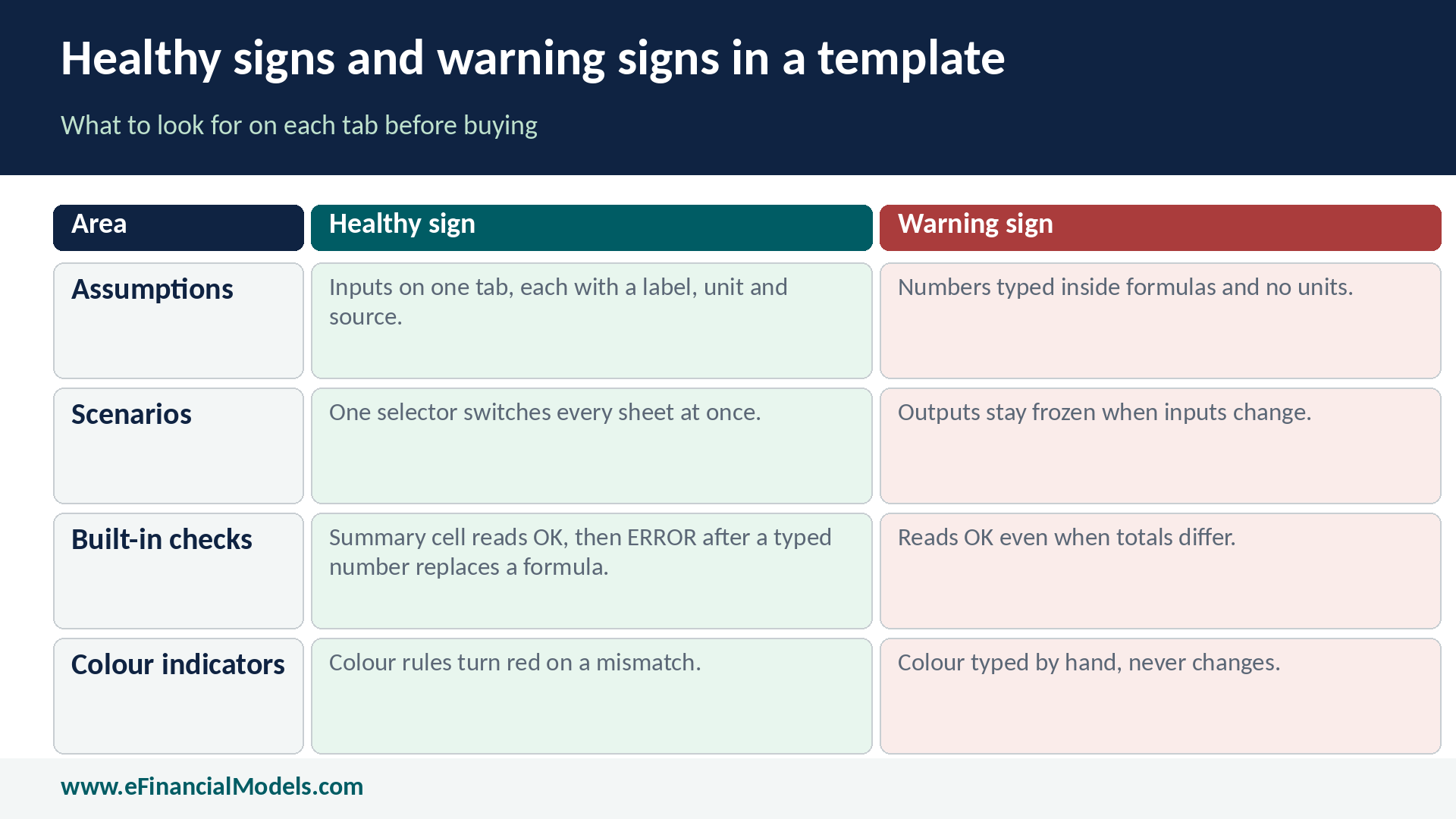
A side-by-side guide to what a sound template shows and what should make a buyer pause.
Which built-in checks should read OK before buying?
Built-in checks are small formulas that compare two numbers that must agree and show a flag when they do not. The most important one is the balance check, which compares total assets with total liabilities plus equity in every period. A template with no balance sheet should still tie its totals, for example cash movements to the closing cash balance. A good template also ties the closing cash on the cash flow statement to the cash on the balance sheet, and gathers all flags into one summary cell that reads OK when everything agrees.
When total assets and total liabilities plus equity differ in any period, the summary cell should read ERROR. A template that shows a difference on the balance sheet but still reads OK has a broken flag. Excel also helps with tracing: Microsoft notes that “you can use the Trace Precedents and Trace Dependents commands to graphically display and trace the relationships” between formulas and cells, in its guide to formula relationships.
What do conditional formatting indicators actually tell a buyer?
Conditional formatting, the spreadsheet feature that changes a cell’s colour when a rule is met, turns checks into visible signals: green for agreement, red for a mismatch. The indicators only help if they can fail. Two tests must be kept apart. A valid input change, such as a higher price, should leave every check green. A broken formula should turn a check red, so a buyer should overwrite one calculated cell, such as a balance sheet total, with a typed number and confirm the relevant cell changes colour and the summary flag follows.
| What the buyer sees | What it usually means | What to ask or do |
|---|---|---|
| Every check green, even after overwriting a calculated cell | The flag is a typed word, not a formula | Deal-breaker: reject the file or ask for the formula |
| A red cell that cannot be traced to a cause | The check works but the model has an unresolved error | Trace precedents, then put the question to the seller |
How do errors get past a careful buyer?
Errors get past buyers because spreadsheet mistakes are common and look like finished work. Phys.org reported in 2024 that “A recent study has found that 94% of spreadsheets used in business decision-making contain errors,” in its report on a spreadsheet quality study. Reliance on spreadsheets is also widespread: TechRadar Pro reported on 12 February 2025 that “Almost all (90%) organizations are still relying on outdated spreadsheets and similar forms for some of their most vital business data,” according to a study from AutoRek, in its article on spreadsheet reliance. Both figures describe spreadsheets in general, not purchased templates, so they support a general caution.
Professional bodies publish rules that a template can be tested against. The Institute of Chartered Accountants in England and Wales (ICAEW) published its Financial Modelling Code in 2024. It says to “Segregate inputs (assumptions), calculations and outputs (results), either by using separate worksheets, or demarcated sections on the same worksheet,” to follow the principle “Avoid using fixed values within formulas,” and to “Include an equality check for each set of values that are calculated separately but ought to be equal,” in its Financial Modelling Code.
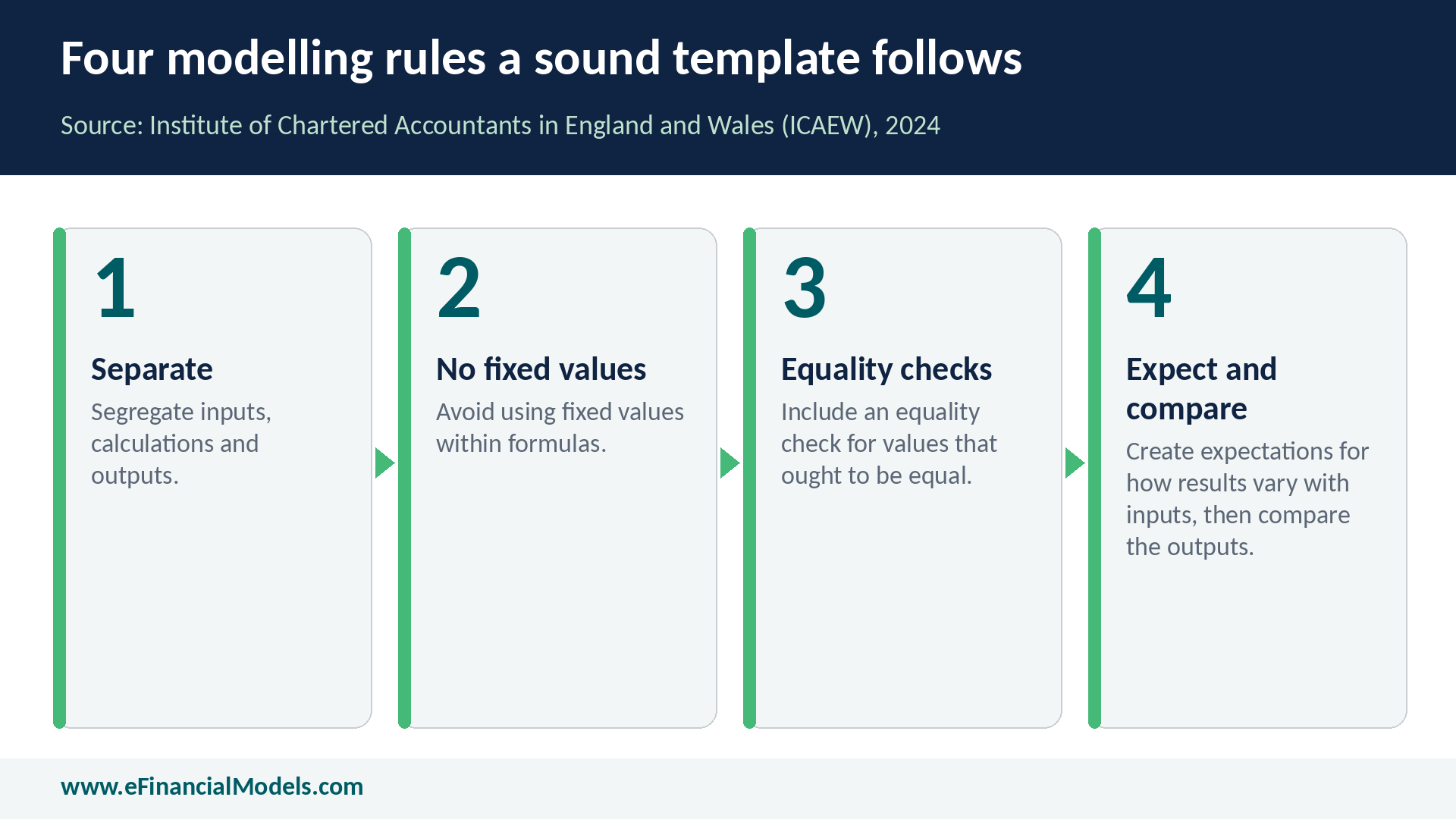
Four rules drawn from the 2024 ICAEW code, which a buyer can turn into quick tests of a template.
Independent review adds protection. The National Audit Office writes that “A lack of independent review increases the likelihood that a model is not fit for purpose or contains errors.”
What is the six-step routine for validating a template?
A fixed routine makes every candidate template comparable, and each step has a pass or fail result. Testing needs a demo copy, a preview or a refund window from the seller, and the Frequently Asked Questions section covers sellers who refuse. The whole routine takes roughly an hour for a small template, as a rough estimate rather than a measured figure.
- Find the assumptions tab and confirm every input has a label, a unit and a source.
- Search the formulas for typed numbers by selecting a few calculated cells and reading them.
- Change three inputs and confirm every statement and chart updates while every check stays green.
- Switch scenarios and confirm every sheet follows the selector.
- Overwrite one calculated total that a check compares, such as total assets, with a typed number that differs from the result, and confirm the checks turn red and the summary reads ERROR.
- Restore the formula, confirm the summary reads OK, and ask a second person to repeat steps 3 to 5.
Failing step 3 or step 5 is a deal-breaker, because the file either does not flex or cannot flag its own errors. A failure in the other steps is a question to put to the seller before buying.
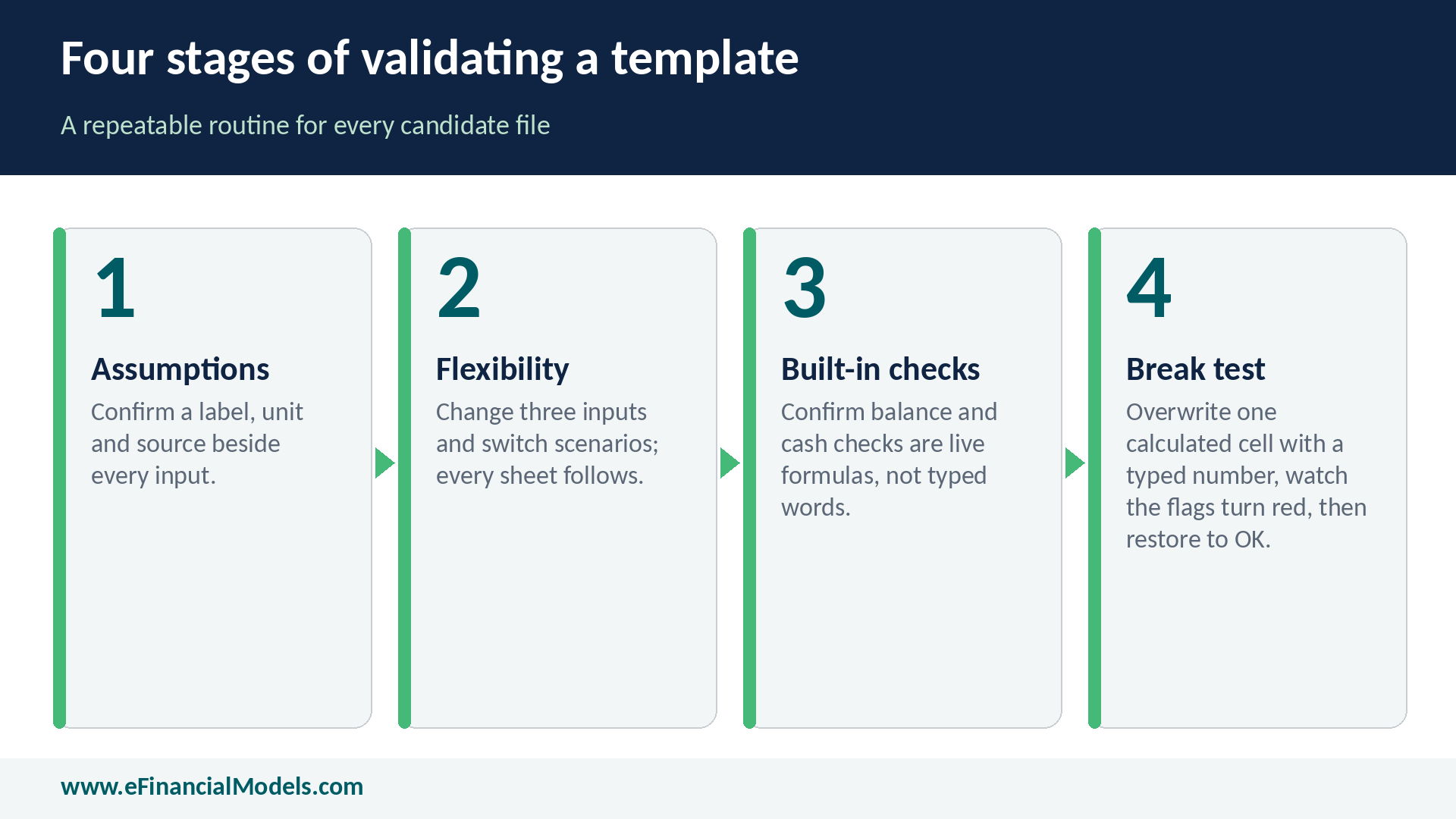
The routine grouped into four stages so each candidate template is judged the same way.
Conclusion
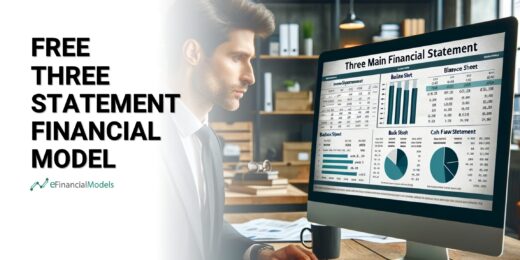
A template earns a purchase when it passes all six steps: inputs in one place, outputs that move, scenarios that switch the whole file and checks that fail when they should. Founders can run the routine on the Free Three Statement Financial Model from eFinancialModels, whose product page describes a design with “clearly labeled input areas and automated calculations.”
Frequently Asked Questions
How long does a proper template validation take?
A first pass takes roughly an hour for a founder who has never audited a model, and less once the routine is familiar. Most of that time goes on the break tests, because each one needs a change, a look at the result and a restore. If the seller offers a refund window, finish the routine inside it and note the date of each test, since such windows usually have a deadline.
What if the seller will not let a buyer test the file first?
A seller who refuses any preview leaves the buyer relying on screenshots and promises, which cannot show whether formulas are linked. Ask for a demo copy with the same structure but sample data, or for a recorded walkthrough in which the seller changes an input and flips a scenario live. If neither is offered, treat the missing evidence as the answer and choose a template whose behaviour can be seen.
Can an Excel template be fully trusted after it passes every check?
Passing checks lowers risk but never removes it, because a check only catches the mismatches it was written for. A template can balance in every period and still use a wrong tax rule or an unrealistic growth assumption. After the file passes, compare its outputs with a rough hand estimate and confirm the business assumptions are the founder’s own. An accountant or an experienced modeller can review the final numbers before they reach lenders or investors.
Do free templates need the same validation as paid ones?
Free templates need the same routine, because the price of a file says nothing about whether its balance check is a live formula. Run all six steps on a free file before sending its outputs to anyone, since a free template that fails costs time and can mislead decisions. A free file that passes is a fair starting point, and the same break tests show quickly whether it deserves that trust.