
0 ITEMS

Mobile Home Park Acquisition Underwriting Model (Excel)
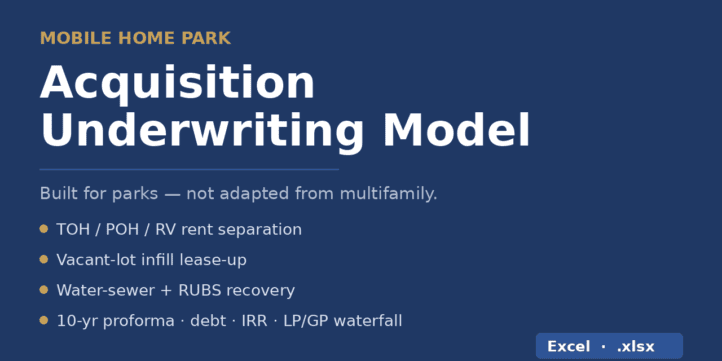
Underwrite a mobile home park deal in minutes: a model actually built for parks, not a multifamily template with the labels swapped. Most “MHP models” are apartment spreadsheets that can’t handle how parks actually make money. This one is built ground-up for lot-rent economics by a real operator. What’s inside • Separates tenant-owned-home (TOH) lot rent from park-owned homes (POH) and RV pads • Models vacant-lot infill lease-up: where forced appreciation actually comes from • Handles water/sewer + RUBS recovery, the expense line that drives park returns • 10-year pro forma → NOI, with realistic expense-ratio behavior for planning and refis • Full debt schedule: LTV sizing, interest-only period, amortization, DSCR • Levered & unlevered IRR, equity multiple, cash-on-cash, price/lot • LP/GP waterfall with preferred return and GP promote • Exit-cap sensitivity table and a one-page deal Dashboard How it works: change only the blue input cells on the Assumptions tab. Everything else calculates. Built in Excel (.xlsx), no macros, works in Excel and Google Sheets. Instant download. For financial analysis only; not investment, tax, or legal advice.


Mobile Home Park Acquisition & Underwriting Model (Excel)
What the template is used for
This is a deal-level underwriting model for acquiring an existing mobile home park or RV community. It takes a park’s rent roll, operating expenses, financing terms, and exit assumptions and projects a full 10-year pro forma, returns, and an equity split. It is built specifically for the economics of parks, where the operator typically rents the lot rather than the home, and is not a multifamily model reused for a different asset class.
Main features and highlights
The model separates income by type — tenant-owned-home (TOH) lot rent, park-owned homes (POH), and RV pads — because each carries different margins and expenses. It includes a vacant-lot infill module that phases in occupancy over time, a water and sewer expense line with an adjustable RUBS utility-recovery input, and configurable operating expenses with a separate growth rate. The financing section sizes an acquisition loan by loan-to-value and models an interest-only period, amortization, and annual DSCR. Returns include levered and unlevered IRR, equity multiple, cash-on-cash, going-in and exit cap rates, and price per lot. A single-hurdle LP/GP waterfall applies a preferred return and a GP promote. The workbook also contains an exit-cap sensitivity table and a one-page summary dashboard. It is built across seven tabs with roughly 550 live formulas and no macros.
How to best work with this template
All inputs live on a single Assumptions tab, where editable cells are colored blue. You change only those cells; every other value is calculated and updates automatically. Results are read on the Dashboard tab. The file works in both Microsoft Excel and Google Sheets. Defaults are in USD and are fully editable.
Why you need this template
Underwriting a park on a generic real estate model misprices the deal, because it cannot represent lot-versus-home rent, infill lease-up, or utility recovery. This template lets an individual investor, syndicator, or small fund size a park acquisition, its debt, and its investor returns quickly and consistently, using assumptions built around how parks actually operate.
This model is provided as a financial analysis tool and does not constitute investment, tax, or legal advice. All assumptions and outputs should be independently verified before making any investment decision.
Similar ProductsOther customers were also interested in...



 eFinancialModels
Electric Vehicle (EV) Charging Station Financial M...
With this comprehensive 5- or 10-year monthly tool, investors can assess the viability of setting up... Read more

Financial Model for Mobile App | Mobile App Busine...
The Mobile App Financial Plan Template in Excel allows you to develop financial projections when lau... Read more

 HenrySheykin
Food Truck Financial Model Excel Template
The Food Truck Financial Model helps entrepreneurs, founders, business owners, consultants, and anal... Read more

Green Hydrogen Production from Wind Energy Financi...
The Green Hydrogen from Wind Financial Model aims to comprehensively forecast a horizon of 40 years ... Read more

Simple Mutual Non-Disclosure Agreement Template
Protect your business secrets with ease using our Simple Mutual Non-Disclosure Agreement Template. S... Read more

Solar Energy Financial Model
The Solar Energy Financial Model Spreadsheet Template in Excel assists you in preparing a sophistica... Read more

 Peter Graf
The Customer-Centric Financial Model for Restauran...
Starting a restaurant without a financial plan is like driving a car blindfolded. You wouldn´t do i... Read more
You must log in to submit a review.