
0 ITEMS

AI / LLM Company Valuation Financial Model – GPU Compute Amortization, Token Unit Economics, Revenue Mix, Inference Margins & Benchmark Multiples
🔥 Premium AI / LLM Company Valuation Financial Model A professional financial model built for AI startups, LLM companies, foundation model businesses, AI SaaS platforms, API-first AI companies, enterprise AI providers, investors, venture funds, corporate development teams, consultants and strategic finance professionals. This model helps forecast and value AI / LLM companies using sector-specific drivers that traditional SaaS and DCF templates usually do not capture. Key modules include: ✅ GPU / compute cost amortization schedules ✅ A100, H100 and next-gen GPU cost modeling ✅ Token-level unit economics ✅ Cost per million tokens vs. revenue per million tokens ✅ API vs. SaaS vs. Enterprise revenue blending ✅ Model training CapEx capitalization vs. expensing treatment ✅ Foundation model training cost schedule ✅ Inference margin compression curve ✅ Retention-adjusted ARR for AI-assisted churn modeling ✅ Benchmark-linked valuation multiples ✅ MMLU, HELM and performance-score valuation inputs ✅ Scenario analysis, sensitivity testing, dashboards and audit checks 📊 Built for AI companies where ordinary SaaS models fail because compute cost, inference economics, training CapEx, token volume and model performance drive the real valuation story.
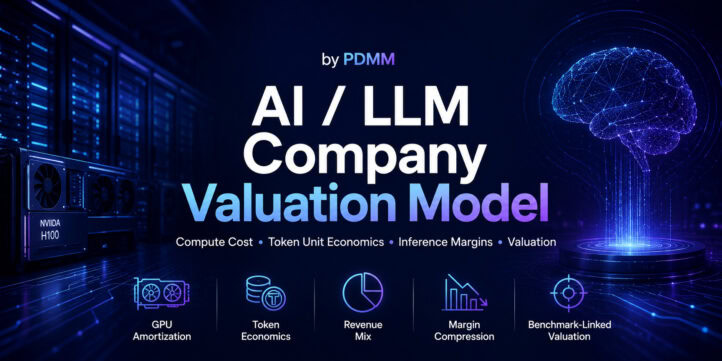


🔥 AI / LLM Company Valuation Financial Model
This premium financial model is built for one of the most important and difficult sectors to model accurately: AI / LLM companies.
Traditional SaaS models are often not enough for AI companies.
Why?
Because AI companies are driven by different economics:
- 🧠 Foundation model training costs
- 💻 GPU and compute infrastructure
- ⚙️ Token-level usage economics
- 📊 API, SaaS and enterprise revenue blending
- 💰 Inference margin compression
- 🧾 Training CapEx capitalization vs. expensing
- 📉 Retention and churn affected by AI usage behavior
- 🎯 Benchmark-linked valuation multiples
- 📈 Model performance and monetization efficiency
This workbook brings those AI-specific economics into one structured, editable and decision-ready valuation model.
What This Model Is Used For
This model helps users forecast, analyze and value AI / LLM companies with more precision than a generic SaaS template.
It can be used for:
✅ AI startup valuation
✅ LLM company financial planning
✅ Foundation model company forecasting
✅ AI SaaS revenue modeling
✅ API usage-based revenue forecasting
✅ Enterprise AI contract planning
✅ GPU and compute cost budgeting
✅ Token-level gross margin analysis
✅ Training CapEx treatment analysis
✅ Inference margin compression review
✅ Retention-adjusted ARR modeling
✅ Investor fundraising support
✅ M&A and corporate development analysis
✅ Scenario and sensitivity analysis
This model is especially useful when valuation depends on compute intensity, token economics, model training investment, usage-based pricing and AI benchmark performance.
Key Model Modules
💻 1. GPU / Compute Cost Amortization
AI companies often spend heavily on compute infrastructure.
This model includes GPU and compute cost amortization schedules for:
- A100 GPUs
- H100 GPUs
- Next-generation GPUs
- Cloud compute cost
- Owned compute infrastructure
- Useful life assumptions
- Depreciation / amortization schedule
- Compute cost allocation over time
This helps users understand how compute investment affects gross margin, operating profit and valuation.
🧮 2. Token-Level Unit Economics
The workbook includes token-level economics for LLM usage.
It helps users analyze:
✅ Cost per million input tokens
✅ Cost per million output tokens
✅ Revenue per million tokens
✅ Gross margin per token
✅ API usage volume
✅ Token consumption growth
✅ Model efficiency improvement
✅ Token-level profitability
This is critical because AI companies may show strong revenue growth but weak margins if inference cost remains high.
🔁 3. API vs. SaaS vs. Enterprise Revenue Blending
AI companies often monetize through multiple revenue models at the same time.
This model includes revenue blending across:
- API usage revenue
- SaaS subscriptions
- Enterprise contracts
- Custom AI deployments
- Usage-based pricing
- Contracted ARR
- Revenue mix by customer type
This helps users understand whether growth is driven by scalable recurring revenue, usage-based demand or large enterprise contracts.
🏗️ 4. Model Training CapEx Capitalization vs. Expensing
Foundation model training cost can be treated differently depending on accounting policy and business context.
This workbook includes a treatment comparison for:
✅ Capitalized training costs
✅ Expensed training costs
✅ Amortization schedule
✅ Impact on EBITDA
✅ Impact on cash flow
✅ Impact on valuation metrics
✅ Training cost recovery analysis
This helps users understand how model training investment affects reported profitability and valuation outcomes.
📉 5. Inference Margin Compression Curve
AI inference margins can compress as competition increases, pricing declines or customers demand lower cost per token.
The model includes an inference margin compression curve to analyze:
- Inference cost trends
- Pricing pressure
- Token cost reduction
- Model efficiency improvements
- Gross margin compression
- Lifecycle margin trend
- Product maturity impact
This is especially important because AI products may begin with premium pricing but face margin pressure as the market becomes more competitive.
📊 6. Retention-Adjusted ARR
The workbook includes retention-adjusted ARR modeling for AI-assisted churn dynamics.
It helps users review:
✅ Starting ARR
✅ New ARR
✅ Expansion ARR
✅ Churned ARR
✅ Retention rate
✅ AI usage engagement
✅ AI-assisted churn improvement
✅ Net revenue retention
✅ ARR quality
This is useful because AI adoption can improve retention for some products but may also create usage volatility where customers reduce spend after experimentation.
🎯 7. Benchmark-Linked Valuation Multiples
The model includes a valuation logic layer that connects model performance benchmarks with valuation multiple assumptions.
Users can model valuation multiple adjustments using inputs such as:
- MMLU-style benchmark score
- HELM-style benchmark score
- Relative model performance
- Product capability score
- Enterprise adoption score
- Benchmark-linked premium or discount
- Revenue multiple adjustment
This helps reflect that AI company valuation may depend not only on revenue, but also on model quality, defensibility, performance and commercial usefulness.
Dashboards and Outputs
📊 The workbook includes professional dashboards and decision-ready outputs.
Key outputs include:
✅ Cover
✅ Index
✅ How To Use
✅ Control Panel
✅ GPU Compute Schedule
✅ Compute Cost Amortization
✅ Token Unit Economics
✅ API Revenue Forecast
✅ SaaS Revenue Forecast
✅ Enterprise Revenue Forecast
✅ Revenue Mix Analysis
✅ Model Training CapEx
✅ CapEx vs. Expensing Treatment
✅ Inference Margin Compression
✅ Retention-Adjusted ARR
✅ AI Churn Modeling
✅ Benchmark-Linked Multiples
✅ Valuation Summary
✅ DCF Valuation
✅ Revenue Multiple Valuation
✅ Scenario Summary
✅ Sensitivity Analysis
✅ KPI Dashboard
✅ Executive Dashboard
✅ Audit Checks
✅ Disclaimer
✅ Glossary
How to Use the Model
1️⃣ Start with the Control Panel
Update assumptions for compute cost, GPU type, token volume, revenue streams, training cost, margins, retention and valuation multiples.
2️⃣ Review GPU / Compute Costs
Analyze how A100, H100 and next-gen GPU costs affect amortization, gross margin and cash flow.
3️⃣ Analyze Token Economics
Review cost per million tokens, revenue per million tokens and token-level profitability.
4️⃣ Review Revenue Mix
Compare API, SaaS and enterprise revenue streams.
5️⃣ Check Training Cost Treatment
Analyze the impact of capitalizing or expensing model training costs.
6️⃣ Review Inference Margins
Stress-test margin compression across the product lifecycle.
7️⃣ Analyze ARR Quality
Review retention-adjusted ARR and AI-assisted churn assumptions.
8️⃣ Review Valuation Outputs
Use DCF, revenue multiples and benchmark-linked multiple scenarios.
9️⃣ Check Dashboards and Audit
Review KPIs, scenario outputs, sensitivities and integrity checks.
Who Should Buy This Model
This model is ideal for:
✅ AI startups
✅ LLM companies
✅ Foundation model companies
✅ AI SaaS businesses
✅ API-first AI companies
✅ Enterprise AI platforms
✅ AI infrastructure companies
✅ Venture capital investors
✅ Private equity analysts
✅ Corporate development teams
✅ M&A advisors
✅ Strategic finance teams
✅ Consultants and analysts
✅ Founders preparing fundraising materials
✅ CFOs and finance teams
Why This Model Is Valuable
Most AI company forecasts are built using ordinary SaaS templates.
That creates a problem because AI companies have different economics.
This model includes the AI-specific drivers that usually get missed:
💻 GPU amortization
🧮 Token-level unit economics
🔁 API / SaaS / enterprise revenue blending
🏗️ Training CapEx treatment
📉 Inference margin compression
📊 Retention-adjusted ARR
🎯 Benchmark-linked valuation multiples
This makes the model useful for serious AI company valuation, investor review, fundraising preparation and strategic planning.
It helps answer practical questions such as:
- How much does compute cost reduce gross margin?
- What is the true cost per million tokens?
- Which revenue stream drives better economics?
- Should model training cost be capitalized or expensed?
- How much margin compression can the company absorb?
- What is retention-adjusted ARR after AI usage dynamics?
- How do model benchmarks affect valuation assumptions?
- What valuation is implied under different scenarios?
Similar ProductsOther customers were also interested in...



 eFinancialModels
Electric Vehicle (EV) Charging Station Financial M...
With this comprehensive 5- or 10-year monthly tool, investors can assess the viability of setting up... Read more

Financial Model for Mobile App | Mobile App Busine...
The Mobile App Financial Plan Template in Excel allows you to develop financial projections when lau... Read more

 HenrySheykin
Food Truck Financial Model Excel Template
The Food Truck Financial Model helps entrepreneurs, founders, business owners, consultants, and anal... Read more

Green Hydrogen Production from Wind Energy Financi...
The Green Hydrogen from Wind Financial Model aims to comprehensively forecast a horizon of 40 years ... Read more

Simple Mutual Non-Disclosure Agreement Template
Protect your business secrets with ease using our Simple Mutual Non-Disclosure Agreement Template. S... Read more

Solar Energy Financial Model
The Solar Energy Financial Model Spreadsheet Template in Excel assists you in preparing a sophistica... Read more

 Peter Graf
The Customer-Centric Financial Model for Restauran...
Starting a restaurant without a financial plan is like driving a car blindfolded. You wouldn´t do i... Read more
You must log in to submit a review.