
0 ITEMS

Mining Company NAV Valuation Model (Multi-Asset Sum-of-Parts DCF)
Value a mining company the way the market does – asset by asset. Model up to three mines with life-of-mine production schedules, AISC cost structures, multi-commodity revenue (gold, silver, copper, and 10+ others via dropdown), royalty terms, and reclamation costs over a 20-year horizon. Consolidates to a per-share NAV with P/NAV multiples, full sensitivity analysis on commodity prices, AISC, and discount rates, plus a scenario calculator that works in any spreadsheet app. Pre-populated with a worked gold mine example.
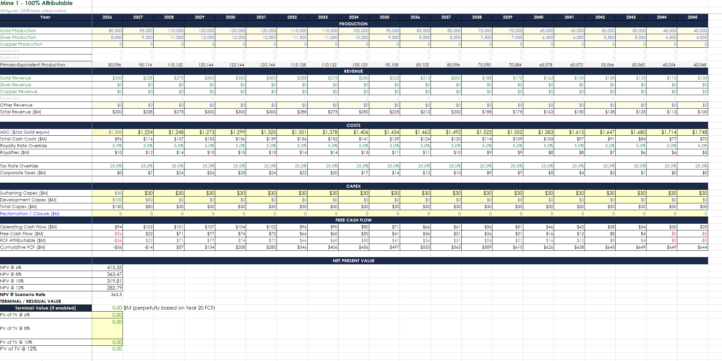


Mining equities trade on NAV. Not earnings multiples, not EV/EBITDA — NAV. Every serious mining analyst values a company by summing its individual mine-level DCFs, adjusting for ownership stakes, and comparing the result to the market cap. This template gives you that exact framework.
Three mine tabs are included, each running a 20-year life-of-mine forecast. The pre-populated example covers a gold mine with silver by-product credits, but the model supports any commodity — gold, silver, copper, zinc, iron ore, lithium, nickel, coal, platinum, palladium, uranium, and more, all selectable via dropdown. Each tab models ore mined, head grade, recovery rate, primary-equivalent production, revenue by metal, AISC per ounce (entered as a base-year figure and escalated at the global cost inflation rate to reflect real-world rising mining costs), sustaining and expansion capital, royalties with a gross/net smelter toggle, corporate tax, and reclamation and closure costs. The output is an after-tax free cash flow stream discounted to a present value at four standard discount rates.
The model handles FX automatically. If a mine’s operating costs are in a different currency from revenue, set the Cost FX Factor on the Assumptions tab and it converts everything consistently. Revenue remains in USD throughout.
The Assumptions tab centralises commodity prices with three configurable scenarios, discount rates, tax and royalty defaults, ownership stakes by mine, terminal value settings, and cost inflation. Change a gold price here and it flows through every mine tab and the consolidated NAV instantly.
The Consolidated tab sums mine-level NPVs (adjusted for attributable ownership), deducts net debt, and produces an equity NAV per share alongside the P/NAV multiple and implied premium or discount to the current share price. It also summarises life-of-mine attributable production by commodity.
The Sensitivity tab is where the model really earns its keep. You get NAV per share sensitivity to gold price (full DCF recalculation, not a shortcut), NAV sensitivity to AISC (as a multiplier on base costs), a two-way table crossing gold price against discount rate, and a scenario calculator that lets you punch in any commodity price and see the resulting mine-level and total NPV — and it works in any spreadsheet app, no Excel DATA TABLE functions required.
The Dashboard provides an executive summary: equity value, NAV per share, P/NAV, implied upside, per-asset NPV breakdown, and current commodity price inputs.
Nine worksheets. 1,350+ formulas. No circular references, no macros. Works in Excel 2016+ and Google Sheets. Built for mining equity analysts, resource-focused fund managers, and investment banking teams who need an auditable NAV model they can adapt to any multi-asset mining company.
Similar ProductsOther customers were also interested in...



 eFinancialModels
Electric Vehicle (EV) Charging Station Financial M...
With this comprehensive 5- or 10-year monthly tool, investors can assess the viability of setting up... Read more

Financial Model for Mobile App | Mobile App Busine...
The Mobile App Financial Plan Template in Excel allows you to develop financial projections when lau... Read more

 HenrySheykin
Food Truck Financial Model Excel Template
The Food Truck Financial Model helps entrepreneurs, founders, business owners, consultants, and anal... Read more

Green Hydrogen Production from Wind Energy Financi...
The Green Hydrogen from Wind Financial Model aims to comprehensively forecast a horizon of 40 years ... Read more

Simple Mutual Non-Disclosure Agreement Template
Protect your business secrets with ease using our Simple Mutual Non-Disclosure Agreement Template. S... Read more

Solar Energy Financial Model
The Solar Energy Financial Model Spreadsheet Template in Excel assists you in preparing a sophistica... Read more

 Peter Graf
The Customer-Centric Financial Model for Restauran...
Starting a restaurant without a financial plan is like driving a car blindfolded. You wouldn´t do i... Read more
You must log in to submit a review.