
0 ITEMS

How to Prepare a Financial Plan for a Chicken Egg Farm?

Starting a chicken egg farm involves careful financial planning and understanding key operational factors.
- The demand for eggs is strong, with eggs being the second-highest consumed protein in the US and global production steadily increasing.
- Setting up a viable farm requires analyzing initial investments, costs, and projected sales to ensure profitability.
- Production volumes depend on breed choices, growth stages, and managing mortality rates and space requirements.
- Accurate forecasting of egg prices and packaging options helps optimize profit margins.
- A well-prepared financial plan covers budgets for equipment, feed, labor, and inventory management.
Continue reading to grasp essential strategies for building a profitable poultry egg business.
11 Key Points when Analyzing a Financial Plan for a Chicken Egg Farm
There is a lot to consider on how to set up a chicken egg farm, including the initial investment, sources of funds, projecting sales, identifying costs, doing financial analysis, preparing financial metrics, and other critical factors to establish that your proposed poultry egg farm is viable.
Let us discuss the components in preparing a financial plan for your poultry farm egg business.
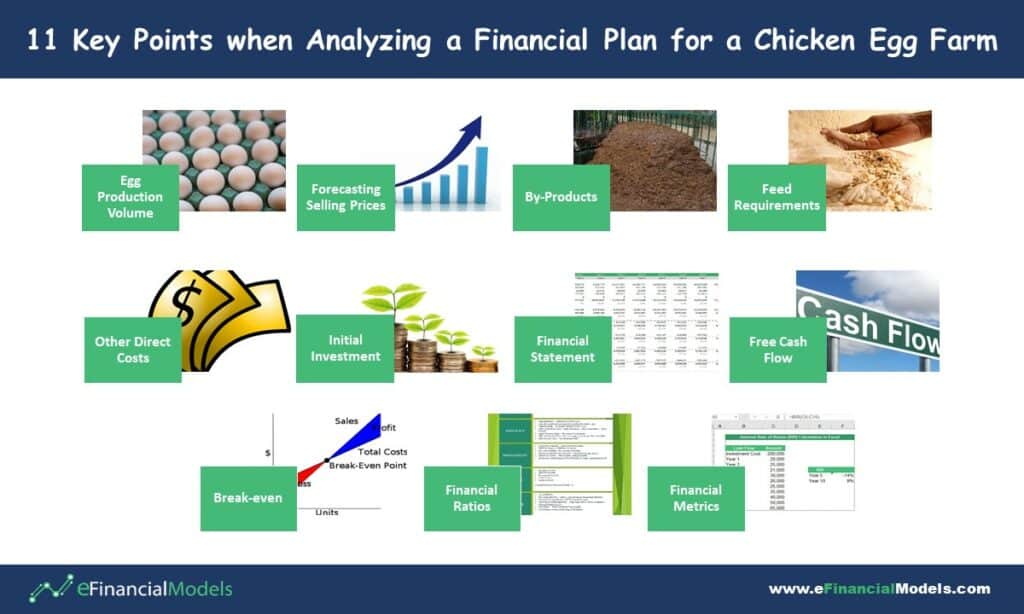
- Egg Production Volumes
- Forecasting Selling Prices
- By-Products
- Feed Requirements
- Other Direct Costs
- Initial Investment
- Financial Statement Forecast
- Free Cash Flow Calculation
- Break-even Analysis
- Financial Ratios
- Financial Profitability Metrics
How to Project the Production Volumes of your Chicken Egg Farm?
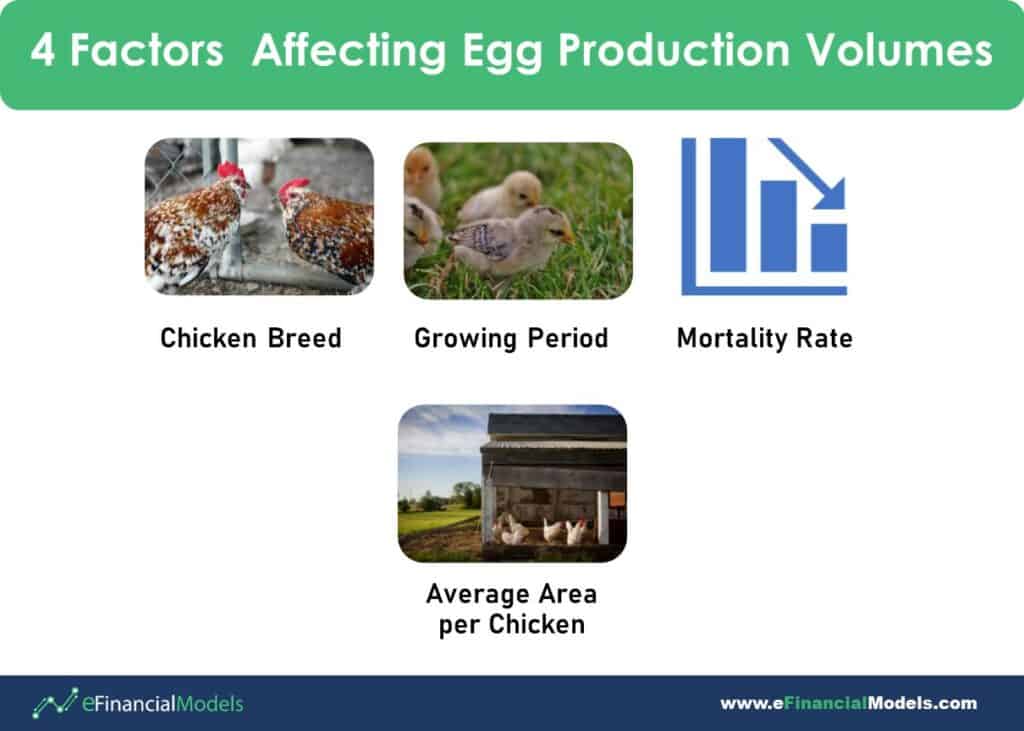
To compute the egg annual production volume, you must consider the chicken breed and its growing period. Different chicken breeds differ in the average eggs produced, sizes of eggs, and productive period.
Other critical factors are the mortality rate and the average area per hen. The mortality rate considered is during the growth of hens from the day-old chick until they are ready to lay eggs. During egg production, there is also some percentage of cracked eggs. Additionally, if the hens are stressed in a small space, they will be less productive.
a. What Chicken Breed Do You Want to Raise?
Some breeds suitable for egg production are Hybrid, Rhode Island Red, Leghorn, Sussex, Plymouth Rock, and Ancona.
Hybrid
There are a variety of hybrid breeds for egg production, such as the Golden Comet. This breed lays many eggs while consuming lesser feeds, giving a high conversion ratio. Hybrid, in general, can produce around 280 eggs per year in a medium-sized and brown color. Hybrid chickens are tough and resilient, making them a good breed for egg production.
Rhode Island Red
Rhode Island Red is a dual-purpose chicken as it can be raised for meat and egg production. They produce around 250 eggs per year of brown and medium-sized eggs. Rhode Island Red can look after themselves and are known to be tough. They have friendly nature, which makes chicken farmers raise this breed.
Leghorn
Leghorns lay around 250 eggs per year in medium-sized, white color. Many farmers choose this breed for egg production. However, if you are a new chicken grower, be aware that Leghorn is shy and hard to tame.
Sussex
Sussex can also be raised both for meat and e0gg production. This breed is capable of producing 250 eggs per year. Egg colors vary from creamy-white to brown. Sussex is a domestic breed, and you won’t have a problem raising it.
Plymouth Rock
Plymouth Rock approximately lays around 200 eggs per year. Egg size ranges from small to medium in a light brown color. However, this breed is more suited for free-range growing.
Ancona
Ancona lays around 200 eggs in a year in a small white egg. Beware, though, Ancona is notorious for flying out of chicken pens.
b. How long does it take to grow from day-old chick to layer hens?
You have to raise the hens until they are ready to produce eggs. Week 1 to 6 is the brooding period when the chicks need the most care. Week 7 to 20 is the growing period and preparation stage. The egg production period starts at Week 21, with around 10% of the hens producing eggs. The production period may vary; it can be shorter or longer depending on the chicken breed. The hens grow until the 40th week, affecting the eggs’ size. The eggs will reach the peak size at the full growth of the hens.
It is crucial to identify the stages of the growing period since it affects costs for feeds, electricity, and sales for egg production. Identifying them will help you accurately projects costs and revenues.
c. Consider Mortality Rate for Chicken Egg Production
When dealing with live animals, you should always account for the mortality rate. Mortality for hen raising is around 5% and 3% for the cracked eggs.
Factors such as the travel time upon purchasing the day-old chick, the average area per chick during growing, and proper care and management will affect the mortality rate of the hens and the eggs they produce. Ensure that the hens are appropriately cared for to increase their survival rate and productivity.
Taking the mortality rate into account will help you project the number of day-old chicks needed to purchase to have the desired number of layer hens and eggs production volume.
d. Allocate Enough Area per Chicken
Ensure that there are enough are per hen, so they are comfortable enough. At least 1.5 sq ft is allotted for indoor space and 20 sq ft for roaming around outdoor per hen. Having enough space will lead to more productive hens.
e. Modeling Production Volumes for Poultry Eggs
Now, considering all the factors above, the challenge in preparing a financial forecast for a chicken farm is to prepare a dynamic model where the targeted egg production volumes drive the required volumes for day-old chicks back to eggs and the required parent breeders.
This forecast then needs to be integrated so that it also increases the required feed volumes. What you want is a forecast which dynamically increases or decreases the whole volumes along the supply chain of a chicken farm.
Keep in mind if you want to produce 1000 eggs per day, you need to plan how many chickens you need to grow to produce those eggs many weeks back.
Chicken egg farming requires planning!
Forecasting Chicken Egg Selling Prices
When selling eggs, the sizes and the packaging of the eggs determine the average selling prices. Sizes may range from small to extra-large eggs, while the packaging may be as a single egg or in trays of 6, 12, and 30 eggs. So what you need is a financial model that allows you to accurately forecast the mix of packaging you are going to apply to figure out the average egg selling price.
Sizes Differ per Chicken Breed
There are chicken breeds that produce small eggs, while other breeds can produce up to extra-large. Market preference will also play a role in the egg sizes you want to produce.
Eggs can be Sold in Various Packaging
A single egg is higher in price than per tray if computed by piece. And it is better to have assorted packaging to cater to different income classes. Keep in mind that packaging will also impact the costs of transporting, moving, and selling the eggs. So chicken egg farming requires a lot of experience and steady cost recalculation to ensure that the operation runs at a profit.
By-Products Produced from the Chicken Egg Layer Farm
When operating a poultry farm egg business, by-products are produced, such as chicken manure and feathers. Chicken manure can be further processed into compost or as is. If your business can also invest in biogas, the better since you will have your source of electricity on the farm.
You can earn additional income from the by-products instead of just disposing of them, which may even cause harm if not done correctly.
Feed Requirement for Various Ages of Chickens
The feed consumption will vary according to the bird’s age. The average chick starter consumption is 0.05 lb/day during the first six weeks. Feeds needed per pullet is 0.20 lb/day during the growing stage. The layer hen and breeder can consume 0.25 lb/day.
You have to project how many breeders and layer hens you will grow and compute the needed feed consumption during their lifetime.
You also need to consider the costs for nutrients and vaccines to ensure that layer hens and breeders are in their best condition.
Identifying the feed conversion ratio to eggs will help you identify how many feeds you need to produce the desired chicken eggs production volumes. You can better project the feed requirement using a financial model to link the number of chickens based on their feed consumption per day, growing stage, and productive life.

What are the Direct Costs for Producing Chicken Eggs?
Direct costs include the purchase of day-old chick and breeder, direct labor, and electricity usage.
Purchase of Day-old Chick and Breeder
You have to buy day-old chicks or pullets to be raised as layer hens at the start of the operation. Also, you need to acquire breeders to have a stable supply of the layer hens and ensure they are the best breed and in condition for raising.
Direct Labor for the Operation
Laborers perform the day-to-day activities on the farm. The larger the farm, the more workers are needed to ensure proper care to the layer hens and breeders and collect the eggs.
Electricity Usage in the Poultry Farm
Electricity consumption is crucial to account since it constitutes a significant amount. During the growing period of chicks and pullets, electricity is needed to produce warmth for the chickens. Artificial light is required once they reach the production stage, especially during winter when daylight is short. The artificial light will provide additional time for production. Usually, it takes 14-16 hours a day for the layer hens to be at their full productivity.
How Much Investment is Needed to Start a Chicken Egg Farm?
In every business venture, it is essential to compute first the investment needed to ensure that you have enough funds to start the project. In Chicken Egg Farming, we can expect investment for Capital Expenditure (CAPEX), Operating Expenses (OPEX), and Net Working Capital (NWC).
What are the components of your CAPEX?
CAPEX includes the following investment:
- Land and Outdoor Areas
- Poultry Houses
- Equipment such as for collecting / storing eggs
- Vehicles for Delivery and Operations
Healthy chickens need outdoor space. It also avoids diseases and treats chickens in the way they deserve to live apart from complying with the local laws for chicken production. In some countries, you can also obtain a quality label when chickens are granted outdoor time every day, allowing you to sell your chicken eggs under a certificate or green label.
The most significant investment for a chicken egg farm is building poultry houses – for growing, layering, and breeding. The poultry houses can be a conventional type made of light materials such as wood and bamboo. There are also poultry houses with more advanced technology like climate-control systems, which will need a significant investment than the conventional type.
You should also invest in equipment that will make the collecting and storing of eggs more efficient.
Lastly, vehicles such as tractors and trucks might be needed to run the operations daily, distribute feeds, and assist with collecting and delivering eggs.
You Should Have Enough Budget for Operating Expenses to Operate the Chicken Egg Farm Smoothly
It takes time before you will start earning from a poultry farm egg business. That is why you should accurately project the needed budget when no cash is going in during the growing period.
Operating expenses include indirect labor, maintenance & repair, quality & certifications, biosecurity, fuel, rent (if applicable), and other related expenses.
Net Working Capital – Do not underestimate the Capital Requirements for Inventory, Receivables, Payables and Short-term Debt in Chicken Farming
Enough inventory for feed should be stored, especially if your poultry farm is quite distant from the suppliers. It may amount to two weeks or one month feeds inventory.
You also have to account for eggs inventory. Ensure that only enough eggs are in inventory and dispose of them accordingly. The freshness of eggs will decline the longer you let them stay in stock. Have proper monitoring of your inventory and regular coordination with your buyers to ensure that their orders are delivered on time.
Another working capital you have to account for is the accounts receivables. Depending on your agreement with buyers, you can get paid in cash, or it may take weeks or months before you will get paid. It is crucial to account for account receivables turnover since it will affect the timing of your cash inflow and the available resources you can utilize for the day-to-day operation.
Other essential components of net working capital are payables and short-term debts. You might have payables to suppliers for feeds, nutrients, and vaccines. Then debts that might be due within a year. Knowing when your payables will be due helps you better project cash available and ensure that short-term liabilities are paid on time.
You can choose from the Poultry Farming Financial Model Templates below to help your financial planning.








Preparing the Financial Statements of a Chicken Egg Farm
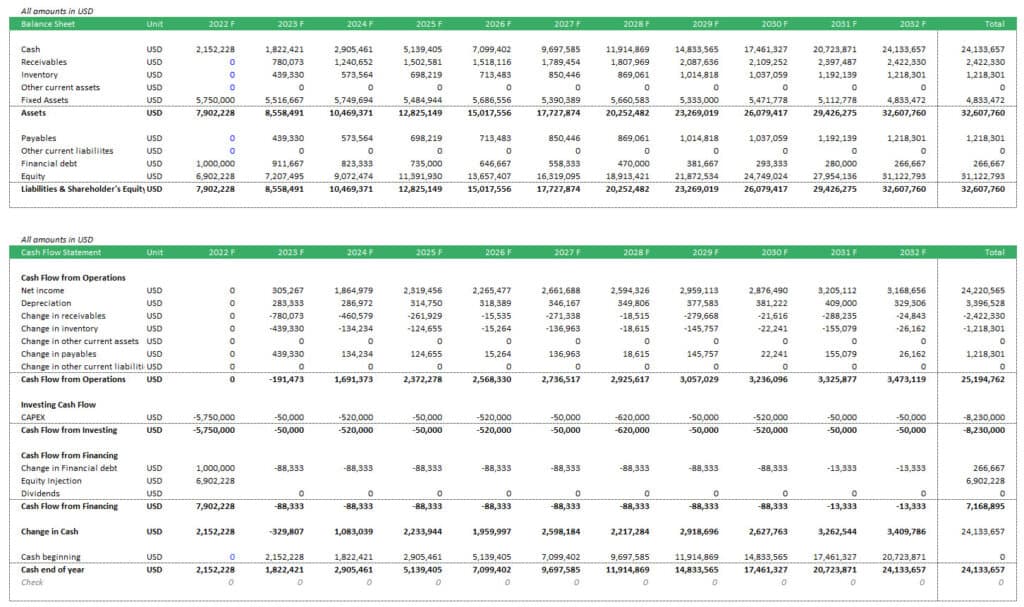
The three financial statements (income statement, balance sheet, and cash flow statements) reflect your business’s different financial aspects.
You can evaluate the sources of revenues and all the costs and expenses through the income statement. By computing the Gross Profit, EBITDA, and Net Income, you can evaluate whether your direct costs, operating expenses, interest expense, amortization, and depreciation are within the allotted budget.
In the example below, revenues are from various sources aside from egg sales as the primary source. Other revenue sources include bird sales, day-old chick sales, and organic by-products (manures, feathers, etc.).
Direct costs are mainly impacted by feed consumption, direct labor, and electricity usage.
At the bottom of the table is the net income, which shows the accounting profit of your chicken egg farm.

You can assess the status of your net working capital through the balance sheet. It shows what composes your assets if it is a healthy combination of cash, receivables, inventory, fixed assets.
The balance sheet also helps you assess how leveraged your business is – if the business is financed more by equity or debt. You will probably need outside financing to acquire the land and build the poultry houses when starting.
The cash flow projection is crucial to evaluate if you have enough cash to finance the day-to-day operation, especially during the early stage of operation. For any agri-venture, you must consider the cropping cycle, which starts from raising the day-old chick until you have enough cash sales to finance the operation internally.
Free Cash Flow Calculation
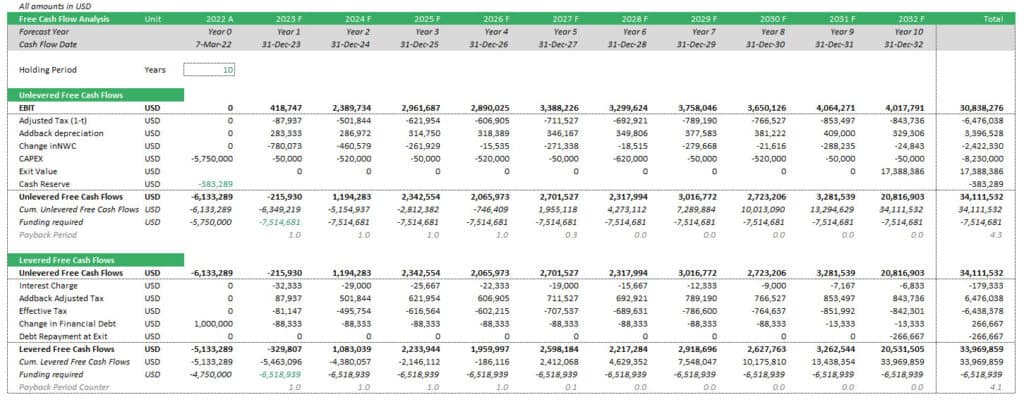
It is helpful to compute both levered and unlevered cash flow to compare the effect of financing on your free cash flow. The unlevered cash flow does not account for the change in financial debt, making it higher than the levered free cash flow. Unlevered free cash flow is available to debt holders and investors.
On the other hand, levered cash flow already accounts for the financial debt, which means the remaining amount is available for distribution as dividends to investors or business expansion. Take a look at the sample free cash flow analysis below for your reference.
Determine the Break-even Point of your Chicken Egg Production
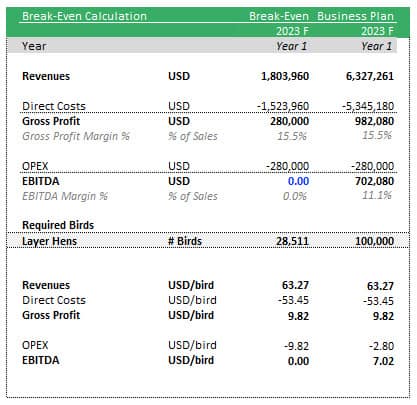
Computing the break-even is necessary to identify the volumes and revenues when you will break even. This is the point when profit is zero.
In the example break-even in the right, break-even revenue is $1,803,960 compared to the $6,327,261 projected revenue. Also, the projected EBITDA is $702,080, which means you are already gaining profit.
After reaching break-even, you will start earning profit.
Financial Ratios of Relevance to Chicken Farmers
Financial ratios are scrutinized by banks to assess the viability of your project. The two types of financial ratios mostly assessed for fundraising are leverage/bank ratios and profitability ratios.
Bank ratios include Financial Debt/EBITDA, Debt Service Coverage, and EBIT/Interest.
Financial Debt/EBITDA – it is computed by dividing interest-bearing debt divided by EBITDA (the Earnings before Interest, Tax, Depreciation, and Amortization). Financial Debt/EBITDA determines the available EBITDA to pay for the financial debt.
Debt Service Coverage Ratio (DSCR) – DSCR is derived by dividing free cash flow to the firm by debt repayment + interest. It shows the capability of the business to pay debts from its available free cash flow.
EBIT/Interest – this bank ratio assesses how much available Earnings before Interest and Taxes (EBIT) is to pay for interest expenses.
Profitability ratios include EBITDA margin, EBIT margin, Return on Invested Capital, Return on Equity, and Revenues/Assets.
EBITDA Margin – this is derived by dividing the EBITDA over net sales. EBITDA margin should be higher than 10% or the cost of capital to cover all the risks and capital requirements.
Return on Equity (ROE) – to compute for ROE, divide the net income over the average shareholder’s equity. In the example below, ROE is 4.3% in 2023 then 22.9% in 2024, which means that the business is properly utilizing its equity to increase income.
Revenues/Assets – this profitability ratio determines how much revenue is earned by utilizing its available assets. A ratio of 0.7x in 2023 is showing a good ratio. It means the business generates 0.7 dollar revenue per 1 dollar of asset.

Calculating the Financial Profitability Metrics to Assess Egg Layering Farm’s Profitability
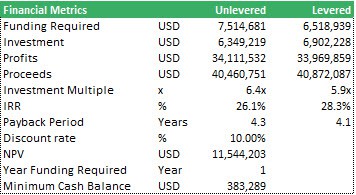
In addition to financial ratios, the financial metrics are crucial in deciding whether to pursue your chicken egg farm. The financial metrics include the Net Present Value (NPV), Internal Rate of Return (IRR), and Payback Period.
Net Present Value – NPV discounts back future cash flows to their present value. It should be more than zero for the project to be viable.
Internal Rate of Return – IRR is when NPV is equal to zero. IRR should be higher than the discount rate (cost of capital), which can be the rate of return of similar investments.
Payback Period – It determines the duration when the initial investment is recovered. The shorter the payback period, the earlier you can recover the investment.
You can choose from the Agriculture financial model templates below that you are interested in.




Use a Chicken Egg Farm Financial Plan Template!
You can use a financial model template for a chicken egg farm to do your financial planning. This way, it is faster and more efficient than starting from scratch. Most of these financial model templates available online are well-thought and equipped with critical metrics for in-depth assessment of your project.
Check this financial model template by eFinancialModels specifically prepared for Chicken Egg Farm. It will help farmers and investors decide whether to pursue a chicken egg farm venture. This financial model answers the questions of whether your proposed project is worth it to pursue.
Please also check out our other interesting Financial Model Templates in the Agriculture space:
You might also like:
- How to Prepare a Financial Feasibility Study?
- How to Profit from Carbon Capture Technology
- 10-Step Financial Planning Checklist for Smart Executives
- 10 Main Elements of a Business Plan
- Poultry Farming
- Budgeting
- Financial Planning
- Financial Projections
- Cash Flow Analysis
- Profitability Analysis
- Financial Modeling for Startups and Small Businesses
- Financial Models Easy to Use
- Top 5 Principles of Corporate Finance
- Financial Ratios Analysis and Its Importance
- How to Start a Distillery Business: What You Need to Know?
- Financial Modeling Using Excel
- Scenario Analysis
- Free Budget Planner Template in Excel for Services Businesses
- Top-Down vs. Bottom-Up Financial Planning: What’s the Difference?
- Understanding the Debt Service Coverage Ratio: An Essential Metric for Financial Analysis
