0 ITEMS

Financial Modeling Consultant: 4 Types, Rates & Red Flags

Choosing the wrong financial modeling consultant costs more than the invoice — it costs you a model you can’t maintain, a fundraise that stalls, or a deal that closes on bad numbers.
Key Takeaways
- 4 consultant types span $75–$600/hr: freelance generalists, freelance specialists, boutique firms, and Big 4 firms — each suited to a different project complexity.
- Fixed-fee contracts protect buyers when scope is defined; hourly billing benefits buyers when requirements are still evolving.
- A 12-point evaluation checklist covering credentials, delivery artifacts, IP terms, and revision policies separates professional consultants from risky hires.
- Scope creep affects an estimated 52% of consulting projects according to the Project Management Institute, making a written change-order process non-negotiable.
- Niche specialists (SaaS, real estate, biotech) command 20–40% rate premiums over generalists but reduce revision cycles on complex models.
- Red flags — no references, no methodology documentation, inability to explain assumptions in plain English — disqualify a consultant before a contract is signed.
- Post-engagement knowledge transfer should be scoped as a deliverable, not an afterthought; budget 8–16 hours for a typical three-statement model handoff.
Understanding the Financial Modeling Consultant Landscape
Financial modeling consultants build quantitative tools — spreadsheet-based or software-based — that help businesses forecast revenue, value assets, plan capital structure, or support transactions. The market ranges from solo freelancers charging $75/hr to Big 4 advisory teams billing $600/hr, and the right choice depends on project complexity, stakeholder requirements, and your internal capacity to maintain the output.
The core problem for most buyers is information asymmetry: you’re hiring someone to build something you can’t fully evaluate until it’s done. Treating consultant selection as a structured procurement process — with defined criteria, scored proposals, and contractual safeguards — closes that gap.

Treating consultant selection as a structured procurement process reduces information asymmetry and prevents costly mis-hires.
Freelance vs. Firm: Matching Consultant Type to Project Requirements
The four consultant types differ on price, accountability, capacity, and institutional credibility. Match the type to your project’s actual requirements, not your budget alone.
The 4 Consultant Types
| Type | Typical Rate | Best For | Risk |
|---|---|---|---|
| Freelance Generalist | $75–$150/hr | Small projects, early-stage startups | Limited specialist depth |
| Freelance Specialist | $150–$300/hr | Complex models, niche industries | Single point of failure |
| Boutique Firm | $200–$400/hr | Multi-stakeholder projects, PE/VC | Higher cost, slower ramp |
| Big 4 / Major Consulting | $300–$600/hr | Enterprise, audit-grade, M&A | Highest cost, junior delivery |
Freelance generalists suit seed-stage startups building their first three-statement model (income statement, balance sheet, and cash flow statement linked together) or small businesses needing a budget template. They’re fast to engage and lowest cost, but they rarely carry errors and omissions (E&O) insurance and may lack deep industry knowledge.
Freelance specialists focus on a single model type or industry: LBO models (leveraged buyout models that analyze returns when a company is acquired using significant debt), SaaS unit economics, or real estate waterfall distributions. Their rate premium is justified when the model’s complexity would generate expensive revision cycles with a generalist.
Boutique firms bring team redundancy, project management, and often proprietary model templates. They’re the right choice when multiple internal stakeholders (CFO, board, lenders) will review the output and institutional credibility matters.
Big 4 and major consulting firms are appropriate when the model must withstand external audit scrutiny, support a public transaction, or satisfy regulatory requirements. Expect junior analysts doing the actual build under senior oversight — a dynamic worth clarifying in your RFP.
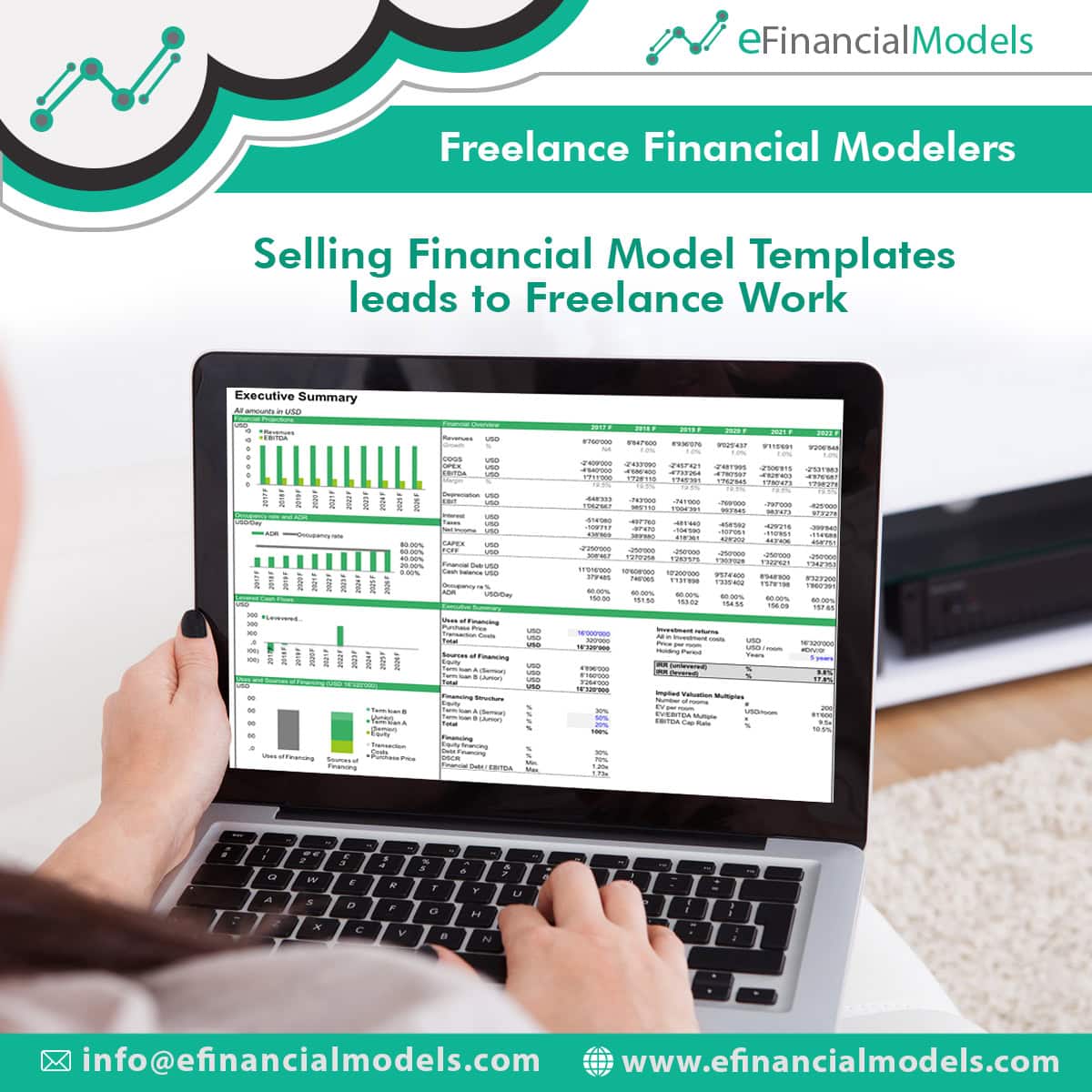
Freelance specialists suit complex niche models; boutique firms add team redundancy and institutional credibility for multi-stakeholder reviews.
Pricing Models Decoded: Fixed-Fee, Hourly, and Value-Based Structures
Pricing structure determines who bears the risk of scope uncertainty — and getting this wrong is one of the most common and expensive mistakes buyers make.
Fixed-fee contracts protect buyers when scope is fully defined upfront. A three-statement model for a Series A fundraise with a documented assumption set is a reasonable fixed-fee engagement. Typical fixed-fee ranges: $2,000–$8,000 for a startup financial model, $8,000–$25,000 for an integrated LBO model, and $15,000–$60,000 for project finance models with complex debt structures.
Hourly billing benefits buyers when requirements are evolving — for example, a phased engagement where the model’s structure depends on investor feedback between rounds. The risk is that hourly engagements without a not-to-exceed cap can balloon. Always negotiate a cap.
Value-based pricing appears in transaction support and fundraising contexts, where the consultant’s fee is tied to deal size or outcome. This aligns incentives but introduces the principal-agent problem: a consultant paid on deal close has an incentive to present optimistic projections. Require independent assumption review when using value-based structures.
Pricing Scenario Comparison
| Scenario | Recommended Structure | Reason |
|---|---|---|
| Defined scope, tight budget | Fixed-fee | Buyer bears no overrun risk |
| Evolving requirements | Hourly + cap | Flexibility without open-ended cost |
| Transaction / fundraising | Value-based + review | Aligns incentives, needs oversight |
| Phased build | Milestone-based | Go/no-go gates control spend |
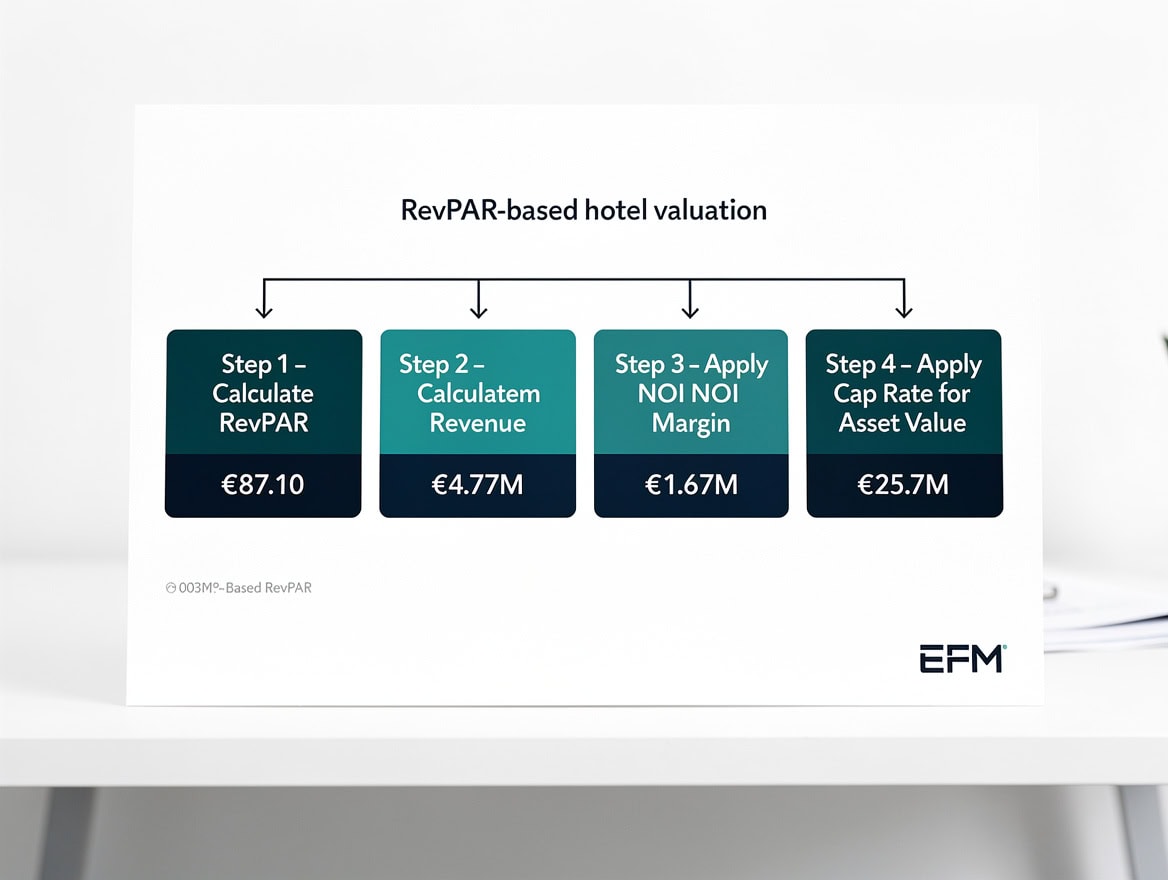
Pricing structure determines who bears scope risk — fixed-fee protects buyers with defined requirements, hourly suits evolving engagements.
The Specialist vs. Generalist Trade-Off for Your Industry
For most standard financial models, a skilled generalist delivers equivalent quality at a lower rate. The specialist premium is justified in three specific situations.
First, SaaS businesses require metrics like ARR (Annual Recurring Revenue), NRR (Net Revenue Retention), CAC payback, and LTV/CAC ratios built into the model’s core logic. A generalist unfamiliar with SaaS unit economics will build a model that looks correct but misses the KPIs investors actually interrogate. You can explore purpose-built startup financial models to benchmark what specialist SaaS output looks like.
Second, real estate models require waterfall distribution logic (the tiered profit-sharing structure between equity partners), IRR hurdles, and debt service coverage ratios that follow asset-class conventions. A generalist building a real estate model from scratch will take 3x as long as a specialist and produce output that sophisticated LPs will immediately question.
Third, biotech and pharma models require milestone-based revenue recognition, probability-weighted pipeline valuation (rNPV), and clinical trial cost modeling. These are genuinely specialized and should not be assigned to a generalist regardless of rate.
For everything else — budget models, scenario analysis, three-statement models for non-specialized businesses — a skilled generalist with strong Excel and accounting fundamentals is the cost-efficient choice.
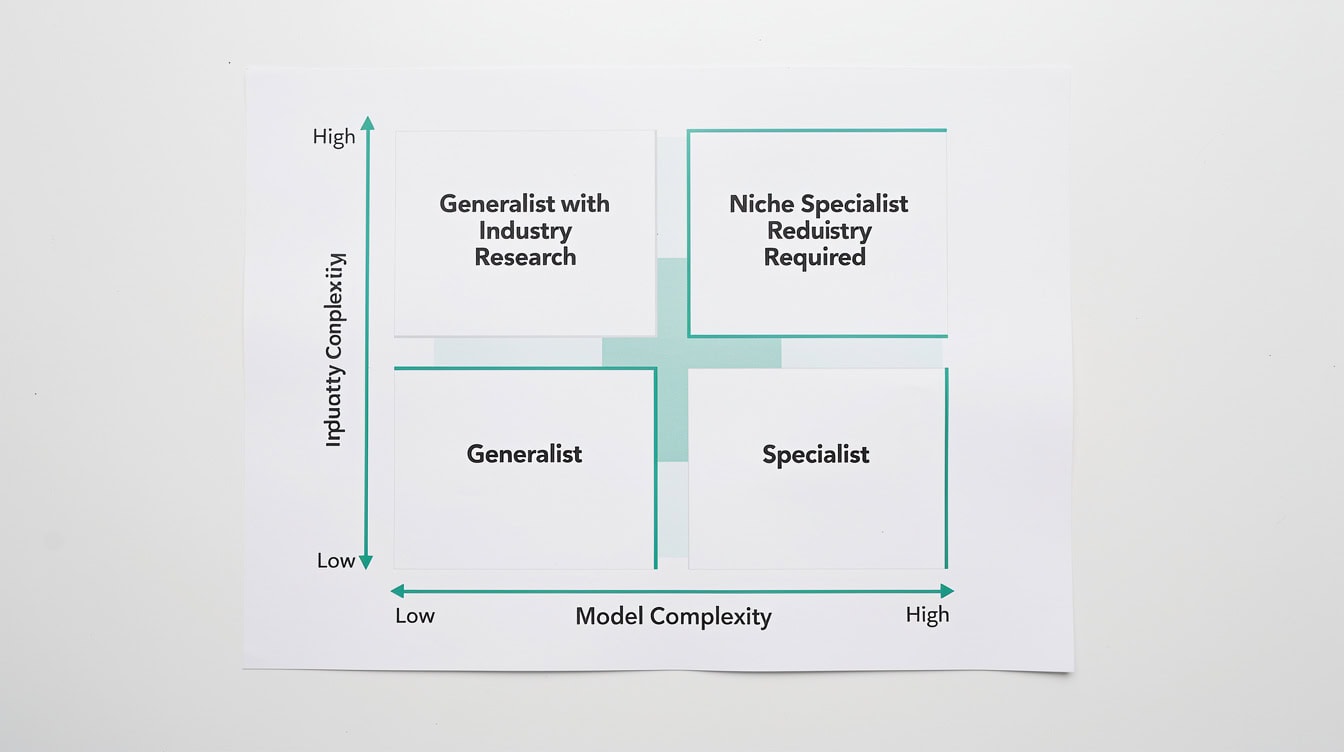
The specialist premium is justified in the top-right quadrant — high industry complexity combined with high model complexity (SaaS LBO, biotech rNPV, real estate waterfall).
The 12-Point Consultant Evaluation Checklist
Use this checklist to score every candidate on a 1–3 scale before making a hiring decision. A total score below 24 out of 36 is a disqualifier.
- Credentials: CFA (Chartered Financial Analyst), CPA, MBA, FMVA (Financial Modeling and Valuation Analyst from CFI), or MoF (Master of Finance) certification present.
- Excel proficiency: Can demonstrate advanced functions — dynamic arrays, XLOOKUP, structured references, and named ranges — not just VLOOKUP.
- Model documentation: Delivers a written assumption log, color-coded cell conventions (inputs vs. calculations vs. outputs), and a version control protocol.
- Audit trail: Uses formula-only cells (no hardcoded numbers inside formulas), with all inputs centralized on a dedicated assumptions sheet.
- Work samples: Provides 2–3 anonymized samples relevant to your model type, not just screenshots.
- References: Supplies 2+ client references willing to discuss the engagement, not just LinkedIn endorsements.
- Communication cadence: Commits to a defined check-in schedule (weekly at minimum for engagements over 3 weeks).
- Revision policy: Specifies the number of included revision rounds and the process for additional revisions in writing.
- IP and confidentiality: Signs an NDA before receiving your data and clarifies model IP ownership in the contract (you should own the final deliverable).
- E&O insurance: Firms should carry errors and omissions insurance; freelancers should disclose whether they carry coverage.
- Business-language fluency: Can explain every modeling assumption in plain English without hiding behind technical jargon.
- Handoff plan: Includes a knowledge transfer session and user guide as a named deliverable, not an optional add-on.
Financial modeling best practices and documentation standards from the CFA Institute’s Financial Reporting and Analysis curriculum provide a useful benchmark for items 3 and 4.

Score every candidate 1–3 on each criterion; a total below 24 out of 36 is a disqualifier regardless of rate.
Red Flags That Should Disqualify a Consultant
Certain behaviors signal structural problems that no contract can fully mitigate. Walk away if you observe any of the following.
Reluctance to provide references. A consultant with a legitimate track record has clients willing to speak. “Confidentiality” is occasionally a valid reason for anonymizing a client name, but it’s never a valid reason to provide zero references.
No standardized methodology or templates. Building every model from a blank sheet without a documented starting framework signals either inexperience or a process that can’t be audited or maintained.
Inability to explain choices in business terms. If a consultant can’t tell you why they chose a particular revenue growth assumption or discount rate in plain English, your board and investors won’t be able to either.
Hardcoded numbers inside formulas. A formula like =B12*0.35 with no labeled input cell for the 35% figure is a maintenance trap. Every assumption must be traceable.
Scope vagueness in the proposal. A proposal that describes deliverables in general terms — “a comprehensive financial model” — without specifying tabs, outputs, and assumption categories is a scope creep invitation.

Any single red flag is sufficient to disqualify a candidate — the cost of a bad hire exceeds the cost of a longer search.
Writing an Effective Consultant Brief and RFP
A well-written brief gets you accurate quotes and filters out consultants who can’t meet your requirements. A vague brief gets you vague proposals and surprise invoices.
Your brief should specify: the model type (three-statement, LBO, project finance, budget), the intended audience (internal management, investors, lenders, auditors), the number of scenarios required, the time horizon (monthly for 3 years, annual for 5 years), the data you’ll provide vs. what the consultant must source, and your deadline.
Request the following from every candidate:
- 2–3 anonymized work samples of the same model type
- A written methodology overview (1–2 pages)
- A fixed-fee or not-to-exceed estimate with assumptions listed
- A project timeline with milestones
- Their revision and change-order policy in writing
Structure your discovery call around four questions: How would you approach building this model? What information do you need from us to start? What are the most common failure points in this type of engagement? How do you handle a situation where the scope changes mid-project?
For financial projections that will be reviewed by investors, also ask whether the consultant has experience with the specific investor type (VC, PE, family office, bank) — their formatting and presentation expectations differ significantly.
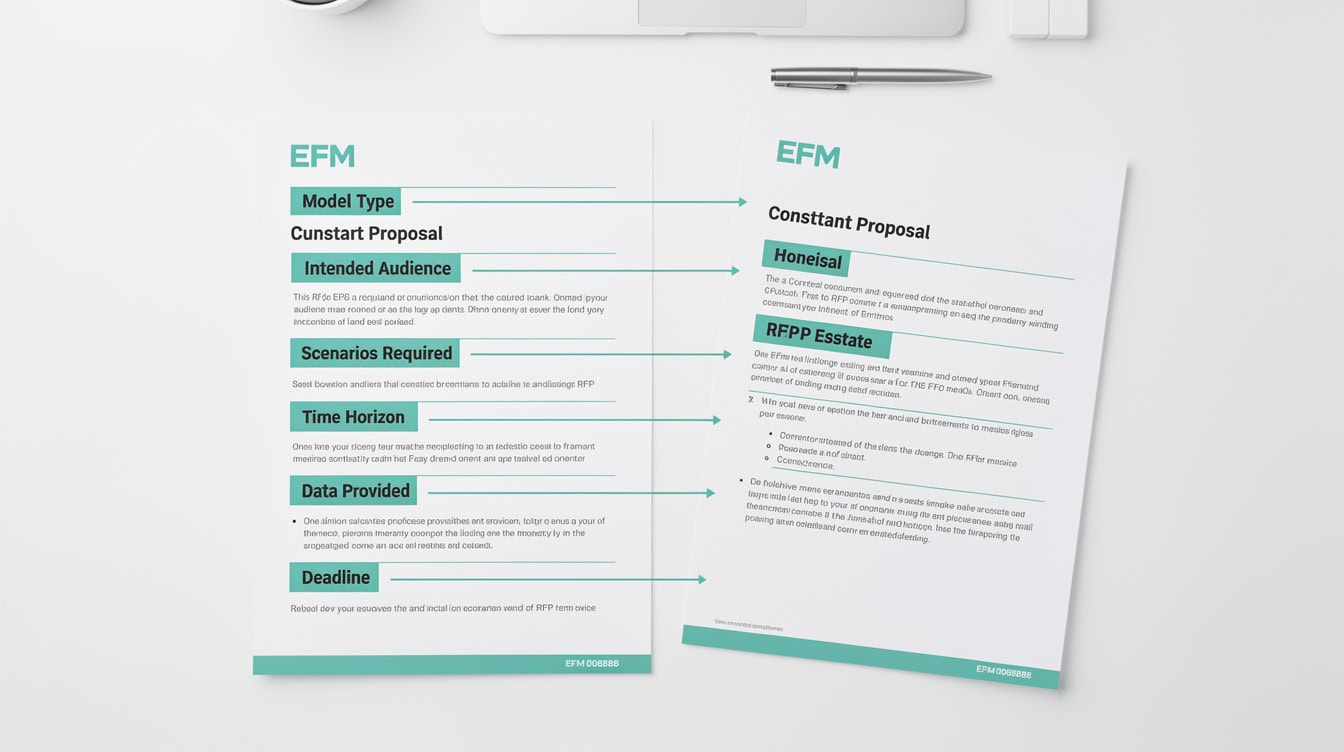
A specific brief with model type, audience, and scenario count gets you comparable proposals — vague briefs get vague quotes.
Structuring the Engagement to Prevent Scope Creep
Scope creep — the gradual expansion of project requirements beyond the original agreement — affects an estimated 52% of projects according to the Project Management Institute, and consulting engagements are particularly vulnerable because clients often discover new requirements as they see the model take shape.
Three structural safeguards reduce scope creep risk. First, define deliverables at the tab level: list every worksheet the model will contain, every output chart, and every scenario. Second, build a written change-order process into the contract: any request outside the defined scope triggers a written change order with a cost and timeline estimate before work begins. Third, use phased engagements with go/no-go decision points for complex projects: complete the revenue model, review it, then proceed to the cost model and balance sheet.
For 5-year financial projections or longer-horizon models, a phased approach also lets you validate early assumptions before building downstream logic that depends on them.

Phased engagements with go/no-go gates let you validate early assumptions before building downstream logic that depends on them.
Knowledge Transfer and Post-Engagement Support Planning
The handoff problem is the most underestimated risk in financial modeling engagements. A model you can’t update or maintain is a liability, not an asset.
Budget 8–16 hours for knowledge transfer on a typical three-statement model: a 2-hour walkthrough session, a written user guide covering the assumption sheet and update process, and a 30-day support window for questions. Complex models (LBO, project finance, integrated budget models) require 20–40 hours of transfer time.
Define your ongoing support model before the engagement ends. Three options exist: a monthly retainer (typically $500–$2,000/month for a freelance specialist) for regular updates, ad-hoc support billed hourly with a defined response time SLA, or a clean handoff with no ongoing relationship. The right choice depends on how frequently the model will be updated and whether your team has the Excel skills to maintain it independently.
For three-statement model maintenance, document the update sequence: always update the income statement assumptions first, then verify the balance sheet balances, then check the cash flow statement reconciles. This sequence prevents circular reference errors during updates.

Budget 8–16 hours for a three-statement model handoff and 20–40 hours for complex models — knowledge transfer is a deliverable, not an afterthought.
Worked Example: Evaluating Two Consultant Proposals
Here’s the math on a real evaluation scenario. You need an integrated three-statement model for a Series A fundraise, with 3 scenarios, monthly granularity for 36 months, and a 3-week deadline.
Proposal A: Freelance generalist, $125/hr, estimated 40 hours, no fixed-fee cap. Total estimated cost: $5,000. No work samples for SaaS models. References available. No E&O insurance. Revision policy: “reasonable revisions included.”
Proposal B: Freelance SaaS specialist, $200/hr, fixed-fee $7,500 for defined scope (listed 8 tabs, 3 scenarios, assumption log, 2 revision rounds, 4-hour handoff session). Work samples from 3 SaaS clients. References available. No E&O insurance.
Scoring on the 12-point checklist: Proposal A scores 19/36 (fails on work samples, revision policy clarity, and handoff plan). Proposal B scores 31/36. The $2,500 premium on Proposal B buys defined scope, specialist SaaS knowledge, and a handoff session — all of which reduce your total cost of ownership when you factor in revision cycles and maintenance time.
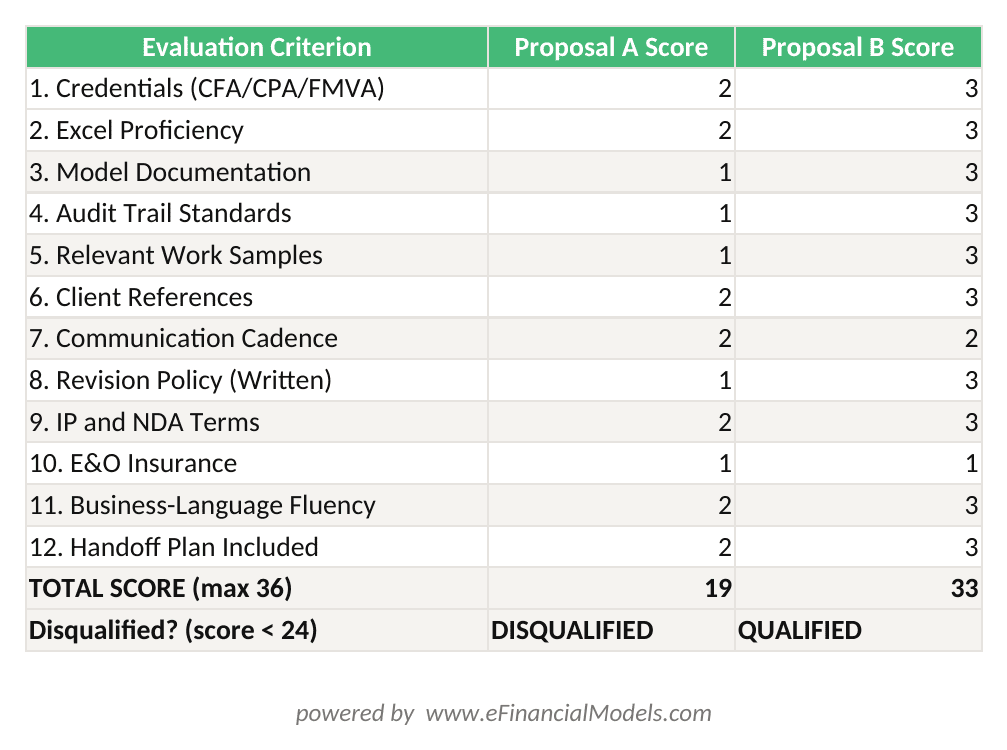
Score each consultant 1–3 on all 12 criteria; total below 24/36 is a disqualifier. Proposal B scores 31/36 vs Proposal A at 19/36.
Frequently Asked Questions
How much does a financial modeling consultant typically charge?
Financial modeling consultant rates range from $75/hr for freelance generalists to $600/hr for Big 4 advisory teams. The most common range for a competent freelance specialist in the US is $150–$300/hr. Project costs for common deliverables run approximately $2,000–$8,000 for a startup three-statement model, $8,000–$25,000 for an LBO model, and $15,000–$60,000 for project finance models. UK rates run roughly 20–30% lower than US rates for equivalent experience levels, and offshore consultants (India, Eastern Europe) typically charge $30–$80/hr. Always compare fixed-fee proposals against an hourly estimate to understand the implied hours and assess whether the scope is realistic.
What credentials should a financial modeling consultant have?
The most relevant credentials are the CFA (Chartered Financial Analyst, administered by the CFA Institute), CPA (Certified Public Accountant), and specialized modeling certifications like the FMVA (Financial Modeling and Valuation Analyst from the Corporate Finance Institute) or the MoF (Master of Finance). For Excel-specific proficiency, Microsoft’s MO-201 Excel Expert certification provides a verifiable benchmark. No single credential is sufficient on its own — always combine credential verification with work sample review and reference checks. A consultant with an FMVA and 3 strong SaaS references is more credible than one with an MBA and no relevant samples.
What’s the difference between a three-statement model and an LBO model?
A three-statement model links the income statement, balance sheet, and cash flow statement into an integrated forecast — it’s the foundation of most financial modeling work and the starting point for virtually every other model type. An LBO (leveraged buyout) model adds a debt schedule, returns analysis, and exit valuation on top of the three-statement foundation to analyze whether a private equity acquisition generates target returns (typically 20–30% IRR). LBO models are significantly more complex, require specialist knowledge of debt structuring and PE return conventions, and typically cost 3–5x more to build than a standalone three-statement model. If you’re not sure which you need, describe your use case to the consultant and ask them to recommend the appropriate model type.
How do I prevent a consultant from overcharging on an hourly engagement?
Three controls limit overcharging risk on hourly engagements. First, negotiate a not-to-exceed cap in the contract — the consultant must notify you before exceeding the cap and get written approval to continue. Second, require weekly time reports showing hours by task, so you can identify if a task is taking longer than expected and course-correct. Third, define deliverables at the milestone level and tie payment to milestone completion rather than hours alone. According to the Project Management Institute, projects with defined milestones and formal change-order processes are significantly less likely to experience cost overruns than those managed on pure time-and-materials terms.
Should I hire a consultant or buy a financial model template?
A pre-built template from a reputable source works well when your business fits a standard model type (SaaS, e-commerce, real estate rental), your team has the Excel skills to customize it, and your use case is internal planning rather than investor presentation. A consultant is the right choice when your business model is non-standard, the model will be reviewed by sophisticated external parties (investors, lenders, auditors), or you lack the internal expertise to build or validate the model yourself. Many buyers use a hybrid approach: start with a free financial model template to define requirements, then hire a consultant to customize it — reducing both cost and scope ambiguity.
What should a consultant’s work sample include?
A strong work sample demonstrates four things: a centralized assumption sheet with clearly labeled inputs, formula-only calculation cells with no hardcoded numbers inside formulas, a logical tab structure that flows from inputs to outputs, and output charts or summary dashboards that a non-technical reader can interpret. Ask for samples in the same model type and industry as your project. If the consultant can only provide screenshots rather than the actual file, treat that as a yellow flag — you can’t assess formula quality from a screenshot. Anonymized files with sensitive data removed are standard practice and acceptable.
How long does a typical financial modeling engagement take?
A three-statement model for a startup typically takes 2–4 weeks from brief to delivery, assuming the client provides clean historical data and responds to questions within 24–48 hours. An LBO model runs 3–6 weeks. Project finance models for infrastructure or energy projects can take 8–16 weeks. The most common cause of delays is slow client response on data requests and assumption approvals — not consultant capacity. Build a data-readiness checklist into your project kickoff: gather 3 years of historical financials, a list of key business drivers, and any existing forecasts before the engagement starts.
Conclusion
Choosing a financial modeling consultant is a procurement decision, not a gut-feel hire. The 4 consultant types, 12-point evaluation checklist, and pricing structure framework in this article give you a repeatable process that works whether you’re hiring for a $3,000 startup model or a $50,000 transaction model. The single most expensive mistake buyers make is skipping the structured evaluation and choosing on price alone — only to spend more on revisions, corrections, and rebuilds than the original engagement cost.
I recommend downloading EFM’s financial modeling templates to benchmark consultant deliverables against professional standards before your first discovery call — knowing what good looks like is the fastest way to identify who can actually deliver it.