
0 ITEMS

Master the Free Cash Flow Formula for Smarter Financial Decisions

Mastering the free cash flow formula is key to making smarter financial decisions for any business, especially those in capital-intensive industries.
- Free cash flow measures the cash a company generates after covering capital expenditures, indicating true operational health.
- Accurate calculation involves different methods, including the free cash flow formula from EBIT and EBITDA, which reveal different aspects of cash generation.
- Understanding unlevered free cash flow helps evaluate a company’s core performance without the influence of debt or capital structure.
- Precise free cash flow analysis supports strategic decisions like mergers, investments, debt repayment, and dividend payments.
- Learning to apply these formulas improves financial modeling, investment evaluation, and long-term planning.
Keep reading to see how mastering these methods enhances your financial insights.
Understanding Free Cash Flow
At its core, free cash flow (FCF) represents the amount of cash a company generates after accounting for capital expenditures necessary to maintain or expand its asset base. It means that after a company has spent money on machinery, equipment, or facilities to keep the business running or growing, the remaining cash is considered free cash flow. FCF is a measure of a company’s financial health and its ability to generate cash. To understand a company’s actual financial performance clearly, we focus on unlevered free cash flows, which excludes the effects of debt financing. This approach allows us to evaluate the pure cash-generating capability of the business without the influence of its capital structure.
As a financial measure, free cash flow represents the amount of yearly cash a company generates after accounting for capital expenditures and net working capital requirements and ready to distributre to capital providers. It provides insight into a company’s ability to generate profits, fund operations, pay dividends, reduce debt, or reinvest in its business. By focusing on cash flow rather than on accounting profits, free cash flow analysis offers a clearer view of a company’s financial health and long-term viability to turn profits into cash, making it a crucial tool for investors, creditors, and management in decision-making processes.
Companies typically calculate free cash flow using the levered free cash flow formula and the unlevered free cash flow formula. The levered free cash flow formula considers the interest paid on debt and thus reflects the cash flow available to equity shareholders after all expenses, debts, and reinvestment needs are met. On the other hand, the unlevered free cash flow formula does not consider interest expenses. It is often used to evaluate the company’s core operating performance, providing a view of the cash flow generated before the impact of the financial structure. It makes the unlevered free cash flow formula particularly useful in valuing firms without regard to the distorting effects of differing capital structures. Both methods offer valuable insights but serve different financial analysis and valuation purposes.
Importance of Accurate Calculation of Free Cash Flow
Accurate calculation of free cash flow is crucial for businesses and investors alike. It is a vital indicator of a company’s financial health. Precise calculation of free cash flow provides a clear and realistic picture of a company’s profitability and operational efficiency, enabling better decision-making for management and more informed investment choices for stakeholders. Missteps in this calculation can lead to misleading financial assessments and poor strategic decisions, underscoring the need for precision and reliability in financial reporting. Accurate calculation of free cash flow is essential for several reasons:
- Mergers & Acquisitions (M&A): Free cash flow analysis is critical to understanding any M&A scenario to create an offer price for a company’s share capital. Free cash flow analysis leads to deep insights into the financial health of a target company and its capacity to generate cash once acquired. The accurate calculation of free cash flow and forecasting is instrumental in determining the company’s fair value and potential return on investment (ROI). When a company generates robust and predictable free cash flows, this is often more appealing as the risk is lower than that of young, growing companies with no ability to generate free cash flow and, therefore, face a higher risk. Free cash flow analysis often unveils the problems and arguments to focus on during a merger or acquisition, thereby influencing decision-making and negotiation processes.
- Investments and Expansion Capabilities: FCF clearly shows how much cash a company has left over after funding its capital expenditures and maintaining its operations. This surplus cash can be used for growth initiatives such as acquiring assets, expanding into new markets, or investing in new projects. Accurate calculation of free cash flow helps management and stakeholders understand how much cash is available for such strategic investments, which is essential for planning and executing growth strategies effectively.
- Debt Repayment Potential: Accurate calculation of free cash flow is crucial for determining a company’s ability to repay its debts. Free cash flow represents a company’s cash after accounting for capital expenditures, which is available to service debt obligations. By analyzing FCF, investors and creditors can gauge whether a company has sufficient cash flow to meet its debt payments, interest, and principal repayments without compromising its operational needs. Consistently strong FCF indicates that the company will likely maintain its debt commitments, reducing the risk for lenders and investors.
- Ability to Pay Dividends: For companies that distribute dividends, FCF is a crucial indicator of their ability to sustain these payments. Dividends are typically paid from the company’s available cash flow, and a steady or increasing FCF suggests that the company can maintain or potentially increase its dividend payments. Investors rely on accurate calculation of free cash flow to assess the stability and sustainability of dividend payouts, making it a significant factor in investment decisions, particularly for income-focused investors.
- Operational Efficiency and Cost Management: Accurate calculation of free cash flow can highlight a company’s operational efficiency and effectiveness in managing costs. By analyzing changes in FCF over time, stakeholders can infer how well the company controls its capital expenditures and operational costs. Efficient management usually results in higher free cash flow, as the company can generate more cash from its operations while minimizing unnecessary spending. This insight can help identify areas for improvement and operational adjustments.
By thoroughly understanding and accurately calculating free cash flow, financial professionals can provide deeper insights and superior strategic guidance to stakeholders, ultimately driving better business outcomes and sound investment decisions.




























































Crack the Code: Master the Free Cash Flow Formula
Understanding the free cash flow formula is crucial for accurate financial analysis, and several methods exist to calculate it. Each approach offers unique insights into a company’s financial health, allowing for a more nuanced evaluation of its cash generation capabilities. In cracking the code, we refer to the unlevered free cash flow formula. It is a crucial metric that represents the amount of cash a company generates before considering financial costs like interest expenses. This metric isolates the operating performance of a business, independent of its capital structure, providing a pure view of the cash flows from operations that are available to all investors, both equity and debt holders.
By focusing on the unlevered free cash flow formula, we can assess a company’s intrinsic value without the distortion of debt payments. The unlevered free cash flow formula is ideal for valuation models like discounted cash flow (DCF) analysis. It involves adjusting net income by adding back non-cash charges such as depreciation and amortization and considering changes in working capital and capital expenditures, which are critical for understanding the company’s capacity to generate cash sustainably.
Calculating the Unlevered Free Cash Flow Formula from EBIT
Calculating the unlevered free cash flow formula from EBIT or net income helps determine a company’s ability to generate cash after expenses and investments, which is crucial for assessing investment potential. EBIT (Earnings Before Interest and Taxes) represents a company’s profit before accounting for interest and taxes, reflecting its core operational profitability. Still, it does not consider non-cash expenses or changes in working capital. Operating Cash Flow, however, adjusts EBIT by adding back non-cash charges (such as depreciation) and accounting for changes in working capital. EBIT is often considered better than EBITDA for evaluating profitability because it includes depreciation and amortization, offering a more realistic picture of a company’s operational efficiency and the impact of its capital expenditures on profit.
The unlevered free cash flow formula from EBIT (Earnings Before Interest and Taxes) is:

Where:
- EBIT is the Earnings Before Interest and Taxes.
- Tax rate is the effective tax rate applicable to the company so that we may calculate pro forma taxes due on profits without taking into account debt financing
- Depreciation and Amortization are non-cash charges that reduce EBIT but do not impact cash flow.
- Change in Working Capital is the difference in working capital (current assets – current liabilities) from one period to the next.
- Capital Expenditures are investments in long-term assets like property, plant, and equipment.
Calculating the Unlevered Free Cash Flow Formula from EBITDA
Calculating the free cash flow formula from EBITDA is crucial because it provides a clearer picture of a company’s actual cash-generating ability and financial health. EBITDA (Earnings Before Interest, Taxes, Depreciation, and Amortization) represents a company’s operating performance but does not account for capital expenditures, changes in working capital, and other cash flow items. In contrast, operating cash flow represents the cash generated from a company’s core operating activities, considering changes in working capital and excluding non-operational income and expenses. The unlevered free cash flow formula from EBITDA measures the company’s ability to sustain operations, invest in growth, and return value to investors. The unlevered free cash flow formula from EBITDA is as follows:

Where:
- EBITDA represents the company’s operational profitability.
- Adjusted Taxes is an approximation for pro forma taxes due on profits assuming no debt financing since EBITDA doesn’t account for taxes
- Changes in Working Capital includes changes in accounts receivable, accounts payable, and inventory.
- Capital Expenditures are the funds used to acquire or upgrade physical assets like property, industrial buildings, or equipment.
Sample Calculations
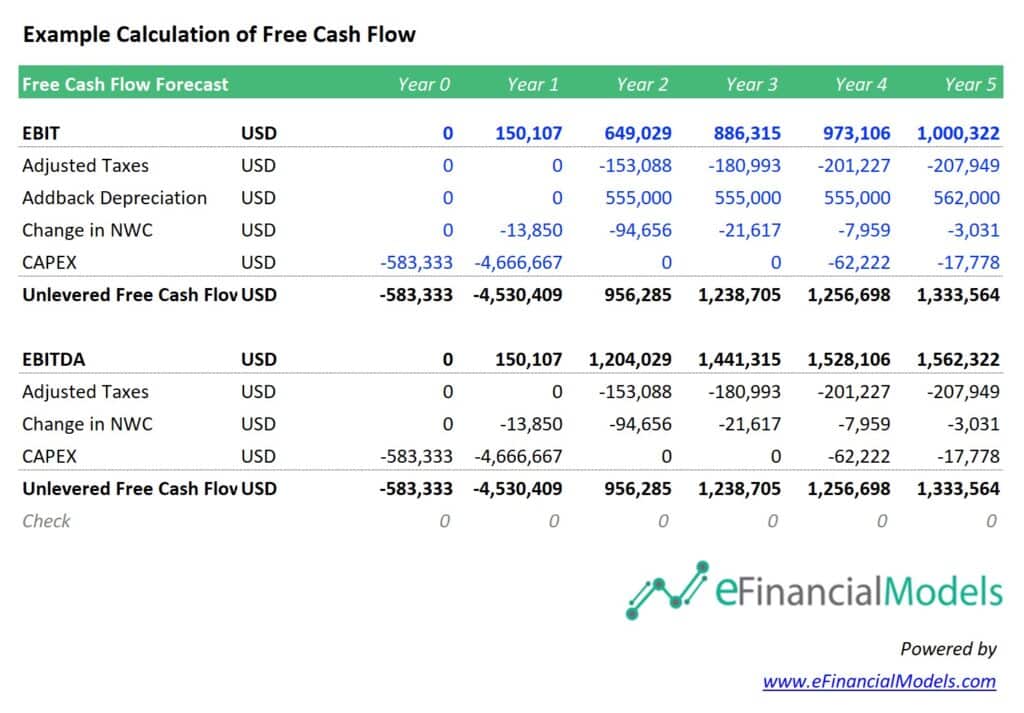
The example calculation of free cash flow shows two methods: the free cash flow formula from EBIT and the free cash flow formula from EBITDA. The EBIT method subtracts taxes, adds depreciation, adjusts for changes in net working capital (NWC), and deducts capital expenditures (CAPEX). The EBITDA method skips depreciation adjustments since it already includes them, simplifying the process. Both approaches lead to the same unlevered free cash flow, but EBITDA provides a clearer view of operational cash flow before non-cash expenses.
In the provided example, the practical application of the unlevered free cash flow formula from EBIT and the unlevered free cash flow formula from EBITDA lies in assessing the cash available to a business before considering any financial obligations such as debt payments. The sample data suggests that the company is in a growth phase, as indicated by the significant increase in unlevered free cash flow over the five years. Initially, the company experienced negative free cash flow due to substantial capital expenditures (CAPEX) in the early years, which is typical for businesses investing in future growth. However, from Year 2 onwards, the company generates positive and steadily increasing unlevered free cash flow, indicating improving profitability and operational efficiency. The consistent rise in free cash flow suggests that the company is successfully growing and potentially becoming more financially stable, with increasing cash available for reinvestment, debt repayment, or distribution to shareholders.



















Practical Applications of Free Cash Flow Analysis
Free cash flow analysis starts with calculating free cash flow. Once FCF is determined, free cash flow analysis involves assessing how the company utilizes this cash. It can include examining the company’s ability to reduce debt, pay dividends, invest in new projects or acquisitions, and buy back shares. By understanding these dynamics, stakeholders can gauge the efficiency of a company’s cash management, its potential for growth, and overall financial health, making a free cash flow analysis an essential part of comprehensive financial analysis and strategic planning.
Understanding the practical applications of free cash flow analysis is crucial for anyone involved in investment decision-making, financial planning, or business valuation. Free cash flow provides a clear picture of the company’s financial health by showing how much cash is available after maintaining or expanding its asset base. This metric is handy for stakeholders, including investors, financial managers, and analysts, who can derive critical insights and make informed decisions based on a free cash flow analysis. For investors, free cash flow is not just a critical indicator; it’s a reassuring sign of a company’s profitability and financial stability. High and consistent levels of FCF can indicate strong earnings quality and the ability to provide dividends or undertake share repurchases. By analyzing free cash flow trends, investors can forecast future performance and make better-informed investment decisions, knowing that they are backed by a solid financial foundation.
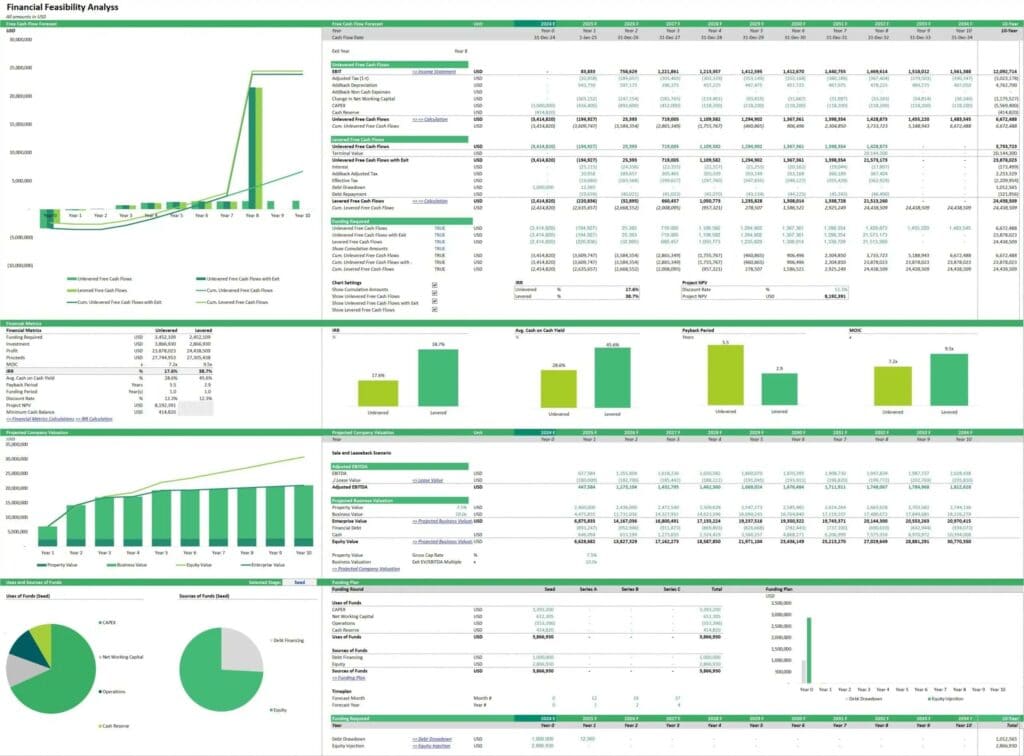
This free cash flow forecast of a liquor distillery financial plan template provides several key indicators to reassure investors of its profitability and financial stability. First, the forecast shows a strong upward trend in unlevered and levered free cash flows over ten years, suggesting growing operational efficiency and profitability. Charts such as the cumulative free cash flow and property value also exhibit substantial growth, indicating a healthy return on investment (ROI).
For financial managers and business owners, free cash flow analysis is not just vital, it’s a source of clarity for strategic planning and capital allocation. It helps managers determine whether they have sufficient internal funds to finance new ventures or if they need to seek external funding. Additionally, a free cash flow analysis can aid in evaluating cost-saving initiatives and operational efficiencies, providing a clear roadmap for financial decisions.
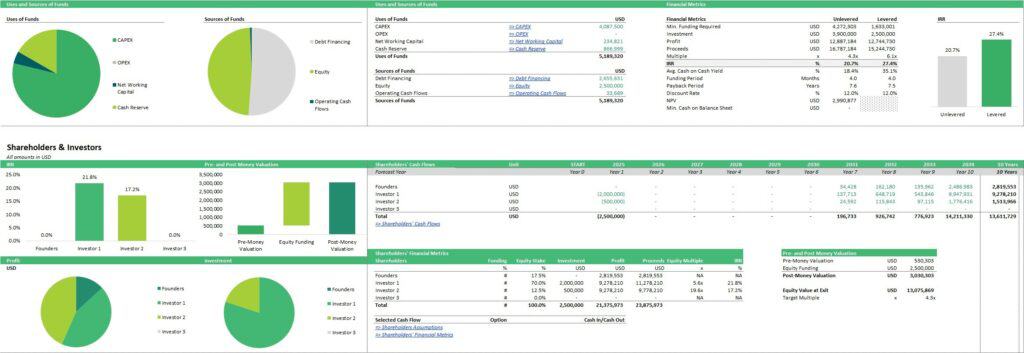
The shareholders’ cash flows section in the above truck rental company financial model is essential for managers and business owners to evaluate whether internal funds are sufficient for new ventures or if external funding is required. It provides a detailed forecast of yearly cash inflows and outflows, enabling a clear view of financial availability for reinvestment. By comparing these projections with the potential cash needs of new ventures, managers can decide on the adequacy of internal cash generation versus the necessity to seek additional external funds.
For analysts, free cash flow analysis provides insights, particularly regarding valuation and financial health. By examining FCF, analysts can assess a company’s ability to generate cash after accounting for capital expenditures, which reflects its operational efficiency and financial stability. This metric is crucial for valuation purposes, as it helps estimate a company’s intrinsic value through the discounted cash flow method. Positive and growing FCF indicates strong potential for future profitability and investment capacity, whereas negative or inconsistent FCF may suggest financial difficulties or operational inefficiencies.
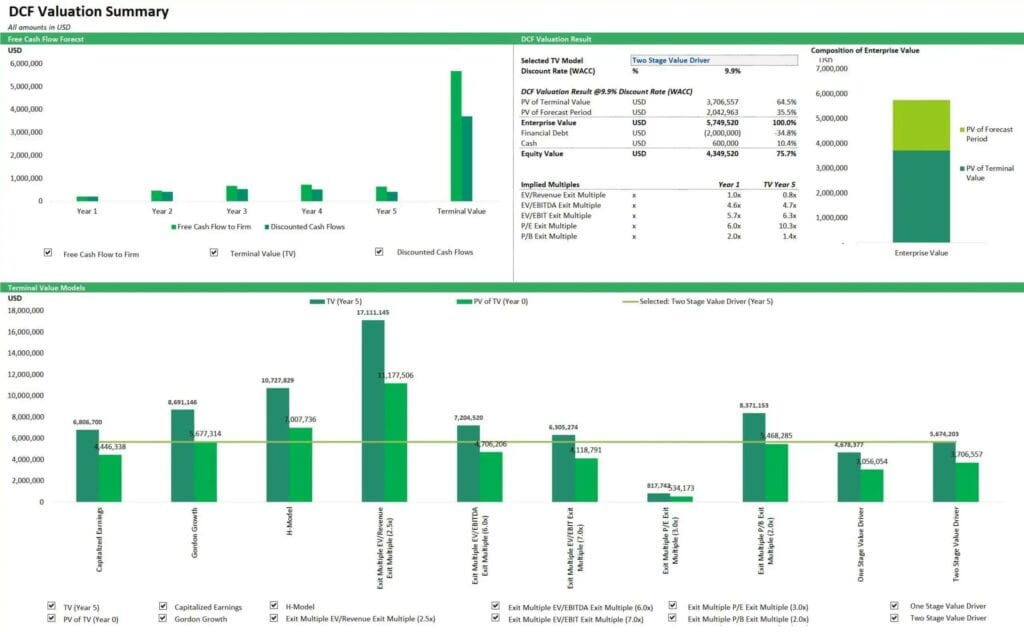
The provided discounted cash flow valuation model summary offers comprehensive insights into a company’s valuation and financial health by analyzing free cash flow to firm (fcff) trends, discounted cash flows reflecting the time value of money, and terminal value (tv) to gauge long-term stability. The calculation of enterprise value (EV) and equity value helps understand the company’s total worth and shareholder equity, respectively, while valuation metrics and multiples, such as EV/Revenue and P/E ratios, allow for comparison against industry standards.
These practical free cash flow analysis applications underline its significance in real-world applications. Startup investors often prioritize FCF over net income because it provides a clearer view of cash generation capabilities. Similarly, in capital-intensive industries like real estate, unlevered free cash flow helps to isolate a project’s pure operational efficiency from the effects of financing structures. In summary, free cash flow analysis is a crucial tool for evaluating various business scenarios’ financial viability and strategic opportunities.
Harness Financial Modeling for Accurate Free Cash Flow Calculation
Mastering the free cash flow formula is crucial for making informed business decisions. By understanding basic and adjusted calculations, you can gain deeper insights into your company’s operational efficiency and profitability. Additionally, using the free cash flow formula from EBITDA and the free cash flow formula from EBIT helps businesses assess their capacity to generate cash and strategically plan investments, paving the way for smarter financial decisions.
Financial modeling is a powerful tool in the calculation of free cash flow, providing businesses with critical insights into their liquidity and financial health. Financial analysts can project future cash flows based on various scenarios and assumptions by integrating income statements, balance sheets, and cash flow statements into a cohesive model. These financial models identify the key drivers of cash generation and consumption, facilitating more accurate forecasts of FCF. It also allows the simulation of different operational, investment, and financing strategies to see their potential impacts on cash flow. Consequently, financial modeling not only aids in calculating current FCF but also enhances strategic planning and decision-making by predicting future financial conditions and their implications for business sustainability and growth.













You might also like:
- 10 Main Elements of a Business Plan
- 10 Tips to Develop a First Class Business Valuation Report
- Cash Flow Analysis in Excel
- Understanding the Levelized Cost of Energy Formula
- Mastering Business Finance: The Three-Statement Financial Model
- How to Value a Business Using a Discounted Cash Flow Model
- 10 Ideas to Increase Average Revenue Per User
- How to Prepare a Financial Feasibility Study?
- Monthly Budget Template (with Financial Statements)
- Understanding What is Yield to Maturity and Why It Matters
- Financial Statements – Definition, Uses, Contents and Templates
- Calculating Revenue Growth Rate: A Key Metric for Business Success
- Steps to Securing Series C Financing
- How to Optimize the Average Selling Price: Strategies for Higher Profits
- How to Make Smart Decisions with 6 Key Financial Metrics?
- Monthly Annuity Calculator
- How Does the Equity Accounting Method Work?
- 5 Best Practices for Managing Days Receivables
- Accounting
- Cash Flow Projections
Tags: Free Cash Flow