
0 ITEMS

Why EBITDA Might Not Be Equal to Cash
Understanding EBITDA is key for accurate business valuation, but it’s not immune to manipulation.
- EBITDA is often used as a cash flow proxy, especially by private equity investors, because it excludes depreciation and amortization, which can be manipulated.
- Industry-specific factors, like inventory accounting methods or biological asset fair value assessments, can significantly distort EBITDA figures.
- Companies in industries with cyclical or biological income, such as agriculture and forestry, may show inflated EBITDA through fair value adjustments.
- Relying solely on EBITDA can be misleading; analyzing actual cash flows provides a clearer picture of financial health.
- Use financial models tailored to your industry, like agriculture templates, to better understand real cash flow and mitigate manipulation risks.
Keep these points in mind to better interpret EBITDA and its impact on business valuation.
EBITDA (Earnings before Interest, Taxes, Depreciation, and Amortization) is used in many cases as a proxy for cash flow. Especially financial investors such as Private Equity firms use the relationship between EBITDA and Enterprise Value (EV) by using EV/EBITDA multiples to value a company. The reason EBITDA is chosen and not EBIT (Earnings before Interest and Taxes) is that depreciation and amortization can be manipulated while cash cannot. Therefore the belief in EBITDA is a solid proxy for cash flow.
In most cases, EBITDA indeed is only very hard to manipulate. However, in many industries such as manufacturing, above the revenues line, there is already a line item called “change in inventory”. This “change in inventory” already depends on the inventory accounting method (FIFO, LIFO, etc.) and thus already leaves some room for manual adjustment.
A more severe manipulation of EBITDA can happen in industries where the income occurs only once a year (e.g. in Agriculture) or once in a lifetime (Forestry). Thus the company will be faced with the problem that first there are only costs while the income will occur later. So without including the income, this will make the company look very unfavorable. Therefore some of the accounting standards such as IAS 41 IFRS 13 were created to account for biological assets by allowing them to be accounted at their estimated fair value basically as income.
From a financial analyst and investor point of view – both are interested in cash flows -, the understanding of EBITDA now becomes critical. Below example of Mriya Agriholding, the largest wheat producer in Ukraine currently in restructuring shows the implication of a fair value estimation of EBITDA very clearly:
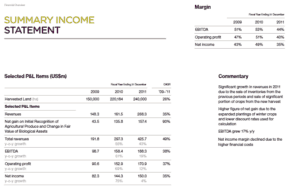
Source: Mriya, Management Presentation June 2012
So basically from USD 188m in EBITDA in 2011, USD 157m originates from the fair value of biological assets, meaning the harvest would occur next year, leaving this income at its business risk till the harvest actually can occur. EBITDA had to be estimated by accountants based on fair value calculations and by using their best judgment (which is not the same as actual sales). This basically puts EBITDA up for discretionary use and can reduce the significance of EBITDA as a measure of cash flow quite drastically.
This is just a short reminder that even EBITDA might not be free from manipulation attempts by creative management. For this reason, it’s important to actually understand the real cash flows in more detail and focus the valuation considerations on effective cash in / out. Thus in some industries even EBITDA has to be treated with caution.
See our financial model templates on agriculture which can give you some ideas on how to build financial models for companies focused on agriculture.














































You might also like:
- 10 Tips to Develop a First Class Business Valuation Report
- 10 Main Elements of a Business Plan
- 10 Ideas to Increase Average Revenue Per User
- Are EV Charging Stations Profitable?
- Cash Flow Analysis in Excel
- Financial Modeling for Startups and Small Businesses
- Financial Ratios Analysis and Its Importance
- Finding a Valuation Model for Your Business
- Master the Free Cash Flow Formula for Smarter Financial Decisions
- How to Build a Capitalization Table
- How to Value a Business Using a Discounted Cash Flow Model
- How to Optimize the Average Selling Price: Strategies for Higher Profits
- Understanding the Debt Service Coverage Ratio: An Essential Metric for Financial Analysis
- Financial Model
- Business Valuation
- Financial Planning
- Real Estate
- 10-Step Financial Planning Checklist for Smart Executives
- Cash Flow Projections
- Valuation Services


