
0 ITEMS

Greenhouse Farming Financial Model Excel Template
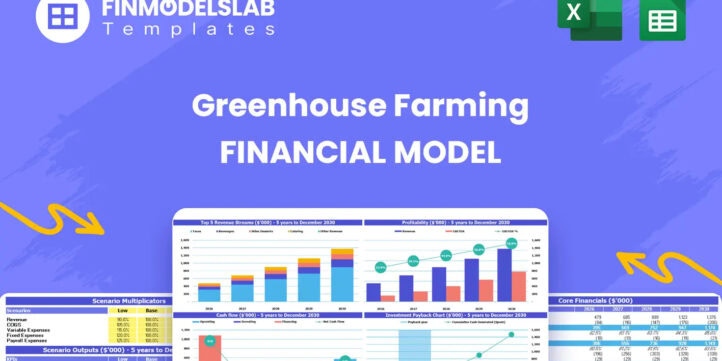
The Greenhouse Farming Financial Model helps users evaluate the economics of a controlled environment agriculture business before launch, expansion, or funding discussions. It gives entrepreneurs, greenhouse operators, consultants, analysts, and business plan writers a structured way to forecast crop revenue, startup costs, operating expenses, payroll, cash flow, and profitability using editable assumptions. Instead of building a complex spreadsheet from scratch, users can begin with a ready-to-use model designed around the real financial drivers of greenhouse farming, including crop mix, yield, pricing, production costs, labor, land use, and capital investment. This template is useful for planning a new greenhouse farm, comparing expansion options, preparing investor materials, or reviewing the financial feasibility of an indoor farming concept. Users can enter revenue assumptions by crop, adjust cultivated area, estimate harvest cycles, model yield loss, and test selling prices to see how commercial decisions affect sales and margins. The model also supports detailed cost planning by separating direct production costs, variable operating expenses, fixed overhead, payroll, and capital expenditures, making it easier to understand the true cost structure of the operation. For funding and stakeholder communication, the Greenhouse Farming Financial Model provides organized outputs that can support business plans, loan applications, investor presentations, and internal decision-making. It helps users review projected financial statements, cash requirements, return metrics, break-even timing, and overall profitability. By connecting assumptions to professional reports, dashboards, and charts, the template gives decision-makers a clearer view of whether the farm can sustain itself, how much funding may be required, and which operational levers have the greatest impact on performance. The model is fully editable and built for practical use in Microsoft Excel and Google Sheets. It is designed for both financial and non-financial users who need a clear planning tool for greenhouse farming without hiring a consultant or spending weeks building formulas. Whether the goal is to validate a startup plan, refine a commercial greenhouse budget, benchmark performance, or manage growth over multiple years, this financial model template provides a practical framework for turning assumptions into actionable financial projections.


Greenhouse Farming Financial Model Overview
The Greenhouse Farming Financial Model is a ready-to-use financial model template built to help entrepreneurs, farm owners, consultants, analysts, and funding teams plan the economics of a greenhouse farming business with greater structure and confidence. Greenhouse operations are capital intensive and operationally detailed, so a useful forecast must go beyond simple sales estimates. This model connects crop selection, cultivated area, yield, harvest cycles, selling prices, production costs, staffing, overhead, land strategy, cash flow, and profitability into one editable planning tool. It is designed to help users evaluate whether a greenhouse farm can generate enough revenue to cover its fixed cost base, manage variable expenses, fund capital investment, and scale toward long-term profitability. The template can support business planning, investor presentations, bank discussions, internal budgeting, and expansion analysis by translating operational assumptions into financial outputs that are easier to review, explain, and update.
All-in-One Dashboard
The all-in-one dashboard brings the most important inputs and outputs into a single planning view so users can quickly understand how the greenhouse farming business is expected to perform. This section typically summarizes core assumptions such as cultivated area, crop mix, pricing, yield, harvest frequency, cost percentages, staffing, capital investment, and financing requirements, then connects those assumptions to key outputs such as revenue, gross profit, EBITDA, net income, cash position, and return metrics. For a greenhouse operation, this is especially useful because many decisions are interdependent. A change in crop allocation can affect revenue, energy demand, packaging costs, labor needs, and cash flow. The dashboard gives users a practical starting point for reviewing the model without having to navigate every worksheet in detail. It also helps business owners and advisors identify the key drivers behind the forecast, spot unusual assumptions, and present a concise overview to investors, lenders, partners, or management teams.
Low, Base, and High Scenario Analysis
The low, base, and high scenario analysis component helps users compare different financial outcomes under conservative, expected, and optimistic assumptions. Greenhouse farming projections can vary significantly depending on crop pricing, yield performance, energy costs, labor efficiency, harvest frequency, land expansion timing, and market demand, so a single forecast is rarely enough for serious planning. This section allows users to test how the business might perform if yields are lower than expected, selling prices soften, input costs rise, or expansion takes longer than planned. It can also show the upside if crop yields improve, pricing is stronger, operating efficiency increases, or cultivated area expands faster. The outputs may include changes in revenue, gross margin, EBITDA, net income, cash flow, break-even timing, and funding requirements. This component is useful for decision-making because it helps users understand risk before committing capital, negotiating loans, or presenting a funding case. It also makes the model more investor-ready by showing that the business has considered more than one possible outcome.
Professional Charts
The professional charts component turns the financial model’s calculations into visual outputs that are easier to interpret and present. Greenhouse farming involves many moving parts, and charts can help users communicate complex financial information more clearly than rows of numbers alone. This section may visualize revenue growth, crop revenue contribution, expense mix, COGS trends, payroll growth, EBITDA progression, cash flow movement, accumulated investment, and long-term profitability. For business plans and stakeholder presentations, charts help explain the relationship between operational scale and financial performance. For example, users can show how revenue increases as cultivated hectares expand, how variable expenses behave as a percentage of sales, or how cash flow is affected by upfront greenhouse structure and system investments. These visuals are useful for entrepreneurs who need to pitch the business, consultants preparing client deliverables, and management teams reviewing performance milestones. The charting structure also supports faster decision-making by making trends, pressure points, and growth opportunities easier to see.
ROE Components and DuPont Analysis
The ROE components section uses a DuPont-style framework to help users understand the drivers behind return on equity rather than looking at profit in isolation. For a greenhouse farming business, return performance can be influenced by operating margin, asset utilization, capital structure, and the amount of equity required to fund construction, systems, land, and working capital. This component may break return on equity into financial factors such as net profit margin, asset turnover, and financial leverage, allowing users to see whether returns are being driven by strong operating profitability, efficient use of assets, or reliance on debt financing. This is valuable because greenhouse farming often requires significant upfront investment in structures, hydroponic systems, climate control, irrigation, lighting, and equipment. A farm can generate positive revenue and still deliver weak returns if capital intensity is too high or margins are too thin. By examining ROE components, users can better assess whether the business is using investor capital efficiently and whether operational improvements or financing changes are needed to improve returns.
Revenue Inputs
The revenue inputs component is where users define the core commercial assumptions behind the greenhouse farming forecast. This section is typically built around crop selection, land allocation, cultivated area, yield per harvest, number of harvests per year, expected yield loss, and selling price per kilogram or unit. For example, a user can allocate a portion of the farm to leafy greens, herbs, tomatoes, cucumbers, strawberries, or other greenhouse crops, then estimate production volume based on harvest cycles and yield assumptions. The model can convert these operational inputs into annual and monthly revenue projections by crop, allowing users to see how each crop contributes to total sales. This is essential for greenhouse farming because crop mix decisions affect not only revenue potential but also labor requirements, growing media costs, packaging, energy usage, and market risk. The revenue inputs section helps users replace broad estimates with a more detailed operating forecast. It is especially useful for feasibility studies, business plans, and funding documents because it shows the logic behind the revenue projection instead of presenting sales as a single unsupported number.
Bank-Ready Reports
The bank-ready reports component organizes the financial outputs into lender-friendly and stakeholder-ready summaries. Greenhouse farming businesses often require external financing for construction, equipment, climate systems, working capital, land acquisition, or expansion, and lenders need clear visibility into repayment capacity, profitability, and cash flow. This section may include formatted profit and loss statements, cash flow forecasts, balance sheet projections, debt schedules, key financial metrics, and summary outputs that are suitable for review by banks, investors, grant providers, or internal finance teams. The reports help users present assumptions and results in a professional structure rather than sending an unorganized spreadsheet. They can also support conversations about funding requirements, loan sizing, repayment timing, minimum cash balance, and financial risk. For users preparing a business plan or loan application, this component saves time by placing the most relevant financial statements and metrics in a cleaner format. It also helps reviewers understand whether the greenhouse operation can generate enough operating cash flow to cover expenses, reinvestment needs, and financing obligations.
Revenue Breakdown
The revenue breakdown component provides a detailed view of revenue streams so users can understand exactly where sales are expected to come from. Instead of only showing total revenue, this section can separate income by crop type, cultivated area, harvest cycle, yield volume, selling price, and year. For a greenhouse farming business, this level of detail is important because not all crops have the same economics. Leafy greens may have frequent harvest cycles and consistent demand, while fruiting crops may require different growing periods, labor intensity, and pricing assumptions. The revenue breakdown helps users compare the contribution of each crop to total sales and evaluate whether the planned crop mix supports margin goals and market strategy. It also makes it easier to identify concentration risk if too much revenue depends on one crop or sales channel. For planning and decision-making, users can adjust crop allocation, test pricing changes, or model expansion into higher-value crops to see the effect on revenue growth. This section is useful for entrepreneurs, operators, and consultants who need to defend the commercial logic of the forecast in a clear and data-backed way.
KPI Dashboard
The KPI dashboard tracks key performance indicators that help users evaluate whether the greenhouse farming business is financially healthy and operationally efficient. This component may include metrics such as revenue per hectare, yield per hectare, gross margin, COGS as a percentage of revenue, energy cost as a percentage of revenue, payroll as a percentage of sales, EBITDA margin, net profit margin, cash runway, payback period, internal rate of return, and return on equity. For controlled environment agriculture, KPI tracking is essential because small changes in yield, pricing, energy costs, or labor productivity can materially affect profitability. The dashboard gives users a benchmark-style view of performance and helps identify which assumptions need closer review. It can also support monthly management reporting once the farm is operating by giving owners and managers a way to compare actual performance against forecast expectations. For investors and lenders, KPIs provide a quick way to evaluate scalability, efficiency, and financial discipline. This component makes the model more practical as both a planning tool and an ongoing performance management resource.
Startup Costs and CAPEX Planning
The startup costs and CAPEX planning component helps users estimate the initial investment required to launch or expand a greenhouse farming operation. This section can include greenhouse structure costs, hydroponic or growing systems, climate control, irrigation, lighting, sensors, automation, packing equipment, cold storage, vehicles, land purchase, lease deposits, permits, professional services, initial marketing, and working capital reserves. Greenhouse farming can require substantial upfront spending before meaningful revenue is generated, so this component is critical for understanding how much funding is needed and when it is needed. The model can separate one-time capital expenditures from ongoing operating costs, helping users avoid underestimating the cash required to reach commercial operation. It can also support phased expansion planning by showing how additional hectares, equipment upgrades, or system improvements affect capital needs over time. For business owners and founders, this section provides a more disciplined way to budget for launch. For lenders and investors, it clarifies the use of funds and shows whether the requested capital aligns with the operational plan.
Break-Even and Profitability Analysis
The break-even and profitability analysis component helps users identify when the greenhouse farming business is expected to cover its costs and begin generating sustainable profit. This section can calculate break-even timing based on revenue, COGS, variable operating expenses, fixed overhead, payroll, depreciation, financing costs, and tax assumptions. It may also show gross profit, EBITDA, operating income, net income, profit margins, and cumulative cash flow over the forecast period. For greenhouse farming, break-even analysis is especially important because the business may have high fixed costs from facility leases, systems maintenance, management salaries, insurance, utilities, and professional services, along with significant capital investment. Understanding the sales volume and crop performance needed to cover those costs helps users make better pricing, staffing, and expansion decisions. This component is also valuable for funding discussions because it shows how long the business may need external support before becoming self-sustaining. By connecting profitability outputs to operational assumptions, the model helps users see which levers have the greatest impact on the path to profit, such as improving yield, increasing price, reducing energy costs, optimizing labor, or adjusting the crop mix.
File types:
Excel – Single-User: .xlsx
Excel – Multi-User: .xlsx
Similar ProductsOther customers were also interested in...


 HenrySheykin
Rice Growing Financial Model Excel Template
The Rice Farming Financial Model helps turn a rice cultivation plan into a structured, investor-read... Read more
Vegetable Farming Financial Model Excel Template
The Vegetable Farming Financial Model helps users turn a farming concept, expansion plan, or funding... Read more

Organic Gardening Financial Model Excel Template
The Gardening Service Financial Model helps users turn a lawn care, garden maintenance, or horticult... Read more
Mushrooms Farming Financial Model Excel Template
The Mushroom Farming Financial Model helps entrepreneurs, growers, business owners, consultants, and... Read more
Cannabis Financial Model Excel Template
The Cannabis Business Financial Model is a ready-to-use financial model template designed to help en... Read more
Fruits Farming Financial Model Excel Template
The Fruit Farming Financial Model helps users turn a fruit farm concept, orchard expansion, or agric... Read more
Poultry Farm Financial Model Excel Template
The Poultry Farming Financial Model helps users turn a poultry farm concept into a structured, lende... Read more
Cotton Growing Financial Model Excel Template
The Cotton Farming Financial Model Financial Model Template helps entrepreneurs, farm owners, consul... Read more
Shrimp Farm Financial Model Excel Template
The Shrimp Farming Financial Model helps entrepreneurs, aquaculture operators, consultants, analysts... Read more
Marijuana Financial Model Excel Template
The Cannabis Business Financial Model is a ready-to-use financial model template designed to help en... Read more
You must log in to submit a review.