
0 ITEMS

Finding a Valuation Model for Your Business
Business valuation models serve multiple purposes, from mergers and acquisitions to strategic planning and investor relations.
- Valuation helps determine the worth of a business for various uses, including taxes, capital gains, and financing.
- Different methods, such as discounted cash flows, asset-based, and market approaches, are used to estimate a company’s value.
- Valuation outcomes impact share prices, IPO pricing, and investment decisions for listed companies.
- Strategic valuation can guide decisions on investing in or divesting business units and shaping corporate strategies.
- Using Excel templates simplifies the valuation process, making complex analyses more accessible.
Continuing with practical insights, this article covers essential valuation techniques and their applications for better decision-making.
A Valuation Model serves a Number of Purposes
Valuation Models are used to carry out business valuation for number purposes such as mergers & acquisitions, loaning and borrowings, taxes, and capital gains. Business valuation models differ according to business types, investor objectives, and the availability of information. For listed companies the valuation models can be applied more easily as compared to unlisted entities. However, the valuation of listed companies is not free from challenges for example, it is difficult to predict the effects of mergers and acquisitions on the share prices. Business valuations can be carried in number of ways, the commonly used methods evaluate the business in multiple dimensions. The health of cash flows, timings of cash flows, net assets, earnings potential and costs.
Generally the valuation model of a business is different for buyer and the seller. Just take an example, a multinational company wants to take over the local company in the Canada in the retail industry in order enter the new markets in the American region. The purpose, assumptions, and the growth of the buyer side effects the results and valuation techniques. Or you may say the company offers specific value for the buyer and the seller according to their business goals. From a negotiation point of view, a valuation is needed to justify a rationale decision, therefore to tell the buyer the value he will get compared to the price he pays and to tell the seller what the business has worth, thus should not sell below that value.
In the listed companies context in particular, the valuation outcomes takes into account the impact of share prices and assist the buyer in selling, holding, and purchasing of shares of a given company. From a seller point of view, the valuation will tell about the shares are under- or overvalued. In the initial public offerings Business valuation is used to justify the prices at which the initial capital could be raised from the public investors.
Business Valuation and Strategic Planning
Valuation is not just for taking over a business, but it can be well used for laying the strategic road map of the business. For example, a large conglomerate can individually carryout the valuation of its individual subsidiaries, strategic business units, or divisions to estimate the earning potential of each, and decide whether to invest, cut, or abandon the business units. This could be helpful in forming the overall financial and corporate strategy of any business. Furthermore, with the help of valuation, a business can assess the impact of the strategic policies on wealth maximization and destruction. Thus a solid valuation model can also help the management in decision making.
Methods for Business Valuation
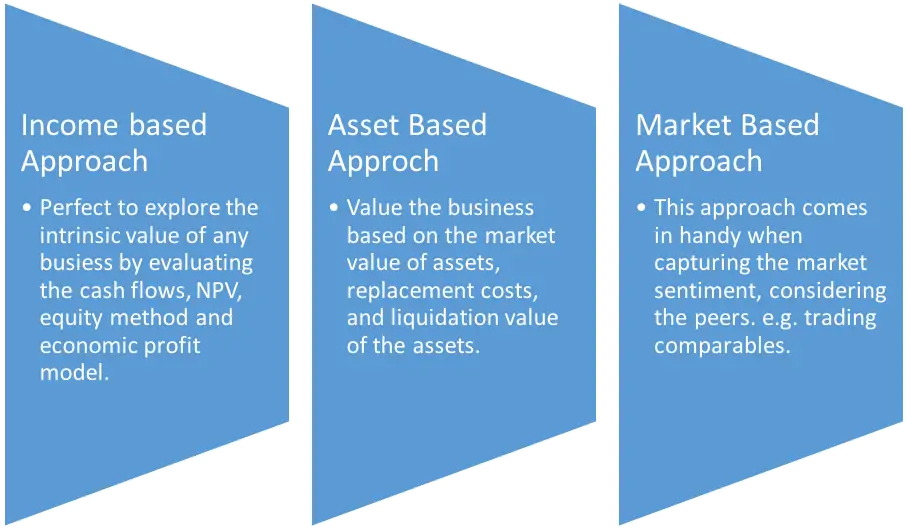
Traditional methods that were used in the early 20th century included balance sheet based approaches that mainly focused on the total assets, net assets, book value, liquidation values, and substantial values of the assets. Today the financial viability is carried out by more advanced valuation methods that are discounted cash flows (DCF), CAPM (Capital Asset Pricing Models), payback analysis, etc. Please note that, a single valuation model will not be able to give us a fair result. To have a fair value range, we need to rely on more than valuation methods. We may adopt income based, assets based, and market based approaches in order value and have a fair estimate to base our decisions. In the diagram below you may glance at the available approaches to business valuation and understand their advantages and disadvantages.
- Income bases valuation approaches
- Asset based valuation approaches
- Market based valuation approaches
Using Excel for Business Valuation
Thanks to Excel based templates that have made the business valuation much easier to carry out. Simply build your own valuation model by working off a templates which guides you through the required input assumptions and gives you quickly an output. Here at eFinancialmodels, we have ready to use business valuation templates, and plan your next investment with us.
You might also like:
- 10 Tips to Develop a First Class Business Valuation Report
- 12 BUSINESS VALUATION METHODS
- How to Value a Business Using a Discounted Cash Flow Model
- What is a business valuation model?
- How Are Valuation Multiples Determined
- Business Valuation
- Financial Ratios Analysis and Its Importance
- Financing
- Financial Forecasting Models by eFinancialModels
- Financial Planning for Small Business Owners – Taking an SBA Loan
- How to Raise Series A Funding?
- How to Start a Distillery Business: What You Need to Know?
- Mastering Business Finance: The Three-Statement Financial Model
- Valuation Services
- Steps to Securing Series C Financing
- Top 10 Mistakes in DCF Valuation Models
- Finding Fair Market Value: A Quick Guide to Real Estate Valuation
- Financial Modeling for Startups and Small Businesses
- Finding the Balance in Your Optimal Capital Structure
- Understanding the Debt Service Coverage Ratio: An Essential Metric for Financial Analysis


