
0 ITEMS

Understanding Illiquidity Discounts in M&A Valuation

Illiquidity impacts the valuation of private companies and assets by requiring discounts that reflect their limited marketability.
- Illiquid assets are harder to sell quickly and often require a reduction in value through an illiquidity discount, typically ranging from 20% to 30%.
- Understanding the difference between liquid assets like stocks and cash versus illiquid assets such as real estate and private equity is crucial in M&A valuation.
- Measuring the illiquidity discount can be done through comparable company analysis or discounted cash flow (DCF) models, both considering marketability challenges.
- An illiquidity discount adjusts valuation multiples, like EV/EBITDA, to provide a more realistic picture of private company worth.
- Incorporating these discounts into financial models helps buyers and sellers negotiate fair prices and make informed investment decisions.
Further insight into how marketability affects valuation and transaction structuring can help optimize deal outcomes.
What Is Illiquidity?
First, let us answer the following question: what is illiquidity? Illiquidity is the difficulty or inability to quickly convert an asset into cash without greatly affecting its price. It can cause delays in accessing funds when needed, making it harder to respond to urgent financial needs or opportunities. What is illiquidity involves assets not easily traded in public markets. Their value can fluctuate based on market conditions or buyer interest. This makes them less reliable for quick cash needs, potentially limiting financial flexibility.
In mergers and acquisitions (M&A), understanding illiquidity is crucial as it influences asset and company valuations. The illiquidity discount is applied during valuation to reflect the challenges of selling these assets. This discount compensates for the risk of holding assets that can’t be quickly liquidated. Investors often use a risk-adjusted discount rate to account for the added uncertainty and delays in converting illiquid assets into cash. Recognizing these factors helps investors and stakeholders in M&A make informed decisions.
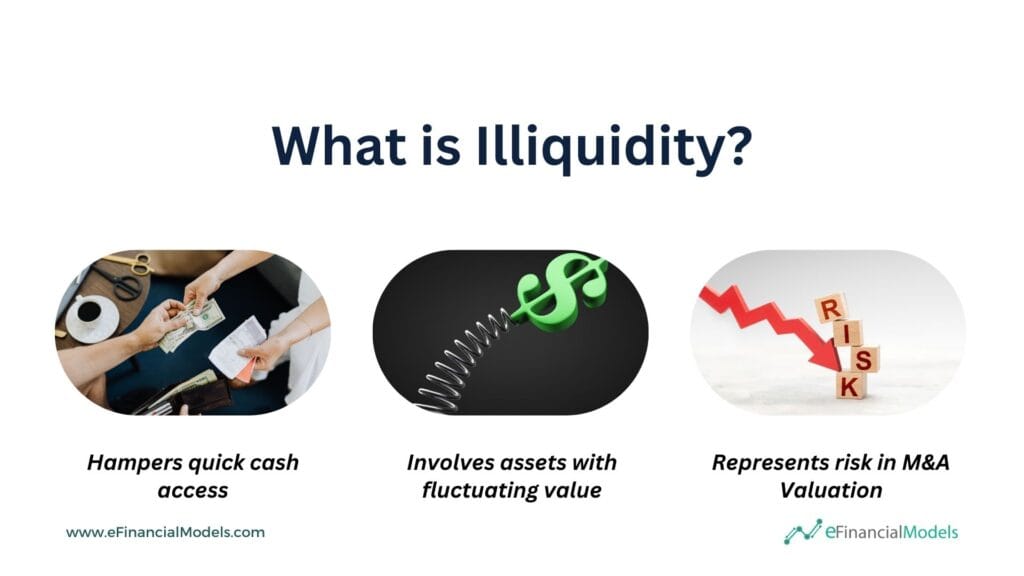
It is essential to note that an increase in illiquidity raises the required return, usually achieved by lowering current prices. This results in a common rule of thumb: the illiquidity discount for private firms typically ranges from 20-30%, with little variation between firms. The illiquidity discount for public companies is typically smaller than for private companies because public companies have more liquid markets.
Liquid vs. Illiquid Assets
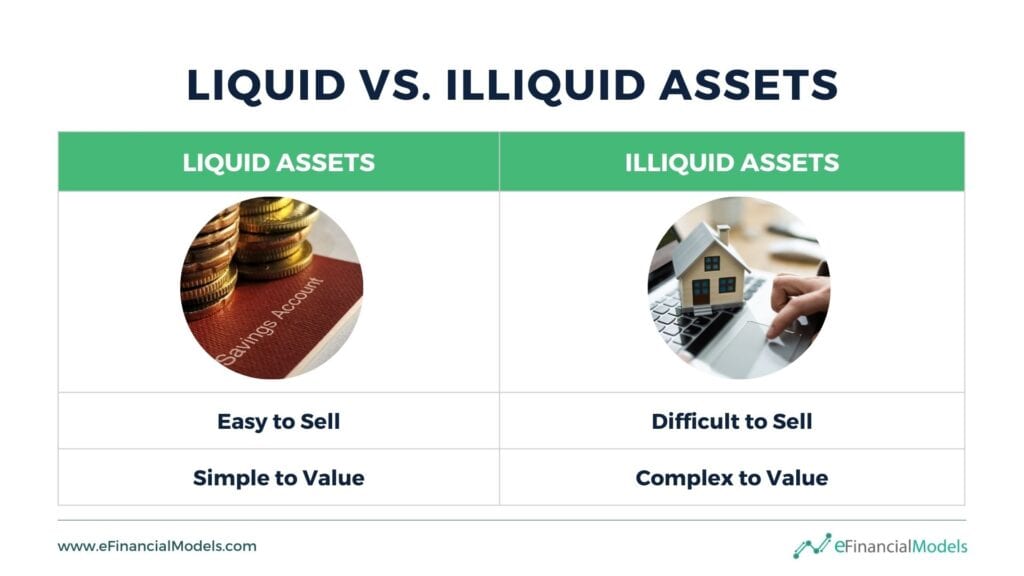
Next, let us understand the difference between liquid vs. illiquid assets. Liquid assets can be quickly converted into cash without significant loss of value. These include cash, bank accounts, and marketable securities, such as stocks and bonds. Liquid assets are essential for meeting immediate financial needs or emergencies because they are readily accessible. Illiquid assets, on the other hand, are harder to sell quickly. They require more time and effort to convert into cash. Real estate, private equity, and collectibles fall into this category.
In an M&A valuation, understanding liquid vs. illiquid assets is essential. Liquid assets are easier to assess and value. They provide a clear and immediate measure of financial health. Their valuation is straightforward because their market value is readily available, helping to streamline the valuation process. Illiquid assets are more complex to value in M&A transactions. They may require a longer timeframe for liquidation. Their valuation depends on market conditions, demand, and potential future earnings, making the process more subjective and time-consuming. This difference can impact how an M&A deal is structured and negotiated.
























































How to Measure the Illiquidity Discount
In mergers and acquisitions (M&As), multiples such as the EV/EBITDA, P/E, or Price-to-Sales ratios are commonly used to estimate the value of a company. However, despite their utility, these multiples often assume that the market for comparable companies or assets is liquid, meaning shares can be quickly bought and sold at prevailing market prices. In contrast, many M&A transactions involve private companies, illiquid assets, or stocks that cannot be traded freely, leading to the need for an illiquidity discount.
Measuring illiquidity requires a tailored approach. The best method depends on the asset type, available data, and market conditions. To measure the illiquidity discount effectively, it is important to combine market data, empirical research, and modeling approaches. The appropriate method depends on the context, such as whether valuing restricted shares, private companies, or specific investments.
Comparable company analysis and discounted cash flow (DCF) analysis are the two typical methods to measure the illiquidity discount.
Measuring Illiquidity Through Comparable Company Analysis
Measuring an illiquidity discount using comparable company analysis involves comparing public company valuations with private company transactions or less liquid assets. A public company sells shares through stock exchanges, and their prices are visible. Privately-held companies don’t trade shares publicly. They are illiquid because buying and selling stakes involve direct negotiations, often leading to limited market demand and lengthy sale processes. It is also essential to understand the type of stake involved, as controlling stakes often lead to control premiums, while minority or non-controlling stakes often lead to illiquidity discounts.
The first step is to select companies operating in the same industry with similar size, growth prospects, and risk profiles. One of the best ways to do this is through precedent transaction valuation. Once you have a list, you may need to gather financial data. Most professional investors prefer the Enterprise Value to EBITDA Multiple (EV/EBITDA) as a valuation metric. Calculate the mean or median of the EV/EBITDA multiples from your comparable companies to mitigate the impact of outliers. Since public companies are more liquid than private companies due to the ease of trading shares on public markets, we need to apply an illiquidity discount based on empirical studies or market practices. As mentioned, common illiquidity discounts range between 20% and 30%, depending on the private company’s risk profile and market environment. The illiquidity discount is then deducted to the median multiple to measure the privately-held company’s illiquidity.
Example Calculation
Let us calculate the enterprise value of a privately held company using the following financial data:
- Median EV/EBITDA multiple of comparable companies = 8.0x
- Illiquidity Discount = 25%
- EBITDA = $10 million
First, we must adjust the EV/EBITDA median multiple by subtracting the illiquidity discount. Then, we multiply the adjusted multiple by the company’s EBITDA to estimate its Enterprise Value (EV).
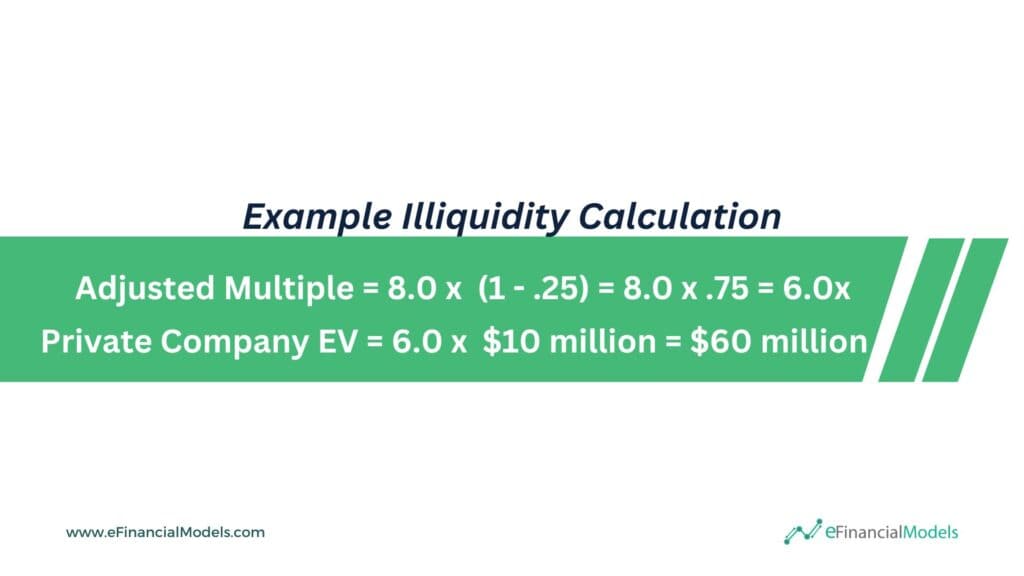
The above calculation shows how to apply an illiquidity discount to a company’s valuation multiple. In essence, the illiquidity discount adjusts for private companies’ reduced marketability. This approach benefits investors by providing a more realistic valuation that accounts for the challenges of selling private company shares compared to publicly traded stocks.
Quantifying Illiquidity Using Discounted Cash Flow Analysis
The Discounted Cash Flow (DCF) approach is commonly used to measure illiquidity discounts by calculating the present value of future cash flows while adjusting for the reduced value of an illiquid asset. In this method, future cash flows are discounted at a risk-adjusted discount rate, a higher rate that reflects the risk and difficulty of quickly selling the asset. The illiquidity discount is factored into that discount rate, which is typically higher for illiquid assets due to their increased risk and the inability to convert them into cash easily. This adjustment allows for a more accurate valuation of illiquid assets, ensuring the final value properly reflects their marketability constraints.
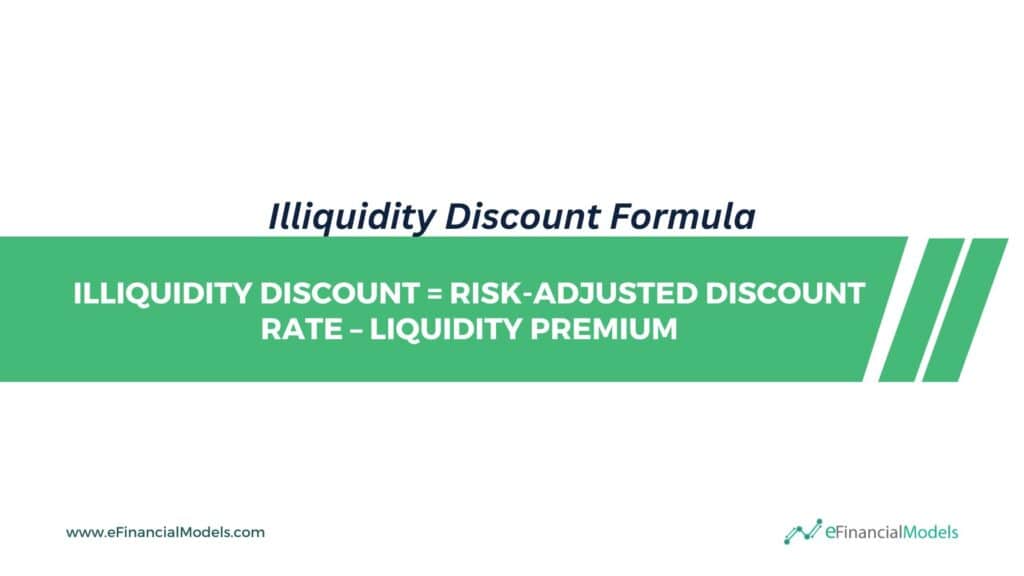
The mathematical formula to calculate the illiquidity discount using DCF is as follows:
Where:
- The risk-adjusted discount rate accounts for the investment’s general risk and the specific risks associated with the asset. It is the sum of a risk-free rate and a risk premium. The risk-free rate, typically the return on a government bond of similar duration to the investment, can be found in government bond yields (e.g., 10-year U.S. Treasury yields) or central bank rates (e.g., the Federal Reserve’s rate for the U.S. market). The risk premium reflects the additional return required for the specific risks of the investment. It can vary based on the asset’s volatility, market conditions, and business-specific risks.
- The liquidity premium is an additional return investors require to compensate for the risk of holding an illiquid asset. It is typically found by comparing the asset’s returns or prices with those of more liquid alternatives, often requiring market data, historical trends, and sector analysis.
Generally, you can find RADR data in public financial reports, where companies disclose their cost of capital. Financial databases like Bloomberg, Reuters, and Damodaran Online provide access to risk-free rates, market premiums, and industry-specific data. Academic studies and financial publications also offer industry-specific risk premiums, particularly for sectors like venture capital and real estate.
Example Calculation:
Let’s assume an M&A valuation has the following assumptions:
- Risk-Adjusted Discount Rate (RADR) = 12%
- Liquidity Premium = 5%
- Initial Enterprise Value = $10 million
First, we calculate the illiquidity discount. Then, we multiply the illiquidity discount by the initial Enterprise Value (EV) to reflect its lack of marketability.
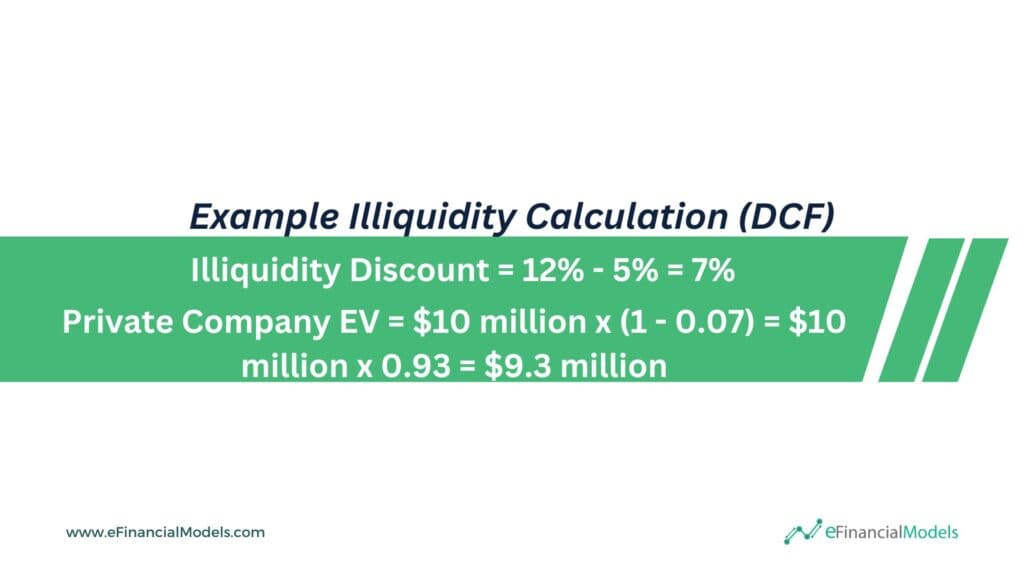
The above calculation demonstrates how applying an illiquidity discount impacts a private company’s estimated enterprise value (EV). Here, the illiquidity discount is calculated as 7%, reducing the EV to $9.3 million. This shows that accounting for illiquidity provides a more realistic valuation, helping investors account for the risks of holding non-public assets and making more informed decisions when comparing investments.
Applying a risk-adjusted discount rate is the best way to measure illiquidity discount in M&A valuation because it accounts for the additional risks associated with illiquid assets. These assets are harder to sell, making them riskier. Adjusting the discount rate for these risks makes the valuation more accurate, reflecting the potential loss in value due to the lack of liquidity. This approach helps buyers and sellers better understand the financial impact of illiquidity on the deal, leading to more informed decisions.
The Impact of Illiquidity Discounts on M&A Valuation
Illiquidity discounts play a significant role in shaping the expectations of both buyers and sellers in M&A deals.
Buyers often push for higher discounts to offset the perceived risk of acquiring a business that might not be easily sold or liquidated in the future. These discounts reduce the price they’re willing to pay, making the deal seem less risky to them. On the other hand, sellers are typically opposed to large discounts. They want to maintain the value of their business and argue that the potential for future growth justifies a higher price.
The negotiation around illiquidity discounts is a critical part of the M&A process. Both parties must find a balance between the buyer’s need for risk mitigation and the seller’s desire to preserve the value of their company. This balance affects not just the price but also the deal’s structure. It often requires careful discussions and compromises to reach a mutually agreeable discount that satisfies both sides.
Ultimately, the illiquidity discount helps set a more accurate valuation by aligning expectations with the realities of market conditions and the ability to exit the investment.
Setting a Fair Illiquidity Discount with Financial Modeling
Illiquidity discounts in M&A valuations are crucial in adjusting asset values to reflect the challenges of selling assets that are not easily liquidated. These discounts apply to businesses or assets that lack marketability, such as private companies or specialized assets. Typically, illiquidity discounts range from 20-30% for private firms and lower for public companies. The adjustment helps buyers mitigate the risk of owning hard-to-sell assets while sellers strive to preserve value. Understanding these discounts ensures more accurate pricing and fair deal structures.
Setting a fair illiquidity discount in M&A valuations is essential for achieving an accurate and mutually agreeable deal. Financial modeling helps buyers and sellers assess the true value of illiquid assets and mitigate risks associated with marketability constraints by applying the right risk-adjusted discount rate (RADR). This process ensures that the discount reflects the asset’s liquidity challenges while maintaining fair pricing. Whether buying, selling, or investing in a private company, leveraging financial modeling tools can optimize your decision-making and improve deal outcomes. Use advanced financial models today to better navigate illiquidity discounts in your next M&A transaction.

















































You might also like:
- Understanding the Debt Service Coverage Ratio: An Essential Metric for Financial Analysis
- How Do Startup Funding Rounds Work?
- How to Make a Startup Financial Plan for Fundraising?
- Understanding What is Yield to Maturity and Why It Matters
- Why Do You Need a Financial Model?
- Top 10 Mistakes in DCF Valuation Models
- IRR vs NPV in the Context of Financial Decision-Making
- How to Value a Business Using a Discounted Cash Flow Model
- What is Break-Even Analysis?
- Financial Services
- Commercial Real Estate Properties
- Real Estate
- Business Valuation
- Financial Valuation
- Scenario Analysis
- Business Valuation Service
- Discounted Cash Flow Valuation Model: Free Excel Template
- Financial Ratios Cheat Sheet
- Simple Cap Table Template – Free Download