
0 ITEMS

Leveraged Buyout (LBO) Financial Model
Leveraged Buyout (LBO) financial model providing acquisition financing, debt analysis, exit valuation, and IRR insights to assess investment returns.

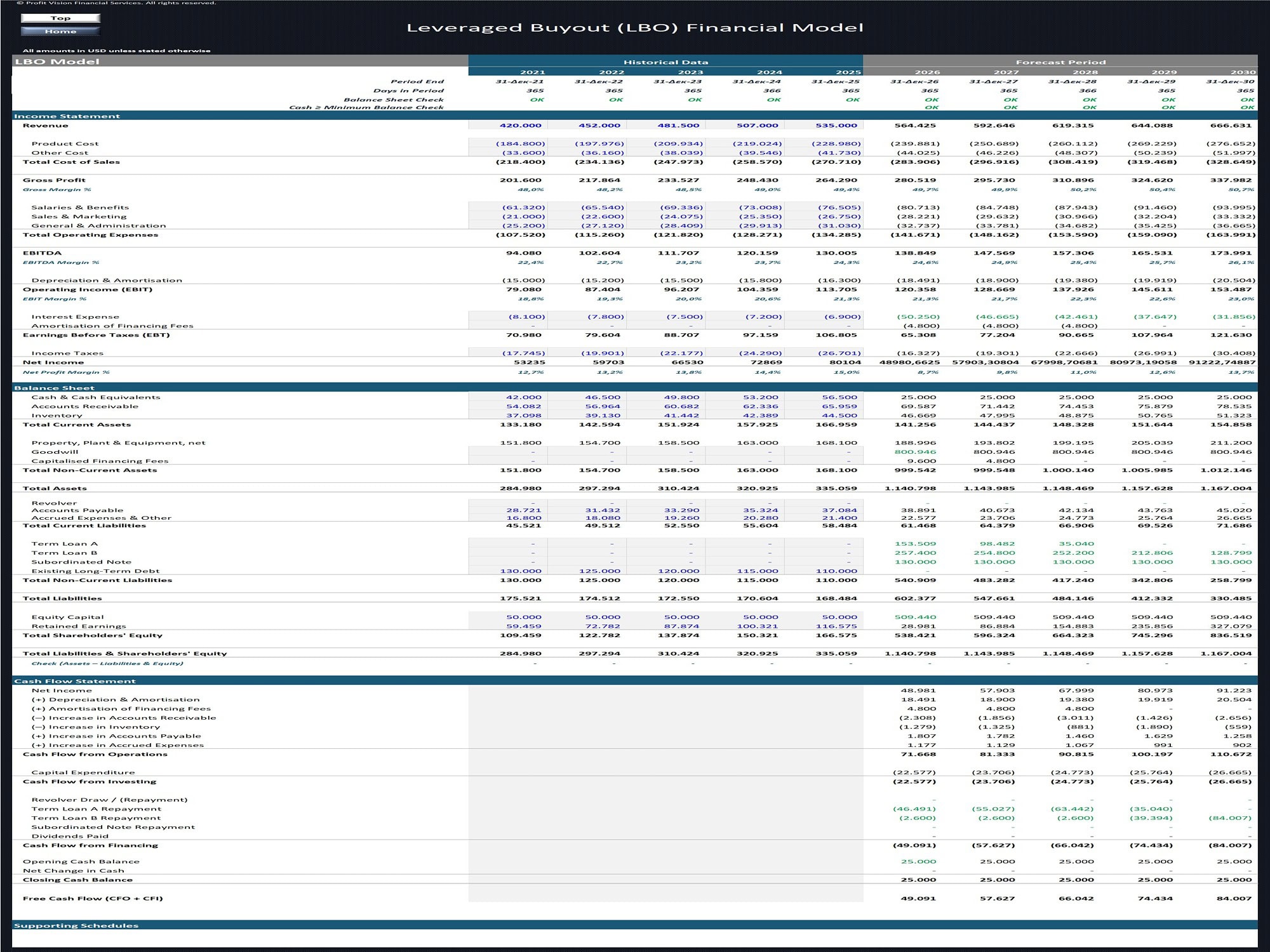
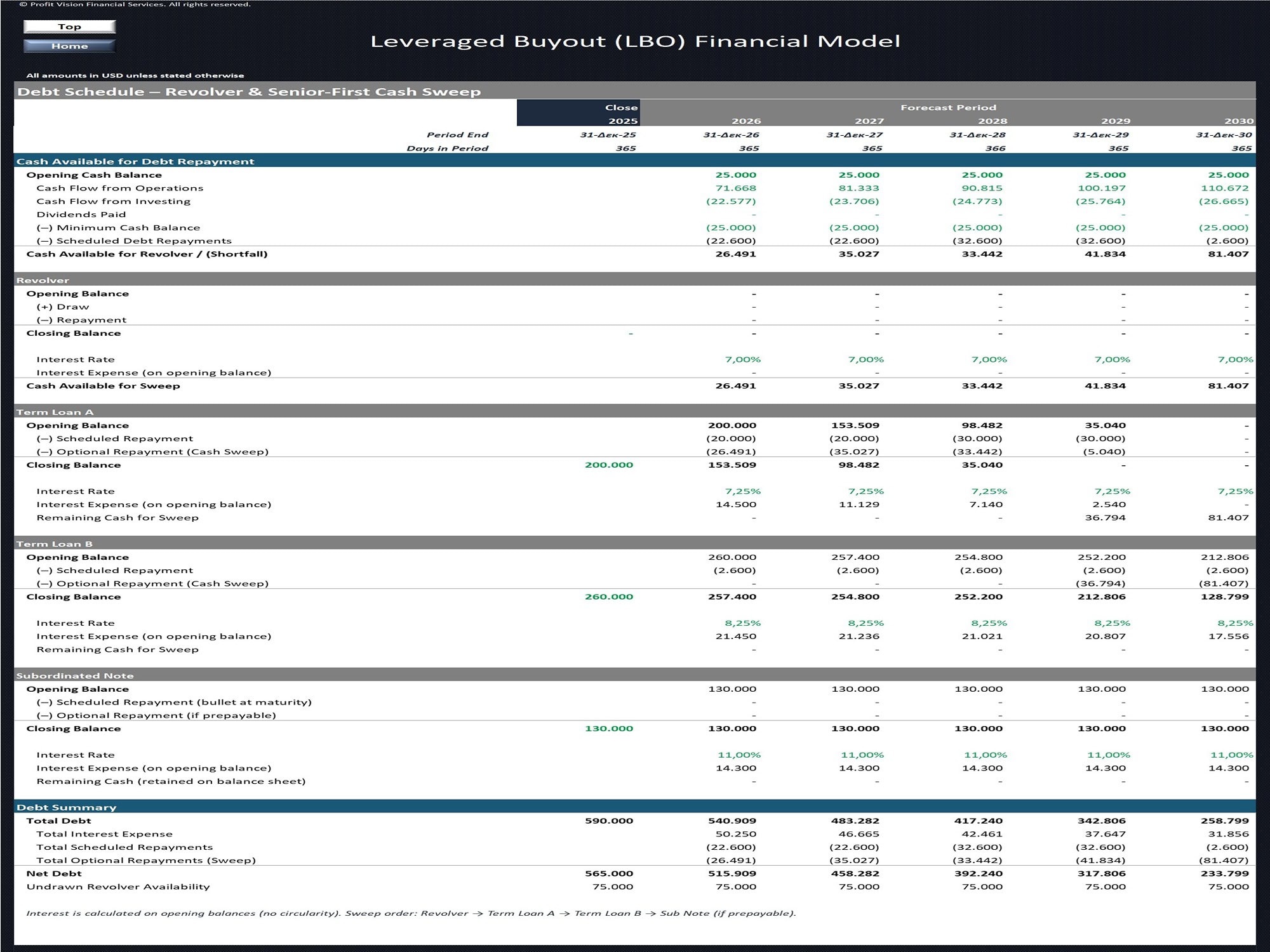
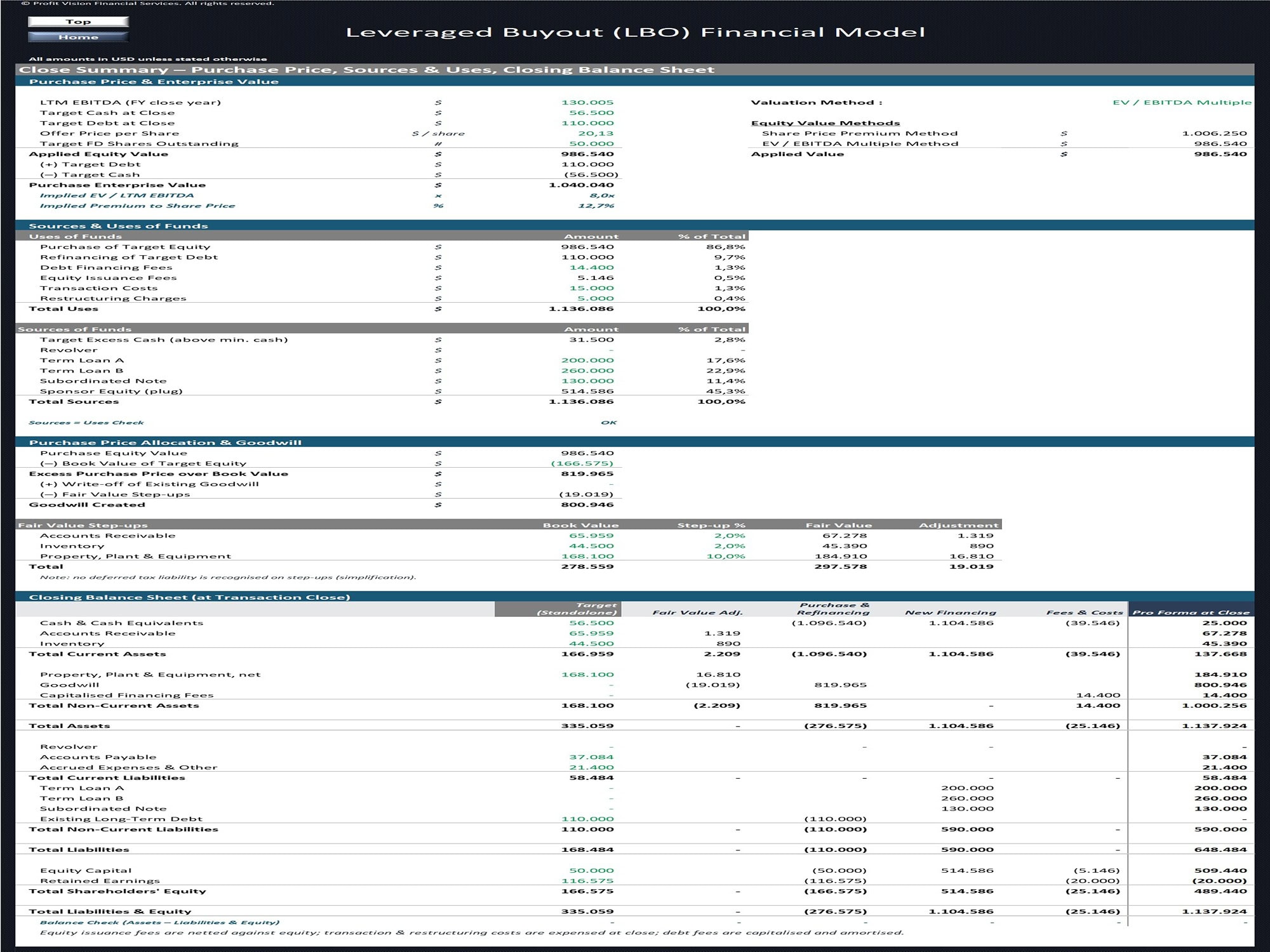
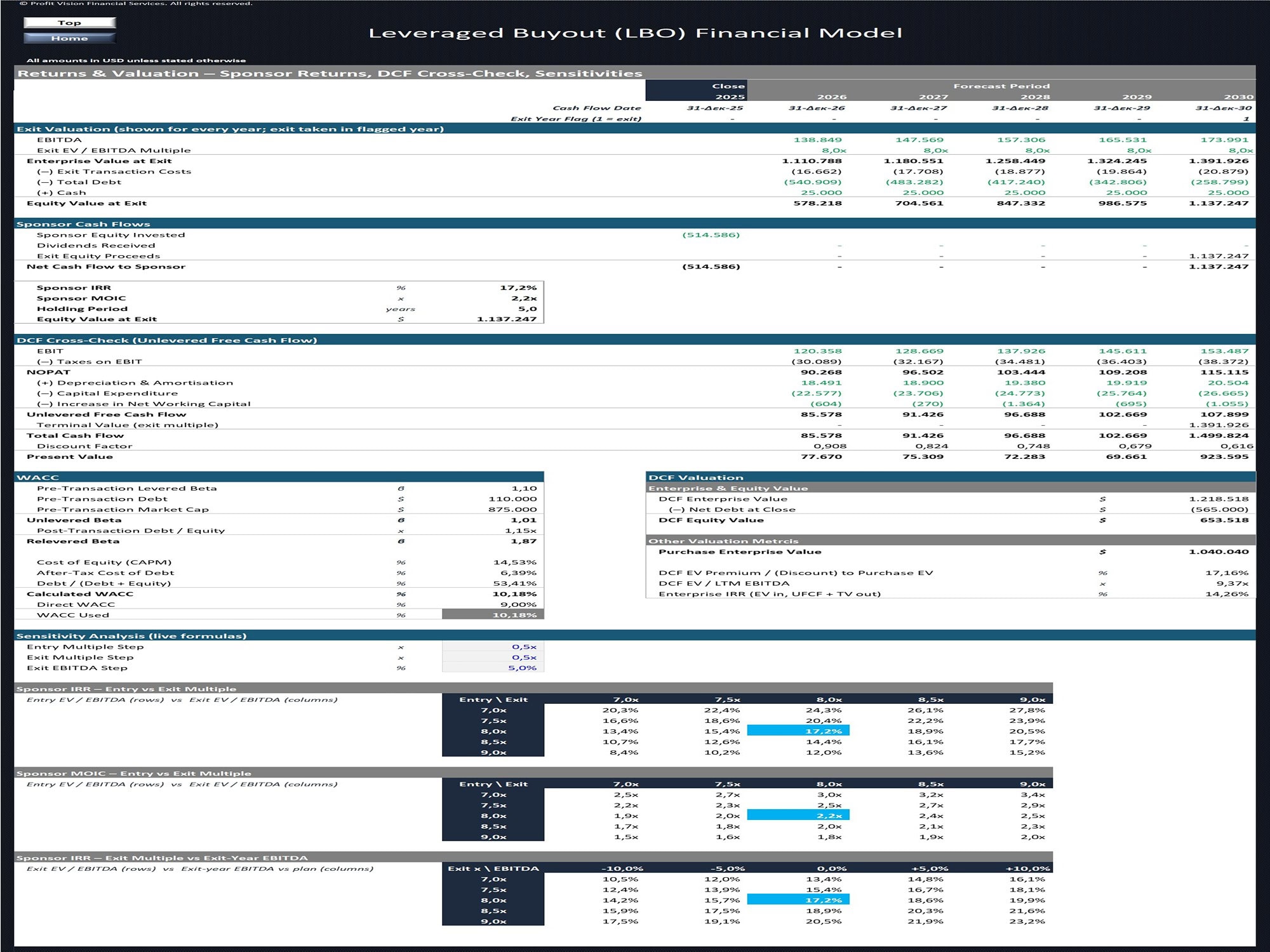
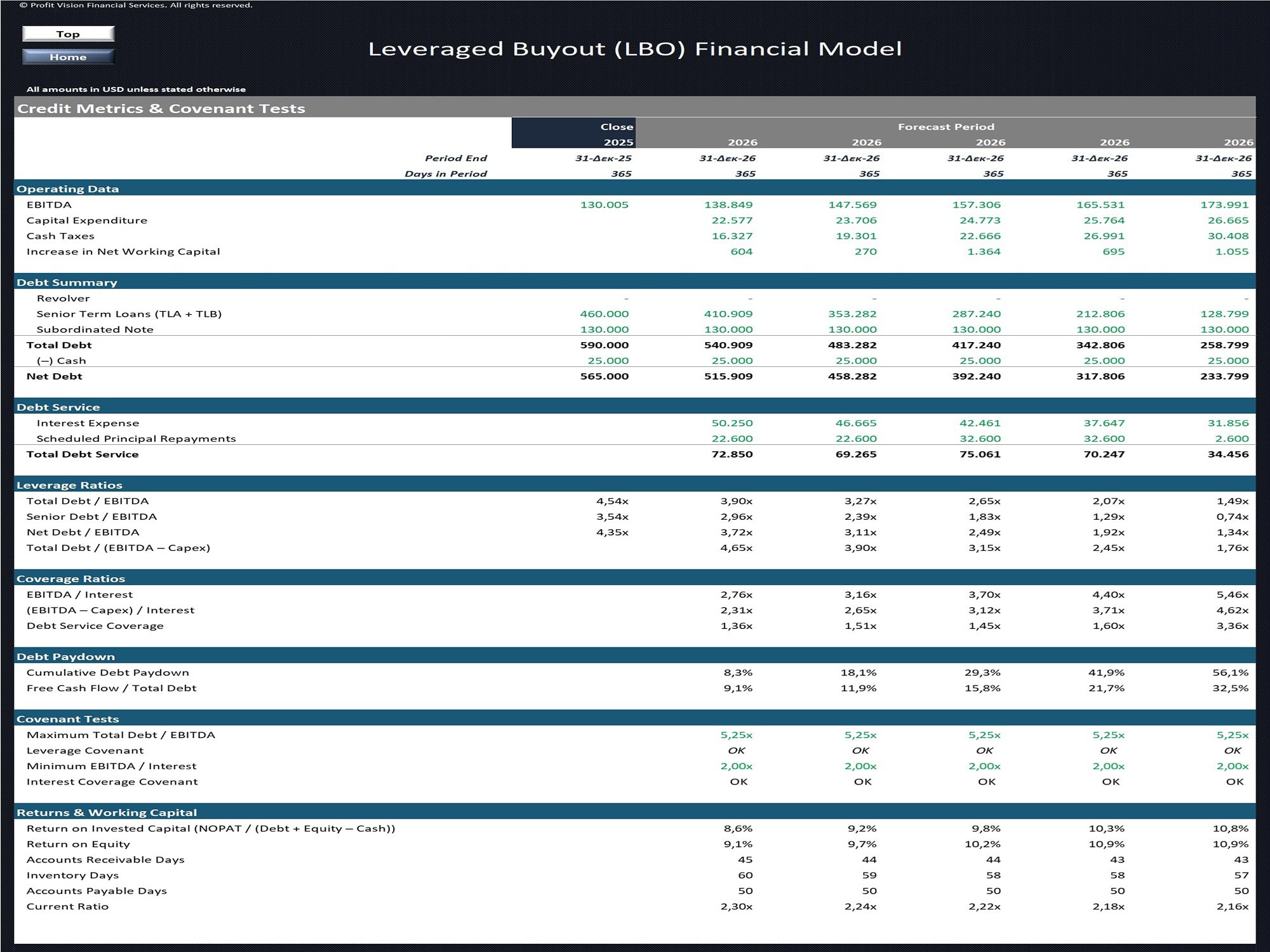
A leveraged buyout (LBO) is an acquisition in which a financial sponsor, typically a private equity investor, acquires a company using a combination of equity and a significant amount of debt. The acquired business’s future cash flows are generally used to service and repay the acquisition debt, while the sponsor seeks to generate an attractive return through EBITDA growth, debt reduction, potential multiple expansion and the eventual sale or exit of the investment.
This Leveraged Buyout (LBO) Financial Model provides a comprehensive framework for evaluating the acquisition of a target company from entry through exit. The model combines entry valuation, transaction financing, an integrated three-statement financial forecast, detailed debt repayment mechanics and exit assumptions to calculate the equity investment required and the resulting returns to the financial sponsor.
The model supports multiple operating scenarios and alternative entry valuation methods, and incorporates a multi-tranche debt structure with Revolver, Term Loan A, Term Loan B and Subordinated Note financing. It also includes purchase price allocation, cash sweep mechanics, debt paydown, credit and covenant analysis, sponsor IRR and MOIC, a DCF valuation cross-check, value creation analysis and live return sensitivities.
Model Structure
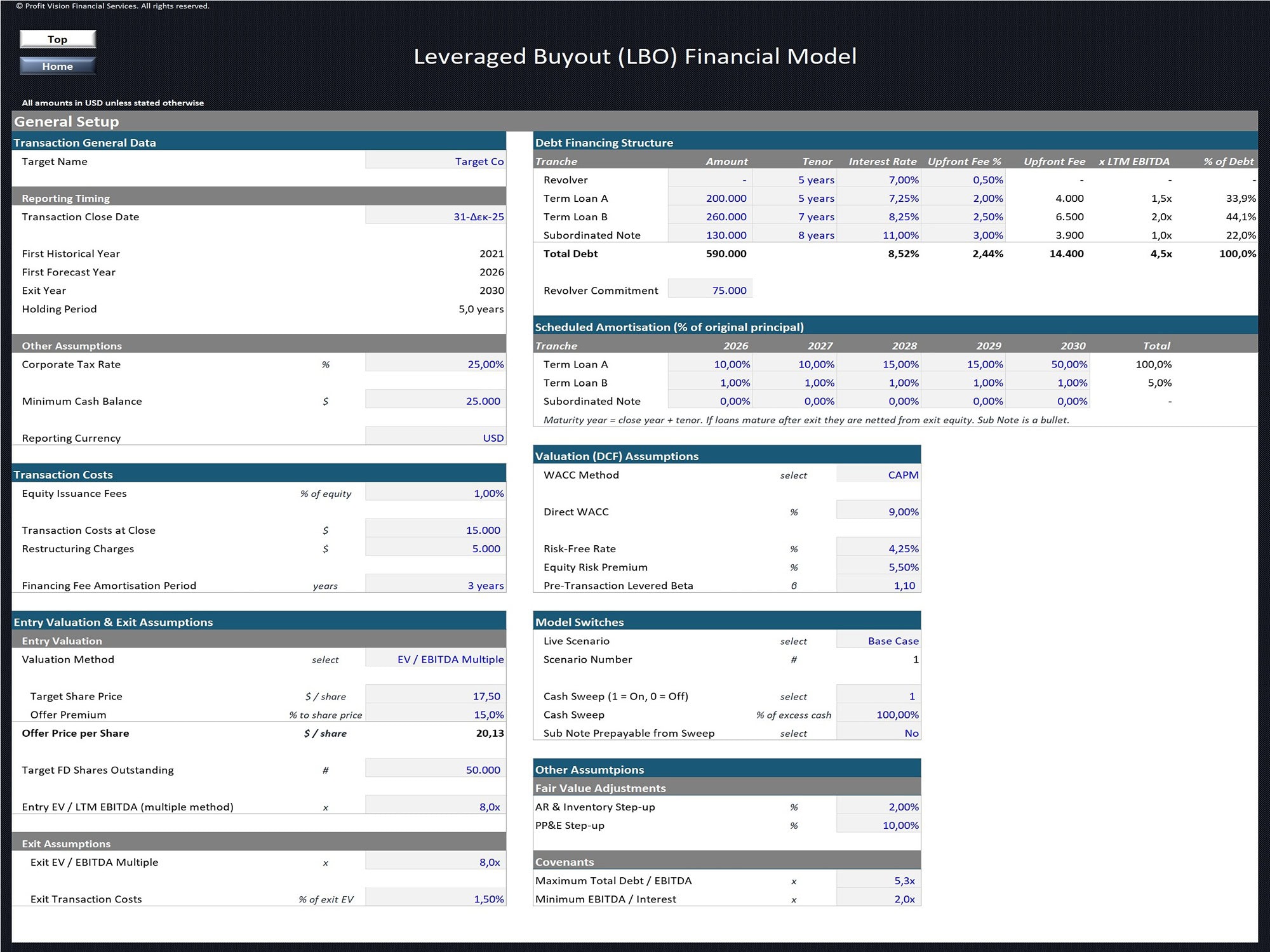
• General Setup
Central assumptions section containing the principal transaction and financing inputs, including transaction timing, tax rate, minimum cash requirements, entry valuation methodology, share price and offer premium, entry and exit EV / EBITDA multiples, transaction fees, fair value adjustments, operating scenario selection, WACC assumptions, debt tranche terms, interest rates, maturities, amortisation and covenant thresholds.
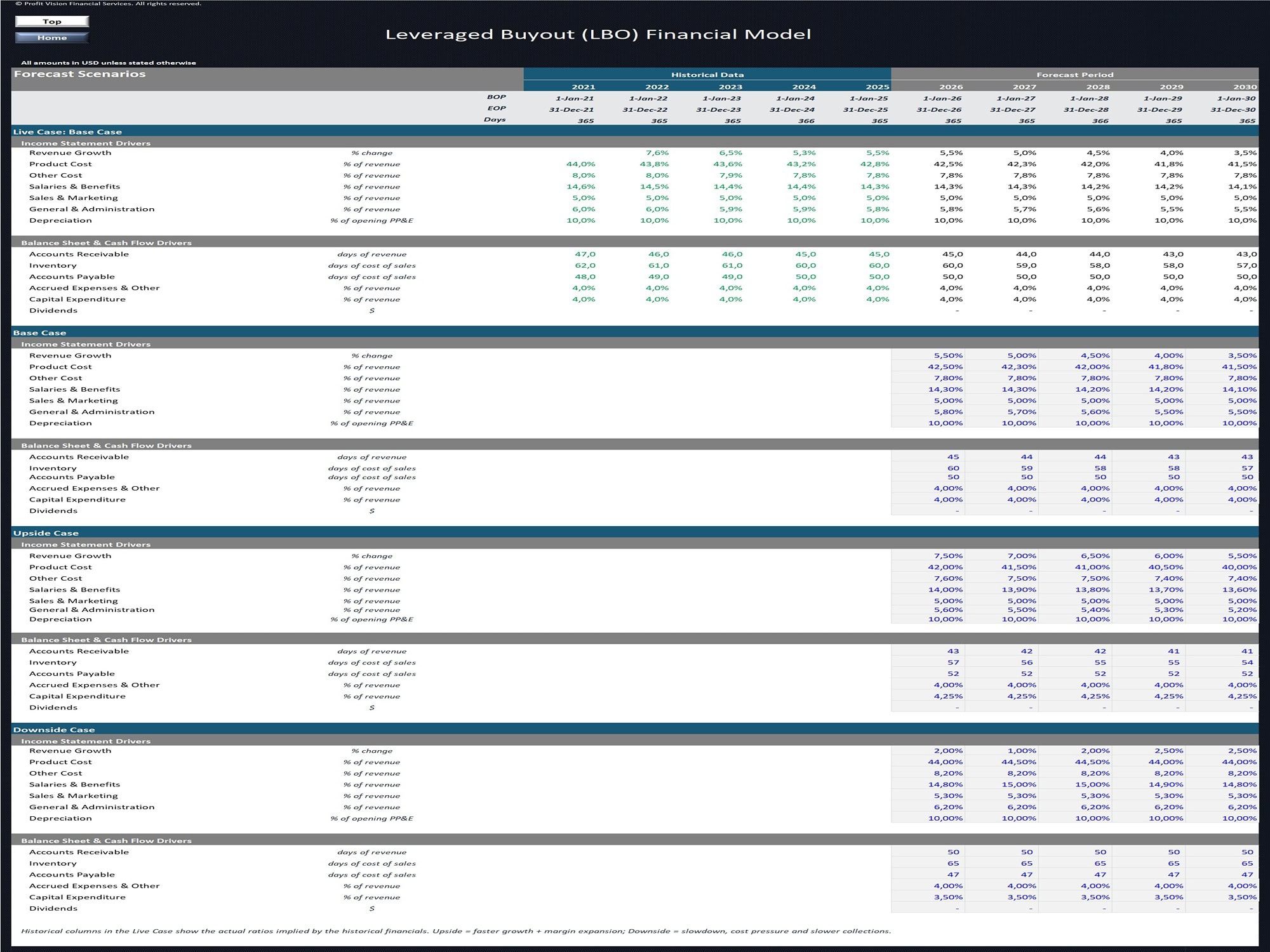
• Forecast Scenarios
Operating assumptions for the Base, Upside and Downside cases used to forecast the Target company’s financial performance. The selected live scenario flows through the model and drives the projected income statement, balance sheet and cash flow statement.
• LBO Model
Integrated three-statement financial model incorporating historical financial information and formula-driven forecast periods. The model projects revenue, operating expenses, EBITDA, earnings, working capital, capital expenditure, cash generation and balance sheet development throughout the investment holding period.
• Debt Schedule
Detailed acquisition debt schedule covering the Revolver, Term Loan A, Term Loan B and Subordinated Note. The schedule calculates interest expense, scheduled amortisation, revolver draws, debt maturities and a senior-first cash sweep that uses available excess cash to repay debt while maintaining the required minimum cash balance.
• Close Summary
Detailed transaction closing analysis presenting purchase price and enterprise value, Sources & Uses of Funds, sponsor equity requirements, debt financing, transaction and financing fees, purchase price allocation, fair value adjustments, goodwill creation and the Pro Forma closing balance sheet.
• Returns & Valuation
Sponsor return and valuation analysis presenting equity invested, exit proceeds, dividends, IRR and MOIC. The section also includes exit valuation, a DCF cross-check using unlevered free cash flow, sponsor value creation analysis and sensitivity tables for key transaction assumptions such as entry and exit valuation multiples.
• Credit Metrics
Analysis of the transaction’s debt capacity and credit profile throughout the forecast period, including Total Debt / EBITDA, EBITDA / Interest, debt service coverage, debt balances and covenant testing. The section helps assess the ability of the Target business to support and repay the proposed acquisition financing.
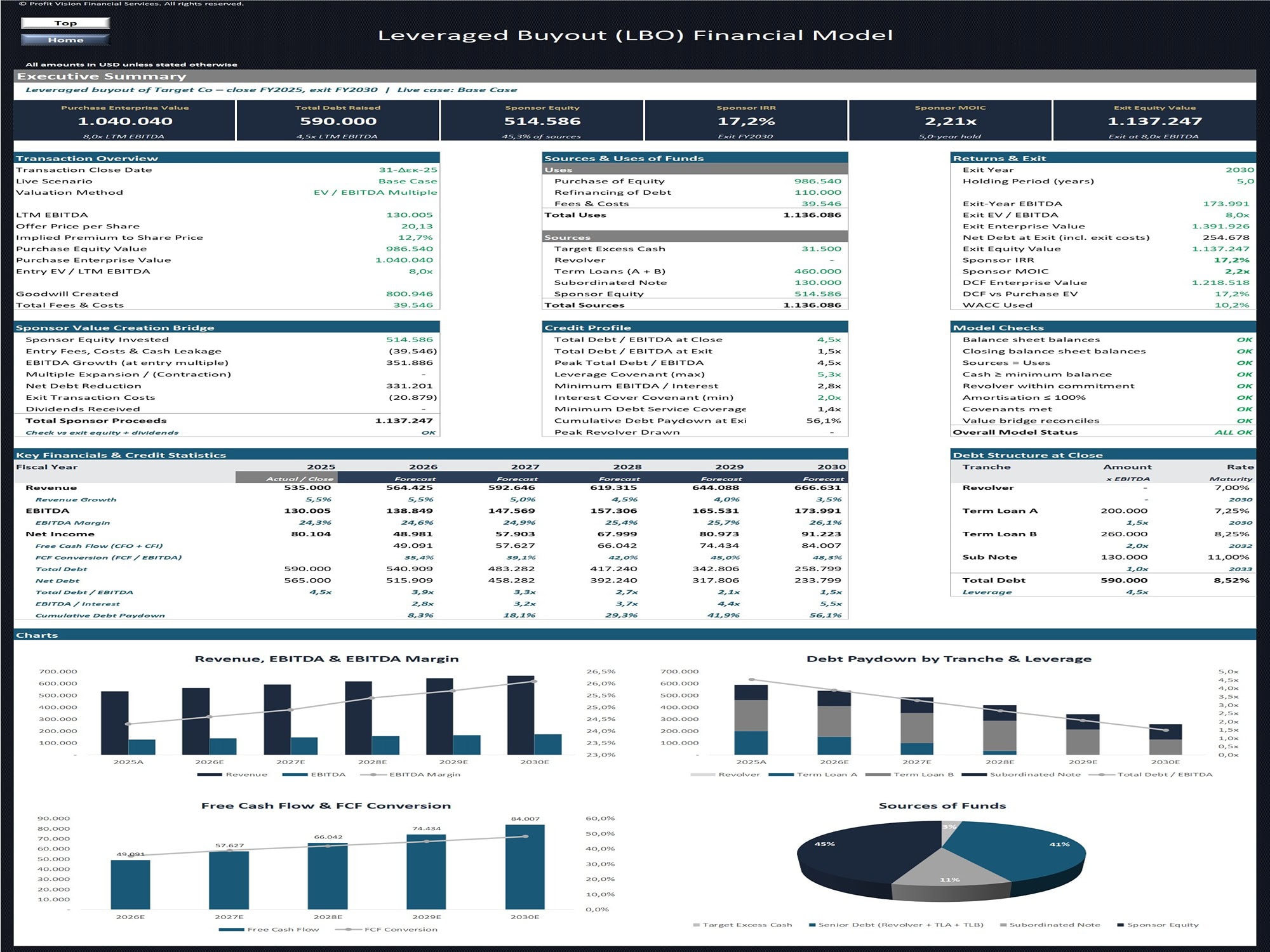
• Executive Summary
High-level dashboard summarising the principal transaction assumptions and outputs, including purchase enterprise value, debt raised, sponsor equity, IRR, MOIC, exit equity value, Sources & Uses, operating performance, debt paydown, credit statistics, value creation drivers and key model checks.
The Executive Summary also provides a concise view of the debt structure at close and the evolution of key financial and leverage metrics over the investment holding period.
Detailed instructions for the use of the model are included in the Excel file.
Help & Support
Committed to high quality and customer satisfaction, all our templates follow best-practice financial modeling principles and are thoughtfully and carefully designed, keeping the user’s needs and comfort in mind.
No matter if you have no experience or are well versed in finance, accounting, and the use of Microsoft Excel, our professional financial models are the right tools to boost your business operations!
If you, however, experience any difficulty while using this template and you are not able to find the appropriate guidance in the provided instructions, please feel free to contact us for assistance.
If you need a template customized for your business requirements, please e-mail us and provide a brief explanation of your specific needs.
Similar ProductsOther customers were also interested in...



 Giorgos
Startup Company Financial Model – 5 Year Fin...
Highly-sophisticated and user-friendly financial model for Startup Companies providing a 5-Year adva... Read more

Advanced Financial Model with DCF and Valuation
Dynamic 10-Year Financial Model, suitable for any type of business, supporting strategic planning, i... Read more

Mergers & Acquisitions (M&A) Financial Mod...
M&A financial model providing transaction analysis, valuation, deal financing, synergies, and ac... Read more

General Financial Models – All-in-One Bundle
A collection of templates suitable for various types of businesses/industries, covering major accoun... Read more

Cap Tables & Investor Returns Model
Cap Table and VC Returns Excel template covering funding rounds, dilution, ownership, preferred shar... Read more
Budgeting & Forecasting Model Template
Budgeting & Forecasting Template suitable for either a Trade or Service company in any type of i... Read more

Investment Financial Models Bundle (7 templates)
A collection of templates suitable for investment decisions in various types of businesses/industrie... Read more

Discounted Cash Flow (DCF) – Business Valuat...
User-friendly template providing a Discounted Cash Flow (DCF) valuation method suitable for any type... Read more

Three Statement Financial Model – 5 Year For...
A 3 statement model linking the income statement, balance sheet, and cash flow statement into one dy... Read more

Initial Public Offering (IPO) – Valuation &a...
IPO financial model providing financial forecasts, company valuation, share pricing, dilution analys... Read more
You must log in to submit a review.