
0 ITEMS

Private Equity
Private equity refers to investment funds organized as limited partnerships that are not publicly traded and whose investors are typically large institutional investors. Our financial model templates include tools for private equity modeling, including deal structuring, leveraged buyout analysis, and fund performance tracking.


A practical Excel-based acquisition underwriting model designed for European SME…
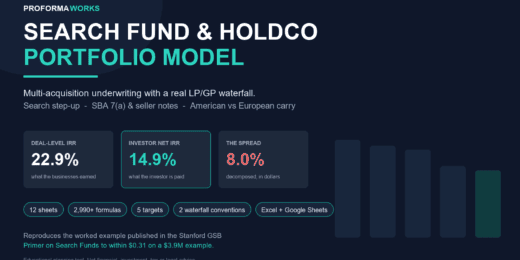

A portfolio of acquisitions is not the sum of five…
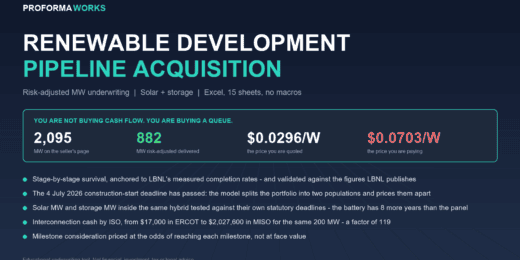
Converts a seller's nameplate megawatts into risk-adjusted delivered megawatts through…
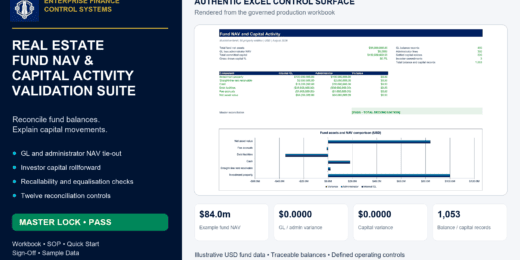

Reconcile fund NAV, investor capital movements and commitments through seven…
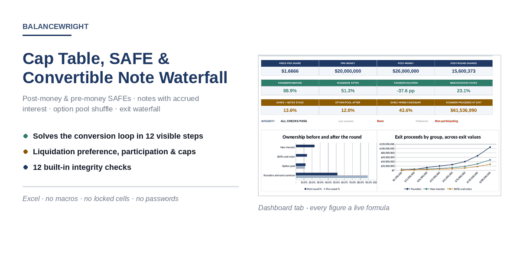

A working Excel model of a priced round: it converts…
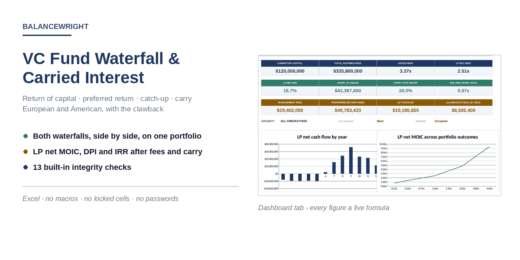
An Excel model of a venture or private equity fund's…


10-year financial model for a farmland investment fund providing forecasts,…


A specialized Excel valuation model for longevity and anti-aging biotechnology…

An integrated 10-year real estate portfolio model for underwriting and…

A professional Excel financial model for residential building development projects…

🏦 Leveraged Buyout Financial Model Bundle — Lite + Pro…

🚀 A professional Private Equity Buy-and-Build Roll-Up M&A Financial Model…

A complete, editable Veterinary Clinic Financial Model Pro built for…

A premium Excel financial model bundle created by PDMM for…

A professional PFAS Water Treatment & Remediation Financial Model created…


A genuinely complete private equity fund model — and one…

A professional Solar + Battery Energy Storage System (BESS) financial…

The Waterfall Profit Distribution Model – Up to 4 Tiers…

A professional Excel financial model suite for debt funds, built…

A professional 8-12 MTPA Liquefied Natural Gas (LNG) Financial and…


A ready-to-use Excel Solar Farm + BESS Financial Model Template…




A bottom‑up, operator-focused projection model that turns warehouse sizing +…


A professional multi-industry financial model allowing up to 1680 project,…


A complete and professional financial model of a photography studio…


Highly versatile debt fund projection model with 25 debt investments,…

10-year financial model for a private credit fund providing forecasts,…

Investment-banking style M&A merger model built for fast deal screening…


This private school financial model Excel provides a structured 10-year…

A tool designed specifically for modeling turnaround projects and then…

One of the most straightforward ways to struggle a preferred…
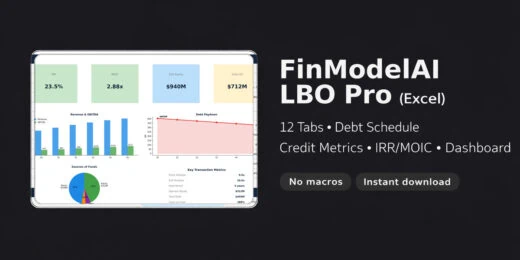
LBO Pro (Excel) – 12-Tab Model with Debt Schedule, Credit Metrics, IRR/MOIC, Sensitivity & Dashboard
Professional 12-tab Excel leveraged buyout (LBO) model with 400+ formulas…


A dynamic, ready-to-use Excel template for Hotel Development and Rental…

This is an IC-ready Excel model for structuring and underwriting…

A 10‑year, investor‑grade model for a battery recycling plant at…


Maximize your warehouse investment with this all-in-one Excel financial model.…

Model up to 10 years of ramping and stabilized operation.…
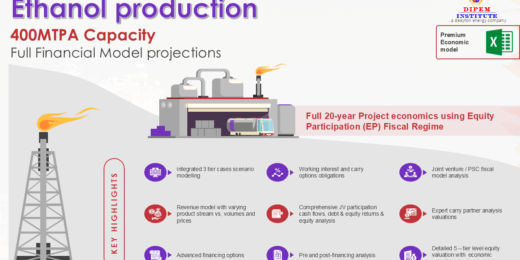

This comprehensive model provides a robust framework for evaluating the…

This financial model forecasts the performance of a subscription-based coworking…

10-Year financial model for a real estate acquisition partially funded…

This model is built to handle acquisitions or new develops…


Unlock the full potential of any data center acquisition with…

An effective cash flow and financial planning tool for multiple…


Institutional-quality analysis for your single-asset and SPV (Special Purpose Vehicle)…

A simple startup model for agent-based SaaS businesses. Includes fundraising…




Includes forward assumptions for LTL, economic vacancy, credit loss /…


This financial model projects monthly future cash flows for a…

A complete financial model, including income statement, balance sheet, and…

A scenario analysis tool that compares various angles of a…


This comprehensive financial model provides a sophisticated analytical framework for…
Introducing the **New Equity Raise Template (Debt-to-Equity Rollover Included)**—an essential…

Enter high-level inputs about underlying collateral, adjust variables, and see…

A powerful underwriting tool designed for leveraged joint venture purchases…



A comprehensive editable, 10-year 3-statement MS Excel spreadsheet for tracking…
Crafting Financial Plans for Successful Private Equity Deals

In the ever-evolving world of finance, private equity stands out for its dynamic approach to investment and value creation. Unlike traditional investment vehicles, private equity involves acquiring stakes in companies to maximize their potential before strategically exiting at profits. This unique aspect makes private equity an attractive option for investors seeking high returns, albeit with corresponding risks. However, crafting a successful private equity deal is no straightforward task; it demands meticulous financial planning and a deep understanding of complex financial instruments. In this article, we explore the intricacies of financial planning in private equity, from identifying key performance indicators to building robust financial models and leveraging the power of Excel templates for precision and clarity.
Successful private equity investments are more than financial transactions; they are strategic pursuits that hinge on comprehensive financial understanding and planning. Whether you are an investor, financial analyst, or a portfolio manager, grasping these essential elements will enhance your capacity to navigate the private equity landscape effectively. We delve into defining private equity's role, examine the key performance indicators vital for investment evaluation, and showcase how to construct meaningful financial models tailored to the complexities of private equity transactions. By the end, we'll highlight the substantial benefits of using Excel spreadsheet templates, backed by the expertise from eFinancialModels.com, for your financial modeling endeavors.
Understanding the Private Equity Landscape
Private equity (PE) is a form of investment in which capital is invested in private companies, or public companies are taken private and delisted from public stock exchanges. The primary goal of private equity firms is to acquire ownership stakes to improve a company's operational efficiency, financial performance, and ultimately increase its value for future profitable exits. The relevance of private equity in the investment landscape is profound, as it provides firms with the necessary resources and expertise to scale businesses, create jobs, and foster innovation.
Private equity investments exhibit certain defining characteristics: they are typically illiquid, involve significant leverage, and require long investment horizons. Illiquidity stems from the fact that investments are not readily tradable on public markets, necessitating committed capital for extended periods. Leverage plays a crucial role in maximizing potential returns by using debt to finance acquisitions or expand companies. However, it's the long investment horizon that allows private equity firms to implement substantial changes and strategies to unlock the true value in their investments.
Achieving success in private equity requires detailed financial planning. Strategic financial planning is essential as it bridges the gap between current performance and long-term business objectives, mitigating risks while enhancing potential gains. By mapping out future cash flows, capital needs, and identifying potential pitfalls ahead of time, private equity firms can guide their portfolio companies toward lucrative exits. This comprehensive planning assists in aligning investor expectations with business realities, ultimately contributing to successful deals.
Key Performance Indicators (KPIs) in Private Equity
The financial success of private equity investments hinges on meticulous tracking of certain key performance indicators (KPIs). Identifying relevant KPIs is crucial for financial planning, as they offer quantifiable measures of an investment's performance and inform critical decision-making. Some of the most pertinent KPIs in private equity include the Internal Rate of Return (IRR), Multiple on Invested Capital (MOIC), Cash-on-Cash Return, and Total Value to Paid-In (TVPI).
The Internal Rate of Return (IRR) is a pivotal KPI that measures the annualized rate of return on investment, incorporating the time value of money. Equally important, the MOIC provides insight into how much investors earn on their principal investment, expressed as a multiple. Cash-on-Cash Return focuses on the immediate income against the capital invested, essential for understanding current financial health. Meanwhile, TVPI offers a comprehensive metric by calculating the total value of a portfolio relative to the amount of capital invested, a broader view for assessing potential exits.
Understanding the importance of these KPIs is paramount as they reveal nuanced insights into an investment's performance. For instance, a high IRR implies a successful investment offering great returns within a shorter time, whereas MOIC and TVPI provide valuable long-term investment outcome perspectives. Benchmarking against industry standards allows investors to measure their performance relative to competitors, ensuring their strategies are aligned with market trajectories. Engaging in a benchmarking process not only aids in performance auditing but also informs strategic adjustments to enhance deal outcomes.
Building Comprehensive Financial Models for Private Equity
In the intricate realm of private equity, robust financial models are indispensable tools in structuring and managing deals. Financial modeling serves as the backbone of deal structuring, allowing analysts and investors to assess potential outcomes, risks, and the financial viability of acquisitions. A well-crafted financial model provides vital insights into a portfolio's performance, assisting stakeholders in making informed decisions.
Essential components of a private equity financial model focus on key areas such as portfolio company valuation, exit strategy modeling, capital structure analysis, and scenario and sensitivity analyses. Valuation forms the cornerstone of investment decisions, dictating transaction prices and forecasted returns. Exit strategy modeling helps define methodologies and timelines for profitable divestitures. A thorough capital structure analysis helps optimize investment structures for maximum returns while maintaining financial stability. Scenario and sensitivity analyses guide stakeholders in understanding how different variables impact financial outcomes, enabling better preparedness in a volatile environment.
The iterative process of financial modeling involves refining models in response to evolving market conditions and deal intricacies. It’s a dynamic journey of continuous improvement and adaptation, as assumptions and forecasts are recalibrated to align with the latest financial data and industry trends. This dynamic nature ensures that financial models remain relevant and actionable, empowering private equity professionals to make well-informed, real-time decisions that drive successful investment outcomes.
The Advantages of Using MS Excel Spreadsheet Templates
Excel has long been the gold standard for financial modeling, and for a good reason. The flexibility and customizability offered by Excel spreadsheet templates make them indispensable tools for private equity financial planning. These templates can be tailored to meet the specific needs of different deals or funds, offering a high degree of customization to match unique business requirements.
One of the standout features of Excel is its user-friendly interface and widespread familiarity among finance professionals, which significantly eases the task of financial modeling. This accessibility allows even complex financial models to be handled efficiently without being hampered by steep learning curves or technical barriers. Moreover, Excel streamlines team collaboration and enhances data sharing, making it easier to present comprehensive financial findings to stakeholders in a coherent format.
Utilizing pre-built templates reduces the risk of human error, ensuring that financial models adhere to industry best practices. Professionally designed templates incorporate proven methodologies and safeguards, creating a robust foundation for accurate financial planning. By leveraging these templates, private equity firms can focus on strategic decision-making without being bogged down by minor computational errors or inconsistencies.
Conclusion: Elevating Financial Planning in Private Equity with eFinancialModels
In conclusion, the private equity landscape demands not only sharp investment acumen but also precise and strategic financial planning. Specialized KPIs such as IRR, MOIC, Cash-on-Cash Return, and TVPI play an integral role in assessing investments’ success, guiding decision-making towards profitable exits. Comprehensive financial models form the backbone of deal structuring and management, equipping investors with the foresight to navigate dynamic market conditions effectively. Excel spreadsheet templates further enhance this process by offering flexibility, customization, and a user-friendly interface, ultimately reducing errors and enhancing collaboration.
For finance professionals seeking to optimize their private equity transactions seamlessly, eFinancialModels.com offers an array of industry-specific financial model templates. These resources are purposefully designed to streamline your financial planning processes, providing clarity and precision necessary for successful private equity deals. We invite you to explore our offerings to elevate your financial planning capabilities to new heights.
FAQs on Financial Planning in Private Equity
- What is the primary goal of private equity firms? Private equity firms aim to acquire ownership stakes in companies to enhance operational efficiency, improve financial performance, and increase value for future profitable exits.
- What characteristics define private equity investments? Private equity investments are characterized by illiquidity, significant leverage, and long investment horizons, allowing firms to implement substantial changes for value enhancement.
- Which KPIs are essential for evaluating private equity investments? Key KPIs include Internal Rate of Return (IRR), Multiple on Invested Capital (MOIC), Cash-on-Cash Return, and Total Value to Paid-In (TVPI), each providing insights into investment performance.