
0 ITEMS

How to Do a Precedent Transaction Valuation ?

Imagine a scenario where a leading technology company is eyeing an acquisition opportunity with a promising startup that recently patented a revolutionary new software. The executives are keen to make an offer but face a critical challenge: determining the right price to pay. It is where precedent transaction valuation or precedent transaction analysis becomes invaluable. By examining the acquisition prices of similar companies in the tech sector, the executives can gain insights into the market rates and adjust their offer accordingly, ensuring they pay a fair price without overbidding.
- They estimate future revenues, expenses, and profits based on market trends and historical data.
- Accurate projections help align business goals with realistic financial outcomes.
- Comparing projected and actual P&L statements reveals performance gaps and improvement areas.
- Using software templates and industry benchmarks enhances forecast reliability.
- Sensitivity analysis prepares your business for varying market conditions.
Every decision can lead to significant financial outcomes in high-stakes mergers and acquisitions, so an accurate valuation method is paramount. A precedent transaction analysis method provides a solid foundation for negotiations and equips companies with the data to justify their offer to shareholders and regulatory bodies. Let’s explore the methodologies, benefits, and intricacies of conducting a precedent transaction valuation.
What Is a Precedent Transaction Valuation?
Precedent transaction valuation is a market approach business valuation method. It estimates the value of a business by examining the implied multiples based on precedent valuation multiples paid for similar businesses in the past. The term “recent past” refers to a period of time close enough to the present to ensure the transaction data is still relevant. This period can vary depending on the industry and market conditions, but it typically ranges from the last 2 to 5 years. In the absence of recent transaction data, extending the time frame beyond the usual 2-5 years might be necessary. This method is particularly beneficial for providing a baseline for a privately held company valuation. It leverages publicly available information to derive estimates of multiples or premiums paid for publicly traded companies. By analyzing these transactions, the approach attempts to establish a reasonable price range that a buyer might be expected to pay for a business based on current transactions.
The strength of Precedent Transaction Analysis lies in its reliance on actual market transactions. It offers a practical perspective on what the market deems a company worth. This is grounded on the premise that the value of a company can be closely approximated by examining what acquirers have historically paid for similar companies under similar conditions. It’s a favored tool among professionals in investment banking, private equity, and corporate development sectors, as it provides a tangible basis for valuation grounded in real-market dynamics. The essence of deriving accurate and meaningful insights hinges on the comparability of transactions.
- Same geography
- Same business model
- Same size
- Same activities
- Same customer structure
- Controlling stake
Finding recent comparable transactions is challenging primarily due to the uniqueness of each transaction and the dynamic nature of markets. Transactions can differ significantly in terms of the assets involved, the conditions under which they occur, the motivations of the parties, and the economic climate at the time of the transaction. Additionally, the availability of detailed and reliable data about recent transactions can be limited, as such information may be confidential or yet to be fully processed and released. These make it crucial to adjust the analysis accordingly. While Precedent Transaction Valuation can be applied to both businesses and properties, our focus here is on its application as a privately held company valuation.

Why Perform Precedent Transaction Analysis?
Precedent transaction analysis is a key market approach business valuation method, alongside comparable company analysis and discounted cash flow. This method examines the price multiples paid in recent mergers and acquisitions (M&A) of similar companies to determine if the target company is valued appropriately within these established ranges. The valuation derived through precedent transaction analysis is anchored in tangible, market-based evidence by analyzing these past transactions, which reflect real-world market conditions and prices paid. This approach ensures that the valuation is not merely theoretical but is supported by actual transactions, providing a more realistic assessment of what buyers are willing to pay for similar companies under comparable circumstances.
The primary reason for performing precedent transaction analysis is to understand the implied valuation multiples, the ratios at which similar companies have been sold. Valuation multiples are ratios (EV/Revenue or enterprise-value-to-EBITDA) that help compare the value of one company to another by standardizing the value against a critical financial metric. By examining recent transactions, analysts can gauge the current market valuation norms for companies within the same industry or sector.
Precedent transaction analysis offers tangible, real-world data on the amounts investors are actually willing to pay for companies in a specific industry or sector. It serves as a market reality check against other valuation methods, like discounted cash flows or market multiples, based on theoretical and future expectations. Considering what has been paid for similar companies recently, this analysis helps validate the market appetite and the price expectations for businesses in that sector.
Furthermore, this type of analysis can provide deep strategic insights into merger and acquisition (M&A) trends by examining the characteristics of companies targeted in successful deals. It helps acquirers understand which aspects of a company or sector are precious. For example, if companies with strong tech portfolios tend to attract higher valuations, this can inform strategic decisions and investment priorities. It can also reveal more significant market trends, such as increased acquisitions within the tech sector or a shift towards specific business models, which are critical for strategic positioning and valuation considerations in future transactions. In summary, precedent transaction analysis offers a comprehensive view of the market’s valuation of similar companies, providing critical insights into how a company might be valued in a change of control scenario. It combines market-based evidence with industry-specific nuances, making it essential to any thorough valuation analysis.










































Steps to Perform Precedent Transaction Valuation
Precedent transaction valuation involves examining the conditions and prices of past transactions similar to those under consideration. These help establish a benchmark for valuation and provide valuable insights into market trends. By analyzing various aspects of completed deals, financial analysts can derive a range of values for a company or asset.
This introductory approach assists in making informed investment decisions and negotiating fair deal terms. The following steps outline a systematic process for conducting a thorough precedent transaction analysis, ensuring that all relevant financial, strategic, and operational factors are considered for accurate valuation and strategic alignment.
Step 1 – Compile Comparable Transactions
Performing a precedent transaction analysis begins with the meticulous compilation of comparable transactions, pivotal for deriving meaningful insights about the valuation and deal structures relevant to the company under scrutiny. This process involves several critical steps designed to identify past transactions closely aligned with the company in several fundamental aspects.
The first step focuses on identifying companies of similar size. It involves comparing key metrics such as revenue, the number of employees, and the number of operational locations. The rationale behind this comparison is to ensure that the transactions considered reflect companies with a similar scale of operations, as size can significantly influence a company’s valuation and the nature of its transactions.
Next, the analysis considers the deal size or the transaction value. This step is essential because transactions of a similar financial magnitude are more likely to provide relevant insights into how similar-sized deals are structured and valued. It also helps understand the market’s perception of value for companies of a similar scale and sector.
Geography is another crucial dimension. It involves examining transactions involving companies with headquarters in similar locations and with comparable revenue and customer mixes. The geographic focus ensures that the analysis accounts for regional market dynamics, regulatory environments, and competitive landscapes, which can all influence deal conditions and valuations.
Industry classification forms the next step in the process. Here, the aim is to select transactions within the same or closely related industries. Industry-specific trends, regulatory frameworks, and market conditions can significantly impact valuation norms and deal rationales, making this alignment critical for accurate analysis.
The product or service mix of the companies involved in the transactions is also a key consideration. Transactions between companies offering similar products or services will likely provide the most relevant insights as they operate under similar market conditions, face competitive pressures, and cater to identical customer bases.
The risk profile, including the discount rate and the weighted average cost of capital (WACC), is assessed. This step is critical for understanding the financial assumptions underlying each transaction and ensuring that the comparative analysis accounts for differences in perceived risk and cost of capital.
Here’s a sample of precedent transactions research we have made for the distillery industry. We start with a long list, which we will filter to the most comparable distillery acquisitions. Moving forward, we analyze the most relevant and recent transactions for accurate benchmarking and valuation purposes.
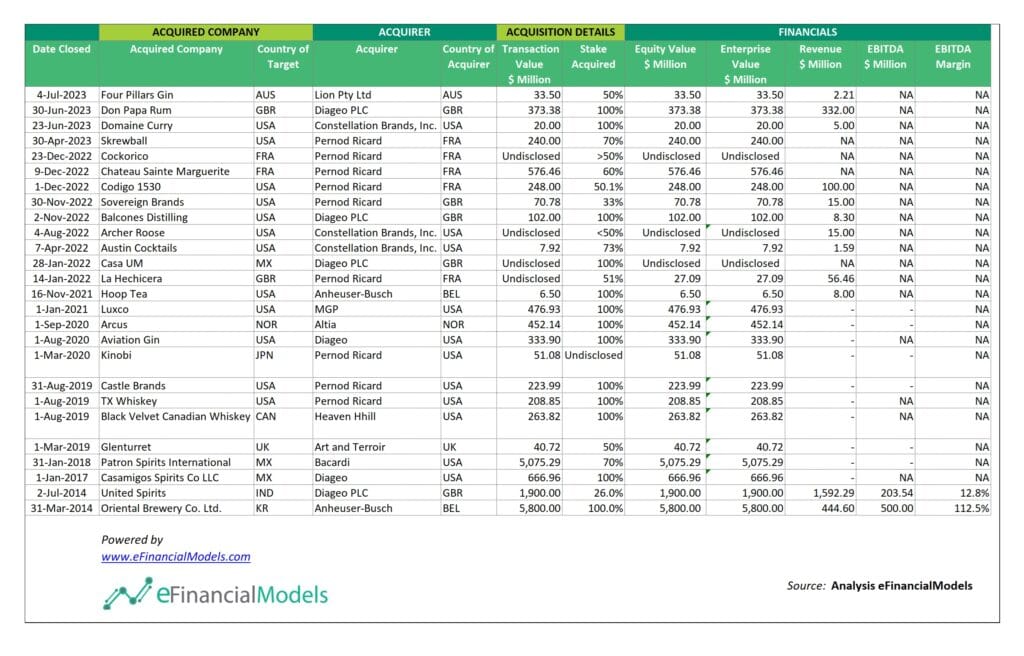
When compiling comparable transactions for a precedent transaction valuation, standard considerations include evaluating each transaction’s buyer profile, purchase type, and sale type.
- The buyer profile is crucial as it provides insights into the strategic or financial motivations behind the acquisition, which can significantly affect the transaction’s valuation and structure. For instance, strategic buyers may be willing to pay a premium for synergies, whereas financial buyers might focus on the potential for return on investment.
- The purchase type — whether an all-cash, all-stock, or mixed deal — also plays a crucial role in assessing the transaction’s financial implications and the relative risk the buyer and seller assume.
- The sale type can also influence the transaction dynamics, whether auctioned or negotiated directly. Auctioned sales often lead to higher sale prices due to competitive bidding, whereas negotiated sales reflect more strategic alignments and considerations between the buyer and seller. These factors provide a comprehensive view of each transaction’s context, enabling more accurate comparisons and insights into market valuations and deal structures.
Analysts can compile a set of comparable transactions that provide a solid foundation for a precedent transaction analysis by systematically comparing transactions across these dimensions. This initial compilation ensures the study is grounded in relevant and comparable market data, ultimately facilitating more accurate and insightful valuation assessments.

Pro-Tip: The best strategy to uncover precedent transactions within a specific industry is to meticulously examine the acquisition and investment histories of the industry’s leading players. By delving into the records of these top acquirers or investors and focusing specifically on their mergers and acquisitions over the past three years, you can gain valuable insights into market trends, valuation benchmarks, and strategic directions.
Step 2 – Determine the Financial Metrics & Valuation Multiples to Use
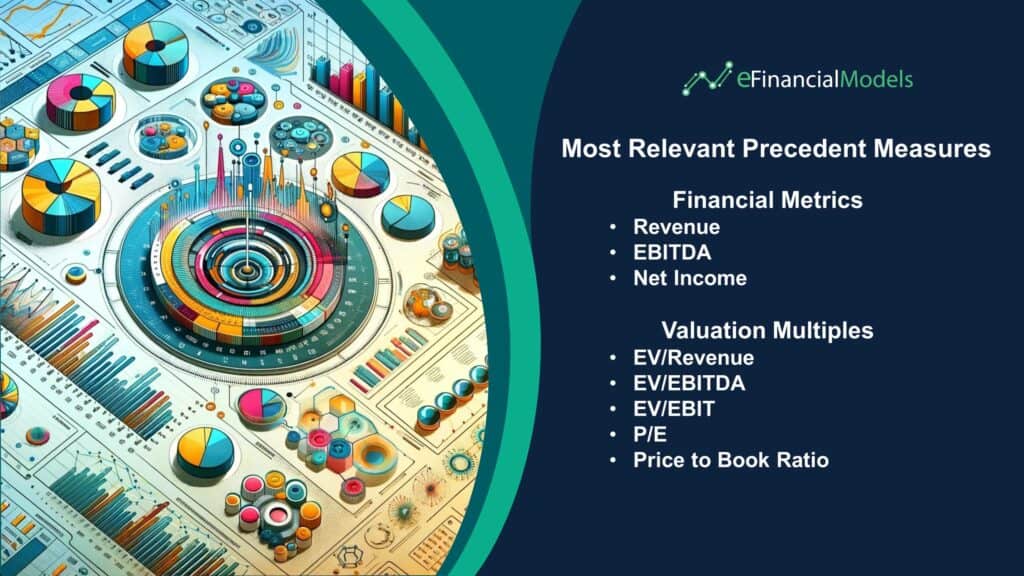
The second step involves determining the financial metrics and valuation multiples to be used in analyzing the value of a company. This step is critical as it lays the foundation for a thorough and accurate valuation by identifying the most relevant measures of a company’s financial performance and market valuation. The general approach in selecting metrics and multiples emphasizes a balance between profitability and sales metrics, leaning towards historical rather than projected figures to mitigate consistency issues.
Identifying the key financial metrics will be used to evaluate the company’s performance and value. The most commonly used metrics are the essential elements of the income statement:
- Revenue gives a sense of the company’s scale and growth potential.
- EBITDA (Earnings Before Interest, Taxes, Depreciation, and Amortization) provides an understanding of operational profitability by excluding non-operating expenses and income.
- Net Income offers a bottom-line measure of profitability after all expenses have been deducted.
These metrics are essential for assessing a company’s financial health and operational efficiency.
Valuation multiples are ratios that compare a company’s market value to a particular financial metric, facilitating comparisons across companies and industries.
- Enterprise Value to Revenue (EV/Revenue), EV to EBITDA, and EV to EBIT (Earnings Before Interest and Taxes) multiples are used to assess value relative to a company’s sales, operational profitability, and earnings before interest and taxes, respectively.
- The Price-to-Earnings (P/E) ratio measures the company’s current market price per share by its earnings per share (EPS). EPS can be trailing (based on the last 12 months of earnings) or forward (an estimate of future earnings).
- The Price-to-Book (P/B) ratio compares a company’s current market price per share to its book value per share. The book value per share is determined by subtracting total liabilities from total assets and dividing by the number of outstanding shares.
These multiples help compare the company’s valuation in terms of its financial performance and market expectations. Where applicable, specialized multiples relevant to the specific industry or sector of the company being valued may also be used. These specialized multiples consider industry-specific dynamics and valuation norms, providing a more tailored and accurate valuation.
Step 3 – Perform Peer Group Multiple Calculations
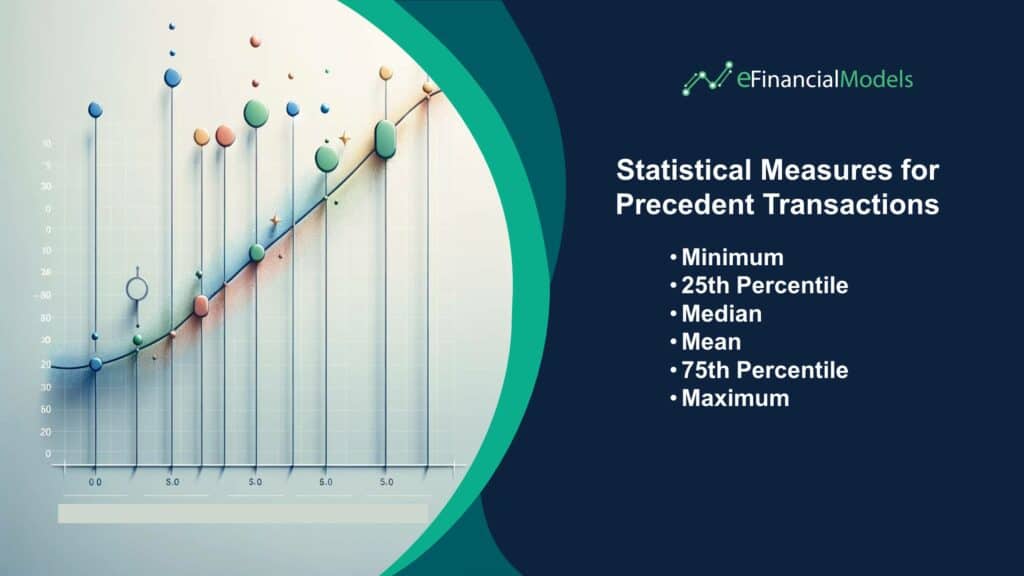
The third step in a precedent transaction valuation, specifically performing peer group multiple calculations, provides a snapshot of the company’s current valuation metrics. This step is crucial in precedent transaction analysis, directly influencing the valuation. Aggregate and summarize the data for all the comparable transaction or peer. It involves compiling the multiples into a dataset and concluding what the applicable multiples are.
Please note that analysts often calculate a dataset’s median, especially when the dataset is huge. It is one way to do it, but this is more of a statistical approach. A problem arises if the median includes many transactions that are not truly comparable. We want to avoid that as the explanatory power of our analysis stands and falls with the selection of genuinely comparable transactions. Therefore, it can be better to identify a few specific transactions where you believe these are truly comparable and estimate the applicable multiple by using the sound judgment of the analyst.
Step 4 – Resolve How to Adjust the Precedent Transactions
Simply taking the median or average of a broad set of transactions without considering their relevance to the target company is not the last step. Instead, it emphasizes conducting thorough research to find the most comparable transaction(s). Analysts will often look at past transactions in the same industry or sector to identify a typical control premium or illiquidity discount when conducting a precedent transaction analysis. These adjustments are then used to adjust the transaction values of comparable companies, thereby providing a more accurate valuation range for the company being valued.
It is also essential to remember that a precedent transaction valuation typically focuses on acquiring minority stakes, which are smaller, non-controlling interests in a company. When these stakes are acquired, the purchase price often includes a control premium—an additional cost paid by a buyer to obtain a controlling interest in a company, reflecting the value of having decision-making power. Simultaneously, this price does not factor in a liquidity discount, which usually reduces the cost to reflect the difficulty and potential delay in selling a less liquid asset. Thus, the prices in these precedent transactions might be higher due to the inclusion of a control premium and the exclusion of a liquidity discount, affecting the valuation analysis.
Step 5 – Work Out the Privately Held Company Valuation Range
When determining the privately held company valuation range for a privately held company in a precedent transaction analysis, several steps must be followed, including deciding on the central tendency measure (mean or median) and whether to apply a control premium or illiquidity discount. We use the mean when the data is symmetrically distributed without outliers. On the other hand, we used the median in the presence of outliers or skewed data, as it represents the middle value, providing a more robust central tendency measure that is less affected by extreme values.
Decide whether to use a control premium or illiquidity discount in the analysis. When acquiring a controlling interest, a premium is often paid over the market value of the shares. This reflects the value of gaining control of the company. For privately held companies, shares are usually less liquid than those of public companies. This illiquidity can lead to a discount in valuation. To decide on an illiquidity discount, consider the level of marketability of the shares. Then, analyze the calculated control premiums to understand the privately held company valuation range, average, and median premiums paid in similar transactions. This analysis provides a comprehensive understanding of the market norms and helps formulate a valuation aligned with industry standards.
Sample Precedent Transaction Valuation
Here is the end result of the precedent transaction valuation we have made for distillery businesses. These transactions include comparable distillery acquisitions from 2014 to 2023. We’ve expanded the search due to insufficient financial information on private distilleries.
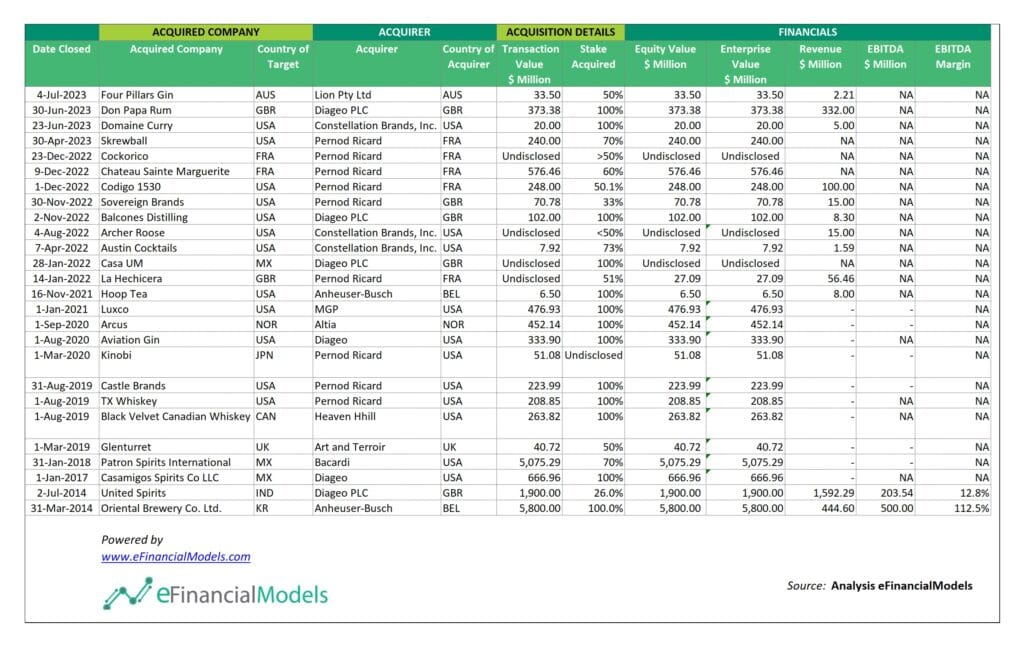
The sample precedent transaction valuation above showed that the distillery industry’s typical EV/Revenue multiple ranges between 1.2x and 2.5x, and the EV/EBITDA multiple ranges between 2.5x and 11.6x. For statistical purposes, we’ve even calculated the median EV/Revenue multiple as 3.2x and the EV/EBITDA multiple as 10.8x. These multiples are relatively high compared to other industries, indicating a solid valuation relative to earnings. Distilleries often operate in specialized markets, creating unique products that attract specific customer segments willing to pay a premium. As such, they usually command higher EV/EBITDA multiples than traditional SMEs.
Optimize Market Approach Business Valuation with a Precedent Transaction Analysis Template
A Precedent Transaction Valuation involves analyzing the transaction details of similar companies in the industry that have been acquired or merged recently. This method is pivotal in understanding the market value of a company by looking at the price paid for similar companies under similar circumstances. It requires gathering a comprehensive list of comparable transactions, adjusting for differences between those transactions and the subject company, and applying the relevant multiples observed in these transactions to the company’s financials being valued. This approach offers insights into what investors are willing to pay for companies in the same sector, providing a realistic market-based benchmark for valuation.
Optimizing this market approach to business valuation through a Precedent Transaction Analysis Template enhances the accuracy and efficiency of the valuation process. A Precedent Transaction Analysis Template is a structured framework that guides the analyst in systematically collecting, organizing, and analyzing relevant transaction data. It ensures consistency in the valuation process, allowing for comparing like-for-like data, and helps identify relevant valuation multiples and benchmarks. Using this template, analysts can more effectively identify market trends, assess transaction comparability, and adjust for unique transaction characteristics, leading to a more precise and tailored valuation outcome. This optimized approach facilitates a deeper understanding of market dynamics and offers a clearer picture of a company’s value in real-world transactions.



















































You might also like:
- How to Prepare a Financial Feasibility Study?
- How Are Valuation Multiples Determined
- 10 Tips to Develop a First Class Business Valuation Report
- Finding Fair Market Value: A Quick Guide to Real Estate Valuation
- The Essential Guide to Calculating the Cap Rate for Real Estate Valuations
- Discounted Cash Flow Valuation Model: Free Excel Template
- Pre-Money and Post-Money Valuation: What You Need to Know
- How to Make Smart Decisions with 6 Key Financial Metrics?
- Financial Valuation Based on Future Earnings Simulation
- Valuation Services
- Commercial Real Estate Valuation Methods: Helping Investors in Taking Informed Decisions
- Financial Model Templates Easy to Use
- Understanding Debt Sizing & Project Finance Ratios
- How to Evaluate a New Solar Park for Investment?
- Creating a Budget Plan – Using the Best Excel Budget Template
- 10 Main Elements of a Business Plan
- IRR vs NPV in the Context of Financial Decision-Making
- Master the Free Cash Flow Formula for Smarter Financial Decisions
- Financial Statements – Definition, Uses, Contents and Templates
- Understanding the Levelized Cost of Energy Formula
Tags: business valuation