
0 ITEMS

The Top 3 Business Valuation Formulas

Business valuation relies on key formulas that help investors and owners estimate a company’s worth in different scenarios.
- The Discounted Cash Flow (DCF) method projects future cash flows and discounts them to their present value, providing long-term valuation insights.
- The Capitalization of Earnings (COE) approach uses stable earnings and a capitalization rate to estimate value, ideal for established businesses.
- Precedent Transactions analyze recent comparable deals to determine market value based on real deal prices.
- Each method offers unique advantages and is suited for different business types and situations.
- Combining these formulas with financial modeling improves accuracy and confidence in valuation outcomes.
Continuing with practical insights, understanding these core formulas helps in making informed financial decisions and maximizing business value.
Business Valuation Meaning Explained: Methods & Key Factors
The business valuation meaning focuses on determining a company’s worth by analyzing its financial performance, market position, and growth potential. A company’s value depends on its revenue, assets, industry trends, and future earnings. Accurate valuation builds trust, attracts investors, and ensures fair deals in negotiations. Understanding a business’s true worth strengthens financial planning, and long-term strategy is the true business valuation meaning. It helps business owners, investors, and buyers make smart decisions about investments, sales, or mergers. No single method can universally apply to all businesses; financial professionals often use a combination of valuation techniques to derive a more accurate estimate.
Key methods to understand the business valuation meaning include analyzing future cash flow, earnings, and past transactions.
- Discounted cash flow (DCF) measures a company’s value based on expected profits over time.
- Capitalization of earnings (COE) estimates worth by dividing stable earnings by a capitalization rate.
- Precedent transaction analysis (PTA) compares similar businesses sold recently to find a fair market value.
These methods help investors, owners, and buyers make informed financial decisions.
A business is more than just its physical assets; its true worth comes from revenue, innovation, and market position. That is why we don’t recommend asset-based valuation to fulfill the business valuation meaning. This method focuses only on tangible assets, ignoring brand value, customer loyalty, and growth opportunities. Relying solely on asset value can undervalue a company and mislead investors. A forward-looking approach gives a clearer picture of a business’s real financial strength.
A company’s worth isn’t just about its revenue—its value depends on its financial health, market position, and growth potential. The key factors affecting business valuation are:
- Financial Performance: A business with strong revenue, profit margins, and cash flow attracts higher valuations.
- Market & Industry Conditions: Favorable market trends and industry growth boost a company’s value, while downturns can weaken it.
- Risk & Scalability: Lower risks and the ability to grow efficiently make a business more valuable to investors.

How to Calculate a Business’s Value
Determining a company’s value is crucial for investors, buyers, and business owners. The top three business valuation formulas—Discounted Cash Flow (DCF), Capitalization of Earnings Method Analysis (CCA), and Precedent Transactions—offer different ways to assess worth. Each business valuation formula provides valuable insights, helping stakeholders make informed decisions. Understanding them ensures a clear, data-driven approach to valuing any business.
The DCF Business Valuation Formula
Discounted Cash Flow (DCF) valuation estimates a business’s worth by projecting future cash flows and discounting them to their net present value (NPV). This income-based approach reflects the time value of money, ensuring that future earnings are properly adjusted for risk and opportunity costs using a discount rate, typically the Weighted Average Cost of Capital (WACC). Investors use DCF to determine if an asset or a company is undervalued or overpriced. A well-structured DCF model helps in making informed investment decisions by focusing on a company’s true earning potential.
The Discounted Cash Flow (DCF) business valuation formula is:

Where:
- CF is cash flow. It represents the money a business generates in a given year.
- r is the discount rate. It reflects the required return or risk of the investment.
- t is the year. It indicates the specific time period for each cash flow.
- TV is the terminal value. It estimates the business’s value beyond the forecast period.
Most businesses generate cash flows indefinitely, but predicting them for decades is impractical. DCF calculates Terminal Value (TV) instead of enterprise or equity value. It simplifies this by estimating the company’s worth after the detailed forecast, typically using the Gordon Growth Model (Perpetuity Growth Method) or Exit Multiple Method. Once TV is calculated, it is discounted to present value and added to the sum of discounted cash flows to derive the total enterprise value (or equity value if adjusted for debt and cash). This approach ensures a more accurate, long-term valuation without requiring infinite projections.

The Discounted Cash Flow Valuation Model above estimates a company’s worth by discounting future cash flows. It calculates Free Cash Flow to Firm (FCFF) over five years and applies discount factors to determine present values. A key advantage of this approach is the Terminal Value (TV) calculation, which accounts for long-term growth beyond the forecast period. Since most of a company’s value often lies in future cash flows, the Present Value (PV) of Terminal Value significantly impacts the final valuation. This method ensures a more accurate, forward-looking estimate, helping investors and businesses assess long-term profitability effectively.






















































The Capitalization of Earnings (COE) Business Valuation Formula
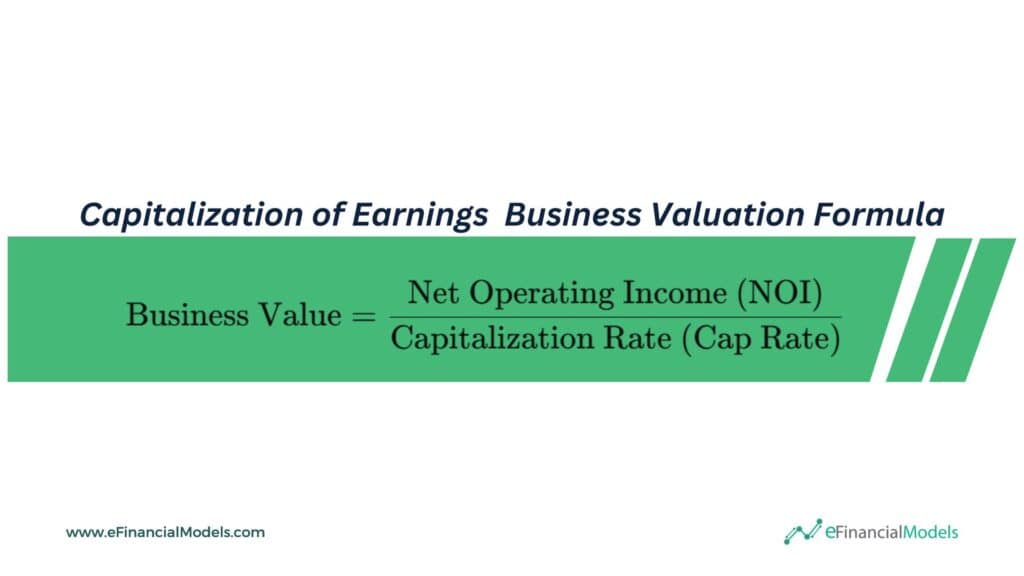
The Capitalization of Earnings (COE) method also values a business based on its expected earnings. It divides the company’s annual net income by a capitalization rate, which reflects risk and expected return. This income-based approach assumes stable earnings and growth over time. Investors use it to estimate value quickly, especially for established businesses with predictable profits. The key is selecting the right capitalization rate, which directly impacts valuation. This method works best when earnings remain steady, making it less useful for startups or volatile industries.
The Capitalization of Earnings (COE) formula is:
Where:
- Net Operating Income (NOI)is the company’s annual net earnings before interest and taxes.
- Capitalization Rate (Cap Rate) represents the required rate of return based on risk and industry conditions. A lower cap rate increases valuation, while a higher cap rate lowers it.
Calculating Equity Value using the Capitalization of Earnings (COE) approach helps investors understand a company’s worth after covering debts. It shows the value available to shareholders based on stable earnings. It helps compare businesses and assess investment risks. This approach works best for companies with steady profits, making it a reliable tool for equity valuation. However, this company does not so well if a business is growing heavily, is unprofitable or subject to large fluctuations in revenues and profits.
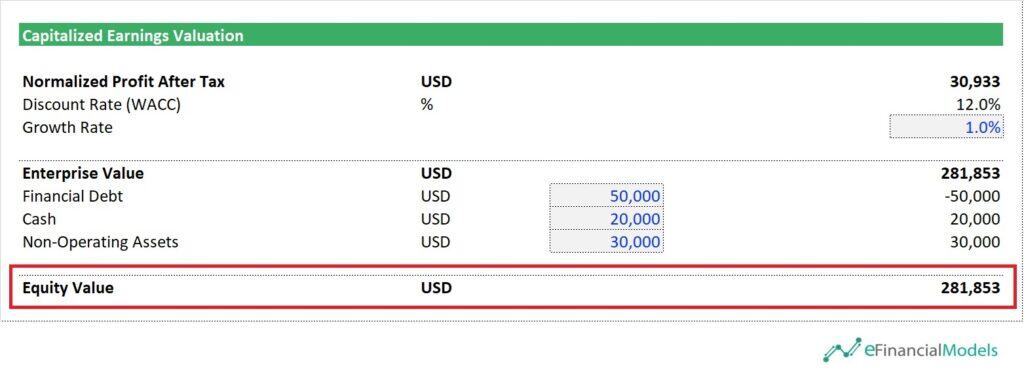
The Simple Capitalized Earnings Business Valuation Model chart above calculates a company’s Equity Value by adjusting Enterprise Value for financial debt, cash, and non-operating assets. It shows the value available to shareholders after covering liabilities. This method is useful for investors assessing a business with steady profits. It simplifies valuation by focusing on expected future income and risk. The benefit of Equity Value is that it provides a clear picture of shareholder worth, helping investors make informed decisions based on financial stability and potential returns.
The Precedent Transaction Multiples Business Valuation Formula
Precedent Transaction Analysis values a business by comparing it to past sales of similar companies. This market-based approach reflects real-world deal prices, showing what buyers are willing to pay. It helps investors and analysts estimate fair market value based on comparing a company’s Enterprise Value (EV), Equity Value (P for Price paid for a company’s Equity) versus its revenues, profits or equity book value. The difference between Enterprise Value and Equity Value is that a company may use Debt Financing and/or has a lot of cash on its balance sheet that might have to be taken into account when looking at a company’s Equity Value.
The following valuation multiples can be used:
- EV/Revenues – can also be used when a company is still loss-making
- EV/EBITDA – the most common used valuation multiple as it reflect’s a business cash profits that cannot be that easily manipulated
- EV/EBIT – reflects a relative company valuation vs. its operating profits. However, operating profits normally are determined AFTER taking into account depreciation which makes this multiple subject to some degree of manipulation
- P/E Ratio – a very quick valuation multiple, however this is more widely used for valuing stock market listed companies and is also subject to a some degree of valuation due to company’s policies regarding depreciation, debt financing and tax optimization.
- P/Book Ratio – focuses just on the relationship between a company’s book value vs. the price to be paid and does not take into account the profit potential of a company.
For more information regarding valuation multiples please refer to the following articles:
- How Are Valuation Multiples Determined
- Value Your Business With the EV/Revenue Multiple
- The EV/EBITDA Multiple – The Preferred Choice for Professional Investors
- When to Use the EV/EBIT Multiple?
- Price-To-Earnings Multiple: Spot Undervalued Stocks Fast
- Why Does Price-To-Book Value Matter for Banks?
So each valuation multiple comes with its pros and cons and the art is to identify which valuation multiple should be used in which sitation. Precedent Transaction is useful for mergers, acquisitions, and exit strategies. However, market fluctuations and unique deal terms can impact accuracy. This method works best when recent, relevant transactions are available for comparison.
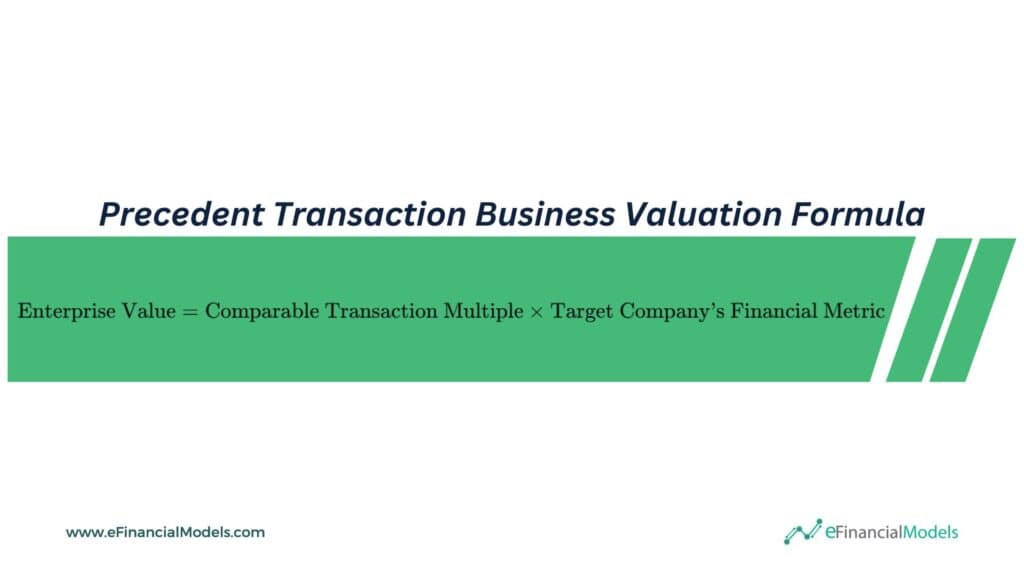
The Precedent Transaction Analysis (PTA) formula works the same for all these multiple by company similar to the following formula. You may calculate a company’s Enterprise Value or Equity Value simply by multiplying the respective metric with the valuation multiple derived from the analysis of multiples used in similar transactions.
Where:
- Comparable Transaction Multiple uses real data from recent mergers and acquisitions involving similar companies in the same industry, region, and size. It reflects buyers’ pay, making it a useful benchmark for valuing a business. This multiple shows how the market values firms based on actual deals, not just theory. It helps investors and sellers set fair prices by comparing them to past, relevant transactions.
- Target Company’s Financial Metric is the specific number used to calculate value, such as EV/Revenue, EV/EBITDA, P/E, or P/B. Each industry favors certain metrics based on how businesses operate. The choice also depends on the deal type—some metrics are more common in mergers, while others fit buyouts or takeovers. You must use the same metric found in comparable past deals to keep results consistent. This ensures a fair and accurate comparison across similar transactions.
Calculating Enterprise Value (EV) using Precedent Transaction Analysis (PTA) helps investors understand real market pricing. It reflects actual deals, making valuations more relevant to current trends. This method factors in industry demand, buyer competition, and deal structures. It provides a market-driven benchmark, reducing reliance on theoretical models. It ensures valuations align with what buyers have paid for similar businesses. However, selecting relevant transactions is key for accuracy.
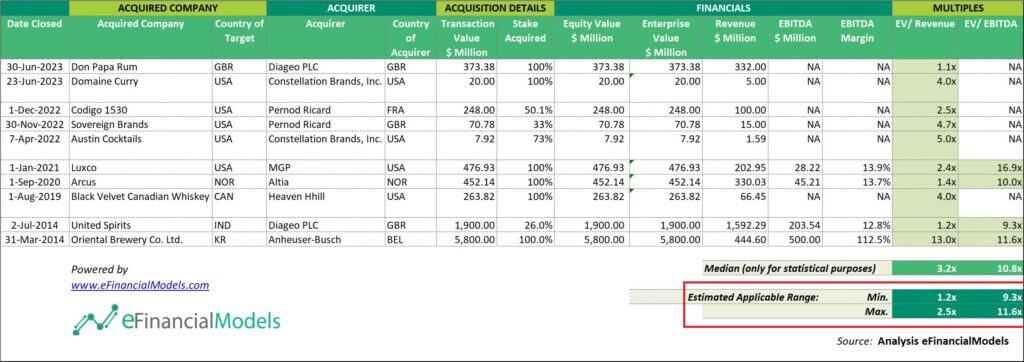
The above Precedent Transactions chart estimates Enterprise Value (EV) using EV/EBITDA or EV/Revenue multiples. To calculate EV, multiply the target company’s EBITDA or Revenue by a relevant multiple from past transactions. This approach reflects real market conditions and investor sentiment. Using the Estimated Applicable Range, analysts can apply a minimum and maximum valuation to set a realistic value range. The benefit is that it provides a market-driven, evidence-based valuation rather than relying on theoretical assumptions. This helps investors make informed decisions for mergers, acquisitions, or financial planning.
Financial Modeling: The Backbone of Formulas for Valuing a Business
The formulas for valuing a business relies on different valuation methods to estimate a company’s worth. DCF focuses on future cash flows and adjusts them for present value. COE values a company based on its earnings and risk profile. PTA looks at past sales to determine market value. Each method offers unique insights, helping investors and owners make informed decisions.
Financial modeling powers business valuation by turning data into clear insights. It forecasts cash flows, assesses risk, and applies key valuation methods like DCF, COE, and PTA. These models help investors and owners make smart decisions based on real numbers. A solid financial model strengthens valuation accuracy and business strategy.
Understanding business valuation formulas is key to making informed financial decisions. Get accurate business valuations with expert financial modeling. This service provides in-depth analysis using proven valuation methods like DCF, COE, and PTA. Whether you’re an investor, business owner, or buyer, a precise valuation helps you make confident decisions. Explore the details here: Business Valuation Service!













You might also like:
- 10 Tips to Develop a First Class Business Valuation Report
- Finding a Valuation Model for Your Business
- The Essential Guide to Calculating the Cap Rate for Real Estate Valuations
- Understanding the Debt Service Coverage Ratio: An Essential Metric for Financial Analysis
- Business Valuation
- 10 Main Elements of a Business Plan
- How to Value a Business Using a Discounted Cash Flow Model
- Understanding What is Yield to Maturity and Why It Matters
- Commercial Real Estate Valuation Methods: Helping Investors in Taking Informed Decisions
- Financial Modeling for Startups and Small Businesses
- Top 10 Mistakes in DCF Valuation Models
- 12 Funding Sources for Businesses and Startups
- Rent vs Buy Decision Guide
- 6 Key Financial Metrics for Successful Business Planning
- How to Prepare a Financial Plan for a Chicken Egg Farm?
- Business Plans
- Financial Projection Models
- Finding Fair Market Value: A Quick Guide to Real Estate Valuation
- Understanding Debt Sizing & Project Finance Ratios
- Master the Free Cash Flow Formula for Smarter Financial Decisions
Tags: business valuation