
0 ITEMS

Recent Transaction Multiples Analysis for Distilleries
Table of Content

Precedent transaction analysis is a key method for valuing distillery businesses based on recent mergers and acquisitions data.
- It compares a target distillery to similar companies that have been acquired or merged, using financial multiples.
- Data collection involves reviewing industry reports, press releases, and annual reports of major distillery players.
- Adjustments are made for differences in financial performance, market conditions, and deal specifics like control premiums.
- Common valuation multiples include EV/Revenue and EV/EBITDA, which are less affected by accounting differences.
- Industry specifics, such as brand loyalty, capital investments, and distribution networks, influence higher distillery valuation multiples.
Continuing analysis helps identify realistic valuation ranges and understand market trends for distillery M&A.
The Concept of Precedent Transaction Multiples Analysis (Recent Transaction Multiples Analysis)
Precedent transaction analysis or recent transaction multiples analysis is a valuation method used in finance to estimate the value of a business, asset, or investment. It is instrumental in mergers and acquisitions (M&A). The process involves examining the details and key financial metrics of precedent case examples similar to the transactions under consideration. The core idea is to use historical deals as a benchmark to guide the valuation of a current deal, providing insights into how much buyers have previously paid for assets or businesses similar to the one being valued.
Performing such a valuation using multiples involves identifying a comprehensive list of precedent case examples – previous acquisitions or sales comparable to the company’s value in terms of industry, size, and market conditions. Analysts then adjust the values of these examples of precedent cases for differences in financial performance, market position, and macroeconomic conditions to arrive at a range of values for the target company. The key steps include selecting relevant examples of precedent cases, collecting financial data, applying financial ratios or valuation multiples, and then adjusting for any unique characteristics of the target firm to estimate its value.
Recent Transaction Multiples Analysis in the Distillery Industry
Valuation using multiples is a common approach in the distillery industry to estimate a company’s value. A Recent Transaction Multiples Analysis involves comparing a company to its peers or industry standards based on various financial metrics.
The spirits and distilleries market, known for its specialized craft and premium product offerings, often commands higher EV/EBITDA (Enterprise Value to Earnings Before Interest, Taxes, Depreciation, and Amortization) multiples than traditional SMEs (Small and Medium Enterprises). It is attributed to the distinct market niche, brand loyalty, and often higher profit margins associated with distilleries.
Additionally, the sector has seen considerable interest from more giant corporations seeking to diversify their portfolios and tap into the craft spirits trend. Among the top players in the global distillery world are Anheuser-Busch, Diageo, Constellation Brands, Inc., and Pernod Ricard. They continually look to enter and expand in emerging markets. These giants often acquire smaller craft distilleries or enter into strategic partnerships to expand their market reach and product portfolios. As a result, there has been a notable uptick in acquisition activities within the industry. From here, we can start researching for precedent case examples.

Valuation using multiples is helpful to examine examples of precedent cases for distilleries, reflecting the premium these businesses can command in the marketplace, to provide a clearer perspective on the valuation landscape.





















































Finding Recent Transactions in the Distillery Industry
When meticulously dissecting recent transactions in the distillery industry, particularly with a focus on precedent case examples, the process typically entails a series of detailed steps that demand a thorough examination of various data sources.
Industry Research: The focus initially is on understanding the distillery industry’s current landscape, including market trends, consumer preferences, and regulatory changes. This step often involves reviewing industry-specific reports, market analysis documents, and relevant trade publications.
Reviewing Annual Reports of Key Players: Next, we analyze the annual reports of major companies in the industry. It includes looking at these top players’ financial health and strategic directions. Specifically, we focus on the sections detailing mergers and acquisitions (M&A) to identify which companies they have acquired recently. These examples of precedent cases give insights into the types of distillery companies that are attractive targets and the rationale behind these acquisitions.
Searching for Press Releases and Financial Reports: We search for press releases and financial statements to supplement the information from annual reports. Press releases are precious as they often provide details about the terms of transactions, strategic intentions, and sometimes even the outcomes of previous acquisitions. Financial reports can offer additional insights into the critical financial metrics in these transactions.
Data Extraction and Analysis: This step involves extracting relevant data from the sources above and analyzing it to discern patterns or trends in M&A activity within the distillery industry. Common data points include transaction values, geographic focus, product lines involved, and the strategic fit between acquiring and acquired entities.

Implied Valuation Multiples based on Precedent Transaction Multiples
Here are the examples of precedent cases for distillery businesses that we have compiled. These are acquisitions made by the top global spirits and distillery industry players—Anheuser-Busch, Diageo, Pernod Ricard, and Constellation Brands—from 2021 to 2023. Unfortunately, since most acquired companies are privately held, we lack enough data to perform accurate precedent transactions. So, we decided to gather more data about comparable distillery acquisitions from 2014. We trace back Precedent Transactions 10 years ago to ensure a comprehensive dataset and reliable analysis when recent data is insufficient.
Second, we have collected financial data for the following acquisitions or candidates for precedent case examples:
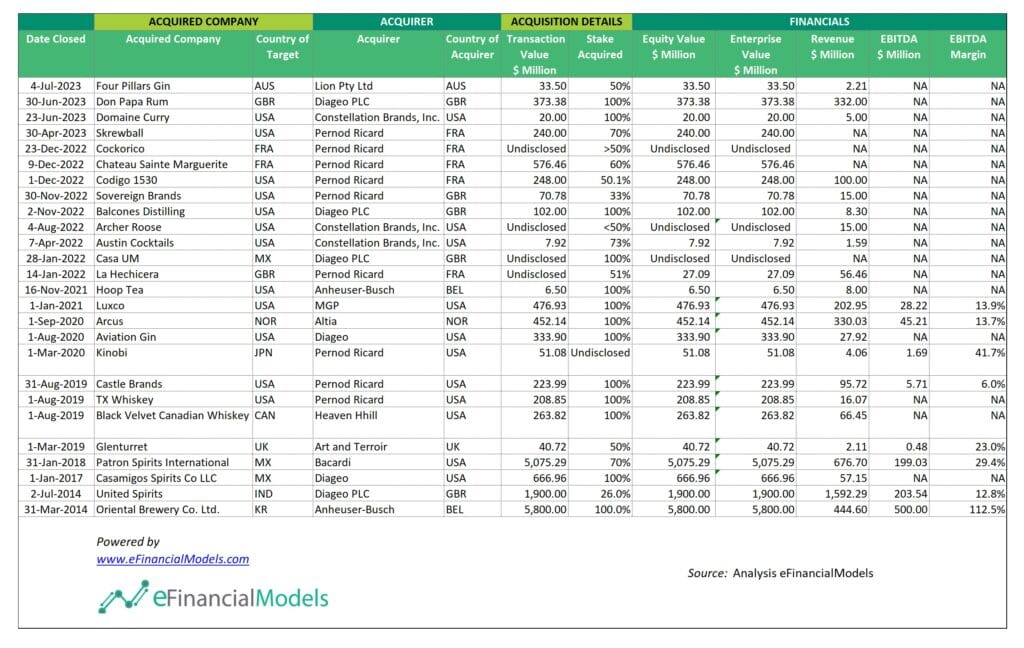
So far, the financial data we have collected only include the transaction value—equivalent to the equity value and the enterprise value in the absence of financial debt. As part of the multiples valuation, we calculated the corresponding EV/Revenue and EV/EBITDA multiples based on the collected data. Calculating the EV/Revenue and EV/EBITDA multiples in a precedent transaction analysis is essential. They provide a standard way to compare companies of different sizes and structures and serve as benchmarks for valuing a company. Analysts can estimate a reasonable price range for a company they are considering buying or selling by looking at the multiples paid for similar companies in past transactions.
It is also important to note that EV/Revenue and EV/EBITDA are considered robust against changes in accounting practices and are less influenced by different depreciation methods or non-operating expenses that can affect net income. These characteristics make the two multiples reliable metrics for valuing businesses in the context of acquisitions, providing a clearer picture of a company’s operational worth even amid varying economic conditions.
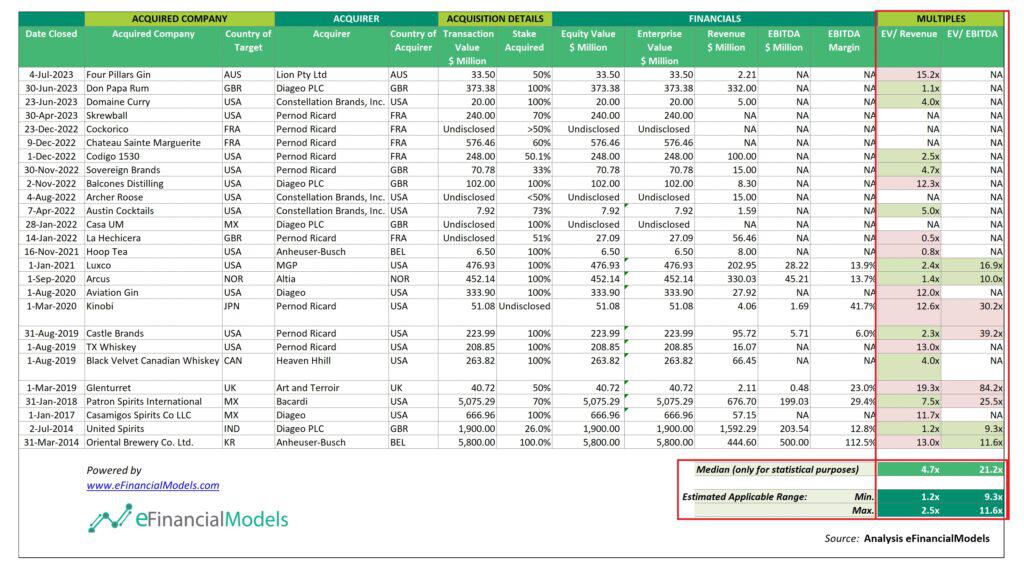
Most financial analysts should have noted that you cannot compare apples to lemons. In our example, we have selected deals with analogous financial characteristics. Our main criteria for precedent case examples include industry relevance and operational similarity, ensuring that companies operate within the same sector and face similar market conditions and competitive dynamics. Additionally, the financial health and size of the companies should be comparable, with considerations for revenue scales, growth rates, and profitability to ensure the transaction metrics are applicable and reflective of the business being analyzed. These are the transactions highlighted in green.
Based on our precedent case examples, a global spirits or distillery company has an EV/Revenue Multiple between 1.2x and 7.5x and an EV/EBITDA Multiple between 9.3x and 16.9x. Distillery EV/EBITDA multiples are often high due to several interrelated factors that enhance their enterprise value.
- Distilleries typically involve significant investments in large fixed assets such as buildings and specialized equipment, which are crucial for production and contribute to their overall valuation.
- Building a distillery brand is a long-term endeavor, and successful brands possess considerable intangible value due to their established reputation and customer loyalty. This brand equity is difficult to replicate, making these companies more valuable.
- Distilleries often foster a dedicated fan base, enhancing repeat customers’ steady, long-term cash flows.
- Furthermore, leading players in the distillery market benefit significantly from established distribution networks. These networks enable them to efficiently market and sell their products and potentially distribute acquired brands, thereby enhancing profitability and justifying higher multiples.
Most analysts calculate the median when performing valuation using multiples, such as precedent transactions. This is because median values are less sensitive to outliers than means. Yet, it is beneficial in transaction data where a few very high or very low values might skew the average.
In our case, the median is irrelevant because we don’t have a target distillery company. Instead, we estimate the applicable minimum and maximum multiple range. Calculating the minimum and maximum values within precedent case examples without a specific target company in mind is valuable for setting broad market benchmarks and understanding the general landscape of industry valuations. This valuation using multiples analysis provides essential insights into the range of acceptable transaction values based on historical deals, helping investors, analysts, and corporate strategists identify and evaluate potential investment opportunities or risks before a target is selected.
The primary limitation of our analysis, where we need to verify the comparability of transactions, is that it potentially includes non-representative data that could skew our valuation conclusions. Typically, transaction comparability is critical in valuation exercises to ensure that the data reflects similar business models, industries, and economic conditions. By removing outliers without assessing comparability, our analysis may inadvertently rely on transactions that are not appropriate analogs for the company being valued. This oversight can lead to inaccurate valuation metrics, as transactions from fundamentally different companies or sectors might have significantly different value drivers and risk profiles. Consequently, the resulting valuation could be misleading, providing either an overly optimistic or pessimistic value estimate.
| Disclaimer: This analysis is provided as a sample precedent transaction and is intended for illustrative purposes only; it should not be considered universally applicable as each company and transaction is unique and may require a different approach. |
Precedent transaction analysis extends beyond merely calculating financial data in evaluating a target company. It delves into the nuances of mergers and acquisitions by considering factors like control premiums and illiquidity discounts. These aspects are crucial as they adjust the valuation to reflect the actual cost or benefit of gaining control over or investing in a company that may not be readily sellable. Such an analysis relies heavily on the detailed examination of previous acquisitions within the same industry or sector, focusing on the specifics of each deal to ascertain the most relevant adjustments. By incorporating these adjustments based on collected acquisition background and data, analysts can achieve a more accurate and tailored valuation of the target company, accounting for the unique characteristics and circumstances surrounding each transaction.
Unlocking the Hidden World of Privately Held Company Financial Statements
Precedent Transaction Analysis is a cornerstone methodology within corporate finance and mergers and acquisitions (M&A). This approach involves scrutinizing past transactions within the same industry or sector to derive meaningful insights and benchmarks. By examining the financial, operational, and strategic aspects of these transactions, analysts can establish a valuation range and strategic expectations for similar future deals.
Unlocking privately held company financial statements through a valuation using multiples reveals a hidden world of business insights and market dynamics often overshadowed by the more accessible data of public entities. Due to the lack of mandated public disclosure, this challenging endeavor offers a unique opportunity for professionals like you to understand the true breadth of precedent transactions, sparking your curiosity and engagement.
The hidden world of precedent transactions requires a deep dive into the intricacies of financial statement templates. These tools are not just about numbers and calculations; they are the gateway to understanding business decisions’ historical context, strategic value, and future implications. Master precedent transaction analysis through financial modeling and unlock future success!






































You might also like:
- Recent Transaction Multiples Analysis for Distilleries
- How Does the Equity Accounting Method Work?
- Finding Fair Market Value: A Quick Guide to Real Estate Valuation
- 10 Tips to Develop a First Class Business Valuation Report
- 10 Main Elements of a Business Plan
- How Are Valuation Multiples Determined
- Understanding the Debt Service Coverage Ratio: An Essential Metric for Financial Analysis
- Financial Model – Valuation of Tax Loss Carryforwards
- Business Valuation Service
- How to Do a Precedent Transaction Valuation ?
- Financial Modeling for Startups and Small Businesses
- Financial Projections Templates – The Easy Way
- How to Calculate Net Present Value (NPV)?
- Financial Modeling using Excel
- Financial Planning for Small Business Owners – Taking an SBA Loan
- Financial Model Templates Easy to Use
- Brandy Distillery Business Financial Model
- Valuation Services
- Top-Down vs. Bottom-Up Financial Planning: What’s the Difference?
- Top 5 Principles of Corporate Finance
Tags: business valuation