
0 ITEMS

The VC Valuation Method – Discounting the Exit Value of Tomorrow
Table of Content
- Fundraising from Investors Raises the Valuation Question
- When Do You Need a VC Valuation?
- The VC Valuation Method Values Big Potentials and Small Assets
- Example Business Valuation Using the VC Valuation Method
- The Importance of Forecasting Financials in the VC Valuation Method
- Benefits of Using the Venture Capital Valuation Method
- Common Challenges and Pitfalls to Avoid in the Venture Capital Method
- The Bottom Line: The Exit Value Tomorrow Defines the Value of Today

The venture capital valuation method focuses on estimating a startup’s worth based on future exit values and investor return requirements.
- It uses financial projections to determine a company’s expected revenue, EBITDA, or user metrics at exit.
- Valuation multiples from comparable transactions or public companies help estimate enterprise value in the future.
- Discounting this future value at the investor’s target IRR shows what the company is worth today.
- The method is especially useful for early-stage companies with limited financial history and high growth potential.
- Scenario analysis, including changes in revenue, return expectations, and dilution, helps refine valuation estimates.
Understanding these core principles can improve negotiations and investment decisions in venture capital funding and startup valuation.
Fundraising from Investors Raises the Valuation Question
When a company seeks to raise funding from investors, one of the critical questions that arise is the valuation of the company at which investors can enter. Valuation refers to estimating a company’s equity value for 100% of the shareholder’s equity capital based on the price investors will be paying for acquiring an agreed-on percentage of a company’s capital. Valuation is a crucial consideration for both the company seeking funding and the investors considering investing in the company. For the company, valuation determines how much equity it must offer investors in exchange for funding, and it also affects the dilution of existing shareholders’ ownership. For investors, valuation is a crucial factor in determining the potential return on their investment and its associated risk.
Various factors typically influence business valuation, including the company’s expected financial performance, growth prospects, market competition, and overall market conditions. Companies seeking funding must provide investors with detailed information on these factors to enable them to assess the company’s value accurately. It is worth noting that valuation is not an exact science, and different investors may have different opinions on a company’s value. Therefore, it is crucial for companies seeking funding to understand the market and investor expectations and to be prepared to negotiate to achieve an acceptable valuation for both parties.
The VC Valuation method uses a company’s financial projections to estimate the users, revenues, or EBITDA at the time of expected investor exits (e.g., in year 7 of the forecast period). We then will select what valuation multiple (EV/user, EV/Revenue, EV/EBITDA, or any other) makes the best sense to apply and research the observable multiples based on comparable transactions or traded public companies. It allows us to quickly calculate the expected enterprise value by year seven or estimate the range the company should be trading at. If we have a forecast of a company’s Balance Sheet, we can correct for financial debt and cash to get to the expected equity value. Then all we need to do is to discount the expected equity value of year seven by using the investor’s target IRR (e.g., 20%) to obtain the present value of that valuation as of today.
When Do You Need a VC Valuation?
The venture capital method compares the required returns on invested capital with similar investments to determine an appropriate valuation. It helps narrow down potential valuations for a given company – from early-stage startups to mature companies.
Investment Decisions
A venture capitalist typically applies the VC valuation method when considering investing in a startup or early-stage company as, in many cases, other valuation methods are less meaningful to use when a company runs losses or relies on a high-growth business plan. The VC valuation method allows for a quick assessment of the company’s net worth and helps the venture capitalist determine how much equity to acquire in exchange for their investment.
The VC valuation method is an elegant way to work around the fact that limited financial and operational data are available in the early stages of a startup’s life. In these cases, the valuation can help the venture capital investor better understand the potential risks and rewards of investing in the company when figuring out a reasonable exit value. In addition, the VC valuation method can help the venture capitalist to negotiate better terms of their investment, especially when it comes to dilution, as the VC investor will need to obtain a particular stake of the company’s value at the time of exit to make his calculation work and achieve the required returns on the investment.
A VC valuation is typically conducted using professional VC investors’ industry and investment experience. It also involves thorough due diligence on the company, its products, and the targeted market to pave the way for solid investment decisions. It is important to note that VC valuations are not an exact science and are subject to a degree of uncertainty, especially when dealing with early-stage companies with limited financial data. Therefore, the result of the valuation is heavily influenced by the judgment and professional experience of the VC investor.
Fundraising
Startups often need to raise funds to finance their growth, and venture capitalists are a common funding source. The startup needs to have a realistic company valuation to negotiate a fair deal with the VC. A VC valuation can help determine the company’s value, which is essential for both the startup and the investor. Therefore, entrepreneurs might need to value a company based on the VC (venture capital) valuation method to better prepare for raising funds from venture capital investors.
Mergers & Acquisitions
In cases where a large multinational company acquires a startup through mergers & acquisitions (M&A), the question is raised about how to value such a company. Apart from using standard valuation methods such as the Discounted Cash Flow (DCF) Valuation method and Net Asset Value method, valuing such startups based on the VC valuation method is also a good idea. It allows a better picture of what other interested parties might be ready to pay for such a company and can complement a valuation analysis. The estimated value will be needed as a basis for a buyer to negotiate a reasonable purchase price and the deal terms. Furthermore, a VC valuation can be essential for investors or buyers to better assess a target company’s potential by analyzing its projected financial and operational metrics, such as revenue, profit margin, growth rate, and market share.
Employee Stock Options
Startups often offer employee stock options (ESO) to employees as a form of compensation. To determine the value of these options, the company needs to have a clear understanding of its valuation. The VC valuation method can offer another alternative in case other valuation methods are not readily applicable. This analysis often shows benefits to ESO holders with more significant potential gains.

























































The VC Valuation Method Values Big Potentials and Small Assets
The VC valuation method has gained popularity in recent years to be used more and more as a business valuation method due to its flexibility and ease of implementation. The bottom line is that the process can be used valuing big potentials and small assets. The main difference between VC and other business valuations is that there is no standard approach for determining how much a company should be worth. Instead, many different methods can be used depending on what information is available about your company (or any other factors like competition).
Let’s say a VC investor determines that a particular startup can be best valued by using an EV/EBITDA multiple (the multiple which compares a company’s enterprise value to its EBITDA) because, at the time of existence, most buyers will value such a company based on EBITDA. EV stands for Enterprise Value, and EBITDA for Earnings Before Interest, Taxes, Depreciation, and Amortization. EBITDA multiples can be observed when comparing the announcements of similar transactions in the industry. He expects the company to need seven years until it can be sold. Here’s a step-by-step guide on how to apply the VC valuation method work.
- The first step is to estimate the company’s EBITDA in the year of exit. EBITDA can be calculated by counting the company’s average growth rate over the following years to determine revenues by year 7. Then we need to estimate the company’s EBITDA profit margin by year 7 to obtain EBITDA at the year of exit.
- The next step is to determine the EV/EBITDA multiple that will be used to value the company. The EV/EBITDA multiple is based on the industry and market conditions and can vary widely. For example, a high-growth tech company may have a multiple of 10x or more, while a stable, mature company may have a multiple of 5x or less. Thorough industry research and data from similar transactions will be needed to determine which range this EBITDA multiple should lie within.
- The third step is calculating the enterprise value (EV) in the year of exit (year 7) by multiplying the EBITDA by the determined EV/EBITDA multiple. To be safe, we can focus on the most conservative multiple if we have a range.
- We can obtain comprehensive projections about the company’s expected balance sheet positions over the following years. In that case, we should understand the company’s financial debt and cash position in the year of exit. Then we can deduct the company’s debt and add the cash position to the enterprise value to obtain the expected equity value in the exit year. If we do not have this information, we must assume that the enterprise value will be the same as the equity value for now.
- The VC investor will need clarity on what return he targets to acquire. It would be a minimum of 20% per year for our VC. Now we can run a simple Net Present Value (NPV) calculation by discounting our Equity Value in the year of exit by seven years to determine the present value today.
- Entering this equity valuation would allow the venture capitalist to generate his minimum return of 20%. Provided all the risks are included, including the risk of dilution when requiring additional rounds of funding, we now have obtained the maximum acceptable Equity Value at which a venture capital investor can afford to enter today.
The VC valuation method is forward-looking and very suitable to capture the potential of a promising business that today might not have a lot of assets or track record.
Discounting your desired rate of return to its net present value (NPV) in a venture capital (VC) valuation method is necessary because the valuation takes into account the time and corresponding compensation required to carry the investment risk until the exit stage for the investor. The time value of money is the idea that money received tomorrow needs to be discounted to compensate investors for the alternative of investing the money in stocks of similar risk as an alternative where they can generate alternative returns.
This calculation considers the risk and uncertainty associated with the investment by charging an opportunity cost of investing in an alternative elsewhere. Overall, discounting the exit value to its present value is the solution to make sense of how to count for a potential based on a projected future valuation.
Example Business Valuation Using the VC Valuation Method
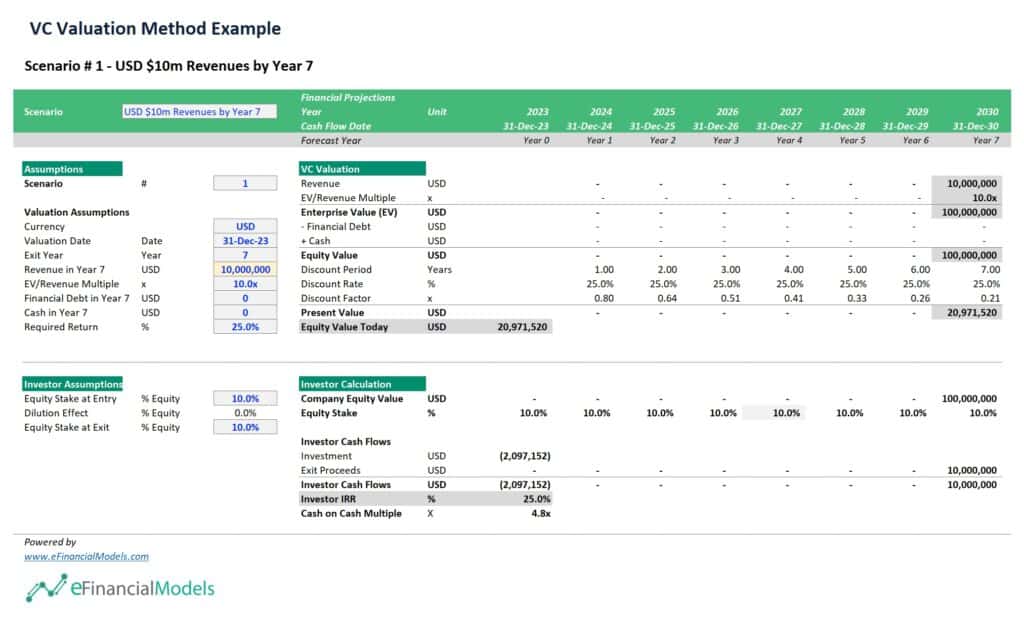
Scenario #1 – USD $10M Revenues by Year 7
Let’s assume that a tech startup seeks funding from a venture capitalist. We expect that the business can only be sold after 7 years, and the VC will have to deliver a 25.0% return on its capital investment due to the returns the VC promised its investors.
The company forecasts revenues of $10 million by year 7, while the research of similar transactions shows that other similar companies were sold at a multiple of around 10.0x EV/Revenue.
We now can calculate that the expected enterprise value at exit should amount to $100 million. As we don’t have any further information and do not expect the business to be able to obtain debt financing, we can assume that the enterprise value would correspond to the equity value.
We then discount the $100 million equity value for 7 years, which leads to a $21 million equity value today. Assuming that our equity stake will remain strong during these 7 years, the $21 million would be the maximum valuation the investor can accept when investing in this company. It could correspond to an investment of $2.1 million for a 10% stake in the company (which implies a $21 million Equity Value today).
Scenario #2 – Lower Revenues at Exit
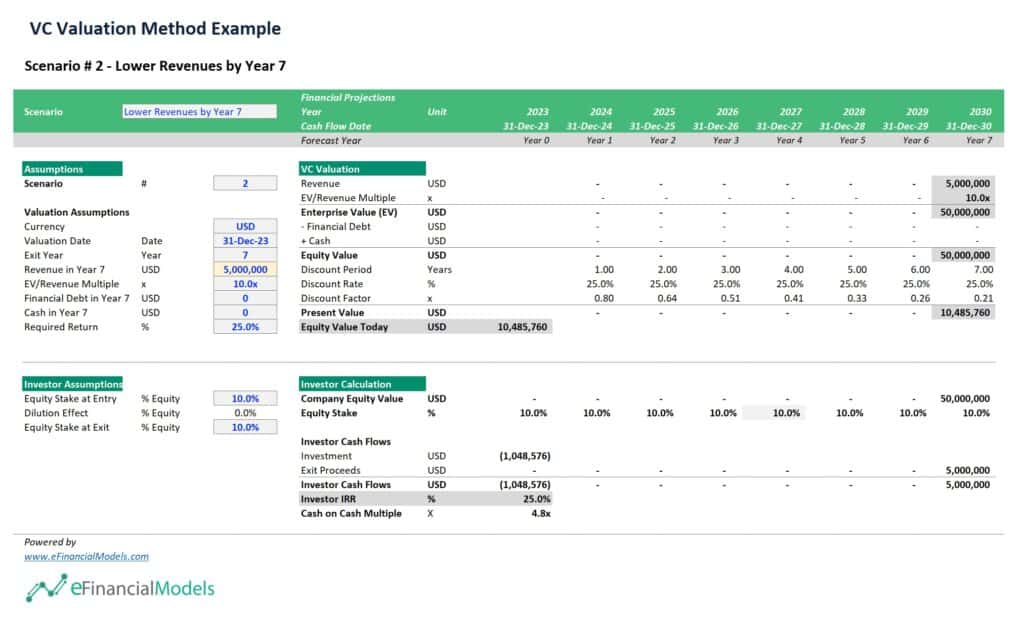
Now let us use the same assumptions, but this time we lower the expected revenue in year 7 from $10 million down to $5 million using the same EV/Revenue valuation multiple as in Scenario 1.
As you can see below, the resulting equity value in year 7 is now lowered to $50 million only. When we discount the resulting Equity Value of $50 million by year 7 at the required return of 25%, the present value will justify a maximum of $10.5 million equity value today.
It changes things. Now the venture capitalist can maximum accept a $10.5 million equity valuation today of the company if he believes the business will show revenues of $5 million in seven years and he needs to deliver a 25% annual compounded return in terms of the IRR.
Compared to scenario 1, the venture capital investor can now only afford to offer $1.0 million for a 10% equity stake (compared to $2.1 Million as in scenario 1).
Scenario #3 – VC Requires Higher Returns
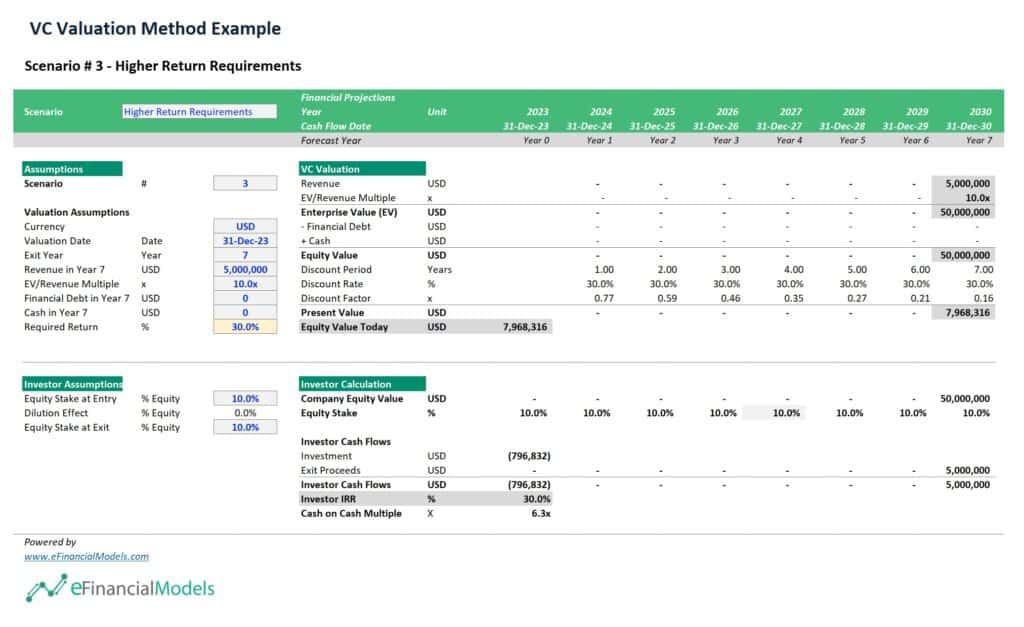
Now let’s look at what happens when the investor concludes that a 25% return for the risk he takes is not enough and demands a 30% return. As shown below, we keep all assumptions as in scenario 2; only the required return increases. The result is that the equity valuation is lowered to a rounded $8 million only. The reason is that the venture capitalist views the company as riskier and uses a higher discount rate in discounting the $50 million equity value in year 7.
Scenario #4 – VC Expects to Become Diluted
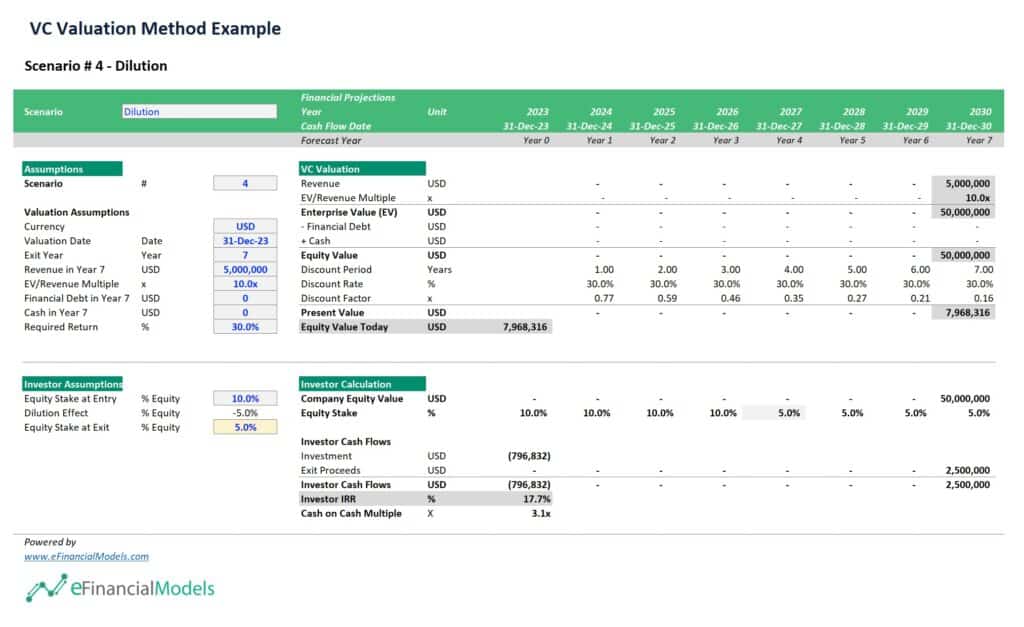
Now we stick with the assumptions as of scenario 3, but this time, we expect that to reach the company’s goal, the company will need to raise additional equity financing by year 4. The venture capitalist expects new investors to enter, demanding a certain percentage of the company’s equity capital. The effect on our venture capital investor will be that his stake in the company gets watered down from 10% to 5% – he becomes diluted. As you can see in the example below, the VC Valuation remains the same as in scenario 3 – rounded $8 Million. However, given the expectations of additional funding rounds, the VC has to consider that he becomes diluted, and his equity stake of 10% today will only be 5% by year 7. In that case, he would miss his return target of 30% IRR as he can only achieve 17.7% mathematically.
So, what is the solution to this Dilemma? – the VC could
(1) Pass on this opportunity and decide to invest somewhere else where he can see more clearly how to
(2) Take the dilution into account and might even be willing to participate in the funding round by year 4
(3) Or he might raise his return target from 30% IRR to an even higher number.
These considerations will impact his negotiations with the startup founders, and it would be good if the entrepreneurs could prepare themselves for such a discussion.
The Importance of Forecasting Financials in the VC Valuation Method
Forecasting financials is critical to the VC (venture capital) valuation method because it helps investors evaluate the company’s expected valuation potential when using appropriate valuation multiples.
Early-stage companies often have limited operating histories, making it difficult to assess their future performance based on past results alone. So, financial forecasts can provide critical insights into the company’s growth trajectory, potential risks, and opportunities in these cases. Furthermore, financial projections are typically used to calculate the company’s valuation using various methods, such as discounted cash flow (DCF) or comparable company analysis (CCA). These valuation methods rely heavily on accurate financial projections, and subjective views of managers and investors in developing such forecasts can significantly impact the perceived company valuation.
Finally, financial forecasts also play a crucial role in negotiating the terms of the investment, such as the amount of funding, the expected rate of return, and the timeframe for exit. By clearly understanding the company’s financial prospects, investors can negotiate terms that align with their investment goals and risk tolerance.
Benefits of Using the Venture Capital Valuation Method
The VC valuation method offers a flexible and straightforward approach to valuing early-stage companies. Here are the main arguments why you might want to use the VC valuation method:
1) Easy to Use
The VC (Venture Capital) Valuation method is often considered easy to use because it is a relatively straightforward approach to valuing a startup company. This method determines a valuation based on the startup’s expected future valuation based on what the VC believes the company’s growth trajectory will be. This estimate is then used to calculate the startup’s current value when discounting the future valuation to its present value.
2) Quick Approach
The VC Valuation Method allows investors to quickly estimate a company by only looking at select key parameters. However, given vital parameters such as projected users, revenues, or EBITDA is difficult to evaluate 7 years later, a more detailed financial projection model and analysis might be required to increase confidence in the chosen valuation approach.
3) Exit Driven
Many times, valuation methods ignore the fact of how to exit an investment. The VC Valuation method is the opposite: The exit valuation determines what the valuation will be worth today, and the process also considers the time required to get there. If it takes longer until the investment can be sold, the company’s current valuation will lower and vice versa.










Common Challenges and Pitfalls to Avoid in the Venture Capital Method
When done correctly, the VC Valuation Method can be a powerful tool in any negotiations for VC funding. However, there are common pitfalls to look out for when utilizing such an approach.
1) Subjective Estimates
A big challenge with the VC Valuation Method is that the process is based on subjective estimates. Many times, you won’t have available accurate data or assumptions. So, whoever prepares a valuation analysis, can manipulate assumptions that favor one outcome over another or rely too heavily on individual judgment rather than data-driven insights. These subjective estimates can lead to incorrect conclusions or skewed results.
It’s important to document each step using financial modeling by providing complete transparency on the assumptions taken and ensuring that each assumption is rooted as much as possible in data-driven insights to avoid these pitfalls. You may also need expert opinions to analyze and organize the data. It will help maintain objectivity in results and give stakeholders greater confidence in their decisions.
2) Not Applicable in Every Situation
The VC method is most appropriate for early-stage companies seeking venture funding. For later-stage companies, you often can use other valuation methods that are more applicable when looking at buy-and-hold scenarios. However, the VC Valuation method can only add another data point to your valuation method when using other methods.
If you’re considering using this valuation method, make sure you rely on inputs provided by people knowledgeable in the industry.

The Bottom Line: The Exit Value Tomorrow Defines the Value of Today
The venture capital valuation method is one of the most common methods used by venture capitalists to determine the value of an early-stage company. Many Startups do not have much financial history or data which can be used to value them. VC investors work around that by estimating the expected value a few years from an exit point of view. Once they have figured out what the company might be worth in a few years, they can easily discount that value and determine its worth today by considering their return requirements in the form of the applicable discount rate.
The VC valuation method requires transparency on the assumptions taken. It opens room for a meaningful discussion of how the financial scenarios of a company might look in the future. Startup founders should know about the VC valuation method whenever they need to prepare for their next funding round. Also, the VC method allows for making informed decisions during investment negotiations.
The result of a VC valuation needs to be more accurate as the method relies on several key assumptions, which are hard to predict accurately. In addition, also, the multiple relied upon when estimating a company’s future value can differ between industries and types of companies. Depending on their situation, using an EV/Revenue or an EV/EBITDA multiple might be better when estimating the exit value. One way to work around this is to think in terms of scenarios: Best case, base-case, and worst-case scenarios. It can open a range in which a reasonable valuation of an early-stage company should lie within.
The good news is that if you’re looking for funding from investors, they’ll want proof that their money will be well spent on this type of investment. So, learning how the VC valuation method works isn’t just useful for entrepreneurs – it’s essential!








































You might also like:
- 10 Tips to Develop a First Class Business Valuation Report
- Finding a Valuation Model for Your Business
- How to Value a Business Using a Discounted Cash Flow Model
- Pre-Money and Post-Money Valuation: What You Need to Know
- Understanding What is Yield to Maturity and Why It Matters
- Venture Capital vs. Private Equity: Which is Right for You
- 10 Main Elements of a Business Plan
- Discount Rate
- The Key Differences Between Levered and Unlevered Free Cash Flow
- Financial Modeling for Startups and Small Businesses
- Calculating Revenue Growth Rate: A Key Metric for Business Success
- Top 5 Tips For a Good Financial Due Diligence
- Mastering the Art of IRR Calculation: A Comprehensive Guide for Investors
- How to Raise Series A Funding?
- Investor Presentations
- How to Build a Capitalization Table
- Calculating EBITDA: Understanding the Core Metric for Financial Analysis
- Financial Due Diligence in Investment
- Top-Down vs. Bottom-Up Financial Planning: What’s the Difference?
- Commercial Real Estate Valuation Methods: Helping Investors in Taking Informed Decisions