
0 ITEMS

How Do I Find Precedent Transactions?

Do you want to unlock historical data to guide the financial future with a treasure trove of real-market data from similar deals? Precedent transaction analysis is the financial world’s time machine, offering a glimpse into the valuation landscape of past deals to forecast the future. It uniquely combines historical data with present-day insights, turning past transactions into a roadmap for tomorrow’s mergers and acquisitions.
However, compiling a list of comparable transactions is not straightforward and does not follow a one-size-fits-all approach. Analysts must employ a meticulous process of sifting through various sources to gather relevant data. This article sheds light on the most effective strategies for identifying and analyzing precedent transactions. Our step-by-step approach ensures a thorough and informed analysis, laying the groundwork for accurate and reliable company valuations.
What are Precedent Transactions?
Precedent transactions are completed mergers and acquisitions (M&A) deals that have occurred in the past within a specific industry or sector. These transactions are historical examples of how companies have been valued and the terms under which they were acquired or merged. To identify what are precedent transactions, key financial data, such as the purchase price, deal structure, and any synergies, are identified. They provide a reference point for evaluating the attractiveness and feasibility of similar future transactions.
Analysts can construct a comprehensive list of of what are precedent transactions that offer valuable insights for their valuation exercises by exploring multiple avenues for information, from databases to financial reports. Professionals use precedent transactions to value companies across investment banking, private equity, and corporate development sectors. This methodology hinges on the assumption that the financial details of similar transactions involving comparable companies can provide a solid benchmark for valuation.
Trading vs. Transaction Multiples
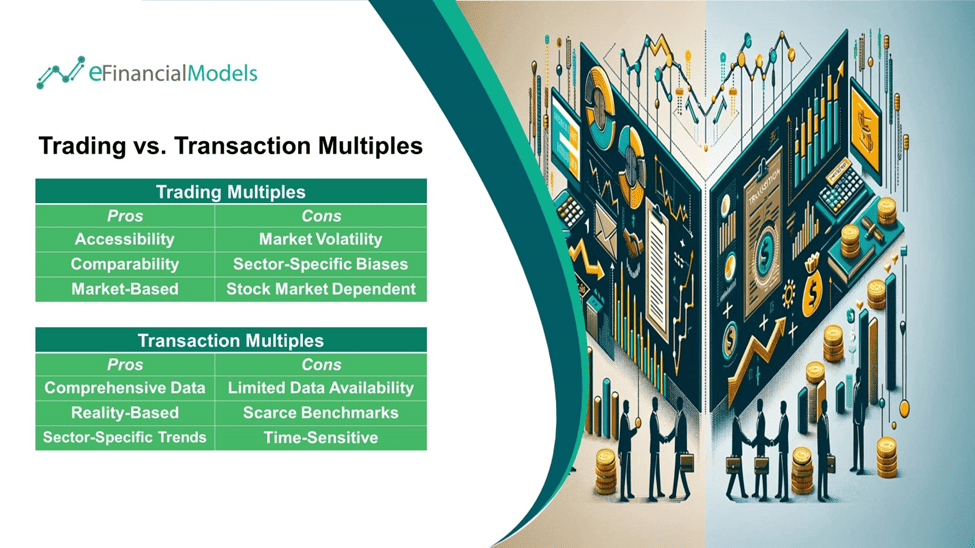
Trading multiples and transaction multiples are two prevalent methods used in the valuation of companies, each with its advantages and disadvantages. They serve as benchmarks to compare the value of a company relative to key financial metrics, such as earnings, sales, or assets.
Trading Multiples
Trading multiples, also known as market multiples, involve valuing a company based on the current market values of comparable public companies. This method uses ratios derived from publicly traded companies to gauge the value of a similar company.
Pros of Trading Multiples
- Accessibility: Easily accessible information from financial markets makes it straightforward to calculate.
- Comparability: Enables comparison between companies in the same sector or industry, offering a relative valuation perspective.
- Market-Based: Reflects the current market sentiment and real-time data of similar companies in the industry.
Cons of Trading Multiples
- Market Volatility: This can be highly sensitive to market conditions, leading to fluctuations that may not accurately reflect a company’s fundamental value.
- Sector-Specific Biases: Might need to account for unique aspects of companies that are not perfectly comparable, leading to potential valuation inaccuracies.
- Stock Market Dependent: Values are based on public perception and investor sentiment, which might not always be rational or reflective of intrinsic value.
- Minority Stakes only – market multiples are based on stock-traded shares reflecting small company shares. They reflect minority stakes only.
- Include a liquidity premium, as these types of transactions are based on liquid markets where there are many buyers and sellers
Transaction Multiples
Precedent transactions consist of multiples derived from similar transactions to estimate the value of a target company. Also known as “transaction multiples or deal multiples,” they are pivotal for analysts who aim to achieve an accurate valuation by drawing parallels from historical deals. These transaction multiples are used in mergers and acquisitions and involve valuing a company based on the prices paid for similar companies in past transactions. This approach derived multiples from completed deals in the relevant industry sector, reflecting what buyers have historically paid for companies.
Pros
- Comprehensive Data: Includes a broader set of data points such as deal structure, financing methods, and market conditions at the time of the transaction.
- Reality-Based: Reflect the price actually paid for companies, providing insight into what investors are willing to pay.
- Sector-Specific Trends: Can highlight trends in M&A activity within a specific industry, offering strategic insights.
- Private Transactions are mostly purchases of majority stakes in a company and contain a Control Premium
Cons
- Limited Data Availability: Transaction details can be challenging to obtain, particularly for private or smaller deals, limiting the data set.
- Scarce Benchmarks: Each transaction is unique, with its own set of circumstances that may not be applicable across the board, making it harder to find comparable transactions.
- Time-Sensitive: Reflects past market conditions and may not indicate current or future valuation landscapes.
- Private Transactions are not available on any public market; buyers and sellers are very limited. Therefore, it is implied that they include an Illiquidity Discount as it might be hard to find another buyer.

























When to Use Trading vs. Transaction Multiples
The choice between trading and transaction multiples often depends on the context of the valuation, the availability of data, and the specific objectives of the analysis. Combining both methods can provide a more comprehensive view of a company’s value from different perspectives.
Use Trading Multiples for a quick, market-based valuation that reflects current investor sentiment and market conditions. They are handy for analyzing public companies or sectors with high comparability and market data availability.
Use Transaction Multiples when more detailed, transaction-based insights are needed, especially for mergers and acquisitions, private company valuation, or when assessing the impact of market trends on company valuations. They are valuable in understanding how similar companies have been valued in actual deals, providing a more grounded basis for valuation that accounts for strategic premiums or discounts.
Resources for Precedent Transaction Analysis
Finding precedent transactions is crucial in conducting financial analysis, especially when evaluating mergers and acquisitions (M&A). Unfortunately, there is no shortcut to compiling a comprehensive list of comparable transactions. This process often requires meticulous and manual research, as many transaction details are private. Analysts must dig deep into available information, using various sources and methods to unearth relevant data that can provide insights into past deals, which can inform current evaluations.
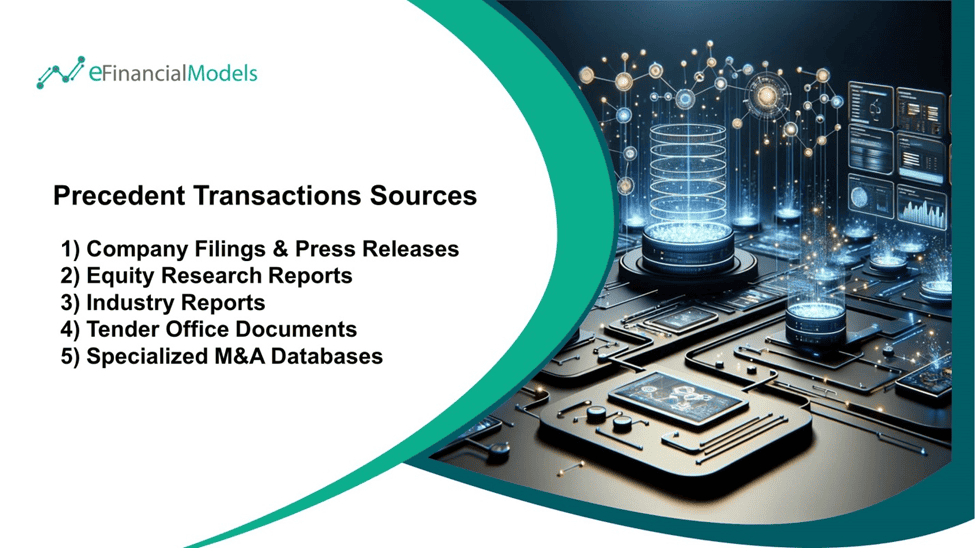
Company Filings & Press Releases
Public companies must disclose significant business transactions, including acquisitions and divestitures, in filings with securities regulatory bodies (such as the SEC in the United States). Annual reports (10-K), quarterly reports (10-Q), and current reports (8-K) can provide detailed information about these transactions. Accessing filings with securities regulatory bodies, like the U.S. Securities and Exchange Commission (SEC), is a straightforward process, thanks to the availability of online databases and resources. For companies in the United States, the SEC’s EDGAR (Electronic Data Gathering, Analysis, and Retrieval) system is the primary tool for finding such documents. This platform provides free public access to corporate filings. Check company press releases. Companies often announce acquisitions and divestitures through press releases available on their official websites. These announcements provide details on the nature of the deal, the parties involved, and sometimes the financial terms or strategic rationale behind the transaction.
Equity Research Reports
Equity Research Reports, which include M&A commentary, are another critical resource for finding precedent transactions. These are analyses produced by financial analysts at banks or financial services firms, providing detailed insights into companies, industries, and market trends. They can include valuations, forecasts, and recommendations. If affiliated with a university, check if your library has subscriptions to relevant databases. Some universities have access to databases like WRDS (Wharton Research Data Services), which can be a valuable resource. Websites like Bloomberg, MarketWatch, Reuters, and Seeking Alpha offer some analysis and information on recent transactions, though it might need to be more detailed.
Industry Reports
The Big 4 firms and boutique investment banks often publish detailed industry reports that include M&A activity, precedent transactions, and analyses of trends. To find relevant industry reports, use precise search terms on Google. Directly search for these reports by including the firm’s name in your search terms, such as:
- “Deloitte technology M&A report”
- “EY [Industry Name] M&A insights”
- “KPMG M&A report”
- “PwC [Industry Name] M&A insights”
- “[Boutique Investment Bank Name] industry report”
Tender Offer Documents
Tender Offer Documents, precisely Schedule 14D-9 and Schedule TO, involves a detailed review of filings with the U.S. Securities and Exchange Commission (SEC). These documents are part of the regulatory filings required during tender offers, where one party offers to purchase the shares of another party, typically as part of a merger or acquisition.
- Schedule 14D-9: Filed by the target company in response to a Schedule TO, includes the target company’s position on the tender offer and reasons for its recommendation to shareholders. It may include financial projections, valuations, and fairness opinions from financial advisors.
- Schedule TO: Filed by the acquirer or bidding company making the tender offer. It details the terms of the offer, the background of the transaction, the financing of the offer, and intentions regarding the target company’s future operations.
Public companies often post their SEC filings in the investor relations section of their website, though the EDGAR database is more comprehensive.
Specialized M&A Databases
Finding precedent transactions, which are past mergers and acquisitions (M&A) deals similar to the one under consideration, is crucial for financial analysis, valuation, and due diligence in the M&A process. Specialized M&A databases are invaluable resources for this purpose because they aggregate, organize, and provide detailed information on past deals, including transaction values, multiples, industry focus, and involved parties. Among the most popular ones are:
- Epsilon Research: Offers detailed reports on European private company M&A transactions.
- Factset: Provides comprehensive data on global M&A deals, analytics, and market data.
- Mergermarket: Known for real-time M&A news and a database of transactions, especially useful for uncovering deals not widely reported.
- PitchBook: Focuses on private equity and venture capital (VC) transactions, including early-stage funding rounds and exits.
- S&P Capital IQ: Offers a broad database of global transactions with detailed financial information and company data.
- Thomson Reuters Eikon: Provides extensive financial data, including detailed M&A transaction data, market analysis, and news.
These databases often offer downloadable reports and analyses on specific transactions, including analyst reports, market reactions, and post-merger integration outcomes. These can provide deeper insights into the rationale behind the transactions and the success factors involved.
Establishes New Benchmarks with Precedent Transaction Analysis
Precedent transaction analysis serves as a crucial tool for both buyers and sellers to gauge the value of a company in an M&A deal. From the perspective of the buy side, the primary objective is to ascertain a fair offer to propose for the acquisition of a company. Conversely, on the sell side, the goal is to establish the maximum price at which the company can be sold, thereby securing the best possible deal for the sellers. This process enables both parties to enter negotiations with a clear understanding of their financial boundaries and expectations, facilitating a smoother transaction process.
When embarking on the search for precedent transactions, adopting a strategic approach is paramount. The principles of “less is more” and “quality over quantity” are particularly applicable, suggesting that a focused search yielding 10-20 high-quality deals is far more valuable than a broader search with numerous less relevant transactions. To achieve this, utilizing specific keywords related to the industry, company names, transaction dates, and terms such as “precedent transaction analysis,” “equity research report,” and “M&A transaction details” is advisable. This targeted search, especially when coupled with the use of date filters in databases, ensures the identification of the most pertinent and recent transactions, thereby enhancing the relevance and accuracy of the analysis.
Moreover, financial modeling is instrumental in establishing new benchmarks for precedent transaction analysis. By accurately calculating the specifics of each transaction, including any premiums or discounts applied, acquirers can gauge the reasonableness of their offer prices against similar past deals. It serves as a critical check and ensures that the offer price is grounded in empirical data, reflecting the actual market value of comparable transactions. Through this meticulous process, precedent transaction analysis informs the initial offer and fortifies the negotiating position of buyers and sellers, ultimately leading to more equitable and prosperous M&A outcomes.







































Tags: business valuation