
0 ITEMS

When to Use the EV/EBIT Valuation Multiple?
Table of Content
The EV/EBIT multiple is a key valuation metric used to assess a company’s operational efficiency and market value.
- Berkshire Hathaway favors EV/EBIT because it captures actual capital expenditures needed for growth, especially in capital-intensive industries.
- The multiple helps compare companies across industries by reflecting differences in growth prospects, risk, and profitability.
- A low EV/EBIT may indicate undervaluation or higher industry risk, while a higher multiple suggests growth potential or stability.
- Industry comparisons reveal which sectors have higher or lower valuation multiples, highlighting relative investment attractiveness.
- Using financial models to analyze EV/EBIT provides deeper insights into operational performance and valuation opportunities.
Reading further will help you understand how to apply this metric effectively in valuation and investment analysis.
What Does the Enterprise Value to EBIT Multiple Tell You?
The Enterprise Value to EBIT Multiple is a valuation metric used to evaluate a company’s value relative to its earnings before interest and taxes (EBIT). It helps investors understand how much they are paying for the company’s operational earnings without the influence of capital structure or tax differences.
Generally, the lower the Enterprise Value to EBIT Multiple, the cheaper the company appears relative to its earnings potential. It tells us that the company might be undervalued compared to its earnings before interest and taxes, potentially offering a good investment opportunity if other fundamentals are solid. The market may also perceive higher risks related to the company’s future growth prospects or stability, leading to a lower valuation relative to its earnings. A low EV/EBIT multiple might also suggest that the industry or the company is facing economic challenges, such as declining demand, increased competition, or regulatory issues affecting profitability.
At the same time, a higher multiple might suggest an overvalued company or expected growth potential. Investors might have high expectations for the company’s future growth, which results in a higher valuation relative to current earnings before interest and taxes. The company may be perceived as a lower-risk investment or part of a high-demand sector, which drives up its valuation relative to its earnings, leading to a premium multiple. It also implies that the company could have a strong competitive advantage, such as a leading market position or valuable intellectual property, justifying a higher valuation by the market.

The Enterprise Value to EBIT Multiple varies widely between industries due to differing growth prospects, risk levels, and profitability. High multiples generally indicate industries with better growth prospects, greater stability, or high barriers to entry. Lower multiples may indicate industries with slower growth, higher risks, or lower margins. By comparing these multiples across industries, investors can understand how expensive or cheap different sectors are relative to their operating earnings.
Refer to the table below, where we highlighted the top 10 industries with the highest EV/EBIT Multiples and the top 10 industries with the lowest EV/EBITA Multiples from NYU STEM’s Enterprise Value Multiples by Sector (US) as of January 2024:

The 2024 EV/EBIT Multiple Per Industry table compares the enterprise value to EBIT for various industries. The Financial Services industry has the highest multiple at 83.08x, while the Coal & Related Energy industry has the lowest at 4.04x. The average multiple across all listed industries is 29.23x. These multiples are used to gauge the relative valuation of firms in each sector, with higher multiples often indicating higher growth expectations or lower risk. Industries like Software and Financial Services show high multiples, suggesting investor optimism about their future earnings potential.
EBIT vs. EBITDA: Unraveling the Key Differences
A common point of confusion in financial analysis is the difference between EBIT vs. EBITDA (Earnings Before Interest, Taxes, Depreciation, and Amortization). Both metrics focus on a company’s earnings, but they do so differently, leading to distinct implications for investors and analysts. EBIT measures profitability by focusing on operational earnings without considering how a company is financed. EBITDA takes it a step further by adding back non-cash expenses to provide a clearer view of cash flow from operations. Understanding the key differences between these metrics helps investors and stakeholders gauge a company’s true earnings power and compare financial health across different industries. Here’s a list of key difference between EBIT vs. EBITDA:
- Focus: EBIT vs. EBITDA differs when it comes to focus. EBITDA is widely regarded as a proxy for cash flow, making it especially valuable when evaluating a company’s capacity to meet debt obligations. This metric sheds light on the available cash flow by excluding non-cash expenses like depreciation and amortization, offering a clearer view of liquidity for debt servicing. In contrast, EBIT places a stronger emphasis on the overall profitability derived directly from operating activities. By incorporating cash and non-cash expenses, EBIT provides insight into a company’s core operating performance, giving a fuller picture of sustainable profitability beyond immediate cash flow.
- Asset-Heavy Returns: EBIT (Earnings Before Interest and Taxes) accounts for depreciation and amortization. These are costs related to assets like machinery, buildings, or patents. By including them, EBIT reflects how effectively a company uses its assets to generate profit. On the other hand, EBITDA (Earnings Before Interest, Taxes, Depreciation, and Amortization) excludes these asset-related costs. It focuses only on operational performance without considering the impact of owning or using assets. So, EBITDA is a good measure for comparing companies, especially with different asset bases or financing structures. EBIT is often the preferred measure for evaluating a company’s true operating efficiency, especially in industries where large, ongoing investments in assets impact both financial performance and future profitability.
- Non-Cash Expenses: EBIT recognizes depreciation and amortization as integral to understanding a company’s full operating costs. Depreciation represents the gradual allocation of costs for tangible long-term assets like property, plant, and equipment (PPE), reflecting their usage and wear over time. Amortization applies to intangible assets—such as patents, trademarks, and goodwill—spreading their costs over their useful lives. Together, depreciation and amortization are non-cash expenses that reduce reported earnings without impacting cash flow directly, as these costs do not involve an outflow of cash. In contrast, EBITDA excludes these expenses, providing a more streamlined view of cash flow by focusing solely on cash-based profitability but potentially overlooking the long-term impact of asset wear and intangible asset usage. However, EBIT’s inclusion of these non-cash items delivers a more realistic assessment of operational profitability for asset-intensive businesses, factoring in the ongoing investment required to maintain and replace key assets.
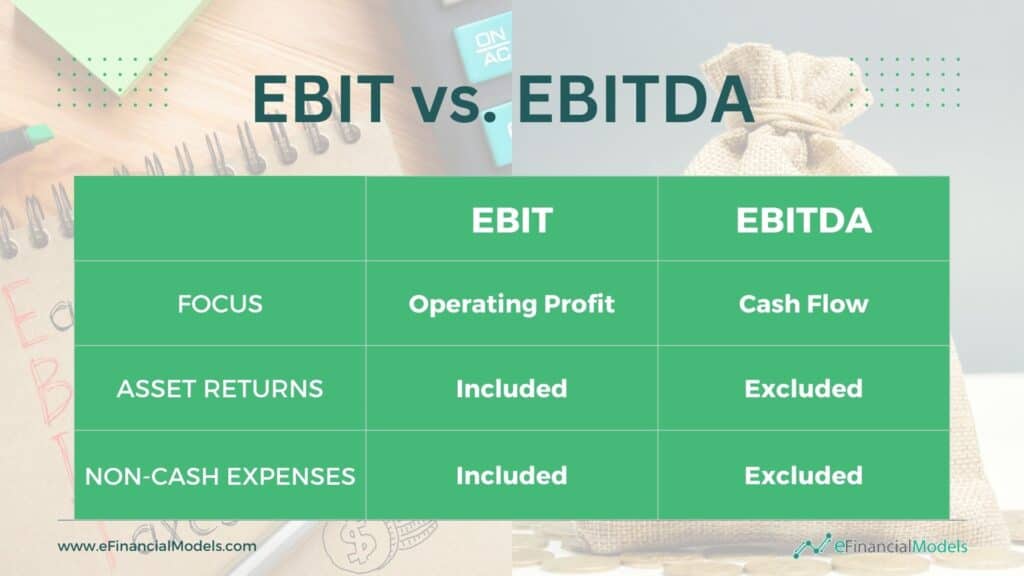
Ultimately, EBIT vs. EBITDA serve different purposes, but they are useful metrics that impact how a company’s valuation and profitability are interpreted.



















































Understanding the EV to EBIT Multiple Formula
The EV to EBIT multiple formula determines a company’s value based on its operating earnings. Investors and analysts use this multiple to determine whether a company is fairly valued, overvalued, or undervalued. The formula has two main components: Enterprise Value and Earnings Before Interest and Taxes (EBIT). Let’s dive deeper into how to use the formula effectively.
1. Calculate Enterprise Value (EV): Calculating enterprise value is the first step in using the EV to EBIT multiple formula. It is a measure of a company’s total value to both equity and debt holders. You need to get the market capitalization and total debt sum, then subtract it from the cash and cash equivalent.
- The market capitalization is the product of multiplying the current stock price by the number of outstanding shares.
- Total debt consists of both short-term and long-term liabilities.
- Cash and Cash Equivalents are highly liquid assets that a company can quickly convert to cash, such as bank deposits, treasury bills, and money market funds.

2. Determine EBIT: Determining the EBIT is the next step in using the EV to EBIT multiple formula. EBIT stands for earnings before interest and taxes. It appears directly on a company’s income statement. Also known as the net income, we calculate earnings before interest and taxes by subtracting the cost of goods sold (COGS) and operating expenses from total revenue. It clearly shows a company’s operating performance, excluding the effects of financial leverage and tax environments. You can also locate the EBIT on the company’s income statement.

3. Calculate EV to EBIT: After obtaining enterprise value and the earnings before interest and taxes on income statement, we can now use the EV to EBIT multiple formula . All we need to do is divide the enterprise value by the EBIT.

Sample Calculation
Let’s say Company A has an Enterprise Value of $500 million and an EBIT of $50 million. Company B, a competitor, has an EV of $400 million and an EBIT of $50 million. The EV/EBIT Multiple would be calculated as follows:]


Company A’s EV/EBIT Multiple of 10x means that investors are willing to pay 10 times the company’s EBIT for its total value, which includes debt and equity. In contrast, Company B’s EV/EBIT Multiple of 8x suggests investors value it at 8 times its EBIT. A higher multiple, like Company A’s, often indicates that the market expects better future growth and higher profitability or sees lower risks associated with that company. Meanwhile, a lower multiple for Company B may indicate that investors see more risk and lower growth potential or consider the company less attractive than its competitor.
When Should You Perform an Enterprise Value to EBIT Multiple Valuation?
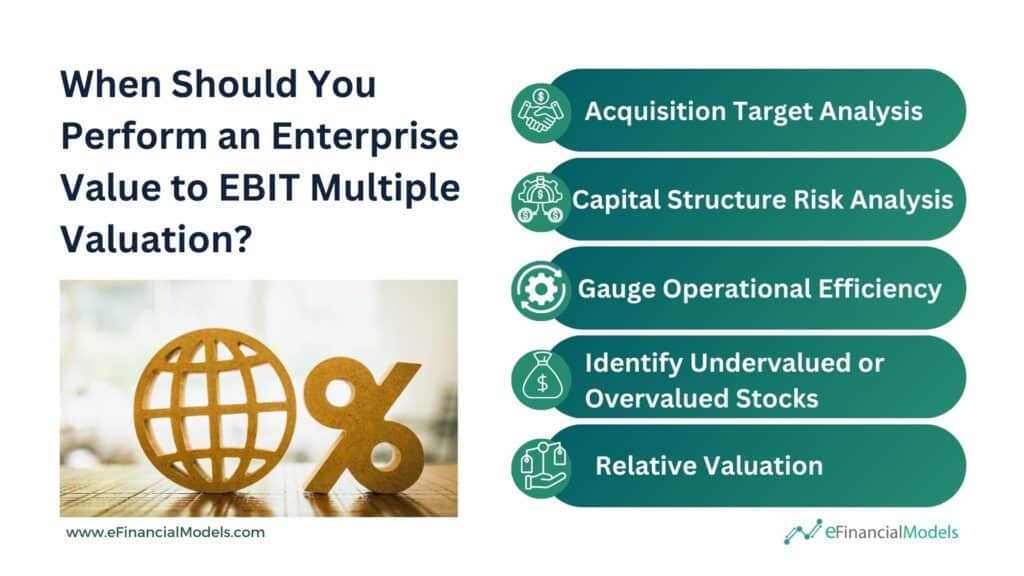
Enterprise Value to EBIT Multiple Valuation provides a comprehensive view of a company’s financial health and operational efficiency. By comparing the value of a business, including debt and equity, to its core earnings, this valuation multiple helps investors and analysts gauge how efficiently a company generates profit relative to its overall market valuation. An Enterprise Value to EBIT Multiple Valuation is particularly useful in the following scenarios:
Acquisition Target Analysis
Enterprise Value (EV) to EBIT is a key multiple for evaluating potential acquisition targets. It helps buyers determine whether a company is an attractive bargain, fairly valued, or overpriced. By comparing the EV to EBIT multiple across similar businesses in the industry, investors can identify potential targets priced below average, indicating a buying opportunity. A lower EV/EBIT multiple suggests that the acquisition cost is more favorable to the operational profit generated by the company, making it a crucial metric during merger and acquisition evaluations.
Imagine a tech company, TechCorp, looking to acquire smaller startups to expand its software product line. TechCorp evaluates two potential acquisition targets: StartUp A and StartUp B. Both startups operate in the software industry, but StartUp A has an EV to EBIT multiple of 10, while StartUp B’s multiple is 15. Since StartUp A’s multiple is lower, TechCorp views it as a more attractive acquisition target because the cost of acquiring its enterprise value (considering its operational profit) is lower compared to StartUp B. This suggests that StartUp A might be a better deal financially, potentially offering a higher return on the acquisition.
Capital Structure Risk Analysis
Enterprise Value to EBIT Multiple Valuation also plays a role in determining the risk associated with a company’s capital structure. Since Enterprise Value accounts for debt and equity, a high EV relative to EBIT could imply significant leverage and debt obligations. It, in turn, highlights higher risk, particularly during periods of economic downturn when profitability might be impacted. Analysts use this ratio to assess whether a company’s capital structure is too risky, providing insights into its ability to sustain operations and service its debt, especially when EBIT—a proxy for operational profitability—faces challenges.
Take the case of two telecommunications companies: Telco A and Telco B. Telco A has a significantly higher EV to EBIT multiple of 20 compared to Telco B’s multiple of 12. Telco A may have a high debt load or higher valuation relative to its earnings. The high EV relative to EBIT implies more risk in Telco A’s capital structure, particularly in times of economic uncertainty. Analysts conclude that Telco A’s profitability might need help to cover its debt obligations if earnings were to fall, making it a riskier investment compared to Telco B, which has a more manageable capital structure reflected in its lower multiple.
Gauge Operational Efficiency
The EV/EBIT multiple also serves as an indicator of a company’s operational efficiency. It measures how effectively a company can generate profits from its operational activities relative to its enterprise value. A low EV/EBIT multiple indicates that a company efficiently converts operations into profits, while a high ratio suggests possible inefficiencies or overvaluation. By examining this multiple, investors can compare operational performance between similar companies, giving them insights into which businesses are well-managed and generating healthy earnings relative to their enterprise value.
Consider two competing grocery store chains: GreenGrocers and FreshFoods. GreenGrocers has an EV/EBIT multiple of 8, while FreshFoods has a multiple of 12. The lower EV/EBIT ratio of GreenGrocers indicates that it is more efficient in generating operational profits relative to its overall enterprise value. GreenGrocers is better at managing costs and generating profit than FreshFoods. An investor looking for a more operationally efficient company may favor GreenGrocers over FreshFoods because of its superior ability to convert value into earnings.
Identify Undervalued or Overvalued Stocks
Investors often perform Enterprise Value to EBIT Multiple Valuation to determine whether a stock is undervalued or overvalued compared to its peers or the industry average. A lower EV/EBIT multiple might indicate that a company is undervalued, representing an investment opportunity. At the same time, a higher one could suggest overvaluation, cautioning investors to be wary of possible declines in value. By comparing EV/EBIT with industry standards, investors can make more informed decisions on stock selection, especially when considering the risk-adjusted returns on their investments.
Suppose private equity firm is comparing two car manufacturing companies, CarMaker A and CarMaker B. CarMaker A has an EV/EBIT multiple of 9, while the industry average is 13. It suggests that CarMaker A might be undervalued compared to its peers, as investors pay less for each unit of operational profit than other companies in the industry. This presents an opportunity for the PE firm to purchase CarMaker A’s stock with the expectation that its market value will increase once the undervaluation is corrected. Conversely, if CarMaker B has an EV/EBIT multiple of 17, it could be overvalued compared to the industry average, making it a less attractive investment.
Relative Valuation
Relative valuation is another key practical use of an Enterprise Value to EBIT Multiple Valuation. It allows investors and analysts to compare companies within the same sector or industry, irrespective of differences in their capital structures. Unlike other metrics affected by varying debt and equity levels, the EV/EBIT multiple provides a comprehensive valuation view, making it easier to compare companies. By using the Enterprise Value to EBIT multiple, investors can perform peer analysis to identify which companies offer more value in terms of their operational earnings, ultimately aiding in selecting superior investments.Imagine an equity analyst evaluating two pharmaceutical companies: PharmaCo X and PharmaCo Y. PharmaCo X has an EV/EBIT multiple of 18, while PharmaCo Y has 14. Both companies have similar revenue streams in the same industry. This indicates that PharmaCo Y has a better value than PharmaCo X, offering higher earnings relative to its enterprise value. The equity analyst then determines that PharmaCo Y because it seems undervalued in comparison, representing a potentially better return on investment, assuming both companies have similar growth prospects.
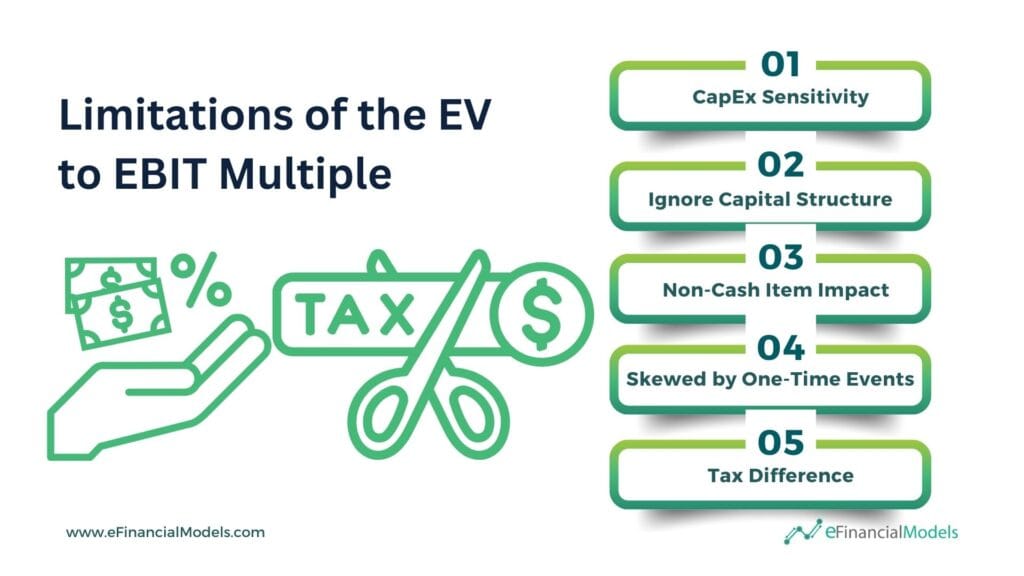
Limitations of the EV to EBIT Valuation Multiple
The EV to EBIT Multiple, a widely used valuation metric, has limitations that investors should consider carefully. While it offers a perspective on a company’s value, it doesn’t account for critical factors. Moreover, the multiple may mask underlying disparities in profitability when comparing companies across sectors with different operational efficiency or capital intensity.
- CapEx Sensitivity: The EV to EBIT Multiple may not accurately reflect a company’s future capital expenditure needs. Since CapEx can vary significantly between industries or companies, ignoring it can lead to misleading valuations, especially for businesses with high or fluctuating CapEx requirements. This oversight can distort a company’s true earning potential and growth prospects.
- Ignore Capital Structure: The EV to EBIT Multiple does not consider a company’s debt-to-equity mix. By ignoring how a company is financed, whether through debt or equity, this metric can give a distorted view of its risk and return potential. It makes comparisons between firms with different capital structures unreliable.
- Non-Cash Item Impact: Since EBIT includes non-cash items such as depreciation and amortization, these accounting figures might skew the EV to EBIT Multiple. Non-cash expenses vary widely between companies depending on their asset base, leading to an incomplete or misleading picture of true operating performance.
- Skewed by One-Time Events: EV/EBIT is susceptible to one-time events, like large gains or losses, which can artificially inflate or deflate EBIT. These events are not indicative of ongoing operations, and without adjustments, they can lead to an inaccurate valuation by overstating or understating a company’s performance.
- Tax Difference: The EV to EBIT Multiple does not account for differences in corporate tax rates, which can vary significantly by jurisdiction. Ignoring tax impact means that a company’s net profitability might be overestimated, leading to inaccurate comparisons between companies operating in different tax environments.
Boost Your Valuation Analysis with EV/EBIT Multiple Using Financial Modeling
The EV/EBIT Multiple is a powerful valuation tool that helps investors gauge a company’s operational efficiency by considering the impact of necessary capital investments. It is particularly valuable in capital-intensive industries, where depreciation and amortization significantly influence financial performance. By focusing on actual operating earnings, the EV/EBIT Multiple allows for more meaningful comparisons between companies, offering insight into both valuation and profitability without the noise of non-operational factors. This metric helps identify undervalued opportunities and determine risk, making it essential for investors to understand a company’s true value potential.
Unlocking insights about the EV/EBIT Multiple through financial modeling empowers investors and analysts to make more informed decisions. By building detailed financial models, you can simulate various scenarios, assess capital structure impacts, and visualize the operational efficiency of businesses. These insights help identify acquisition opportunities, evaluate risk, and compare valuations across industries—all key components of a successful investment strategy. Leverage the power of the EV/EBIT Multiple in your financial models to sharpen your analysis and uncover the real value behind a company’s numbers.
Model Your Value Today!




































You might also like:
- 10 Main Elements of a Business Plan
- 10 Tips to Develop a First Class Business Valuation Report
- Calculating Revenue Growth Rate: A Key Metric for Business Success
- Financial Ratios Analysis and Its Importance
- How to Write a Business Plan Step-by-Step
- Value Your Business With the EV/Revenue Multiple
- Pros and Cons of Equity Financing
- How Are Valuation Multiples Determined
- Finding the Balance in Your Optimal Capital Structure
- Understanding the Key Differences Between Levered and Unlevered Free Cash Flow
- Financial Modeling for Startups and Small Businesses
- Building a Monthly Budget – Using Monthly Budget Templates
- Financial Business Plan for Nail Salon
- Understanding the Debt Service Coverage Ratio: An Essential Metric for Financial Analysis
- Financial Planning for Small Business Owners – Taking an SBA Loan
- Value Your Business With the EV/Revenue Multiple
- Are EV Charging Stations Profitable?
- 12 Funding Sources for Businesses and Startups
- Financial Model – Valuation of Tax Loss Carryforwards
- Measuring Monthly Recurring Revenue For SaaS Business
Tags: business valuation