
0 ITEMS

A Guide to Understanding Capitalized Earnings Valuation

Let’s start with a quote from Philip Fisher, a renowned American stock investor:
“Even a great company can be priced too high if there’s a lot of glamour attached to it.”
In essence, the saying highlights the importance of considering the true underlying value of a company rather than solely relying on its reputation or perceived glamour. A high valuation of a business based on excessive glamour may not accurately reflect the company’s financial performance or prospects, potentially leading to an overpriced investment.
If you are looking for a fair and quick income valuation approach, capitalized earnings valuation, also known as capitalization rate business valuation, can be your solution. It reasonably estimates the company’s worth based on its estimated earnings. This approach is widely used in financial analysis and valuation because it provides a straightforward and quick way to estimate the value of a company.
The Idea of Capitalizing Earnings
Capitalized Rate Business Valuation is an income valuation approach used to determine the value of a business based on its expected future earnings. It involves using two key elements: normalized earnings and the capitalization rate formula.
- Normalized earnings refer to a business’s average or representative earnings over a specific period, typically adjusted for irregular or one-time factors that might distort the earnings. This adjustment helps to provide a more accurate representation of the sustainable earnings potential of the business. A capitalization rate business valuation typically uses the last three years historical financial statements to project them.
- The capitalization rate formula converts the normalized earnings into a present value by applying a rate of return or capitalization rate. It represents the rate of return an investor would expect to receive on their investment in the business. It considers factors such as the risk associated with the business, prevailing interest rates, and the expected earnings growth rate. The weighted average cost of capital (WACC) is commonly used as the discount or capitalization rate. It is because it represents the average rate of return required by a company’s investors (both debt and equity) to compensate for the risk associated with investing in that company.
Capitalization of earnings takes into account the time value of money, which means that a dollar earned in the future is worth less than a dollar earned today. By capitalizing future earnings, the valuation incorporates the discounted value of all cumulative earnings until infinity at their discounted net present values.
Capitalization of earnings focuses on sustainable earnings rather than short-term fluctuations. It assumes that the company will continue to generate a certain amount of earnings forever. A company with stable earnings is needed to estimate such a level of required normalized earnings reliably. It makes the capitalized earnings valuation approach less suitable for companies with high volatility in their earnings but more suitable for stable income-producing companies.
Difference Between Capitalized Earnings & Discounted Cash Flow (DCF)
Discounted Cash Flow (DCF) and capitalized earnings valuations are both an income valuation approach. While both approaches aim to estimate the intrinsic value of an asset, they differ in their underlying assumptions and calculations. Here are the main distinctions:
- Earnings vs. Cash Flow Focus: Capitalization rate business valuation focuses on the company’s historical or projected earnings, specifically the net income or earnings after taxes. Discounted Cash Flow analysis focuses on the company’s cash flows, specifically the free cash flows generated by the business.
- Fluctuations of Earnings and Cash Flows: The capitalized earnings valuation approach requires companies with stable positive earnings. DCF analysis is better suited to value companies with stronger free cash flow and earnings volatilities.
- Cost of Capital: In business valuation, the cost of capital refers to the rate of return required by capital providers to compensate them for the risk associated with investing in a particular business. The capitalized Earnings and DCF methods aim to estimate a company’s enterprise value. Therefore, we can use the same cost of capital.
- Sensitivity to Assumptions: A capitalization rate business, in general, uses fewer assumptions, therefore, is relatively more sensitive to any change in key assumptions (especially impacting the estimated level of normalized earnings) since it affects all forecast years. In DCF, it depends on how the forecast model is built and if the assumption affects only a few years or has a major impact on the terminal value estimate.
In conclusion, both methods have their strengths and weaknesses, and the choice between them depends on factors such as the nature of the business, the availability of budget data, and the objective of the business valuation.























































How Does Capitalized Rate Business Valuation Work
The basic formula for a capitalization rate business valuation is expected normalized earnings divided by the capitalization rate. The following steps can be used to calculate a company’s worth when applying this income valuation approach:
Step 1 – Estimate the Discount Rate
The weighted average cost of capital formula is used to calculate the estimated discount rate for the company. It is typically used as the capitalization rate formula in the capitalization rate business valuation because it calculates the average rate of return a company needs to earn to satisfy its capital providers.
Step 2 – Historic Profits Analysis
Analyze the 3-year historic profits at the Earnings Before Interest and Taxes (EBIT) level. Analyzing three years of historic profits at the EBIT level in historical financial statements helps identify trends, patterns, and factors influencing the company’s earnings over time. It allows us to estimate better the level of normalized earnings applicable to the future. Please note EBIT deducts not only cash costs but also depreciation which can be viewed as a proxy for investments over time.
Step 3 – Normalize Earnings
The third step in a capitalization rate business valuation is determining the estimated normalized earnings potential of the business subject to this valuation. Calculating normalized earnings involves identifying and eliminating non-recurring or one-off items that may have distorted the true picture of a company’s earnings. These may include gains or losses from the sale of assets, one-time legal settlements, restructuring costs, or any other unusual income or expense items. By eliminating these effects impacting historical financial statements, historic profits are adjusted to reflect the earnings that would have been generated without such extraordinary effects.
Step 4 – Estimate Sustainable Earnings
As a forward-looking valuation method, the capitalization of earnings requires us to estimate normalized earnings applicable to the future. In most cases, we use the 3-year historical average of normalized earnings as a proxy for the expected level of sustainable profits going forward.
We intend to smooth out short-term fluctuations and determine a more stable estimation of relevant earnings for our analysis. By averaging earnings over multiple years, the impact of exceptional events, such as a particularly good or bad year, is reduced. It allows a more balanced representation of the company’s performance across different cycle stages.
However, if we believe that past results might not be a reliable proxy for estimating future earnings, we could also make our own estimation or only use 1 or 2 years of historical data or make additional adjustments. Therefore, the estimation requires some professional judgment of a business valuation expert and, in the end, reflects a subjective opinion on value.
Step 5 – Determine Sustainable Profits After-Tax
The next step in the capitalized earnings income valuation approach is determining sustainable profits after tax. It is achieved by deducting pro-forma income taxes from the company’s normalized earnings before interest and taxes (EBIT). To calculate the sustainable profits after tax, you would multiply the normalized EBIT by (1 – income tax rate). The company’s income tax rate can be determined by either analyzing historic profits or researching the applicable income tax rates of the jurisdictions in which the company operates.
Step 6 – Capitalize Earnings
The capitalization rate business valuation uses the Gordon Growth Model to estimate the company’s enterprise value. The corresponding valuation formula to determine a company’s enterprise value would be:
Enterprise Value = EBIT *(1-t) / (WACC – g)
Where:
EBIT represents a company’s operating income
t corresponds to a company’s income tax rate
WACC represents the capitalization rate
g represents the expected long-term growth rate of the company’s earnings
Step 7 – Calculate Equity Value from Enterprise Value
You might have noted that we have calculated the company’s enterprise value by capitalized earnings. Now we need to obtain the company’s equity value. We can do this by deducting and adding the following balance sheet positions as per the company’s valuation date:
Enterprise Value
– Financial Debt
+ Cash
+ Non-Operating Assets
Equity Value











Capitalized Earnings Valuation Method Examples
Scenario No. 1: Valuation of XZY Corporation
Suppose you are considering investing in a company called XYZ Corporation and want to determine its value using the Capitalized Earnings Valuation method. You have gathered the necessary financial information and made some assumptions as follows:
- XYZ Corporation has a stable growth rate of 1% per year.
- This investment’s required rate of return (discount rate/cap rate) is 12%.
- The company’s average earnings are at $300,000.
Let us calculate the Enterprise Value & Equity Value of Company XYZ using a Simple Capitalized Earnings Valuation Template:

This Capitalized Earnings (Simple Business Valuation) template above used the last three years of historical financials to estimate the approximate value of the business. It auto-calculates Company XYZ’s normalized earnings, Enterprise Value, and Equity Value. In the sample above, the Enterprise Value is currently $ 281,853.
Scenario No. 2: Increasing the Discount Rate to 15%
Let us use the same assumptions in Scenario No. 1 and change the discount rate to 15%. Using the Simple Capitalized Earnings Valuation Template, here are the results:
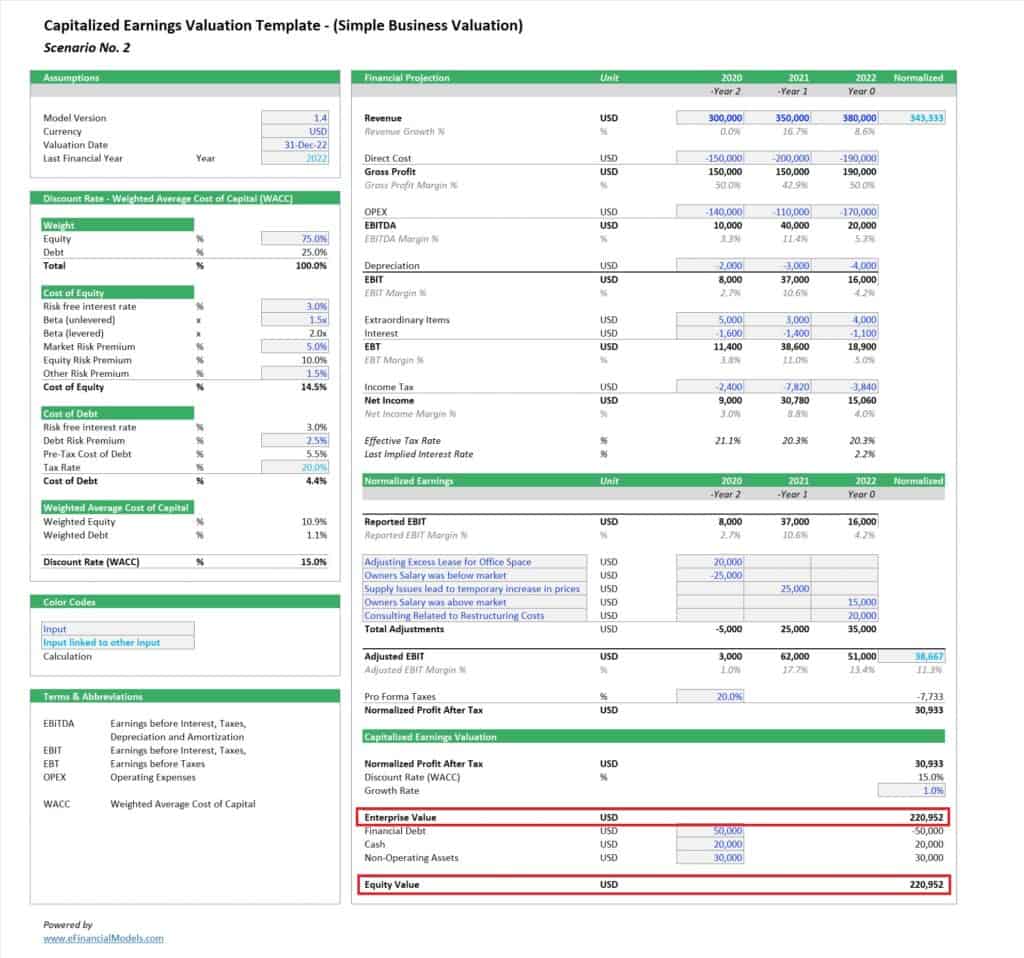
As you can see, the Enterprise Value and Equity Value decreased to $220,952. A higher discount rate implies that the investor requires a higher return on their investment, which means they are less willing to pay a higher price for the asset or project. As a result, the capitalized value decreases as the discount rate increases.
Scenario No. 3: Eternal Business Growth of 3% per year
Again, let us use the same assumptions in Scenario No. 1 and change the growth rate to 3%. Using the Simple Capitalized Earnings Valuation Template, here are the results:
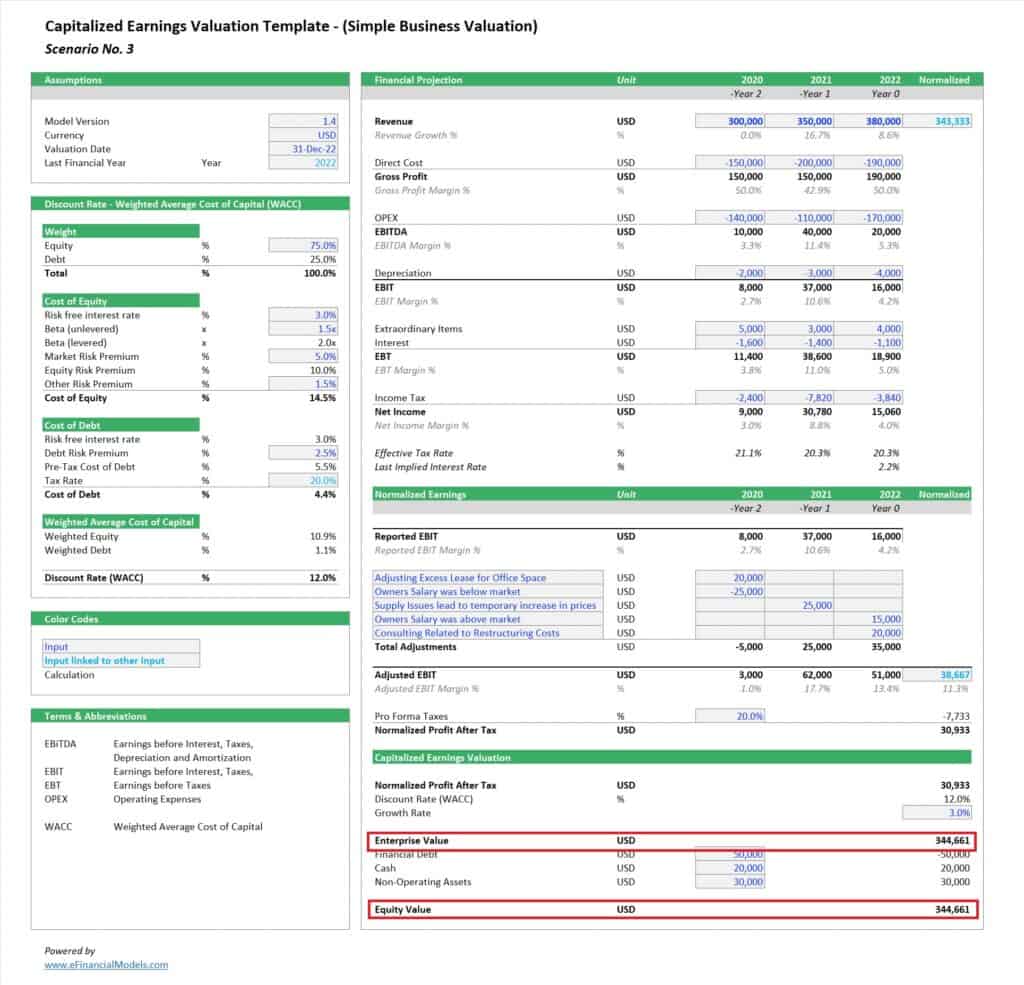
Here, the Enterprise Value and Equity Value increased to $344.661. When the growth rate is higher, it indicates that the asset or investment has the potential to generate larger future cash flows. As a result, the expected cash flows in the future are higher, and when discounted back to the present, they have a greater value.
When Should Capitalized Earnings Valuation Be Used?
Capitalization rate business valuation comes in handy for certain scenarios. This method may suit the following situations well:
- Hard-to-value Assets: Some companies are more valuable for their intangible and intellectual property than physical assets. Capitalized earnings valuation allows you to base value on the actual earnings power of the business rather than trying to value obscure assets.
- Limited Growth: Capitalized earnings can provide a solid valuation estimate for stable, mature companies. This method also favors companies with limited growth potential. If a business is poised for rapid expansion, capitalized earnings may undervalue it since future increased payments are not accounted for.
- Professional Practices: Capitalized earnings valuation is a preferred method for valuing professional practices like medical, dental, legal, and accounting firms. Expected earnings are often the best way to value the potential of such businesses.
- Stable Earnings: Capitalized earnings valuation works best when a company has demonstrated a steady stream of cash flows or revenues over the past several years. That is why it is often considered a suitable approach for valuing real estate investments with income-generating assets. If profits have been volatile, it will be difficult to determine a normalized level of earnings to base your valuation.
- Tax Valuation: A capitalization rate business valuation is best for tax valuation purposes, among other business valuation methods. Its simplicity makes it easier to calculate and understand, which can be advantageous for tax purposes where clarity and efficiency are important. It also aligns well with tax valuation purposes, as tax assessments often consider the income-producing capacity of the business.
- Unavailability of Comparable Transactions: Capitalized earnings may be the only feasible method for valuing a private company if comparable sales and transactions are unavailable. It allows for a more individualized assessment by focusing on the historical earnings generated by the valued business. In the absence of comparable transactions, historical earnings make reasonable assumptions about future growth and profitability and provide a way to estimate the value of the business.

















































Pros & Cons of the Capitalized Earnings Method
Like other business valuation methods, the capitalized earnings approach has pros and cons. Considering both sides before using the said approach to determine a company’s value is essential.
Pros
- The capitalization rate business valuation is an easy-to-calculate, straightforward approach. It only requires two inputs: normalized earnings and the capitalization rate, making it simple to compute and understand.
- Since the valuation is based on a company’s earnings, it emphasizes its ability to generate profits, which can provide a more accurate value for high-growth, profitable companies.
- The capitalized earnings method works well for valuing private companies or small businesses with little public information. It only requires the company’s financial statements to determine an estimate of value.
Cons
- The normalized earnings and capitalization rate require estimates, assumptions, and judgments. If these inputs are inaccurate, the capitalization rate business valuation will be flawed.
- Earnings are not the same quality as free cash flows in business valuation. Earnings can be subject to more manipulation as we can measure the cash balance easier.
- The inputs are based on a company’s historical financials, which may not reflect the company’s true value in the current market. Market-based valuation methods can provide a more up-to-date estimate of value.
- The capitalized earnings approach only looks at a company’s current earnings. It fails to consider a company’s balance sheet assets or future growth opportunities that could significantly impact value.
- The capitalized earning method may result in excess profits for companies with a high return on invested capital (ROIC), i.e., more than 20% year after year. High returns might attract competitors, and earnings may become lower. So normalized earnings estimated today might not reflect a company’s earnings potential.
Remember, applying multiple methods for the most accurate.

Reasonably Estimate Your Company’s Fair Market Value
With the right inputs for your business, the capitalized earnings valuation can reasonably estimate your company’s fair market value and help determine an appropriate offer price. While it may seem complex initially, breaking it down into two main components – normalized earnings and the capitalization rate – makes it easier to understand. The capitalization rate is the key to determining an accurate business valuation using this model. Calculate it correctly using the weighted average cost of capital formula, and you’ll have a solid estimate of what a business is worth to potential buyers.
Of course, no valuation method is perfect. The capitalized earnings approach works best for stable, profitable companies with a proven earnings track record. It may undervalue high-growth businesses or overvalue declining ones. Try it using a business valuation model and see what results you have! You may find that your business is worth more than you realized.







































Tags: business valuation