
0 ITEMS

Rent Roll Analysis Excel Template
Analysis of existing and prospective tenants and their lease conditions in commercial real estate

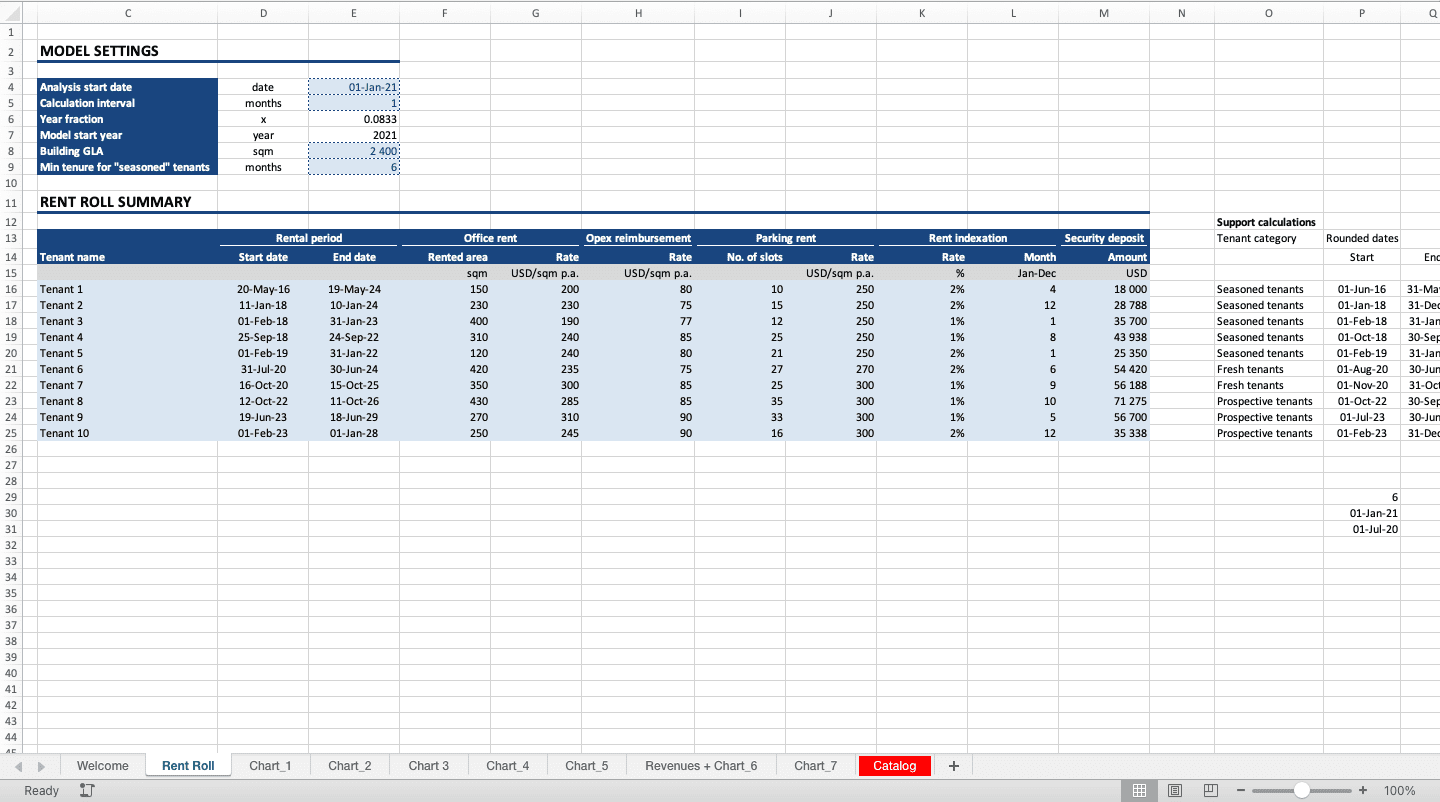






A rent roll is a table listing the tenants of a real estate asset, showing how much area they occupy, rental rates they pay, duration of their rental agreements, and other relevant information.
There can be different types of real estate assets: office buildings, retail centers, warehouses, residential apartment blocks. For any of these types, a rent roll allows the user to:
- Estimate the financial performance of an asset
- See how much of its areas are leased
- What the rental revenues and net operating income are
- How they will be declining in the future (due to lease contract expirations)
- How many square meters will be vacated, and when
Having an accurate rent roll and a proper underlying analysis is important for anyone who needs a full picture of an asset:
– landlords and property managers
– investors, buyers, and sellers in a potential transaction
– banks and financial institutions
– appraisers
– etc.
As the existing agreements approach their expiry dates, we start the discussions with prospective tenants. Their preliminary conditions are included in the rent roll and become part of the analysis. But, until the lease is signed, we need to keep in mind the uncertainty of having them as future tenants and separate them in the analysis.
Furthermore, existing tenants can also be split into “seasoned” tenants (having a sufficient track record, e.g. over six months) and “fresh” tenants (who just came in recently and have not yet demonstrated their financial condition and discipline as tenants). Therefore, existing tenants are also separated into these categories in the analysis.
If you have a different classification of tenants or think some categories are not needed, you can change this in the model quite quickly.
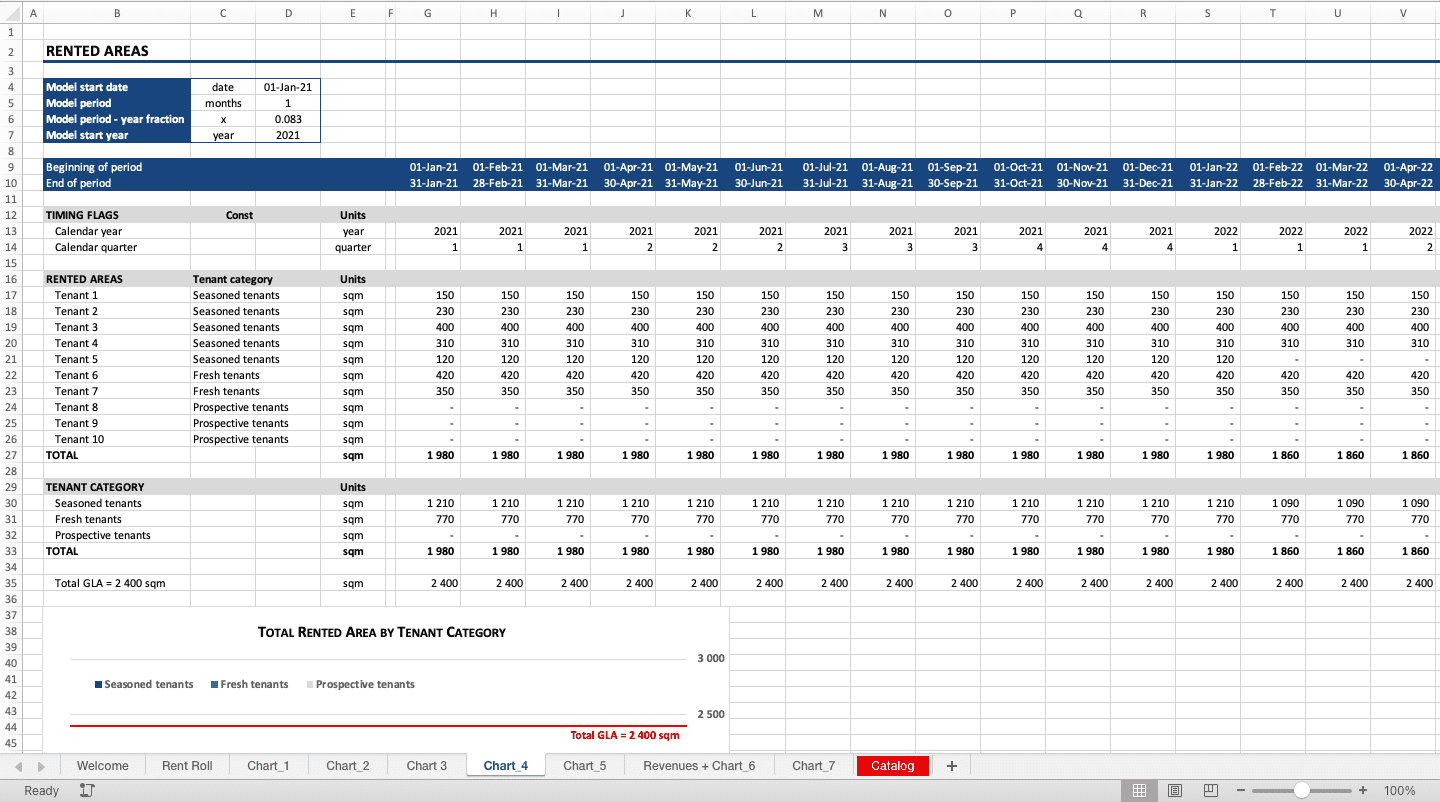
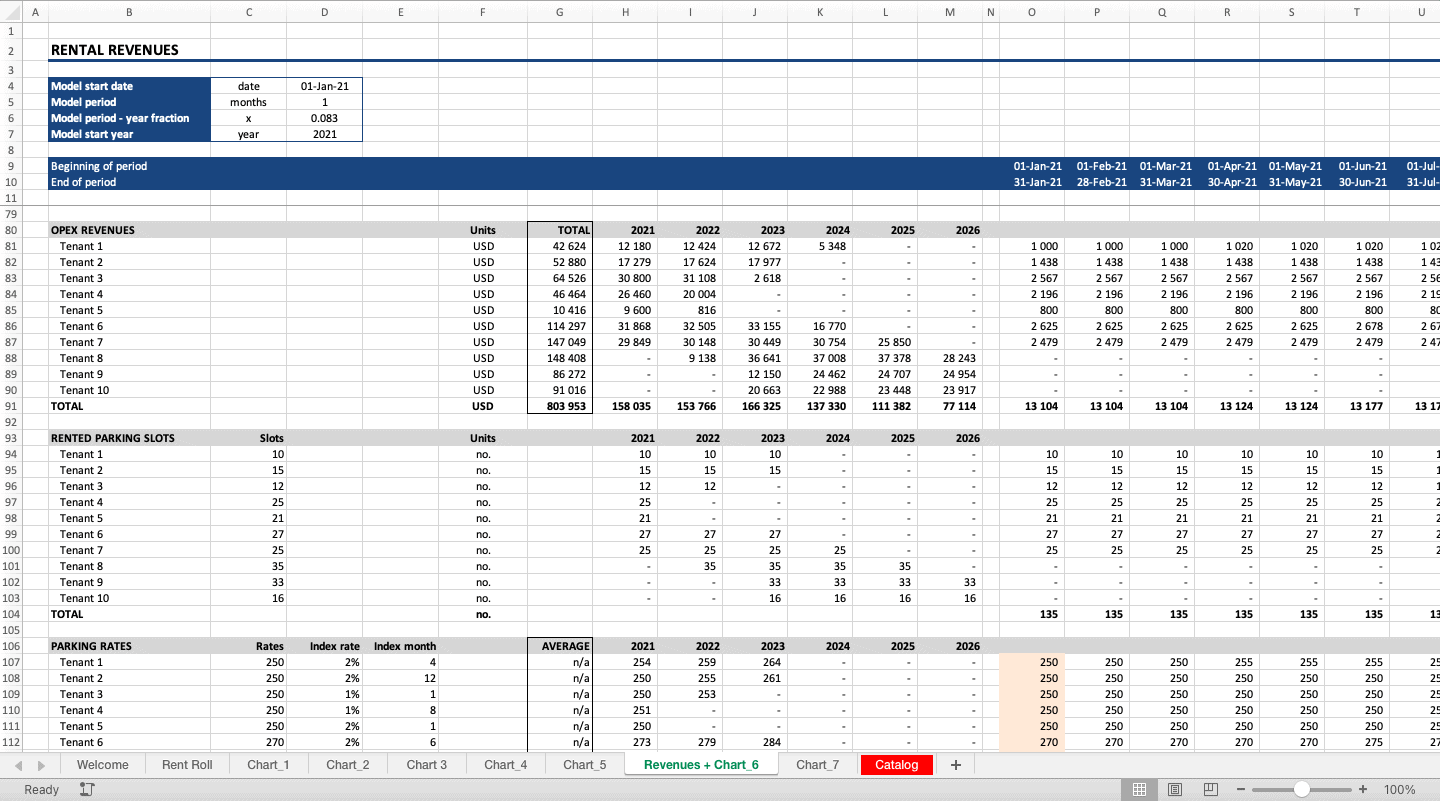
The attached file contains a thorough rent roll analysis. It demonstrates how to perform the calculations and to visualize the results to show:
1. Areas occupied by every tenant and vacant areas
2. Rental revenues by tenant and by type of revenue, security deposits collected and released
3. Rental revenues by tenant and by year
4. Lease length by tenant, active tenants at any point in time
5. Rental areas, lease expirations, and rental rate by tenant category
6. Rented areas by tenant category at any point in time
7. Lease length by tenant, rented areas against the total occupancy (vacancy) of the building
The analysis has been developed primarily for office buildings but can be adapted to other types of real estate quickly. The model analyzes base rent, opex reimbursements, parking fees, and security deposits. Rental rates can be adjusted annually by a specific index for each tenant in a certain month.
The calculations are done on a monthly basis and cover a period of six years but these are also flexible to change.
Similar ProductsOther customers were also interested in...


 eFinancialModels
Real Estate Portfolio Financial Model
The Real Estate Portfolio Financial Model Template forecasts the financial performance when building... Read more

 Giorgos
Residential Building Development Model (Sale, Rent...
Financial model presenting a development scenario for a Residential Building with units available fo... Read more
 Jason Varner
Mixed-Use Real Estate Model: Leverage / JV Options
A general real estate model to plan all assumptions for up to 7 'uses' for a given property. Include... Read more

Real Estate Private Equity (REPE) Financial Model
New Version Updates:• The model supports now up to 50 properties• Updated Acquisition, Financing... Read more

Real Estate Acquisition Financial Model (Commercia...
10-Year financial model for a real estate acquisition projecting revenue, operating expenses, and ca... Read more
 JILL LIU
Real Estate Acquisition-Rent-Sell Comprehensive An...
An integrated, dynamic and ready-to-use Real Estate Acquisition-Rent-Sell Comprehensive Analysis Mod... Read more

 anthony
Acquisition Model for Commercial Property
This is the Quintessential Commercial Property Acquisition Model that allows you to compare up to 20... Read more

 Eastwich Advisors
Multifamily Rehab Model (Includes Investor Returns...
Introducing the Multifamily Rehab Flip Model with Investor Returns Waterfall - a comprehensive tool ... Read more

Condominium Development – Dynamic 10 Year Fi...
A condominium (or condo for short) is a building structure divided into several units that are each ... Read more
Single Family Residential Property Investment Mode...
10-Year financial model for a single-family residential property investment projecting acquisition c... Read more
You must log in to submit a review.