
0 ITEMS

Event Organizer Business Model Template
Elevate your event planning business to new heights with our state-of-the-art Event Organizer Business Financial Model Template in Excel. The Excel spreadsheet template was meticulously designed to plan the launch and development of an event planning business addressing the needs of ambitious event organizers. This template is your ultimate tool for forecasting and strategizing the growth of an event management startup business plan during the next decade, offering a detailed plan for year 1 and a multi-year planning tool to understand to which heights your business may grow. This Excel spreadsheet model template offers a comprehensive financial planning tool ideal for fundraising and feasibility analysis of your event management business.


Starting an event organizer business can be quite attractive as, in many cases, only a little capital investment is required to generate substantial profits. Profits can be re-invested in hosting new events, which allows the growth of such businesses and offers an attractive event-planning business model. This requires a thorough understanding and analysis of the profitability per event and strict cost control. The model suits event planning business models where tickets are sold, and additional revenue from hosting events can be obtained. Starting such a business requires a thorough understanding of its financial implications. Make your event management startup business plan more solid by performing the financial analysis as well.
The following video provides a walkthrough of the financial model:
Goals of the Event Planning Business Template
This financial plan spreadsheet template has the following objectives:
- Obtain a thorough understanding of the profitability per Event and Event Type.
- Planning the re-investment of profits during a multi-year period to grow the business.
- Understand the break-even point and the level of overhead cost your event organizer business can bear.
- Validate the financial feasibility of your event planning business model.
- Prepare to raise funding from capital providers such as investors and banks.
- Run different business scenarios and understand their financial impact by either changing the assumptions or understanding their impact on the expected return (IRR).
- Make educated financial decisions based on solid bottom-up financial analysis of your event planning business.
Start your next event organizer business with this financial model template to determine the potential of your business and analyze the profitability of your expected events in more detail. This financial model template models the revenues and costs for each of your events in the next year and lets you forecast the type of events to be hosted during the forecast years 2-10 to grow your startup business to its full potential.
Key Features of this Event Organizer Business Financial Plan Template:
The spreadsheet template offers the following key features:
- Event Planning: Plan the profitability of each event in the first forecast year and estimate the types of events you want to host to grow the business in the forecast years 2-10.
- Sources of Revenue: Apart from selling tickets, the financial plan template also includes the possibility to account for additional revenues by event, in the form e.g. selling merchandise, Food and Beverages, or income from sponsorships or sub-rentals.
- Event Profitability Analysis: To be successful, each event should generate profits, requiring a detailed budget of income and profits by event.
- Seasonality: This template is suitable for businesses that plan to host events The template allows us to schedule events during the first year and allocate them to the respective months. For the other forecast year, we can estimate the percentage of the yearly events that will be hosted during each month of the year. This allows you to accurately model the seasonality of your event organizer business.
- Overhead Expenses: To turn the organizing of events into a business, a more permanent setup is needed,with e.g. office rent, permanent staff, and general marketing. Therefore, the model also includes the estimation of the overhead costs to be able to organize events regularly.
- Break-Even Analysis: A break-even analysis tells you how many events need to be hosted or how many tickets need to be sold to make this event planning business.
- Multi-Year Forecasting: Plan ahead with confidence using our comprehensive 10-year financial forecasting framework. The forecast results in a three-statement forecast, including the income statement, balance sheet, and cash flow statement forecast. In addition, a forecast of financial ratios and a free cash flow forecast are included, together with a variety of breakdowns and analyses to understand the financial forecast from all angles. Understand your possible short- and long-term business trajectory and run different scenarios to understand their financial implications.
- Debt Schedule: Schedules the debt repayment plan for up to two debt facilities and the corresponding financial ratios relevant to the banks.
- Financial Tables and Summaries: The model offers a variety of charts and summary tables to summarize the financial model results understandably.
- Funding Requirements and Key Financial Metrics: The model calculates the funding requirements to execute your business plan and all the relevant key metrics such as the Internal Rate of Return (IRR), Net Present Value (NPV), Payback Period, Expected Profits, etc.
- Forecasted Business Valuation: The model also provides an idea about the obtainable business valuation during each forecast year. This allows us to understand the business’s possible exit valuation better.
- Investor Metrics and VC Valuation: Equity Cash Flows are allocated as per investor participation in the required funding and their equity stakes. A VC Valuation (Venture Capital Valuation) is also included to better assess the requested investment proposition from a Venture Capital point of view.
The Structure of this Event Management Startup Business PlanTemplate
This spreadsheet template focuses on supporting your event management startup business plan by offering a neat model structure, which includes the following worksheets:
- Instructions: A Worksheet that contains instructions on how to use the template and explains the applied cell color codes
- Assumptions: Contains the main assumptions of the template:
- General assumptions such as currency, inflation rate, net working capital, tax, and valuation assumptions, among others
- Event assumptions by event type, such as the number of tickets to be sold, ticket prices, additional revenues by event, costs, and personnel to be hired to host the event.
- Overhead cost assumptions such as permanent staff and a budget for the expected Operating Expenses (OPEX)
- Capital Investment (CAPEX) assumptions to account for all fixed assets that need to be purchased and will be activated on the balance sheet.
- Debt Financing assumptions to account for possible debt financing of the business.
- Investor assumptions concerning their participation in the equity funding requirements and their equity stakes.
- Event Assumptions: This allows you to review the scheduled events in more detail and overwrite the default assumptions with more specific assumptions for the events of the first forecast year. Also, this sheet collects the assumptions of all event types to be scheduled throughout the forecast period.
- Executive Summary: One-page summary of the resulting Financial Plan offering executives a quick understanding of the resulting Financial Plan.
- Summaries: A more detailed summary with charts and tables offering a more comprehensive understanding of the forecasted number and types of events to be hosted, ticket sales, purchases from merchandise, food and beverages, average ticket prices, and breakdowns of revenues and costs. The Summary sheet also summarizes the debt schedule, forecasted balance sheet and cash flow statement, free cash flows, financial metrics, investor metrics, etc.
- Monthly: This worksheet contains the monthly calculation of events, tickets, purchases, revenues, and costs. It results in forecasted monthly financial statements, allowing for monthly tracking of the expected cash balance.
- Yearly: This worksheet aggregates the monthly financial results into yearly financials and calculates all relevant financial ratios and breakdowns.
- Investors: A worksheet that outlines the expected yearly cash flows per investor by considering their participation in the funding requirements and equity stakes.
- Break-even: A worksheet focused on calculating the break-even points for the required number of events, tickets to be sold, or average revenues to achieve break-even.
- Abbreviations: A summary of the Terms and Abbreviations used in this financial model.
Why Planning Your Event Planning Business Model?
When planning events and aiming to turn such activities into a business, it is essential to understand the profitability in more detail and figure out how to re-invest profits to turn these activities into a sustainable event planning business model. Obtain more clarity about the financial prospects of your event organizer business by performing a financial feasibility analysis upfront and having a tool at hand to run various business scenarios efficiently. Make your event management startup business plan more convincing by using this tool to prepare a convincing proposition to capital providers such as banks and investors and impress them with a thorough financial analysis showing that you understand your event-organizing business’s value drivers.
The model, current version 1.4, is available in two versions:
- Excel Version – pre-filled with an example forecast.
- PDF Version – outlines the details of the model structure.
File types:
.xlsx (MS Excel)
.pdf (Adobe Acrobat Reader)
Similar ProductsOther customers were also interested in...


 eFinancialModels
Webinar Organizer Business Plan Template
Discover the key to financial success in your webinar ventures with our Webinar Organizer Business P... Read more

Party Planning Business Financial Model
Introducing the Party Planning Business Financial Model – Your Ultimate Tool for Flawless Financia... Read more
 Giorgos
Events & Weddings Venue – 5 Year Financial M...
Financial Model providing an advanced 5-year financial plan for a startup Events & Weddings Venu... Read more
Music Events & Festivals Production – 5 ...
Financial Model providing an advanced 5-year financial plan for a Music Events & Festivals Produ... Read more
Event Planning Company – Dynamic 10 Year Fin...
Financial Model providing a dynamic up to 10-year financial forecast for a startup or existing Event... Read more

Family Entertainment Center – 5 Year Financial M...
Financial Model providing an advanced 5-year financial plan for a startup or operating Family Entert... Read more

Escape Room Financial Model – 5 Year Forecast
Financial Model providing an advanced 5-year financial plan for a startup or operating Escape Room B... Read more

 HenrySheykin
Events Agency Financial Model Excel Template
The Event Planner Financial Model helps users turn an event planning business idea into a structured... Read more

Public Relations Agency Financial Model Excel Temp...
The Public Relations Agency Financial Model helps entrepreneurs, agency founders, consultants, analy... Read more
Event Planner Financial Model Excel Template
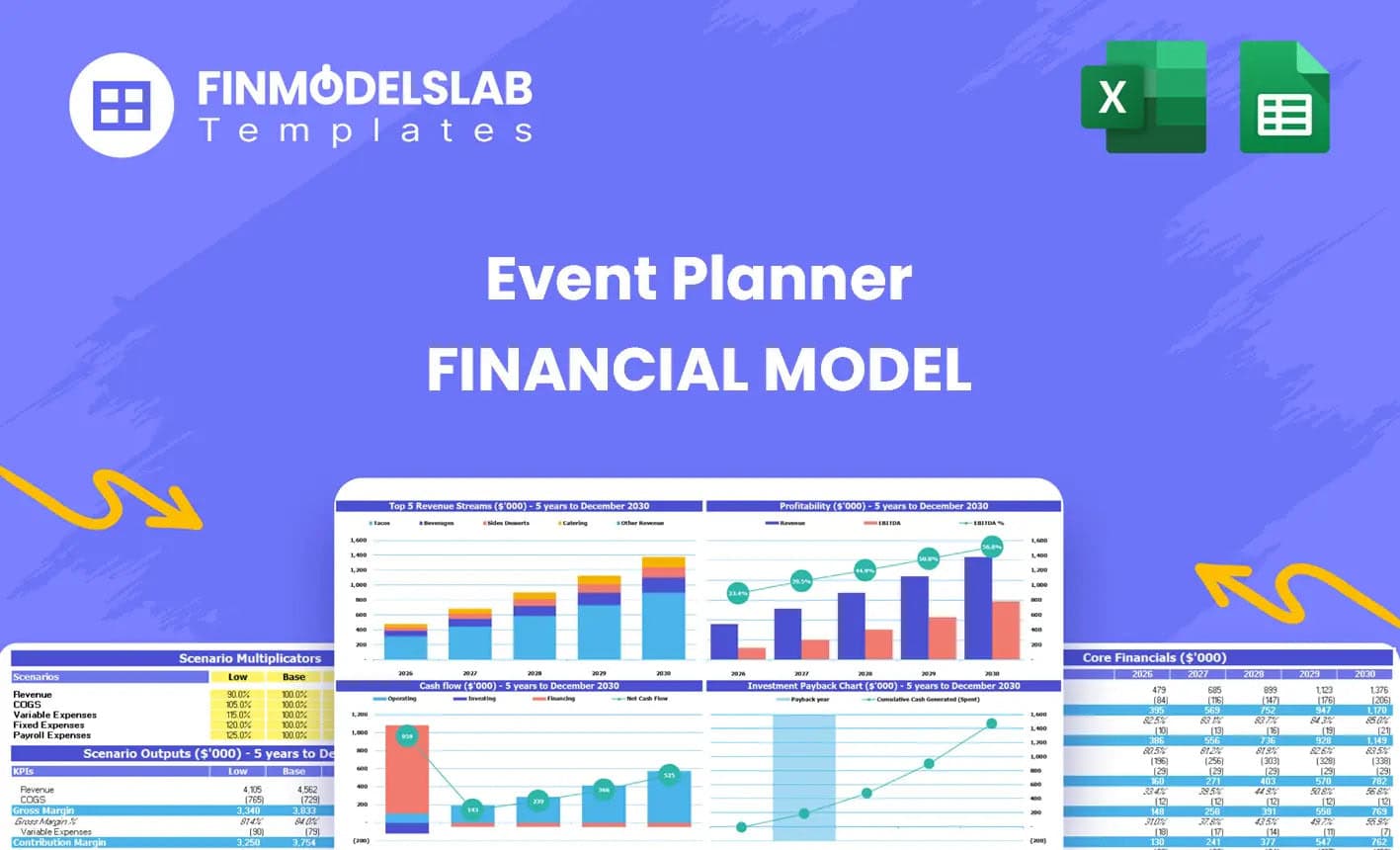
The Event Planner Financial Model helps users turn an event planning business idea into a structured... Read more
You must log in to submit a review.