
0 ITEMS

Bootstrapping vs. Venture Capital Funding: Which is Better?
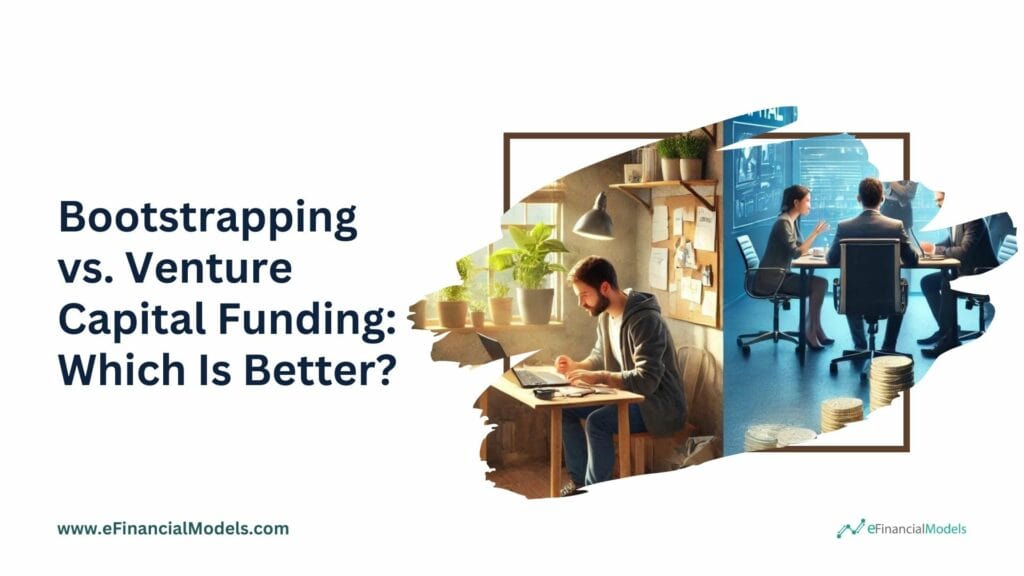
Choosing between bootstrapping and venture capital impacts your startup’s growth, control, and long-term success.
- Bootstrapping relies on personal savings and reinvested revenue, keeping founders full ownership and control.
- Venture capital accelerates growth with external funding but involves giving up equity and some decision-making power.
- Bootstrapped companies often grow more slowly but develop a lean, sustainable business model.
- VC funding is ideal for capital-intensive industries and startups aiming for rapid expansion and market dominance.
Understanding the differences helps entrepreneurs decide the right path based on their industry, goals, and risk appetite.
What Does Bootstrapping a Business Mean?
Bootstrapping a business refers to starting and growing using only personal savings, internal cash flow, and the profits it generates. It is a self-funded approach where external investors are not involved, allowing founders to retain complete ownership of their venture. This method prioritizes self-sufficiency, often relying on the founders’ internal cash flow and personal savings. Essentially, bootstrapping a business entails funding its own operations and reinvesting profits back into the company to fuel growth. This self-imposed financial discipline can be a double-edged sword, simultaneously promoting lean operations-a business strategy that focuses on efficiency and cost-effectiveness-and necessitating slower, more organic growth than businesses with significant external funding.
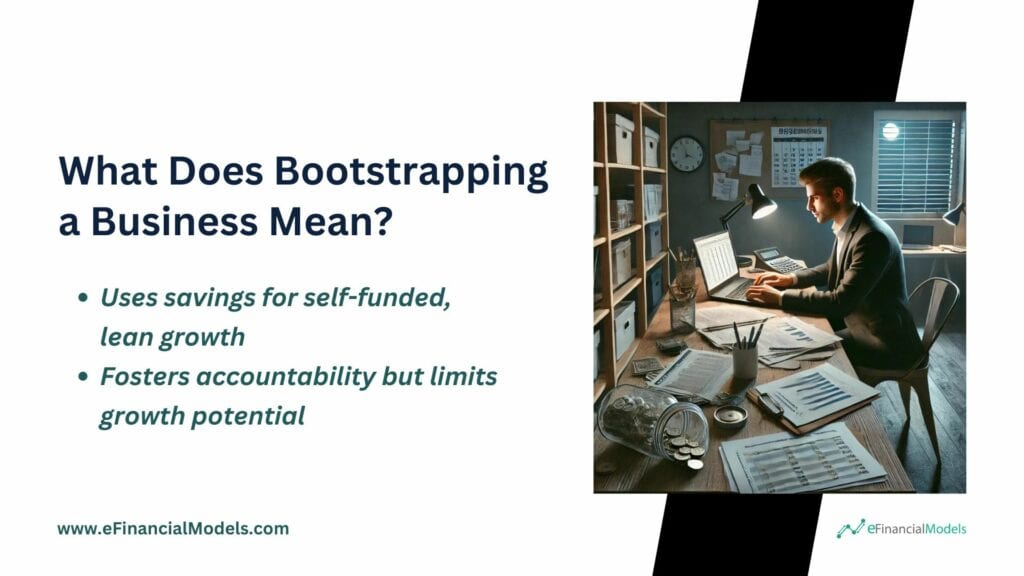
Many founders are attracted to bootstrapping a business because it instills a sense of responsibility and accountability. When you bootstrap a business, you are responsible for its sustainability, resourcefulness, and efficiency. However, this also means that your financial resources are limited, potentially leading to slower growth and survival challenges during difficult times.
Key Traits If You Bootstrap a Business
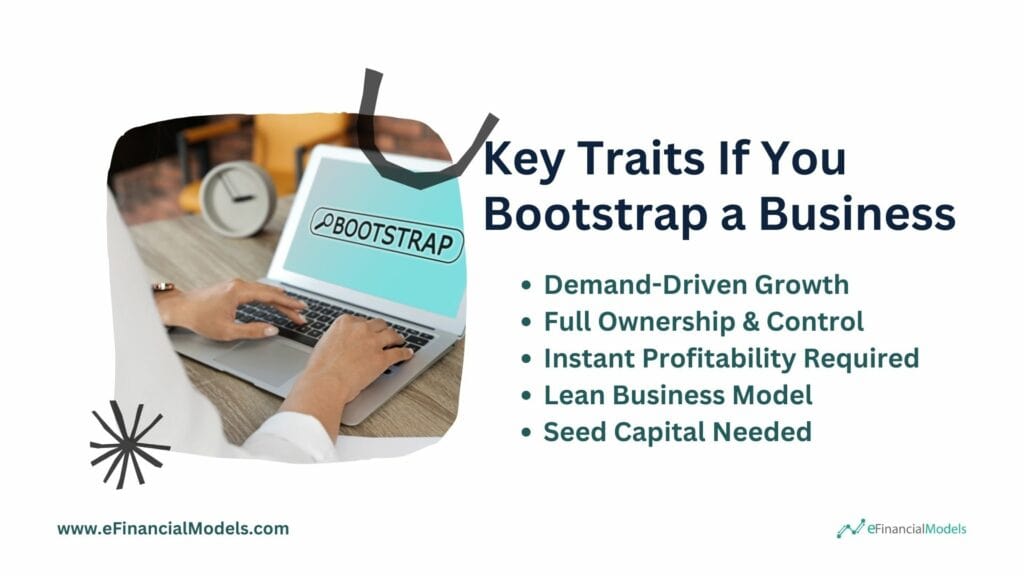
When you bootstrap a business involves building and growing a company without external funding, relying instead on personal savings, internal cash flow, or reinvesting profits to sustain operations. Entrepreneurs who choose this path often prioritize maintaining full control of their business and staying lean, as they work with limited financial resources. This approach requires a strong focus on cost-efficiency, creativity in problem-solving, and resilience. As you bootstrap a business, you face unique challenges in scaling and competing against venture-funded companies. However, it also offers the potential for greater independence and long-term financial rewards. Here are the key traits if you bootstrap a business:
- Demand-Driven Growth: When you bootstrap a business, you must achieve profitability quickly through strong initial traction and organic growth. This approach only works if early customers cover costs and generate sufficient revenue to reinvest in expanding the business. Startups must focus intensely on customer acquisition strategies that are both effective and low-cost, such as word-of-mouth marketing, leveraging social media, or building strong customer relationships. The ability to turn initial customers into repeat buyers or advocates is crucial, as it eliminates the need for extensive advertising budgets and enables the business to scale using its own revenue. With this early traction, the company can avoid stagnation or failure due to a lack of sustainable cash flow.
- Full Ownership & Control: When you bootstrap a business, you retain full ownership and control over your company, as no external investors or shareholders are involved. This means that you can make decisions independently without the need to seek approval from outside parties. The founder has the freedom to set the vision, goals, and strategy for the business without external influence. However, this also places the full weight of responsibility on the entrepreneur for both successes and failures, as no one else shares the financial risk.
- Instant Profitability Required: When you bootstrap a business, you need a business model to produce immediate profits. It is a strategy best suited for ventures with low initial capital requirements and fast cash flow cycles. Ideal types of businesses for bootstrapping include service-based businesses, small e-commerce stores, or niche product manufacturers, where the ability to sell and receive payments quickly helps sustain operations. For example, software-as-a-service (SaaS) companies or consulting services can be profitable from day one because they often have low overhead costs and require minimal ongoing investments, unlike capital-intensive industries like manufacturing or biotechnology, which may require substantial upfront investment and longer development timelines.
- Lean Business Model: A lean business model is crucial when you bootstrap a business, as your limited financial resources require you to operate efficiently and minimize waste. You must carefully consider every expense; creativity becomes essential in finding cost-effective solutions. It often means running a smaller team, using minimal office space, and leveraging technology to streamline operations. By focusing on delivering value to customers with fewer resources, you can remain agile and adapt quickly to changing market conditions while maintaining profitability.
- Seed Capital Needed: While bootstrapping focuses on self-funding and reinvesting profits, it often demands a small pool of resources to get the business off the ground. This could include savings, personal credit lines, or support from friends and family. These initial funds are typically used for essential expenses such as purchasing inventory, setting up a website, or covering marketing and operational costs in the early stages. Access to small funding sources ensures that unexpected expenses or short-term cash flow gaps don’t derail the business before it reaches a self-sustaining point. The key is to minimize external borrowing and avoid diluting ownership, maintaining the entrepreneur’s control over decision-making.
Pros & Cons of Bootstrapping a Business
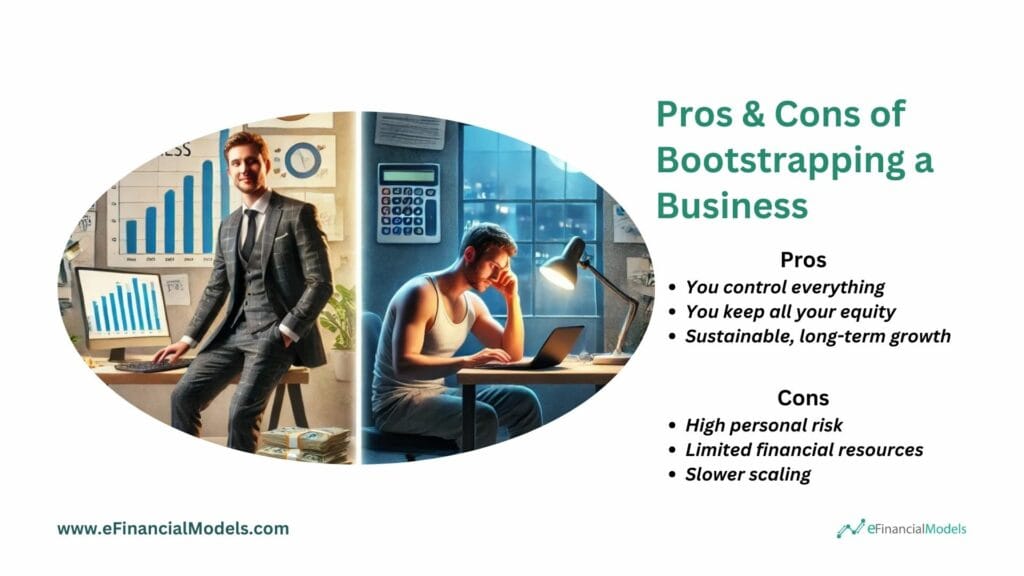
Bootstrapping a business refers to starting and growing a company using personal savings or revenue without relying on outside funding. While it allows founders to maintain full control, it also presents unique challenges in scaling and sustaining operations.
Pros
- You control everything: One key advantage of bootstrapping a business is the complete control founders retain over decision-making. Without outside investors or lenders, there’s no pressure to meet external demands, giving founders the freedom to shape the company’s vision, strategy, and operations according to their preferences and timelines.
- You keep all your equity: Another significant benefit is that bootstrapping allows founders to keep 100% of their equity. By avoiding external funding, there’s no dilution of ownership, meaning all future profits and business value remain with the original founders, which can lead to significant personal financial gains if the business is successful.
- Sustainable, long-term growth: Bootstrapping often encourages sustainable, long-term growth. Since the company must rely on its own revenue for expansion, it tends to avoid reckless spending and focus on efficient, gradual development, fostering a stronger, more resilient business in the long run.
Cons
- High personal risk: One of the major downsides of bootstrapping a business is the high personal risk involved. Founders often use their personal savings or assets to fund the company, which can create significant financial strain. If the business fails, it can result in personal financial losses, making this a risky option for many entrepreneurs.
- Limited financial resources: Another disadvantage is the limited financial resources available when bootstrapping. However, with the right strategy and determination, founders may be able to invest in necessary tools, employees, or marketing efforts to grow the business, potentially limiting its potential in the early stages but not its long-term success.
- Slower scaling: Bootstrapped businesses also tend to experience slower scaling. Since reinvested profits primarily drive growth, expansion can be slower compared to companies with outside investors who can inject large amounts of capital to speed up operations and market penetration.














































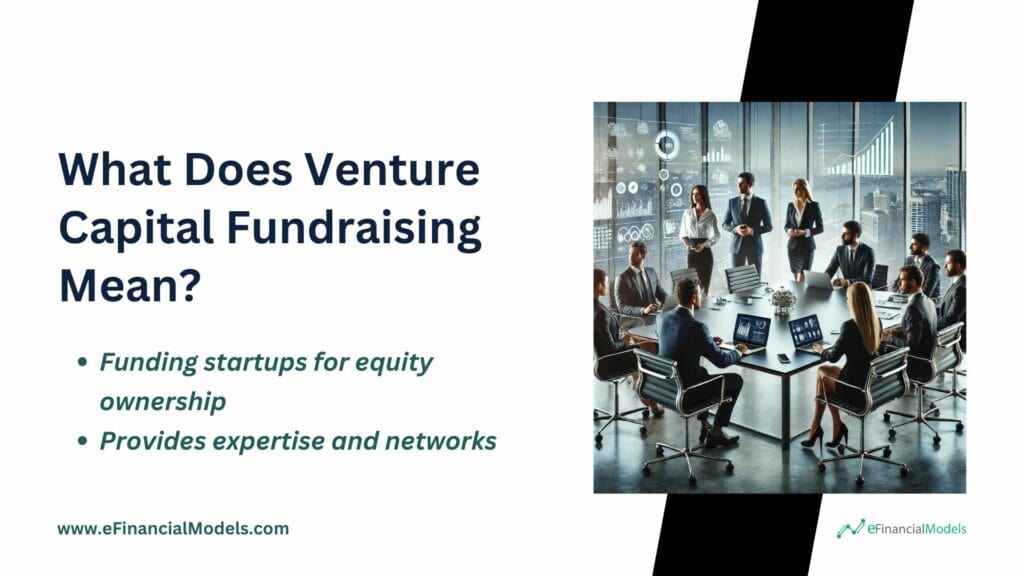
What Does Venture Capital Fundraising Mean?
Venture capital fundraising is a form of private equity financing investors provide to startups and small businesses with high growth potential. In exchange for venture capital fundraising, investors typically receive equity in the company, meaning they own a percentage of the business. VCs often target companies in sectors like technology, fintech, and biotech, where rapid growth and high returns are expected. Venture capital firms typically take a 20-30% equity stake in a company during early funding rounds.
Venture capital fundraising is not just about financial support; it’s a package deal that includes invaluable expertise, industry knowledge, and networks. The primary allure of venture capital lies in its available substantial financial resources, which can be instrumental in navigating the high growth and innovation phases of a company’s development. VCs play a pivotal role in the startup ecosystem by fueling companies that need access to traditional financial avenues such as bank loans or public stock offerings. Startups often operate in highly uncertain and dynamic markets where traditional financial stability and profit metrics might not be present. Venture capitalists help bridge this gap, taking on substantial risk in the hope of high returns when the startup eventually becomes successful through an initial public offering (IPO) or acquisition.
How Does a Venture Capital Fund Work?
How does a venture capital fund work involves a pooled investment vehicle through which investors provide capital to startups and early-stage companies with high growth potential. These funds, managed by venture capital firms, aim to generate returns by taking equity stakes in businesses that may be too risky for traditional financing but offer substantial rewards if successful. How does a venture capital fund work also involve funding across several stages, including seed funding, Series A, Series B, and later rounds like Series C and beyond, each supporting a company’s growth at different phases of development from early concept to scaling and expansion. Below are the stages of how does a venture capital fund work:
- Fundraising: In the fundraising stage, venture capital (VC) firms seek capital commitments from investors, often institutional investors like pension funds, high-net-worth individuals, or family offices, to create a fund. The VC firm pitches its investment strategy, past performance, and value-add to attract capital.
- Evaluation: During the evaluation stage, the VC firm takes on the responsibility of screening potential investment opportunities. The VC valuation method, which assesses market size, growth potential, business model, and the founding team, is a key part of this stage. The firm also conducts due diligence, including financial analysis and risk assessment, before making any investment decisions.
- Investment: Once a startup passes the evaluation stage, the VC firm negotiates the investment terms, such as equity stake and board involvement. The firm then provides capital, often in exchange for equity, to help the startup scale its business, with the expectation of a significant return in the future.
- Governance: Post-investment, the VC firm plays an active role in governance, often taking board seats and providing strategic guidance, networking opportunities, and operational support to the startup. This ensures the startup grows in a direction that aligns with the VC’s and founders’ objectives. Such a stage makes how does a venture capital fund work unique.
- Exit: An exit is how a VC realizes its return on investment (ROI), usually through a public offering (IPO), acquisition by another company, or selling its stake to other investors. The goal is to exit at a significantly higher valuation than the original investment.
- Distribution of Returns: After a successful exit, the VC firm distributes the returns to its limited partners (LPs) based on their original investment in the fund. This is typically done after deducting the management fees and the VC’s share of profits, known as carried interest.
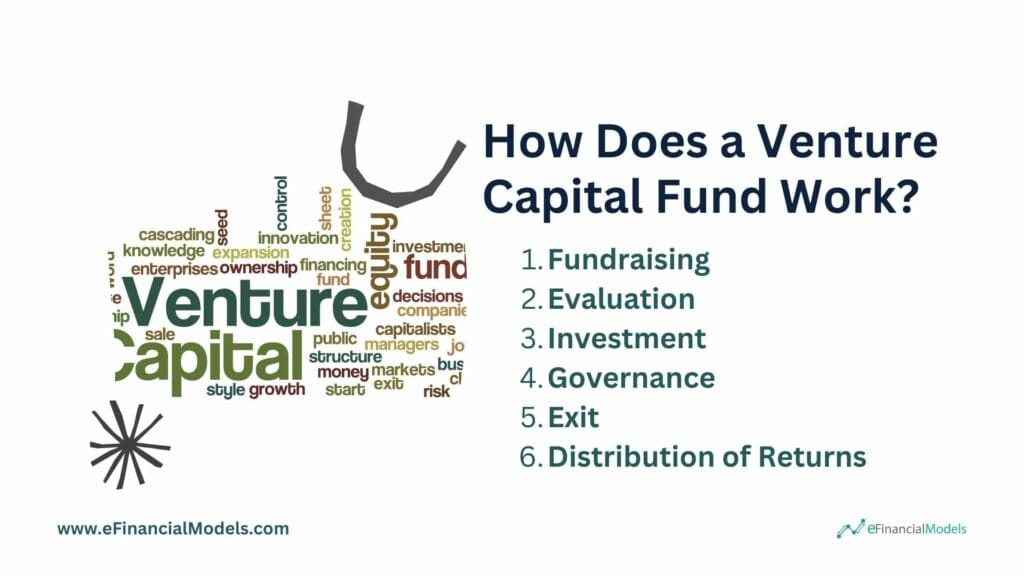
In summary, understanding how does a venture capital fund work involves navigating through several key stages, including fundraising, evaluating potential investments, making capital commitments, actively governing startups, and eventually achieving an exit. The process culminates in the distribution of returns to investors, driven by the fund’s ability to guide startups to higher valuations successfully. Each stage is crucial to ensuring the fund’s and its portfolio companies’ long-term success.
Pros & Cons of Venture Capital Fundraising
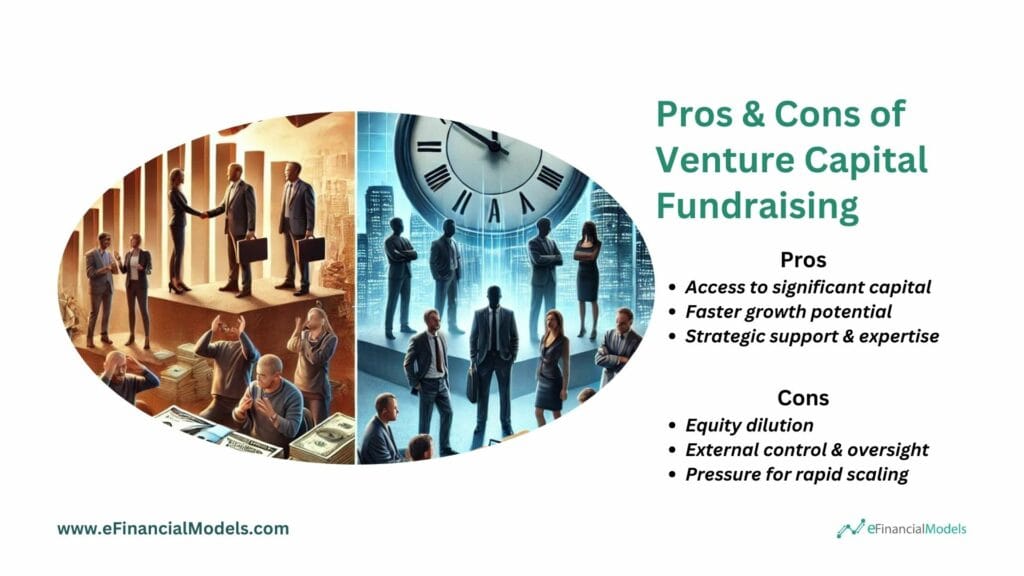
Venture capital fundraising offers startups the opportunity to scale rapidly by providing substantial financial backing in exchange for equity. However, this funding can also lead to founders losing control, as venture capitalists often require a say in strategic decisions and a significant ownership stake.
Pros
- Access to significant capital: Venture capital fundraising plays a critical role in providing startups with substantial financial resources often difficult to obtain through traditional means like bank loans or personal savings. This capital can be the key for businesses that must invest in infrastructure, product development, or marketing to scale quickly and compete effectively in their market.
- Faster growth potential: With access to large amounts of funding, startups can accelerate their growth by rapidly expanding operations, hiring key talent, and entering new markets. Venture capital allows companies to grow at a pace that would be impossible through organic growth alone, giving them a competitive edge in fast-moving industries.
- Strategic support and expertise: Venture capital firms often provide strategic guidance, industry connections, and operational expertise in addition to capital. This support can help startups navigate challenges, refine their business models, and make informed decisions, increasing the likelihood of long-term success.
Cons
- Equity dilution: Venture capital fundraising involves issuing new shares in exchange for capital, reducing the ownership percentage of the original founders. This often results in losing control and reduced future earnings from the company’s success.
- External control & oversight: When founders take on venture capital, they often must give up a degree of autonomy. This is because investors typically require board seats, voting rights, and influence over major business decisions. It’s crucial for founders to ensure that these decisions align with their own vision for the company, as this alignment is key to a successful partnership.
- Pressure for rapid scaling: Venture capitalists expect high returns on their investments, pushing companies to scale quickly. This sometimes leads to unsustainable growth, operational issues, or sacrificing long-term strategy for short-term gains.





















































Bootstrapping vs. Venture Capital: A Comparison
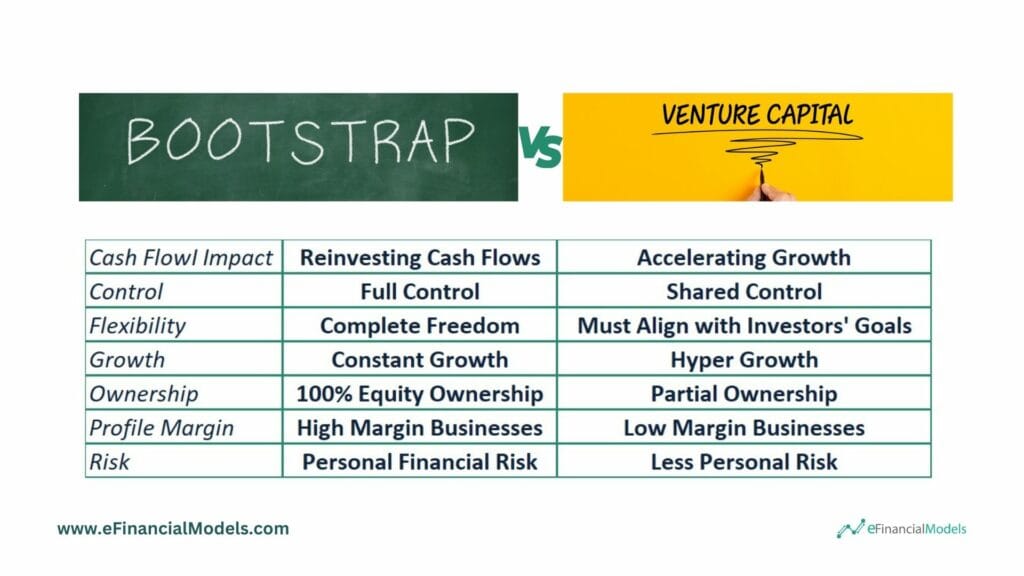
Bootstrapping vs. venture capital represent two distinct approaches to funding a startup, each with advantages and challenges. Understanding the key differences between these funding methods can help entrepreneurs choose the path that best aligns with their vision, resources, and long-term goals.
- Cash Flow Impact: Bootstrapping vs. venture capital have different impacts on a company’s cash flows. Bootstrapping relies on internal resources, such as personal savings and reinvested profits, which means the business must operate within its means, resulting in tighter cash flows. As a result, growth tends to be slower, but the business retains control and equity. Conversely, venture capital involves large, external funding to accelerate growth, enabling the company to scale rapidly despite negative cash flows initially, as revenue is often insufficient to cover operating costs. While this approach supports hypergrowth strategies, it comes with equity dilution and increased pressure for high returns.
- Control: The primary difference between bootstrapping and venture capital in terms of control lies in ownership and decision-making. With bootstrapping, founders maintain full control over the business since they fund the company with their own resources, allowing them to make decisions independently. In contrast, venture capital involves giving up a portion of ownership to investors in exchange for funding, which often means sharing control over key business decisions and strategies with these external stakeholders.
- Flexibility: Regarding flexibility, bootstrapping offers complete freedom, as founders can make decisions based on their vision and timing without having to justify their choices to outside investors. This allows for greater adaptability in responding to market changes or shifting business strategies. On the other hand, with venture capital, founders must align with their investors’ goals and expectations, which can impose certain constraints on decision-making and force the company to prioritize growth, profitability, or other metrics that investors value, sometimes at the expense of the founder’s original vision.
- Growth: Regarding growth, bootstrapping allows founders to retain 100% equity ownership, meaning they fully benefit from any increase in the company’s value without diluting their stake. However, this often leads to slower growth, as the company is limited to its own resources for expansion. Venture capital, by contrast, accelerates growth by providing significant funding, but this comes at the cost of partial ownership. Founders must give up a portion of their equity to investors, which can result in faster scaling but reduced control over the long-term financial rewards of the company.
- Ownership: Regarding ownership, bootstrapping allows founders to maintain 100% equity ownership of their business, meaning they fully control the company and retain all financial benefits from its success. This independence can be highly appealing but limits access to external funds for rapid growth. With venture capital, founders receive substantial investment but must give up a portion of their equity to investors, resulting in partial ownership. While this can accelerate growth, it also means sharing future profits and decision-making authority with outside parties.
- Profile Margin: The business’s margin profile can significantly influence bootstrapping and venture capital funding approaches. Bootstrapping is often more challenging for low-margin businesses as limited profits restrict the ability to reinvest in growth, making external funding through venture capital more appealing to scale operations and overcome cash flow constraints. On the other hand, high-margin businesses are better suited for bootstrapping since they generate sufficient profits to fuel expansion without requiring external investment. However, venture capital can still be advantageous for high-margin companies seeking hypergrowth, but it may come at the cost of equity dilution and strategic control.
- Risk: In terms of risk, bootstrapping places the entire financial burden on the founders, as they use their own savings or business revenues to fund operations. This leads to significant personal financial risk if the business struggles. However, they retain full ownership and control. With venture capital, the personal financial risk is reduced because external investors provide the funding, spreading the risk between the founders and investors. While founders faceless personal financial exposure, they may face pressure to meet investor expectations and achieve high growth targets.
Bootstrapping vs. Venture Capital: When is the Right Time for Each Funding Strategy?
There is no better investment between bootstrapping vs. venture capital funding. What is crucial is understanding the appropriate stage of a business for each funding strategy.
- Industry: Bootstrapping is typically better suited for software or service-based businesses because these models often have lower upfront costs, allowing founders to grow organically by reinvesting profits. This approach offers greater control and flexibility without the pressure of external investors. In contrast, venture capital (VC) is more suitable for capital-intensive industries, such as manufacturing or biotech, where substantial funds are needed early on for equipment, research, or scaling operations. VC funding provides the necessary capital to accelerate growth, though it often comes with the trade-off of giving up equity and some level of control.
- Market & Competition: Bootstrapping is often the better strategy when the market is still developing. It allows businesses to take a slower, more measured approach, refining their product and building customer relationships without the pressure of aggressive growth. This strategy works well in less competitive environments where timing is less critical. On the other hand, venture capital is a better fit when competitors are moving quickly and scaling, as it provides the substantial resources needed to accelerate growth, capture market share, and stay competitive in a rapidly evolving landscape where speed can be the difference between success and failure.
- Stage of the Business: For early-stage startups, bootstrapping is often the better funding strategy as it allows founders to maintain full control, focus on refining their product or service, and prove the business model before seeking external investment. This approach encourages lean operations and organic growth, which can be crucial in the early stages of development. Conversely, venture capital is more appropriate for startups in the growth or scale-up stages, where substantial funds are needed to expand operations, enter new markets, or accelerate customer acquisition. At this stage, VC funding can fuel rapid growth but usually comes with the trade-off of equity and control.
- Timing: Bootstrapping is a great strategy as long as you see steady progress in your business, allowing you to maintain full control, minimize risks, and grow at your own pace without external pressure. This approach works well when your operations are sustainable, and growth is achievable with existing resources. However, venture capital becomes the better option when you’ve reached a point where the only thing holding your business back from faster growth is a lack of significant capital. At this stage, VC funding can provide the financial boost needed to scale rapidly, expand into new markets, and capitalize on growth opportunities. However, it typically involves giving up some equity and control.
- Vision & Goals: Bootstrapping is ideal if your primary focus is on building a business that aligns with your vision or values, allowing you to maintain complete control and stay true to your original mission without the influence of external investors. This approach best suits founders prioritizing long-term sustainability over rapid growth. On the other hand, if your goal is to scale aggressively, aim for an IPO, or become a dominant player in your industry, venture capital is the better funding strategy. VC investment provides the capital to fuel fast growth and pursue ambitious goals. However, it often comes with the trade-off of giving up equity and some level of control.
When to Bootstrap a Business?
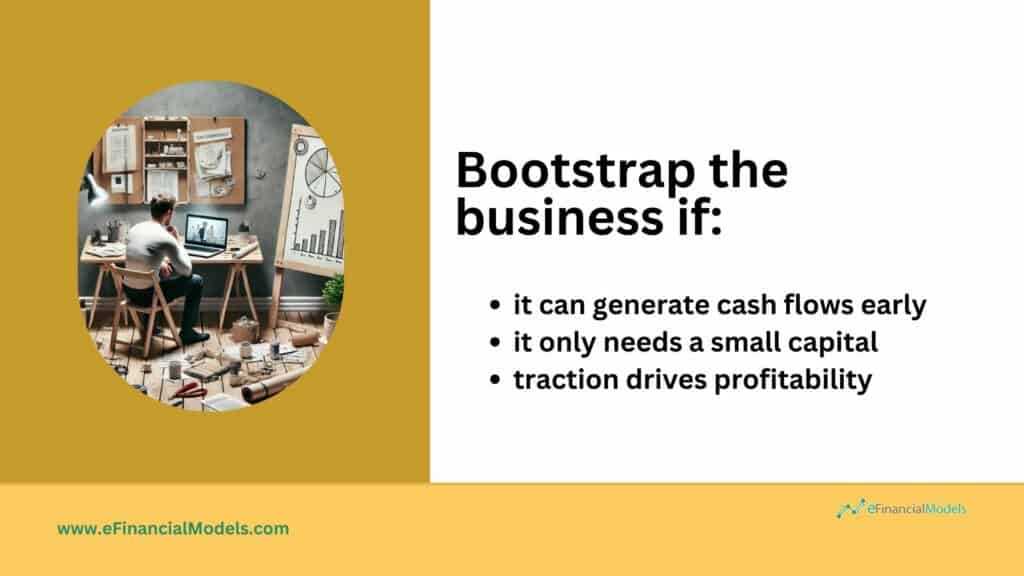
Bootstrap the business if it can generate cash flows early, as this approach minimizes dependence on external funding. Start with a small amount of capital from your own resources to maintain full control, and focus on building momentum and traction among users that will lead to steady revenues and profitability. Suppose your business requires only a small amount of initial capital to start. In that case, bootstrapping allows you to minimize financial risk and build momentum using limited resources until the business becomes self-sustaining. Bootstrap the business if traction is a key driver of profitability, enabling growth through strong customer demand and market adoption. With increasing traction, the company can reinvest revenues to expand operations and scale efficiently without external funding.
When to Use VC Funding?
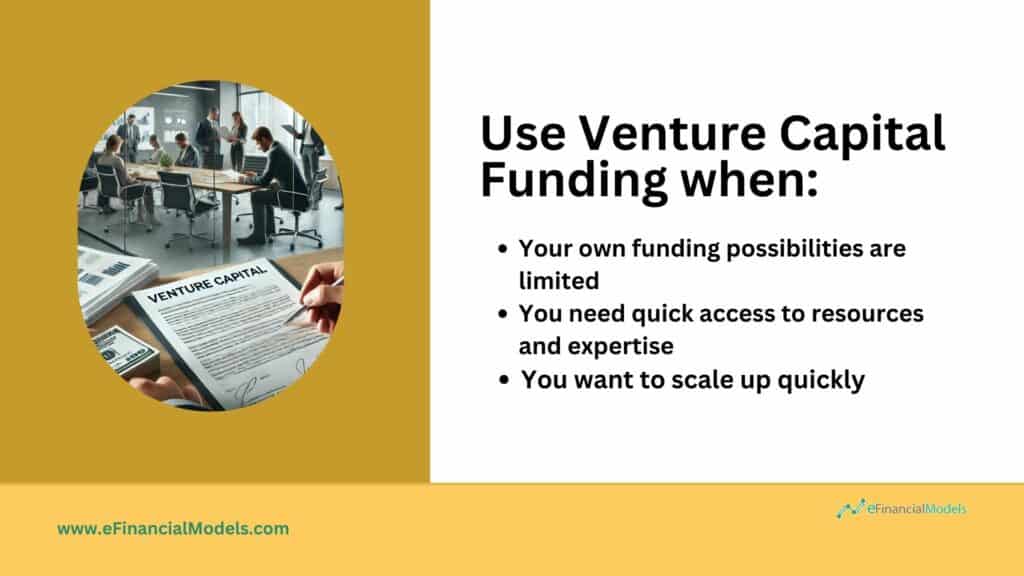
On the other hand, venture capital brings substantial financial resources and access to a wealth of expertise and networks. While this can expedite growth and lift startups to new heights, it often comes at the expense of ceding partial ownership and some degree of decision-making power. Consider VC funding when your personal funding options are constrained and you need external capital to drive growth. Venture capital funding is also ideal when your business requires rapid access to critical resources and industry expertise to fuel growth. By partnering with VCs, you gain financial support, strategic guidance, and valuable connections. VC funding is the right choice when rapid scaling is a priority and you need substantial capital to expand operations swiftly. With financial backing and strategic support from venture capitalists, businesses can accelerate growth and capture market share faster.
Bootstrapping Your Business: The Smartest Path to Profit
The choice between bootstrapping and venture capital is challenging, and each option comes with its own set of frustrations. Both paths are valid, and neither is better than the other — it just depends on your goals, the unique needs of your business, timing, and priorities. Selecting the appropriate funding source for a business is not merely a financial necessity; it intertwines deeply with the company’s overarching goals and long-term vision.
Choosing bootstrapping over external funding whenever possible is wise for entrepreneurs seeking greater control and long-term sustainability for their businesses. By relying on internal resources, founders maintain full ownership and decision-making power, allowing them to shape the company according to their vision without external interference. Bootstrapping also cultivates discipline in managing finances, ensuring that every dollar is spent efficiently and pushing the team to be resourceful and innovative. While it might mean slower growth in the short term, the approach reduces dependency on external capital, minimizes financial risk, and sets the business on a solid foundation for sustainable expansion.
Empowering entrepreneurs to make informed funding decisions through financial modeling equips them with the tools to evaluate different financing options, forecast cash flows, and assess risks and returns more precisely. Using robust financial models, entrepreneurs can simulate various scenarios, analyze the impact of different funding sources, and develop data-driven strategies to maximize business growth while minimizing potential pitfalls. This proactive approach to financial planning enables business owners to navigate complex funding landscapes confidently, aligning their decisions with long-term objectives.








































You might also like:
- 10 Main Elements of a Business Plan
- 10 Tips to Develop a First Class Business Valuation Report
- 5 Practical Tips to Help Raise Funds For Startups
- Bootstrapping vs. Venture Capital Funding: Which is Better?
- 12 Funding Sources for Businesses and Startups
- Pros and Cons of Equity Financing
- How to Make a Startup Financial Plan for Fundraising?
- 5 Steps to Creating a Drop Down List Using Data Validation in Excel
- Startup Financial Models
- Financial Modeling for Startups and Small Businesses
- Financial Planning for Small Business Owners – Taking an SBA Loan
- A Step-By-Step Guide on How to Calculate Property Tax
- Financial Ratios Analysis and Its Importance
- Financial Model Templates Easy to Use
- Cash Flow Analysis in Excel
- Understanding the Debt Service Coverage Ratio: An Essential Metric for Financial Analysis
- Financial Statements – Definition, Uses, Contents and Templates
- How to Secure Seed Financing?
- Financial Model – Valuation of Tax Loss Carryforwards