
0 ITEMS

A Step-By-Step Guide on How to Calculate Property Tax

Property taxes are a key part of real estate ownership, funding local services like schools, roads, and emergency services.
- Property taxes are based on assessed values, which are determined periodically by local authorities.
- The assessed value often differs from the property’s market value and influences the tax amount.
- Mill levy rates vary by jurisdiction and determine the tax rate applied to assessed property value.
- Calculating your property tax involves multiplying assessed value by the mill rate, then subtracting exemptions or deductions.
- Staying informed about local tax laws and assessment schedules helps manage real estate taxes effectively.
Understanding these basics helps property owners plan for ongoing tax obligations and make smarter financial decisions.
Disclaimer:
This article is intended solely for informational purposes and should not be construed as tax advice. The content provided herein is general and may not apply to your specific financial situation or the tax laws of your jurisdiction.
Tax regulations are subject to frequent changes, and their applicability can vary widely depending on individual circumstances. Therefore, before making any financial or tax-related decisions, it is essential to consult with a qualified tax advisor or a certified professional who can provide guidance tailored to your specific needs and the current tax laws in your jurisdiction.
We disclaim all responsibility for the truthfulness, trustworthiness, and completeness of the data given in this article. You assume all responsibility for any actions due to the information supplied. We strongly recommend that you seek professional advice from a tax advisor to ensure that your financial decisions align with your unique circumstances and adhere to the tax regulations in your area.
By reading this article, you acknowledge that it does not constitute tax advice, and you agree to release us from any responsibility or liability for any consequences resulting from your reliance on the information herein. It is your responsibility to verify the accuracy and applicability of the information with your own tax advisor.
We all pay real estate taxes. In return, we have comfort and safety living in the community. Real estate ownership inevitably involves paying property taxes. Consequently, knowing how to calculate property tax is essential. From figuring out your property’s assessed value and tax rate to looking at possible tax deductions, we’ll walk you through the step-by-step process. We aim to give you the knowledge to efficiently manage your real estate taxes and make wise financial decisions.
The Basics of Property Taxes
The state, local governments, or counties impose property taxes on physical assets like buildings, land, and real estate. Real estate property taxes are another name for them. However, it also includes personal property taxes on things like cars, boats, planes, machinery, and even livestock in certain places. The community’s numerous services, including fire, garbage collection, police, roads, and schools, are supported by the collected property taxes.
Real estate property taxes are typically paid in arrears, either annually, semi-annually, or quarterly. In some cases, mortgage servicers with escrow accounts bill property taxes monthly. Paying in arrears means the payment covered a past period. For example, paying real estate property taxes in 2023 covers the preceding year, 2022.
The amount of real estate property tax owed is typically based on the property’s assessed value, which is determined by local assessors or tax authorities. They vary widely based on location, public service access, property type, potential, and improvement, among other factors. Some deductions or tax exemptions may also apply. Property owners receive a property tax bill indicating the amount they owe, and failure to pay property taxes can result in penalties, interest, or even the potential for the property to be sold in a tax lien sale to cover the unpaid taxes.
Property’s Assessed Value vs. Property’s Market Value
Real estate valuation focuses on finding the fair market value of a property. The property’s market value is its current market worth. Regarding real property taxes, the focus is on the property’s assessed value rather than the property’s market value. A property’s assessed value is the value assigned by the local tax assessor’s office. It is important to note that the property’s assessed values typically differ from the property’s market value.
To determine your property’s assessed value, the tax assessor will consider various factors such as the size & condition of your property, its location, any improvements or renovations made, and current listing prices for nearby comparable properties. The assessor may also consider any income-generating potential of the property, such as if it is used for rental purposes. Assessments are typically conducted anytime between one to five years. Once you have the property’s assessed value, you can use the local tax rate to calculate your property taxes.
Mill Levy Calculation
A mill levy is a property tax rate used by local governments, such as counties, cities, school districts, and special districts, to generate revenue for funding various public services and projects. It’s important to note that mill levies can vary from one jurisdiction to another. The property tax rate is typically expressed in “mills.” You will pay $1 for every $1,000 home value for every mill rate of 0.001. For instance, a mill levy of 10 means that for every $1,000 of assessed property value, a property owner will pay $10 in property taxes.
Mill levy calculation starts with the local government determining the fiscal year’s public services and infrastructure budget. Then, the local government divides that budget into all taxable properties within its jurisdiction. The resulting figure is called the mill rate. The mill levy calculation expresses the mill rate as one-tenth of one percent. The mill rate calculation formula can be mathematically expressed as:
Mill Levy = (Mill Rate) x 1,000
For example, if a local government has a budget of $10 million and the total assessed property value in its jurisdiction is $1 billion, the calculation would be as follows:
Mill Rate = $10,000,000 / $1,000,000,000 = 0.01 (or 1%)
Mill Levy = 0.01 x 1,000 = 10 mills
So, in this case, the property owners within that jurisdiction would pay 10 mills or $10 in property taxes for every $1,000 of assessed property value.



















































Calculating Your Real Estate Property Taxes
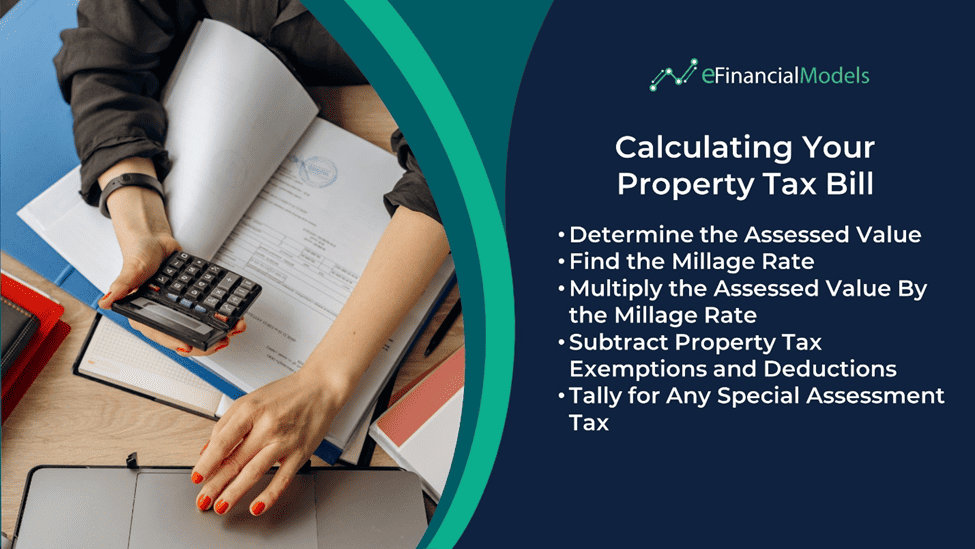
Calculating your real estate property tax bill involves several steps, and the process can vary depending on your location and the specific assessment methods used by your local government. However, here’s a general overview of how real estate property taxes are typically calculated:
Step 1 – Determine the Assessed Value
The property’s assessed value is the starting point for calculating property taxes. As mentioned, local tax authorities assess the value of your property periodically, usually every few years. Many local governments have online databases where you can search for property information, including assessed values. You may need to enter your property’s address or parcel number to access this information. Alternatively, you can check your property tax statement, contact your local tax assessor’s office, or search online real estate websites like Redfin, Realtor.com, or Zillow.
Step 2 – Determine the Millage Rate
The millage rate, often expressed in mills (1 mill = 0.001 or 1/10th of a percent), represents the tax you owe per every $1,000 of assessed property value. To calculate your property tax before any exemptions or deductions, multiply the assessed value by the millage rate. You can check the millage rate in local newspapers, the local tax assessor’s website, the online property tax portal, or your property tax assessment notice.
Step 3 – Multiply the Assessed Value By the Millage Rate
The typical property tax formula is mathematically expressed as:
Property Tax = Assessed Value * (Millage Rate / 1,000)
Step 4 – Subtract Property Tax Exemptions and Deductions
Many jurisdictions offer exemptions and deductions that can reduce your property tax bill. These exemptions often apply to certain categories of property owners, such as veterans, seniors, or individuals with disabilities. Additionally, some jurisdictions offer homestead exemptions for primary residences, which can reduce the taxable value of your property. Subtract any applicable exemptions and deductions from the calculated property tax amount.
Step 5 – Tally for Any Special Assessment Tax
Some areas may have additional taxes and fees, such as special assessments for local improvements or school district taxes. These should be added to your property tax bill.
Sample Property Tax Rate Calculation
Suppose you own a house with an assessed value of $250,000, and the local millage rate is 50 mills (0.05). You also qualify for a $5,000 homestead exemption. But there’s also an additional $500 school district tax.
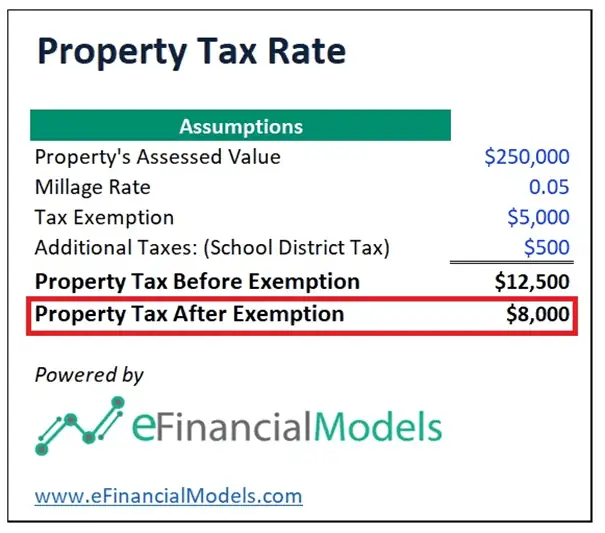
The spreadsheet above shows that your property tax bill would be $8,000. Remember that property tax calculations can vary widely based on local laws and regulations, so it’s essential to consult your local tax authority or access your property tax statement for the most accurate and up-to-date information.
Mastering Property Tax Calculation: A Financial Model for Success
Financial modeling can be a valuable tool in real estate property tax calculation by helping property owners, investors, and assessors make more accurate predictions and assessments.
A financial model can provide a more precise valuation of the property’s assessed value. This is done by considering comparable sales, income potential, and the cost approach. Furthermore, financial models can project property tax liabilities over the long term, allowing property owners to plan for future tax obligations and make informed investment decisions.
To effectively use financial modeling for property tax calculations, it’s essential to have accurate data inputs, including property details, market data, and economic indicators. Additionally, staying up-to-date with changes in tax laws and regulations in your jurisdiction is crucial for accurate modeling and tax planning. Consulting with real estate or tax experts can provide valuable insights and guidance.
Disclaimer:
This article is intended solely for informational purposes and should not be construed as tax advice. The content provided herein is general and may not apply to your specific financial situation or the tax laws of your jurisdiction.
Tax regulations are subject to frequent changes, and their applicability can vary widely depending on individual circumstances. Therefore, before making any financial or tax-related decisions, it is essential to consult with a qualified tax advisor or a certified professional who can provide guidance tailored to your specific needs and the current tax laws in your jurisdiction.
We disclaim all responsibility for the truthfulness, trustworthiness, and completeness of the data given in this article. You assume all responsibility for any actions due to the information supplied. We strongly recommend that you seek professional advice from a tax advisor to ensure that your financial decisions align with your unique circumstances and adhere to the tax regulations in your area.
By reading this article, you acknowledge that it does not constitute tax advice, and you agree to release us from any responsibility or liability for any consequences resulting from your reliance on the information herein. It is your responsibility to verify the accuracy and applicability of the information with your own tax advisor.












































You might also like:
- 10 Main Elements of a Business Plan
- Best in Class Property Appraisal Methods and What to Look Out for
- Finding Fair Market Value: A Quick Guide to Real Estate Valuation
- Financial Modeling for Startups and Small Businesses
- Steps to Building Financial Models in Excel
- Commercial Real Estate Valuation Methods: Helping Investors in Taking Informed Decisions
- Understanding the Essential Elements of an Income Statement
- 10 Tips to Develop a First Class Business Valuation Report
- How to Calculate Annual Recurring (ARR) Revenue for Sustainable Growth
- Creating a Business Plan for your Food Truck Business
- How to Prepare a Financial Feasibility Study?
- Cash Flow Statement: Streamline Financial Success
- How Will You Value Your Business With the EV/Revenue Multiple?
- Financial Model – Valuation of Tax Loss Carryforwards
- Property Valuation
- 5 Best Practices for Managing Days Receivables
- Financial Planning for Small Business Owners – Taking an SBA Loan
- Development in Real Estate: What You Need to Know
- Real Estate Financial Modeling in Excel
- 10 Awesome Excel Formulas To Use For Your Next Financial Model In Excel