
0 ITEMS

How to Calculate Annual Recurring (ARR) Revenue for Sustainable Growth
Table of Content
- Differences Between ARR and Traditional Revenue
- Importance of Annual Recurring Revenue (ARR)
- Why ARR is Key for Subscription-Based Businesses
- How to Calculate Annual Recurring Revenue
- Annual Recurring Revenue (ARR) Calculator
- Benefits of ARR for Investors and Stakeholders
- How ARR Impacts Business Scalability
- ARR vs. MRR (Monthly Recurring Revenue)
- Tips for Increasing ARR
- Incorporating ARR into Financial Models
- The Importance of Monitoring Annual Recurring Revenue (ARR)
Understanding and tracking Annual Recurring Revenue (ARR) is essential for subscription-based businesses aiming for predictable growth.
- ARR measures the total value of recurring subscription revenue expected annually from current customers.
- It provides stable projections that improve financial forecasting and strategic planning.
- Comparing ARR with traditional revenue highlights the benefits of recurring income, such as reduced volatility and better valuation.
- Strategies to boost ARR include reducing customer churn, upselling, cross-selling, and optimizing pricing models.
- Accurate ARR calculation and ongoing monitoring support long-term growth, investor confidence, and scalability.
Continuing to refine your ARR management can enhance your business’s financial stability and growth potential.
Differences Between ARR and Traditional Revenue
Understanding the distinctions between Annual Recurring Revenue (ARR) and traditional revenue is crucial for businesses, particularly those operating in subscription-based models. Traditional revenue typically refers to one-time sales transactions where a customer makes a purchase, and the revenue is recognized immediately upon the sale. In contrast, ARR measures the predictable, recurring revenue a company expects over a year from its subscription services. This fundamental difference underscores why ARR is deemed a more reliable metric for anticipating steady income streams than traditional revenue’s often volatile nature.
ARR offers several advantages over traditional revenue. Firstly, it provides a clearer view of a company’s financial health by emphasizing the consistent revenue that can be expected annually. This predictability is particularly valuable for business planning and investment decisions. For instance, investors often favor companies with a high ARR because it signals stable and long-term income potential. Additionally, ARR allows businesses to manage their resources better and make informed strategic decisions, such as when to invest in growth initiatives or how to allocate marketing budgets effectively. In contrast, reliance on traditional revenue can lead to fluctuations that make it difficult to maintain consistent business operations.
Predictability and Stability
One of the primary differences between ARR and traditional revenue lies in predictability. ARR offers a reliable forecast of future income, which is essential for long-term financial stability. This predictability enables businesses to plan more effectively and securely in the knowledge that a certain amount of income will consistently flow in. Traditional revenue, on the other hand, can be unpredictable, as it depends on sporadic sales activities. This makes planning and forecasting more challenging, as the revenue stream can vary significantly from one period to another.
Impact on Valuation
Another critical difference is the impact on a company’s valuation. ARR allows potential investors and financial analysts to assess a business’s future cash flows more accurately. Companies with high ARR often receive higher valuations because consistent recurring revenue reduces financial risk. In contrast, traditional revenue streams might not offer the same level of assurance, leading to more conservative valuations. ARR’s emphasis on long-term revenue potential provides a more comprehensive view of a company’s viability and growth prospects.
Customer Relationships
ARR also reflects stronger customer relationships. In subscription models, customers engage continuously with the business, often leading to higher customer lifetime value and lower acquisition costs over time. In traditional revenue models, customer interaction may be limited to one-time transactions, missing opportunities for ongoing engagement and value extraction.
In conclusion, while ARR and traditional revenue play vital roles in assessing a company’s performance, ARR offers more substantial benefits in predictability, business planning, and valuation. By focusing on ARR, businesses can ensure a steadier financial footing, making it easier to navigate market fluctuations and sustain long-term growth.
Importance of Annual Recurring Revenue (ARR)

Annual Recurring Revenue (ARR) is a crucial metric for subscription-based businesses, providing a clear and predictable measure of the annualized revenue generated from a company’s subscribers. This metric brings stability and foresight, allowing businesses to project future revenue more accurately. In models where recurring income is essential, ARR’s predictability is invaluable, helping companies gauge performance, plan strategically, and ensure consistent growth. For example, SaaS companies often track ARR to assess whether they achieve sustainable development, maintain healthy customer retention, and effectively leverage upsell opportunities.
By monitoring ARR, businesses can make informed decisions about resource allocation, product development, and marketing. A clear understanding of ARR enables them to estimate future revenue streams, adjust operations as needed, and prioritize customer support to reduce churn or focus on product improvements to enhance customer satisfaction. ARR aligns business efforts with long-term financial goals, ensuring steady growth and profitability.
For investors and stakeholders, ARR offers a transparent and reliable indicator of a company’s financial health. Unlike one-time revenue, ARR highlights the ongoing value of recurring customer relationships, making it appealing to investors looking for long-term, sustainable opportunities. It provides insights into a company’s ability to maintain and grow revenue even in fluctuating market conditions, instilling confidence and attracting capital. Predictable, recurring revenue enables stakeholders to make more informed decisions regarding mergers, acquisitions, or expansion plans. A strong ARR reduces perceived risk and enhances a company’s appeal to venture capitalists and private equity firms, boosting financial credibility.
ARR also plays a key role in business scalability by offering a reliable foundation for financial forecasting and planning. With predictable revenue, companies can build more accurate models and confidently pursue growth initiatives such as scaling operations or expanding into new markets. ARR provides insights into areas needing improvement, like customer retention and acquisition strategies, allowing businesses to implement actions that foster sustainable growth. Companies can refine marketing and customer support efforts by analyzing ARR components such as new revenue, upgrades, and churn. In short, a growing ARR reflects financial health and enables businesses to scale effectively and sustainably.
Why ARR is Key for Subscription-Based Businesses
In subscription-based businesses, Annual Recurring Revenue (ARR) is a cornerstone metric that offers invaluable insights into the company’s financial performance and future growth prospects. Unlike traditional sales that may vary significantly from one period to another, ARR provides a stable and predictable revenue stream, allowing businesses to plan strategically and make more informed decisions. This predictability ensures stable cash flows, which is essential for operational sustainability and strategic investments.
ARR is a metric that quantifies the recurring annual revenue generated from subscription-based services. This measure is particularly relevant for businesses relying on subscriptions because it accounts for all recurring revenue components, including base subscription fees, recurring upgrades, and any additional customer services. By focusing on ARR, companies can effectively gauge their long-term financial health, making it easier to secure funding from investors who seek predictable and stable revenue streams. Moreover, tracking ARR allows businesses to identify customer behavior trends, measure retention strategies’ success, and make data-driven decisions to drive sustainable growth.
Understanding ARR for Business Performance
- Ensuring Predictable Growth: One of the most significant advantages of monitoring ARR is that it offers a clear view of the company’s growth trajectory. This metric helps businesses forecast revenues more accurately, enabling them to make informed decisions regarding expansions or new product offerings. For instance, if a company sees a steady increase in ARR, it can confidently invest in scaling operations or enhancing its product line without the uncertainty of fluctuating income.
- Strategic Planning and Resource Allocation: ARR is central to long-term strategic planning. It enables businesses to allocate resources more effectively by understanding which customer segments or products contribute the most to recurring revenue. For example, if a company notices high ARR from a particular service, it can focus on further developing and marketing that service. Conversely, companies can investigate and adjust their strategies to boost performance if ARR growth stagnates in certain areas.
- Evaluating Customer Lifetime Value (CLTV): By incorporating ARR into financial models, businesses can better assess the Customer Lifetime Value (CLTV). This metric indicates the total revenue a business can expect from a single customer account over their entire relationship. Understanding CLTV through ARR helps to devise retention strategies and to tailor services to meet customer needs more effectively, thereby increasing overall profitability.
In conclusion, ARR is a revenue measure and a strategic tool that provides deep insights into business health, facilitates predictable growth, and supports strategic planning and resource allocation. For subscription-based businesses, paying close attention to ARR can mean the difference between fluctuating financial stability and sustainable, long-term success.
How to Calculate Annual Recurring Revenue
Annual Recurring Revenue (ARR) is a critical metric for businesses, particularly those operating under a subscription model. Understanding how to calculate it accurately is essential for gaining insights into your company’s financial health and planning for sustainable growth. Here’s a detailed guide on how to calculate ARR.
Annual Recurring Revenue (ARR) Calculator
Core income earned from recurring subscription fees.
Additional services or upgrades that customers subscribe to.
Revenue lost from plan downgrades or churn.
Annual Recurring Revenue (ARR) is a crucial metric for subscription-based businesses, providing a clear and predictable measure of the annualized revenue generated from a company’s subscribers. This metric brings stability and foresight, allowing businesses to project future revenue with greater accuracy.
How to Calculate Annual Recurring Revenue
Knowing how to calculate Annual Recurring Revenue (ARR) accurately is vital for businesses relying on subscription models. ARR provides a consistent snapshot of annual revenue derived from subscription arrangements, painting a clearer picture of the company’s financial health. The process of calculating ARR can be broken down into a straightforward formula:

Let’s delve into each component of this formula to understand it better.
- Subscription Revenue: This is the core income that the company earns from recurring subscription fees. For instance, if a business has 100 customers paying $1,000 annually, the subscription revenue would be $100,000.
- Recurring Add-ons and Upgrades: Businesses often offer additional services or upgrades that customers can subscribe to for an extra fee. Suppose the same business also convinces 20% of its customers to purchase a $200 upgrade. This adds $4,000 to the total.
- Downgrades and Cancellations: Only some customers stick to their initial subscription plan. Some may downgrade to a cheaper plan or cancel altogether. If, say, ten customers downgrade to a plan that is $200 cheaper and five customers cancel their $1,000 plans, this results in a reduction of $4,000 and $5,000, respectively, in ARR.
Annual Recurring Revenue Calculator
Businesses can use online tools or calculators designed for ARR computation to simplify this process. An annual recurring revenue calculator can streamline the process by allowing companies to easily input their revenue streams and adjustments, ensuring accurate and quick calculations. These calculators, available on various financial websites, provide a practical solution for businesses to consistently monitor and update their ARR without complex manual calculations.
Many businesses use an online annual recurring revenue calculator to simplify this process. These tools can help compute ARR quickly and accurately, considering factors like billing cycles and customer behaviors. For example, websites such as eFinancialModels and other financial platforms often offer these calculators for free or as part of their financial modeling services. Using these tools can eliminate manual errors and provide a clear picture of your company’s recurring revenue, making it easier to strategize and predict future revenues.
In essence, understanding how to calculate annual recurring revenue and using the right tools to assist can provide invaluable insights into your business’s financial health. It allows businesses to make informed decisions regarding growth strategies, customer retention, and overall financial planning. Maintaining accurate and up-to-date customer data ensures that your ARR calculations are precise and reflect your actual business performance.
Examples and Scenarios
Consider a company that starts the year with 200 customers, each paying an annual subscription of $500. Over the year, they acquire an additional 50 customers at the same rate. They also upsell 30% of their existing customers a $100 upgrade, while 20 customers downgrade their plans, reducing the revenue by $50 each, and 10 customers cancel outright. The company’s ARR calculation would look like this:
- Initial Subscription Revenue: 200 x $500 = $100,000
- New Subscription Revenue: 50 x $500 = $25,000
- Recurring Add-ons and Upgrades: (200 x 0.30) x $100 = $6,000
- Downgrades: 20 x $50 = $1,000
- Cancellations: 10 x $500 = $5,000
So, the total ARR would be:
ARR = ($100,000 + $25,000 + $6,000) - ($1,000 + $5,000) = $125,000
Benefits of ARR for Investors and Stakeholders

Annual Recurring Revenue (ARR) is a valuable metric for subscription-based businesses and highly benefits investors and stakeholders. One of ARR’s primary advantages for investors is its predictability. Unlike traditional one-time sales revenue, ARR offers a clear, consistent depiction of a company’s financial health and future earning potential. This predictability is particularly appealing to investors who seek stable and reliable returns on investment. By focusing on ARR, investors can make more informed decisions about where to allocate their capital, reducing the risk associated with unpredictable income streams.
Stakeholders, including executives, employees, and even customers, also greatly benefit from the transparency and stability offered by ARR. Tracking ARR allows for better financial forecasting and strategic planning for executives and managers. It enables them to identify trends in customer behavior, such as churn rates and upgrade patterns, and apply this knowledge to optimize business operations. Moreover, employees whose compensation may be linked to the company’s financial performance gain more confidence in their income security when they see a steady ARR. Customers, too, can benefit indirectly; companies with a stable ARR are more likely to invest in improving customer experience and service quality, thus enhancing long-term satisfaction and loyalty.
ARR significantly boosts investor confidence by providing a steady and transparent view of a company’s recurring revenue. It also aids stakeholders in orchestrating strategic decisions that foster sustainable growth and stability. By leveraging ARR, businesses can create a more attractive proposition for investors while ensuring all internal and external stakeholders benefit from predictable and stable financial performance.
How ARR Impacts Business Scalability
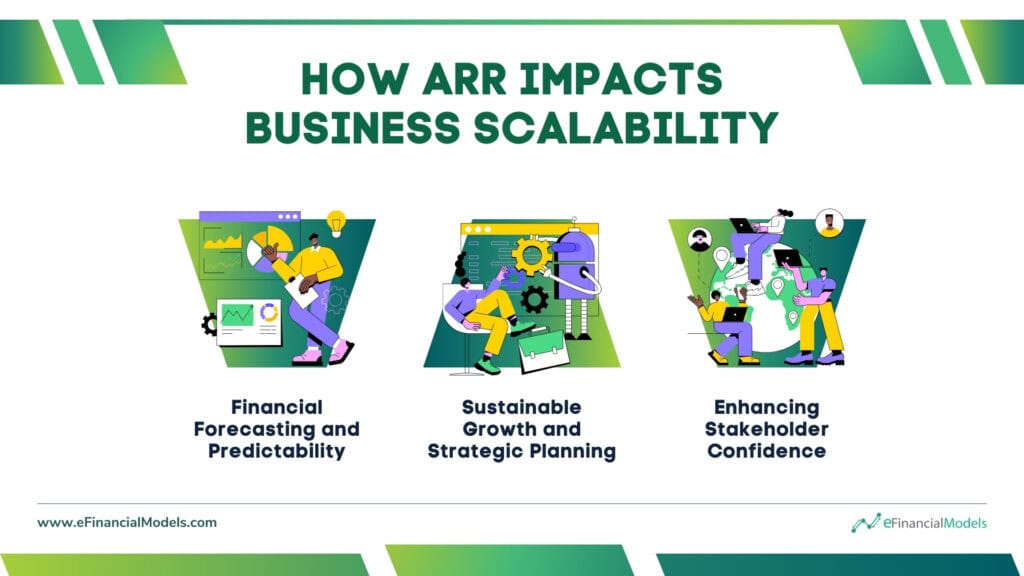
Annual Recurring Revenue (ARR) is pivotal in determining a business’s scalability, particularly in subscription-based models. ARR refers to the revenue a company expects to receive annually from customers for subscriptions or ongoing services. It serves as a critical metric for predicting long-term financial stability and helps businesses make informed decisions about growth and expansion. ARR impacts business scalability by improving financial forecasting, enabling sustainable growth strategies, and offering clearer insights into revenue streams.
Financial Forecasting and Predictability
One of the foremost ways ARR impacts business scalability is through enhanced financial forecasting. Unlike traditional revenue metrics, ARR provides a consistent and predictable income stream. This predictability allows businesses to create more accurate financial models, allocate resources more effectively, and make strategic decisions with higher confidence. For instance, software-as-a-service (SaaS) companies rely heavily on ARR to assess their future revenue potential, plan for operational expansions, and secure funding. With accurate ARR calculations, these companies can gauge how much revenue will be generated, enabling them to budget for future projects, hire additional staff, or invest in new technology without the looming fear of revenue shortfalls.
Sustainable Growth and Strategic Planning
ARR’s predictability also fosters sustainable growth. Businesses can develop robust growth strategies without overstretching their resources by offering a clear view of projected annual income. Based on steady income projections, companies can plan product expansions, enter new markets, or improve existing services. High ARR figures can also ensure that a business has the financial health to weather economic downturns or market volatility. For example, if a company witnesses an upward trend in ARR, it indicates a growing and loyal customer base, which can be further leveraged by investing in customer retention programs and exploring new revenue opportunities. This strategic approach minimizes risks and promotes a steady ascent toward business scaling.
Enhancing Stakeholder Confidence
Moreover, ARR significantly boosts stakeholder and investor confidence. Investors look for companies with stable and predictable revenue streams. High ARR signals a thriving, well-managed business with a reliable customer base. This, in turn, makes a business more attractive for investment, facilitating easier access to capital for expansion. Investors are more likely to fund companies with a solid ARR because they can generate consistent revenue and achieve sustainable growth over time. Hence, businesses that accurately track and optimize their ARR are better positioned to secure investments, drive growth, and scale efficiently.
In summary, ARR is a foundation for financial planning, providing crucial insights for scalable and sustainable business growth. By leveraging ARR, businesses can enhance financial forecasting, develop strategic growth plans, and attract investor confidence, setting a solid groundwork for scaling operations and achieving long-term success.
ARR vs. MRR (Monthly Recurring Revenue)
When evaluating a subscription-based business’s financial health and performance, two key metrics often come into play: Annual Recurring Revenue (ARR) and Monthly Recurring Revenue (MRR). Both offer valuable insights into a company’s revenue stream but serve different purposes and suit various business contexts.
ARR provides an overview of the predictable, recurring revenue a company expects over a year, while MRR measures the same predictable revenue every month. ARR offers a macro perspective ideal for long-term strategic planning, while MRR is better suited for more immediate, short-term financial insights.
ARR is especially useful for understanding a subscription business’s health and prospects. Consolidating revenue data into an annual figure allows companies to make strategic decisions about investments, growth, and long-term planning. Businesses use ARR to gauge scalability, secure funding, and attract investors by demonstrating steady, predictable income.
MRR, on the other hand, is crucial for tracking immediate performance. It helps businesses monitor monthly cash flow, measure the impact of marketing campaigns, and quickly address issues like high churn rates. Since it offers a more detailed view of monthly financial health, MRR is a valuable tool for short-term operational decision-making.
The choice between ARR and MRR depends on the business's specific financial analysis or operational focus. ARR is best for long-term planning, such as securing investments, evaluating growth over a year, or making annual budget decisions. MRR, in contrast, is ideal for tracking month-over-month performance, addressing short-term revenue fluctuations, and evaluating the effectiveness of monthly sales and marketing efforts.
Both metrics are indispensable for subscription-based businesses. For example, a SaaS company might use ARR to project revenue for the upcoming year and make decisions about scaling its operations, such as expanding its product line or entering new markets. At the same time, the company would use MRR to track the immediate impact of these strategies. MRR data can quickly reflect customer responses through increased subscriptions or churn if a new product feature is released. This feedback helps the company make timely adjustments to ensure continuous growth and customer satisfaction.
In summary, while ARR provides a comprehensive, long-term view of financial health, MRR offers detailed, real-time insights into monthly performance. Effectively utilizing both metrics allows businesses to balance strategic planning with operational efficiency, driving sustainable growth and financial stability.
Tips for Increasing ARR
Increasing Annual Recurring Revenue (ARR) is a paramount goal for subscription-based businesses aiming for sustainable growth and financial stability. Here are some actionable tips to help companies to enhance their ARR.
- Reduce Churn
Customer churn is detrimental to ARR growth. Thus, implementing strategies to reduce churn is crucial. Start by identifying the root causes of why customers leave. Common reasons could be dissatisfaction with the product, pricing issues, or lack of sufficient customer support. Implementing a robust customer feedback mechanism can help you pinpoint these issues. Once identified, take steps to address them. For instance, improving customer service through better support channels and trained personnel can significantly reduce churn. Additionally, offering loyalty rewards or incentives for long-term subscriptions can encourage customers to stay.
- Improve Customer Retention
In addition to reducing churn, actively focusing on customer retention can substantially boost ARR. One effective approach is to enhance the customer experience by providing continuous value through regular updates, new features, and personalized services. Using customer data analytics, businesses can predict customer needs and make proactive suggestions, thereby increasing the perceived value of the subscription. Another strategy is to foster a community around your product. User forums, webinars, and community events can create a sense of belonging among users, encouraging them to remain loyal subscribers.
- Upsell and Cross-Sell Services
Upselling and cross-selling are potent strategies to increase ARR. Upselling involves encouraging existing customers to upgrade to more expensive plans that offer additional features. Conversely, cross-selling means suggesting complementary products or services that enhance the core product’s utility. For instance, a software-as-a-service (SaaS) company might offer additional data storage or premium support as part of an upsell, or they might suggest supplementary tools like analytics software as a cross-sell. Effective customer data analytics can help identify potential upsell and cross-sell opportunities, tailoring these suggestions to customer needs and usage patterns.
- Implement Effective Pricing Strategies
Optimizing your pricing strategy can also have a direct impact on ARR. This includes reviewing and adjusting pricing tiers based on market conditions and customer feedback. Value-based pricing, where prices are set based on the perceived value to the customer rather than the cost of production, can be particularly effective. Offering various pricing tiers allows customers to choose a plan that fits their needs and budgets, potentially pulling in revenue from different market segments. Additionally, promotional offers such as discounts for annual payments instead of monthly subscriptions can encourage customers to commit longer, thus boosting ARR.
- Enhance Product Value
Continuously adding new features and improving the product based on customer feedback is essential to retain and attract subscribers. An agile development approach focusing on regular updates can keep the product relevant and valuable. Engaging with customers through beta testing of new features can also provide useful insights and make customers feel involved in the development process, increasing their commitment to the product. Moreover, ensuring a seamless user experience, quick onboarding, and proactive customer support can significantly enhance the product’s value proposition.
By implementing these strategies, businesses can effectively increase their Annual Recurring Revenue, driving long-term financial stability and growth.
Incorporating ARR into Financial Models
Incorporating Annual Recurring Revenue (ARR) into financial models is essential for accurately planning and valuing subscription-based businesses over the long term. ARR provides a stable and predictable measure of recurring income, which is crucial for financial projections. Unlike traditional metrics focusing on one-time sales, ARR captures the nuances of subscription models, where customer retention, upsells, and renewals drive growth. By integrating ARR into financial models, businesses can better assess their operational performance, forecast future revenues, and make informed capital allocation decisions.
To incorporate ARR, companies analyze key metrics such as customer acquisition, churn rates, and upsell potential. These factors are embedded into forecasting models to project revenue and expenses. This enables scenario planning, helping businesses visualize how different strategies, such as pricing adjustments or retention efforts, will impact their financial outlook. For example, changes in customer retention strategies can be modeled to assess how they might affect ARR and, consequently, long-term revenue growth.
Accurate ARR projections also significantly impact business valuations, particularly in the eyes of investors and stakeholders. Since ARR reflects steady and predictable revenue streams, it’s a key factor in determining a company’s value. Strong ARR projections can boost investor confidence, signaling financial stability and growth potential. Businesses with solid ARR projections often receive higher valuations because they can generate recurring revenue, grow their customer base, and retain existing clients.
Moreover, ARR allows companies to assess their scalability. Investors are especially interested in how a business can grow its ARR while maintaining customer retention. This growth potential, supported by stable recurring income, strengthens the company’s case when attracting investment or negotiating deals.
Analyzing financial health through ARR requires breaking down its components—new revenue from acquisitions, upgrades, and churn. This granular approach helps businesses identify where they are performing well and where improvements are needed. For example, if a company’s churn rate is high, it might need to reevaluate its customer retention strategies. Conversely, a high rate of customer upgrades could indicate that premium offerings are well-received, encouraging further investment in product development.
Regularly analyzing ARR also reveals trends and anomalies that may otherwise go unnoticed. For instance, a sudden increase in churn could signal dissatisfaction, prompting deeper investigations into service performance, while consistent upgrades validate product development strategies. This ongoing analysis helps businesses stay agile and responsive, ensuring they can adapt quickly to market changes and customer behavior.
Incorporating ARR into financial models supports better decision-making and builds a compelling case for attracting investment and achieving sustainable growth. By leveraging ARR as a core metric, businesses maintain a clear view of their financial health and can plan effectively for long-term success. This approach fosters stability, scalability, and profitability in subscription-based business models.
The Importance of Monitoring Annual Recurring Revenue (ARR)
Annual Recurring Revenue (ARR) is a crucial metric for subscription-based businesses, offering insights into long-term financial health and growth. Throughout this article, we’ve explored ARR’s definition, calculation, and unique features compared to other revenue metrics like Monthly Recurring Revenue (MRR). Understanding ARR enables businesses to forecast accurately, scale effectively, and attract investors by providing transparency and predictability.
Monitoring ARR is an ongoing process vital for sustainable growth. It helps identify trends, spot upselling opportunities, and mitigate risks such as customer churn. Utilizing tools like an ARR calculator simplifies the tracking process and ensures accuracy. Staying updated on technological advancements in ARR tracking will help businesses adapt quickly to market changes.
Looking ahead, businesses will rely more on advanced ARR tracking tools, allowing for deeper analysis and more precise financial forecasting. As a result, ARR will continue to play a key role in driving long-term business success and strategic decision-making.
Integrating robust financial models is essential to integrating and fully leveraging ARR’s power. Economic models provide a clear roadmap for growth, helping you understand your revenue streams, forecast future performance, and make informed decisions. Whether you’re looking to scale or attract investors, accurate financial modeling is your key to sustainable success. Start building your financial model today to unlock the full potential of ARR and drive long-term business growth.
You might also like:
- 10 Ideas to Increase Average Revenue Per User
- How Contribution Margin Analysis Can Drive Your Business to Financial Success
- 12 Funding Sources for Businesses and Startups
- Calculating Revenue Growth Rate: A Key Metric for Business Success
- How to Calculate SaaS Monthly Recurring Revenue?
- How to Make Smart Decisions with 6 Key Financial Metrics?
- Understanding What is Yield to Maturity and Why It Matters
- Master the Free Cash Flow Formula for Smarter Financial Decisions
- Financial Modeling using Excel
- Financial Modeling for Startups and Small Businesses
- Investor Cash Flows
- Funding Sources for Businesses
- Startup Financial Models
- Growth Rate Calculator: Exploring the Benefits
- Cash Flow Analysis in Excel
- SaaS Business Financial Model
- Simple Fundraising Model
- Financial Model for Mobile App | Mobile App Business Plan
- How to Value a Business Using a Discounted Cash Flow Model
- Key Financial Ratios
