
0 ITEMS

Which Cash Flow Patterns Prevent IRR Calculation?

Internal Rate of Return (IRR) is one of the most widely used metrics in financial modeling and investment analysis, but what happens when the formula doesn’t work? While IRR is designed to measure the rate of return on an investment, certain cash flow patterns can make its calculation impossible—or even misleading.
A classic example of this is venture capital, where a startup might receive multiple funding rounds before generating revenue. Suppose a biotech startup raises $10 million in Series A funding, followed by an additional $20 million two years later, with no cash inflows in between. If the company eventually exits with a $50 million valuation, traditional IRR calculations may fail or yield multiple IRRs, creating confusion for investors.
This article explores the specific cash flow patterns that prevent IRR calculation and their implications in financial modeling.
What Is IRR Calculation in Excel?
The Internal Rate of Return (IRR) measures the profitability of an investment. IRR is the discount rate that makes future cash flows’ net present value (NPV) zero. A higher IRR means a better return. Businesses and investors use IRR to compare projects and decide where to invest. If IRR exceeds the cost of capital, the investment is typically worthwhile. The IRR formula follows this equation: 0 = Σ [Ct / (1 + IRR)^t], where Ct is cash flow at time t. The formula isn’t straightforward, so Excel or financial calculators are often used.
IRR calculation in Excel helps investors measure the profitability of an investment. It finds the discount rate that makes cash flows’ net present value (NPV) zero. You can use the =IRR() function for evenly spaced cash flows or =XIRR() for irregular ones. IRR calculation in Excel has three key components: cash flows, time periods, and the discount rate.
- Cash flows include both the initial investment and future returns.
- Time periods define when each cash flow occurs.
- The discount rate is what IRR solves for—it makes the net present value (NPV) of cash flows zero.
Input cash flows in a column, starting with the initial investment as a negative number. Excel then calculates the internal rate of return automatically.

IRR and Cash Flow Patterns: How Timing Impacts Returns
Cash flow patterns shape the internal rate of return (IRR) by defining when money moves in and out of an investment. This makes IRR sensitive to cash flow patterns, not just total profits. Early inflows increase IRR, while delayed returns lower it. A project with steady cash flows may have a different IRR than one with uneven payouts, even if total profits match. Understanding these patterns helps investors assess risk and compare opportunities effectively. Investors must analyze timing carefully to ensure returns align with their financial goals.
IRR assumes all cash flows are reinvested at the same rate, which can distort results when cash flow patterns vary. If returns are high early on, IRR may overstate profitability. The actual return could be much less if later cash flows are lower. This makes IRR less reliable for projects with irregular earnings. To get a clearer picture, investors often use the Modified Internal Rate of Return (MIRR), which adjusts for realistic reinvestment rates. Understanding this limitation helps in making better financial decisions.
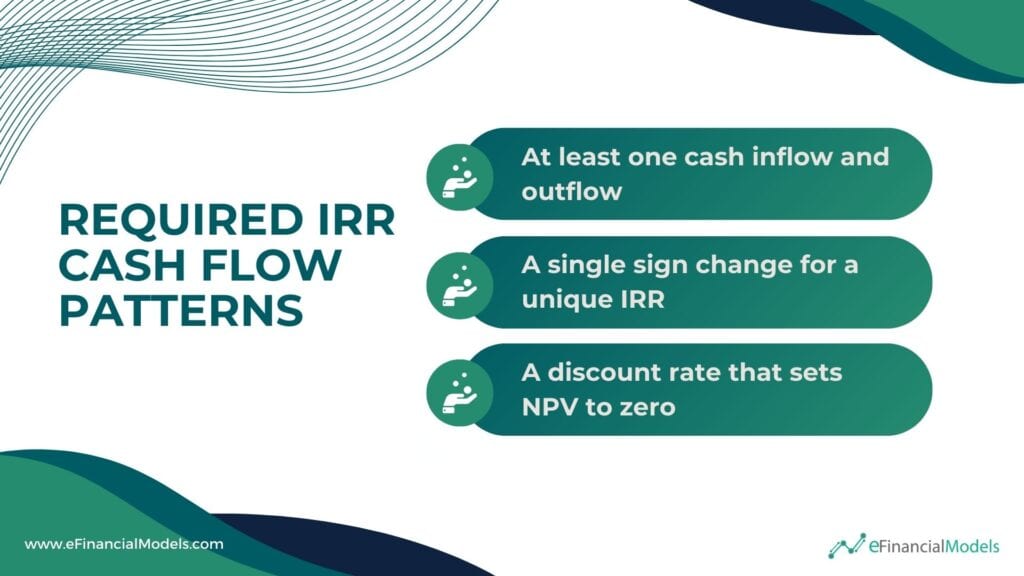
To successfully compute IRR, cash flows must meet the following conditions:
- At least one negative and one positive cash flow: A valid IRR requires a clear transition from an initial investment (negative cash flow) to future inflows (positive cash flows).
- A single sign change for a unique IRR: If cash flows change signs more than once, multiple IRRs may complicate decision-making.
- Mathematical solvability: IRR is non-existent if no discount rate sets the Net Present Value (NPV) to zero.
When cash flows deviate from these conditions, IRR cannot be calculated or produces unreliable results.






















































Cash Flow Patterns That Disrupt IRR Calculation
Cash flow timing can significantly impact IRR, sometimes leading to misleading results. IRR assumes consistent reinvestment and smooth cash flows, but real-world patterns rarely follow this ideal. Uneven inflows, sudden outflows, or long gaps between returns can distort the true profitability of an investment. When disruptions occur, they can inflate or deflate IRR, making it less reliable for decision-making. Understanding these patterns helps investors avoid misjudging a project’s true return potential based on the limitations of IRR.
All Positive Cash Flows
The Internal Rate of Return (IRR) is designed to measure the profitability of an investment by identifying the discount rate at which the Net Present Value (NPV) of cash flows equals zero. The cash flow pattern must include positive (inflows) and negative (outflows) values for this calculation to work. If all cash flows are positive—meaning there are only inflows and no initial investment or subsequent costs—the IRR formula cannot determine a meaningful rate of return because there is no break-even point for the investment. IRR calculation in Excel fundamentally requires at least one negative cash flow, usually representing an initial investment or a future expense, to establish a basis for computing returns over time. Without this balance, IRR becomes mathematically undefined or leads to misleading results.
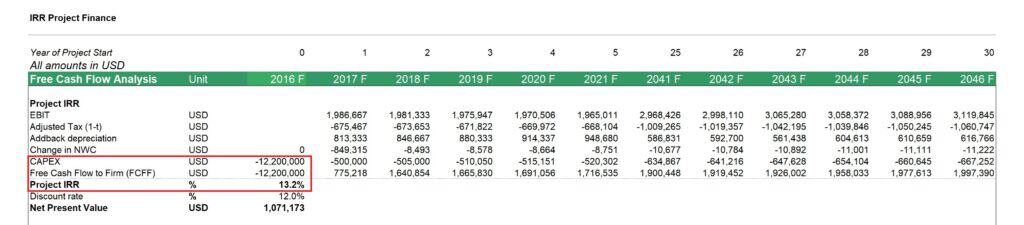
See the following examples of IRR calculation in Excel from our IRR Project Finance Analysis Template:
Example No. 1
Example No. 2
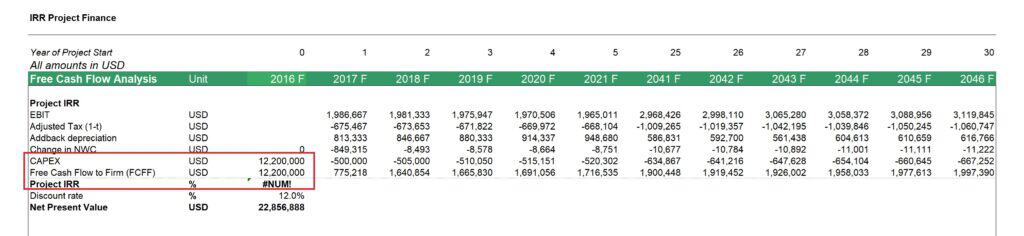
In Example No. 1, the IRR is calculable because the project has both negative and positive cash flows, creating a valid internal rate of return. However, in Example No. 2, all cash flows are positive, meaning there is no real discount rate at which the net present value (NPV) equals zero. Since IRR relies on at least one negative cash flow to establish a breakeven point, the formula returns a #NUM! error, making IRR incalculable.
All Negative Cash Flows
IRR calculation in Excel relies on at least one negative and one positive cash flow to determine a rate where NPV equals zero. When all cash flows are negative, the project never generates returns, making it impossible to find a discount rate that balances inflows and outflows. Without a mix of positive cash inflows, the IRR formula fails to identify a breakeven point, leading to a #NUM! Error in Excel. This disrupts financial analysis since IRR becomes meaningless when there’s no profitable outcome, highlighting the need for varied cash flow patterns in investment evaluations.
Example No. 3
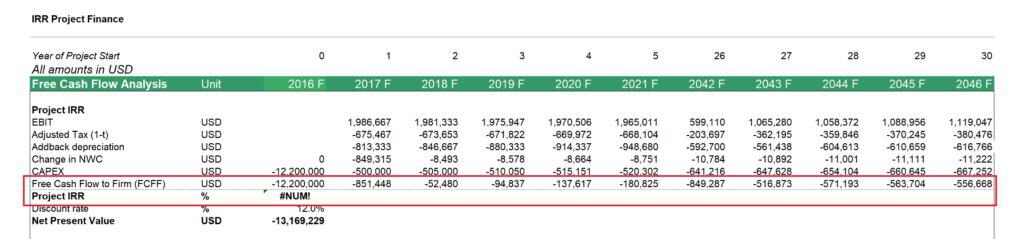
The chart above shows that every cash flow is negative, preventing the IRR formula from finding a valid discount rate where NPV equals zero. Since IRR requires both negative and positive values to calculate a return, an all-negative pattern disrupts the equation. The model shows ongoing losses with no profitable inflows, making it impossible to determine a breakeven point. As a result, Excel returns a #NUM! Error, signaling that IRR cannot be computed. This highlights why investment evaluations need a mix of inflows and outflows to generate meaningful IRR results.
Multiple Cash Flow Sign Changes
Internal Rate of Return (IRR) works best when cash flows follow a simple pattern—one initial investment outflow followed by positive returns. However, the IRR calculation becomes unreliable when the cash flow pattern switches between positive and negative multiple times. This happens because each cash flow sign change can create multiple IRR values or no solution. IRR is based on solving for a discount rate that makes the net present value (NPV) zero. With frequent sign changes, the equation has multiple valid solutions, leading to confusion. In extreme cases, no IRR exists because the equation cannot balance. This makes IRR useless for decision-making in such situations.
Example No. 4
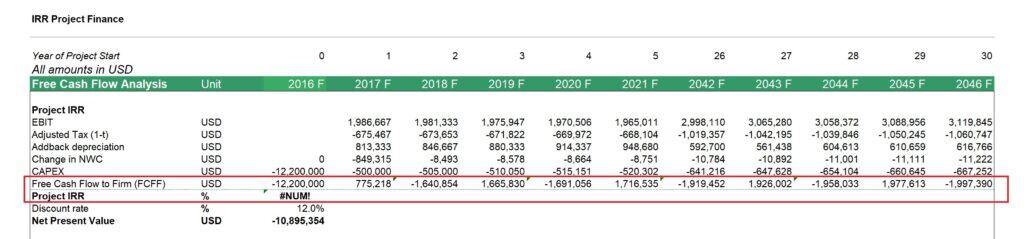
The chart above shows multiple cash flow sign changes, making the IRR calculation invalid. In 2016, the Free Cash Flow to Firm (FCFF) started with a large negative value, followed by positive and negative shifts across the years. These alternating signs create multiple IRRs or no real solution, causing the “#NUM!” error. IRR assumes a single sign change from negative to positive for a unique solution, but multiple reversals confuse the formula.

Addressing the Limitations of IRR: Best Alternatives
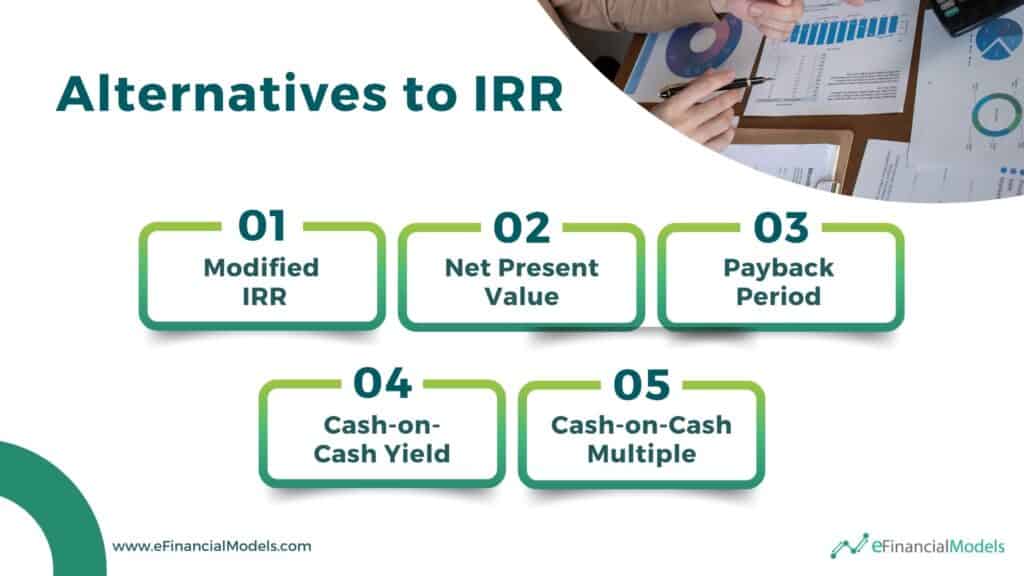
The Internal Rate of Return (IRR) is a popular metric. However, we can use other key financial metrics to combat the limitations of IRR for non-standard cash flows.
- Modified Internal Rate of Return (MIRR): MIRR improves on IRR by addressing its flaws, such as multiple IRRs and unrealistic reinvestment assumptions. It assumes cash flows are reinvested at a more realistic rate, usually the cost of capital. This provides a clearer picture of a project’s true profitability. Businesses use MIRR to compare investments more accurately and make better financial decisions.
- Net Present Value (NPV): NPV measures the difference between the present value of cash inflows and outflows. It accounts for the time value of money, ensuring future cash flows are properly discounted. A positive NPV means a project is profitable, while a negative NPV signals a loss. Companies prefer NPV because it directly reflects value creation, making it a key tool in capital budgeting.
- Payback Period: The payback period calculates how long it takes to recover an investment. A shorter payback period means faster risk recovery, ideal for businesses needing quick returns. Though it lacks profitability insights, it helps assess liquidity and risk exposure.
- Cash-on-Cash Yield: Cash-on-cash yield measures the annual cash return from an investment relative to its cost. It is commonly used in real estate and fixed-income investments. A higher cash yield indicates better cash flow generation, helping investors compare income-producing assets. Since it focuses on actual cash returns, it provides a straightforward profitability measure.
- Cash-on-Cash Multiple: Cash-on-cash multiple compares total cash returns to the initial investment. It provides a simple profitability snapshot, often used in private equity and real estate. A higher multiple means a more profitable investment. While it ignores time value and financing effects, it helps investors quickly evaluate overall returns.
Financial Modeling: The Key to IRR Calculation in Excel
IRR calculation fails when cash flow patterns disrupt its logic. IRR cannot be determined if all cash flows are positive or negative because no rate equates inflows and outflows. Additionally, multiple cash flow sign changes can produce multiple IRRs, making the result unreliable. These limitations of IRR highlight why it is useful only for standard investment scenarios with one upfront cost followed by positive returns. Alternative financial metrics like MIRR, NPV, payback period, cash-on-cash yield, and cash-on-cash multiple provide clearer investment analysis for complex cash flows.
Building a precise IRR calculation in Excel requires a strong financial model that accounts for potential pitfalls. While IRR is a powerful metric for evaluating investments, its accuracy depends on predictable cash flow patterns. Excel users should incorporate alternative metrics to overcome these challenges and ensure a more reliable analysis. A well-structured financial model not only corrects the limitations of IRR but also provides deeper insights into profitability and risk.
Want to refine your IRR calculations? Explore our expert financial models designed to enhance accuracy and decision-making today!










































You might also like:
- IRR vs NPV in the Context of Financial Decision-Making
- Mastering the Art of IRR Calculation: A Comprehensive Guide for Investors
- Financial Modeling for Startups and Small Businesses
- How to Calculate Net Present Value (NPV)?
- Understanding the Debt Service Coverage Ratio: An Essential Metric for Financial Analysis
- Leveraged vs. Unleveraged IRR: What You Need to Know
- Financial Modeling
- Financial Projections
- Real Estate
- Financial Services
- The Top 5 Frameworks for Making Investment Decisions
- Financial Forecasting Models by eFinancialModels
- Analyzing Cash Flow Statement: The Key to Financial Success
- The Essential Guide to Personal Finance 101
- How Waze Mapped Its Way to Success?
- Top 10 Mistakes in DCF Valuation Models
- Net Present Value Calculator in Excel
- Free Simple Restaurant Financial Plan Template
- Investment
- Cash Flow Analysis