
0 ITEMS

Skin Care Financial Model Excel Template
The Skin Care Clinic Financial Model helps entrepreneurs, clinic owners, consultants, analysts, and business planners turn a skin care or aesthetic clinic concept into a structured five-year financial forecast. Instead of relying on a basic spreadsheet or rough estimates, this financial model template gives users a practical framework for projecting revenue, startup costs, operating expenses, payroll, cash flow, profitability, and investment performance. It is built around the realities of a service-based clinic model, where practitioner capacity, treatment pricing, utilization rates, service mix, equipment investment, and recurring overhead all directly affect financial results. This template is designed for people preparing a business plan, funding application, investor presentation, lender package, or internal growth forecast. Users can customize the assumptions to reflect their own clinic size, treatment menu, staffing plan, marketing budget, pricing strategy, and launch timeline. The model helps estimate how much capital may be required before opening, how monthly revenue may build over time, how salaries and operating expenses affect margins, and how cash flow changes as the clinic scales. It is especially useful for founders evaluating whether a new skin care clinic can become profitable, as well as existing clinic operators planning expansion, new equipment purchases, or additional practitioners. The Skin Care Clinic Financial Model connects commercial assumptions with financial outcomes so users can make better decisions before committing capital. By adjusting inputs such as the number of aestheticians, laser specialists, dermatologists, treatment capacity, utilization, service pricing, and marketing spend, users can see how the forecast responds across revenue, profit, cash flow, and break-even timing. This helps replace guesswork with a more organized planning process and makes it easier to communicate the business case to banks, investors, partners, and stakeholders. Built for practical use, the template includes editable assumptions, automated calculations, professional financial outputs, scenario planning, visual reporting, and performance metrics. It supports planning for startup launch, funding requirements, operating budgets, profitability targets, break-even analysis, and ongoing decision-making. Whether you are opening a new aesthetic clinic, preparing a dermatology clinic business plan, analyzing a medical spa opportunity, or improving the financial visibility of an existing skin care practice, this model provides a ready-to-use foundation that can be tailored to your specific business goals.
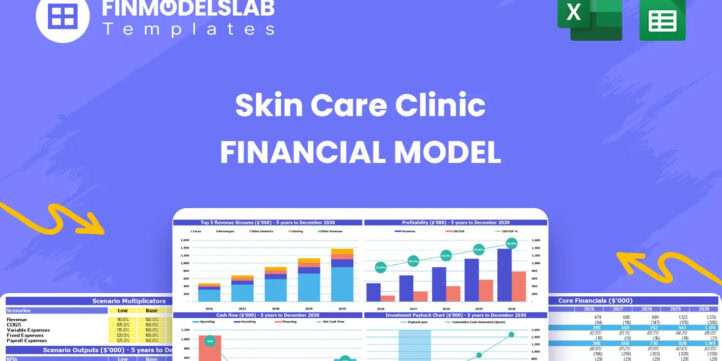


Skin Care Clinic Financial Model Overview
The Skin Care Clinic Financial Model is a ready-to-use financial model template created for planning, launching, funding, and managing a skin care clinic, aesthetic clinic, dermatology practice, or medical spa-style business. It gives entrepreneurs, clinic owners, consultants, analysts, and business plan writers a structured way to forecast revenue, startup investment, operating costs, payroll, cash flow, profitability, and return on investment over a five-year planning period. A skin care clinic often has several moving parts, including practitioner capacity, treatment utilization, service pricing, high-value equipment purchases, retail or treatment-based revenue, staffing, marketing spend, and monthly overhead. This template brings those assumptions together in one connected model so users can understand how changes in the business plan affect financial performance. Instead of building formulas and financial statements from scratch, users can customize the existing framework, enter their own assumptions, review projected outputs, test scenarios, and prepare cleaner reports for lenders, investors, partners, or internal decision-making.
All-in-One Dashboard
The all-in-one dashboard gives users a centralized view of the Skin Care Clinic Financial Model by combining core inputs and core outputs in one practical planning area. This section is useful because clinic owners and advisors need to see the most important assumptions and financial results without searching through multiple tabs or disconnected spreadsheets. Inputs may include service pricing, practitioner headcount, monthly treatment capacity, utilization rates, startup timing, operating expense assumptions, payroll plans, and capital investment requirements. Outputs may include projected revenue, gross profit, EBITDA, net income, cash flow, cash balance, break-even timing, and key investment metrics. For a skin care clinic, the dashboard helps connect operating decisions with financial outcomes, such as how adding an aesthetician, increasing laser treatment utilization, or changing prices affects projected performance. It is especially valuable for quick reviews, planning meetings, and funding discussions because it gives users an immediate snapshot of whether the clinic model is financially viable, adequately funded, and moving toward sustainable profitability.
Low Base High Scenario Analysis
The low, base, and high scenario analysis component helps users compare different versions of the skin care clinic forecast under conservative, expected, and optimistic assumptions. This is important because a clinic’s results can change significantly depending on utilization rates, client demand, practitioner productivity, service pricing, marketing efficiency, and the pace of growth. In a low case, users may assume slower appointment volume, lower practitioner utilization, higher customer acquisition costs, or delayed hiring. In a base case, the model can reflect the most realistic operating plan. In a high case, users can test stronger demand, faster schedule fill rates, higher average transaction values, or quicker expansion. The component then helps show how these assumptions affect revenue, margins, cash flow, profitability, funding needs, and payback timing. For business planning and investor communication, this is useful because it presents a more balanced view of risk and upside. Rather than relying on a single forecast, users can evaluate how resilient the business is if demand is weaker than expected and how attractive the opportunity becomes if the clinic performs above plan.
Professional Charts
The professional charts component turns the financial projections into presentation-ready visuals that are easier for founders, partners, lenders, and investors to understand. A detailed financial model can include many lines of assumptions and calculations, but charts help communicate the story behind the numbers more clearly. This section may visualize revenue growth, operating expenses, EBITDA, net profit, cash balance, cash flow trends, service mix, funding requirements, and profitability progression over time. For a skin care clinic, charts are especially useful because they can show how growth is driven by increased utilization, added practitioners, expansion of high-value services, and improved cost efficiency. They also help users identify patterns, such as periods where cash may tighten due to equipment purchases, marketing investment, or payroll expansion. In a funding presentation or business plan, visual outputs make the model more professional and easier to review. This component supports decision-making by helping users quickly spot trends, compare assumptions, and explain complex financial projections without overwhelming stakeholders with raw spreadsheet data.
ROE Components and DuPont Analysis
The ROE components and DuPont analysis section helps users understand the drivers behind return on equity rather than looking only at a single profitability figure. Return on equity can be influenced by profit margins, asset efficiency, and financial leverage, all of which matter for a skin care clinic with meaningful upfront investment in build-out, devices, technology, furniture, and working capital. This component may break down how net profit margin, asset turnover, and equity structure contribute to the overall ROE result. For investors and owners, this is useful because it shows whether returns are being created through healthy operating profitability, efficient use of clinic assets, or reliance on financing structure. In a skin care clinic model, DuPont analysis can help assess whether expensive equipment is producing enough revenue, whether margins are strong enough after payroll and marketing, and whether the business is using capital effectively. It gives users a deeper view of financial performance and helps support decisions about pricing, service mix, equipment purchases, expansion, and capital structure.
Revenue Inputs
The revenue inputs component is where users define the core revenue assumptions that drive the Skin Care Clinic Financial Model. For this type of business, revenue is usually built around practitioners, treatment capacity, utilization rates, service categories, average pricing, and sometimes retail product sales or consultation fees. Inputs may include the number of aestheticians, laser specialists, dermatologists, body contouring providers, and skin consultants, along with the number of treatments each can perform per month, expected utilization, and price per service. This structure helps users build revenue from operational logic rather than entering a single top-line sales estimate. For example, the model can reflect how two aestheticians at a defined capacity and utilization rate generate monthly service revenue, while higher-priced body contouring sessions or dermatology procedures contribute differently to the overall forecast. This component is critical for business planning because it forces users to validate whether projected sales are realistic based on staffing, capacity, appointment volume, and market pricing. It also makes the model easier to adjust as the clinic grows, adds services, changes prices, or improves utilization.
Bank-Ready Reports
The bank-ready reports component provides lender-friendly financial outputs that can support funding applications, loan discussions, business plans, and stakeholder review. Banks and financing partners typically want to see clear financial statements, realistic assumptions, repayment capacity, projected cash flow, profitability, and evidence that the business can manage its operating obligations. This section helps organize the Skin Care Clinic Financial Model into professional outputs such as projected income statements, cash flow forecasts, balance sheet summaries, capital investment schedules, and key financial metrics. For a clinic that may require significant upfront capital for build-out, laser devices, body contouring equipment, diagnostic technology, deposits, and working capital, clean reporting is essential. The reports help users explain how much funding is needed, how the funds may be used, when the business is expected to generate positive cash flow, and whether the clinic can support debt service or investor expectations. This component saves time when preparing documents for lenders and improves credibility by presenting the forecast in a structured, finance-ready format.
Revenue Breakdown
The revenue breakdown component gives users a detailed view of how each service line contributes to total clinic revenue. A skin care clinic may earn income from aesthetician services such as facials and peels, laser treatments such as hair removal and skin rejuvenation, dermatologist consultations and procedures, body contouring sessions, skin consultant appointments, and potentially retail skin care products. This section helps separate those revenue streams so users can understand which services generate the most income, which are most dependent on practitioner capacity, and which may offer higher average ticket values or stronger margins. Inputs may include pricing, client volume, utilization, treatment frequency, service launch timing, and provider availability. Outputs may show monthly or annual revenue by category, percentage mix, growth trends, and contribution to total sales. For planning and decision-making, this is valuable because not all services behave the same way financially. High-volume treatments may drive appointment flow, while premium procedures may have stronger revenue per session. The revenue breakdown helps users refine the service menu, prioritize marketing, plan staffing, evaluate equipment purchases, and identify the most important drivers of growth.
KPI Dashboard
The KPI dashboard component tracks key performance indicators that help users evaluate the financial and operating health of the clinic over time. While financial statements show the overall result, KPIs help explain what is happening underneath the numbers. For a skin care clinic, relevant metrics may include revenue growth, average revenue per treatment, utilization rate, treatments per practitioner, gross margin, EBITDA margin, net profit margin, marketing as a percentage of revenue, payroll as a percentage of revenue, cash balance, payback period, return on equity, and break-even timing. The dashboard may also support benchmarking against industry expectations, helping users compare their assumptions and results with common clinic performance standards. This section is useful for monthly management, investor updates, internal reviews, and strategic planning because it keeps attention on the drivers that matter most. If utilization is too low, marketing spend is too high, payroll is growing faster than revenue, or cash is declining, the KPI dashboard makes those issues easier to identify. It helps users move beyond static planning and use the model as an ongoing decision-making tool.
Break-Even Analysis
The break-even analysis component helps users estimate when the skin care clinic may begin covering its costs and generating profit. This section is especially important for a clinic business because the launch phase often includes substantial upfront investment, fixed monthly overhead, payroll commitments, marketing costs, and equipment-related expenses. Inputs may include fixed operating costs, variable costs, gross margins, service pricing, practitioner capacity, utilization rates, payroll, rent, utilities, insurance, software, supplies, and marketing spend. The model can then estimate the revenue level, client volume, treatment volume, or month in which the clinic reaches break-even. For a founder or investor, this is one of the most important planning questions because it indicates how long the business may need support before becoming self-sustaining. It also helps users evaluate whether current pricing and cost assumptions are realistic. If break-even requires more appointments than the clinic can physically handle, the business plan may need to be adjusted. If break-even occurs quickly under reasonable assumptions, it can strengthen a funding pitch and support more confident launch decisions.
Startup Cost and Capital Investment Planning
The startup cost and capital investment planning component organizes the initial funding required to prepare the skin care clinic for operations. A clinic may require significant pre-opening spending for leasehold improvements, interior design, treatment rooms, reception areas, laser and RF devices, body contouring systems, diagnostic equipment, furniture, technology, licenses, deposits, initial inventory, marketing, professional fees, training, and working capital. This section helps users separate one-time startup costs from recurring operating expenses so the launch budget is clearer and more realistic. Inputs may include equipment purchase amounts, build-out costs, vendor deposits, pre-opening payroll, software setup, legal and permitting costs, and contingency reserves. Outputs may include total startup capital required, timing of cash outflows, funding gap analysis, and the opening cash position. This is useful for business planning and fundraising because it creates a clear capital target and helps prevent underfunding. For decision-making, it also helps users evaluate whether to buy or lease equipment, delay certain purchases, phase service launches, or raise additional capital before opening. A well-structured startup cost plan gives owners and stakeholders a more reliable view of what it will take to launch the clinic without immediate cash pressure.
File types:
Excel – Single-User: .xlsx
Excel – Multi-User: .xlsx
Similar ProductsOther customers were also interested in...



 HenrySheykin
Spa Financial Model Excel Template
The Spa Financial Model helps entrepreneurs, spa owners, consultants, analysts, and business planner... Read more

Chiropractic Center Financial Model Excel Template
The Chiropractic Clinic Financial Model helps users turn a clinic concept, launch plan, or expansion... Read more

Dermatology Center Financial Model Excel Template
The Dermatology Clinic Financial Model Financial Model Template helps users turn a dermatology pract... Read more

Nursing Home Financial Model Excel Template
The Nursing Home Financial Model helps users turn a senior care facility concept into a structured, ... Read more

 Giorgos
Speech Therapy Center – 5 Year Financial Model
Financial Model providing an advanced 5-year financial plan for a startup or operating Speech Therap... Read more
Physiotherapy Financial Model Excel Template
The Physiotherapy Clinic Financial Model helps founders, clinic owners, consultants, analysts, and b... Read more

Nail Salon Financial Model Excel Template
The Nail Salon Financial Model Financial Model Template helps entrepreneurs, salon owners, consultan... Read more
Outpatient Clinic Financial Model Excel Template
The Outpatient Clinic Financial Model helps users turn a clinic business concept into a structured, ... Read more
Barber Shop Financial Model Excel Template
The Barber Shop Financial Model Financial Model Template helps entrepreneurs, business owners, consu... Read more

Dog Grooming Financial Model Excel Template
The Dog Grooming Financial Model helps entrepreneurs, salon owners, consultants, analysts, and busin... Read more
You must log in to submit a review.