
0 ITEMS

Barber Shop Financial Model Excel Template
The Barber Shop Financial Model Financial Model Template helps entrepreneurs, business owners, consultants, and analysts turn a barber shop concept into a structured five-year financial forecast. Instead of starting with a blank spreadsheet, users can work from a ready-to-use model designed around the operating realities of a barbershop, including service pricing, customer visits, add-on services, retail sales, staffing, startup investment, and ongoing expenses. It gives users a practical way to estimate revenue potential, plan startup costs, forecast operating expenses, review payroll needs, and understand whether the business can become profitable over time. This template is built for financial planning, business plan preparation, funding discussions, lender reviews, and internal decision-making. It helps users connect the main commercial drivers of a barber shop, such as average daily visits, service mix, price levels, operating days, and retail product sales, with the financial outputs that investors and stakeholders typically expect to see. By adjusting editable assumptions, users can test how changes in pricing, customer growth, staffing levels, rent, marketing, supplies, and other costs affect cash flow, profitability, and long-term performance. The model is especially useful for founders opening a new barber shop, existing owners planning expansion, advisors preparing client forecasts, or anyone building funding documents for a salon, grooming studio, or men’s care business. It supports a more disciplined approach to budgeting by organizing startup costs, monthly expenses, payroll planning, revenue assumptions, profit projections, and cash flow forecasting in one connected structure. This makes it easier to identify funding needs, estimate the timing of cash pressure, and prepare a more credible financial story for banks, investors, partners, or internal stakeholders. With built-in forecasting logic, editable inputs, scenario planning, profitability views, break-even analysis, and presentation-ready outputs, the Barber Shop Financial Model Financial Model Template helps users move from assumptions to decisions. It provides a clear framework for evaluating whether the business can support its cost structure, when it may reach sustainable profitability, and what changes may improve performance. The template is compatible with Microsoft Excel and Google Sheets, making it practical for collaboration, updates, and ongoing financial management as the business plan evolves.
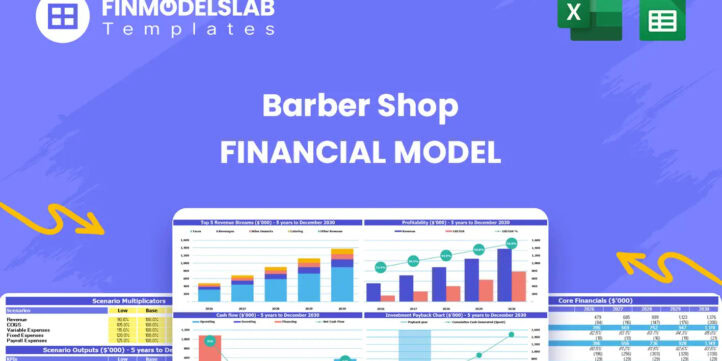


Financial Model Overview
The Barber Shop Financial Model Financial Model Template gives entrepreneurs, business owners, consultants, and analysts a structured way to plan, forecast, and evaluate a barber shop before launch, during funding preparation, or as part of an expansion strategy. A barber shop has several moving parts that must work together financially, including customer traffic, service pricing, chair capacity, barber staffing, retail product sales, rent, supplies, utilities, marketing, startup investment, and ongoing working capital. This template brings those assumptions into one connected financial model so users can estimate revenue, costs, cash flow, profitability, break-even timing, and funding requirements without building a spreadsheet from scratch. It is designed to be editable, investor-ready, and practical for real business planning, allowing users to replace generic assumptions with their own location, pricing strategy, service mix, cost structure, and growth expectations. By using the model, users can create a clearer financial roadmap, support lender or investor conversations, compare different operating strategies, and make better decisions about opening, funding, managing, or scaling a barber shop.
All-in-One Dashboard
The all-in-one dashboard gives users a central view of the most important inputs and outputs in the Barber Shop Financial Model Financial Model Template. It is designed to reduce the need to search through multiple tabs by bringing core assumptions and high-level financial results into one easy-to-review area. Users can typically review major business drivers such as customer visits, service pricing, sales mix, operating days, growth assumptions, margins, staffing costs, and investment requirements alongside key forecast outputs such as revenue, EBITDA, net profit, cash position, payback period, and break-even timing. This component is useful because it connects the barber shop’s operating plan with the financial consequences of that plan. For example, a change in average daily visits, haircut pricing, retail sales share, or payroll structure can flow through to projected revenue, profitability, and cash flow. For founders and business owners, the dashboard supports faster decision-making. For consultants, analysts, and advisors, it provides a clean summary that can be reviewed with clients or stakeholders. For investors and lenders, it helps present a concise financial story that shows whether the barber shop is planned around realistic assumptions and whether the business has a clear path toward sustainable performance.
Low, Base, and High Scenario Analysis
The low, base, and high scenario analysis section helps users test how different business conditions may affect the barber shop’s financial performance. Instead of relying on one fixed forecast, the model allows users to compare a conservative case, an expected case, and an upside case using different assumptions for key drivers such as customer ramp-up, average daily visits, pricing, service mix, add-on sales, retail product performance, wage costs, rent, marketing spend, and operating efficiency. This is particularly important for a barber shop because early customer acquisition can vary significantly depending on location, brand awareness, local competition, barber reputation, walk-in traffic, and marketing execution. A low case may show what happens if customer volume grows more slowly than planned or costs increase faster than expected. A base case can represent the user’s most realistic plan. A high case can show the impact of stronger demand, better chair utilization, premium pricing, or successful retail and add-on strategies. This component is valuable for planning and funding because it helps users understand downside risk, cash needs, and upside potential. It also supports better decision-making by showing which assumptions have the greatest effect on revenue, profitability, and liquidity over the forecast period.
Professional Charts
The professional charts section turns financial model outputs into visual reports that are easier to understand, review, and present. Barber shop financial forecasts can include many monthly and annual figures, but charts help users quickly identify trends in revenue growth, gross profit, EBITDA, net income, cash balance, operating expenses, and other key financial metrics. This component is useful for preparing business plans, pitch materials, lender submissions, internal reviews, and management presentations because it translates detailed spreadsheet calculations into clear visual insights. Users can see whether revenue is increasing steadily, whether costs are growing faster than sales, whether the business is moving toward profitability, and whether cash flow remains stable during the ramp-up period. The charts can also support discussions with partners or investors who may not want to review every line of the model but still need to understand the business trajectory. For a barber shop, visual reporting can be especially helpful when explaining the relationship between customer visits, service volume, pricing changes, startup investment, and the time required to reach a healthier cash position. By presenting financial results in a clean and professional format, this section helps users communicate the business case with greater confidence and clarity.
ROE Components and DuPont Analysis
The ROE components and DuPont analysis section helps users understand what is driving return on equity and whether the barber shop is using capital effectively. Return on equity is an important investor metric because it measures how much profit the business generates relative to the equity invested. The DuPont framework breaks this return into underlying drivers, often including profitability, asset efficiency, and financial leverage, which makes it easier to see whether performance is being driven by strong margins, efficient use of assets, or the structure of financing. In a barber shop context, this analysis can help users evaluate whether build-out costs, equipment investments, leasehold improvements, barber chairs, retail inventory, and working capital are producing an acceptable return over time. Inputs may include net income, revenue, total assets, equity investment, debt assumptions, and projected balance sheet items. Outputs may include return on equity and related component metrics that show how operational and financing decisions affect investor returns. This section is useful for funding discussions because investors often want to know not only whether the business becomes profitable, but whether the return justifies the capital required. It also helps owners compare different strategies, such as investing more in a premium location, expanding chair capacity, adding retail inventory, or keeping the operating model leaner.
Revenue Inputs
The revenue inputs section is where users define the main commercial assumptions behind the barber shop forecast. This component focuses on the drivers that create sales, such as average customer visits per day, operating days per year, service categories, pricing, sales mix, growth rates, premium add-ons, retail product sales, and potential changes in customer demand over time. For a barber shop, revenue is not just a single number. It is usually built from several income streams, including haircuts, hot shaves, beard sculpting, grooming packages, product sales, and possibly memberships or prepaid packages. The model allows users to adjust these assumptions so the forecast reflects their actual concept, target market, service menu, local pricing environment, and expected capacity. Outputs from this section feed directly into revenue projections, gross margin calculations, cash flow, profitability, and break-even analysis. This is useful because small changes in customer visits, price points, or service mix can have a major impact on annual revenue and profit. For example, increasing the share of higher-margin beard services or retail product sales may improve profitability without requiring the same level of additional fixed costs. By organizing the revenue assumptions clearly, this section helps users build a more defensible forecast for business planning, investor communication, and day-to-day decision-making.
Bank-Ready Reports
The bank-ready reports section provides structured financial outputs that can support lender reviews, investor discussions, business plan submissions, and stakeholder presentations. Banks and funding partners typically want to see more than a simple revenue estimate. They often expect to review a complete financial picture, including profit and loss projections, cash flow forecasts, balance sheet outputs, funding needs, repayment capacity, operating assumptions, and profitability milestones. This component helps users present the barber shop’s numbers in a professional and lender-friendly format, with connected statements that reflect how revenue, expenses, startup costs, financing, and working capital interact over time. Inputs may include loan amounts, equity contributions, startup investments, operating expenses, revenue assumptions, payroll costs, taxes, and capital expenditures. Outputs may include annual and monthly financial statements, cash flow summaries, projected profits, and key funding metrics. This section is useful because it helps users move beyond informal planning and prepare materials that can be shared with banks, investors, landlords, partners, or advisors. For a barber shop seeking financing for build-out, chairs, equipment, renovation, deposits, inventory, and initial working capital, clear financial reports can make the plan easier to evaluate and more credible to outside decision-makers.
Revenue Breakdown
The revenue breakdown section gives users a detailed view of how total sales are generated across the barber shop’s different revenue streams. Rather than treating revenue as one broad assumption, this section separates income by service and product category so users can understand the contribution of each part of the business. A barber shop may generate sales from standard haircuts, premium haircuts, hot shaves, beard sculpting, grooming packages, retail hair and beard products, memberships, special treatments, or other add-on services. Inputs may include pricing by service, percentage of customers choosing each service, product conversion rates, average spend per visit, operating days, and growth assumptions. Outputs can show total revenue by stream, the percentage contribution of each category, and how the mix changes over the five-year forecast period. This component is useful for planning because it highlights which services create the most revenue and which areas may deserve more marketing attention, staff training, or pricing optimization. It can also help users identify opportunities to improve profitability by increasing higher-margin services or encouraging add-on purchases. For investors and lenders, a detailed revenue breakdown makes the forecast more transparent and credible because it shows the logic behind sales projections instead of relying on a single unexplained revenue figure.
KPI Dashboard
The KPI dashboard section helps users monitor performance metrics that are especially relevant to a barber shop’s financial health and operating efficiency. Key performance indicators may include revenue growth, average revenue per customer, average visits per day, revenue per chair, gross margin, EBITDA margin, payroll as a percentage of revenue, rent as a percentage of revenue, cash balance, break-even progress, customer volume growth, and return metrics. Inputs are drawn from the model’s revenue, cost, payroll, cash flow, and financial statement sections, while outputs are presented in a format that makes performance easier to evaluate at a glance. This component is useful because the success of a barber shop depends not only on total sales but also on how efficiently the business converts customer traffic into profit and cash. For example, strong customer volume may still produce weak results if payroll scheduling, supply costs, rent, or discounting are not controlled. The KPI dashboard helps users identify whether the business is moving in the right direction, where performance may be falling short, and which assumptions need adjustment. It also supports benchmarking and stakeholder communication by providing a concise view of the financial and operational metrics that matter most for planning, funding, and ongoing management.
Startup Cost Breakdown
The startup cost breakdown section organizes the initial investment required to open or prepare the barber shop for operations. This is one of the most important planning areas because many barber shop owners underestimate how much cash is needed before the first customer is served. Inputs may include lease deposits, shop build-out, renovation, plumbing and electrical work, barber chairs, stations, mirrors, sinks, waiting area furniture, décor, signage, point-of-sale equipment, booking software, licenses, permits, insurance, initial inventory, towels, capes, grooming tools, cleaning supplies, launch marketing, professional fees, and opening working capital. The model helps users separate one-time capital expenditures from recurring operating expenses so the total funding requirement is easier to understand. Outputs may include total startup investment, category-level cost summaries, funding needs, and the timing of cash outflows before and during launch. This component is useful for owners preparing to approach banks, investors, landlords, or partners because it provides a clear explanation of where the money will go. It also helps users avoid undercapitalization by accounting for both visible costs, such as chairs and renovation, and less obvious costs, such as deposits, pre-opening payroll, inventory, and cash reserves. A well-organized startup budget gives the business a stronger foundation and helps reduce the risk of early cash flow pressure.
Break-Even Analysis
The break-even analysis section helps users identify when the barber shop is expected to generate enough revenue to cover its fixed and variable costs. This component is critical because opening a barber shop often involves a ramp-up period where customer traffic is still building while rent, payroll, utilities, insurance, marketing, and other expenses must be paid consistently. Inputs may include service pricing, sales mix, average daily visits, operating days, variable supply costs, retail product costs, payroll, rent, marketing, utilities, insurance, software, and other overhead expenses. Outputs may include the break-even month, break-even revenue, required customer volume, margin of safety, and the relationship between sales growth and profitability.
File types:
Excel – Single-User: .xlsx
Excel – Multi-User: .xlsx
Similar ProductsOther customers were also interested in...



 HenrySheykin
Hair Salon Financial Model Excel Template
The Hair Salon Financial Model helps salon owners, founders, consultants, and business planners turn... Read more
Nail Salon Financial Model Excel Template
The Nail Salon Financial Model Financial Model Template helps entrepreneurs, salon owners, consultan... Read more
Spa Financial Model Excel Template
The Spa Financial Model helps entrepreneurs, spa owners, consultants, analysts, and business planner... Read more

Hair Salon Chain Financial Model Excel Template
The Hair Salon Chain Financial Model helps entrepreneurs, salon owners, consultants, analysts, and b... Read more

Beauty Salon Financial Model Excel Template
The Beauty Salon Financial Model helps entrepreneurs, salon owners, consultants, analysts, and found... Read more

 Giorgos
Hair and Beauty Salon – 5 Year Financial Mod...
5-year financial model for a hair and beauty salon providing revenue forecasts, cost analysis, and i... Read more

 Andreas
Dog Grooming Services Financial Model (10+ Yrs DCF...
The Dog Grooming Services financial model is a comprehensive tool designed to analyze the financial ... Read more

Barber Shop – 5 Year Financial Model
5-year financial model for a barber shop providing revenue forecasts, cost analysis, and profitabili... Read more

Hair Salon Financial Model
Hair Salon Financial Model presents the business case of a brand-new start up Hair Salon with an upf... Read more

 David
David
Hair & Beauty Salon 5-Year 3 Statement Financi...
3 statement 5 year rolling financial projection Excel model for a Hair & Beauty salon business o... Read more
You must log in to submit a review.