
0 ITEMS

Hair Salon Financial Model Excel Template
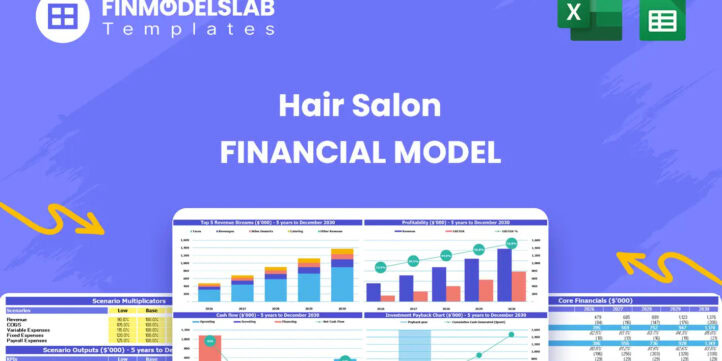
The Hair Salon Financial Model helps salon owners, founders, consultants, and business planners turn a salon concept into a structured financial forecast. Instead of starting with a blank spreadsheet, users can work from a ready-to-use financial model template designed around the realities of a hair salon business, including client visits, service pricing, retail product sales, staffing, product costs, rent, launch investment, and monthly cash flow. It gives users a practical way to estimate startup costs, forecast revenue assumptions, plan operating expenses, and understand how the salon may perform over time. Built for business planning, funding preparation, internal budgeting, and investor or lender discussions, the model helps users see the financial impact of key decisions before committing capital. A salon owner can adjust assumptions for haircut services, color services, treatment services, retail sales, average daily visits, operating days, pricing, payroll, professional products, marketing, and other cost drivers. The template then connects those assumptions to projected revenue, profitability, cash flow, and break-even analysis, helping users evaluate whether the business can become financially sustainable. This Hair Salon Financial Model is useful for entrepreneurs preparing to open a new salon, existing business owners considering expansion, consultants building client forecasts, and analysts reviewing the financial feasibility of a beauty or hair care concept. It supports decision-making by showing how changes in pricing, utilization, service mix, hiring, or spending can affect profit margins and cash requirements. Users can also compare low, base, and high scenarios to understand risk, upside potential, and funding needs under different business conditions. The template is fully editable and compatible with Microsoft Excel and Google Sheets, making it easy to customize for a local market, specific salon size, or unique operating strategy. With professional formatting, financial projections, cash flow forecasting, profitability analysis, KPI tracking, and presentation-ready outputs, it helps users organize the numbers behind a salon business plan and communicate them clearly to partners, banks, investors, or internal stakeholders.


Financial Model Overview
The Hair Salon Financial Model is a ready-to-use financial model template designed to help salon owners, founders, consultants, analysts, and business planners forecast the financial performance of a hair salon with clarity and structure. It brings together the key assumptions that drive a salon business, including client visits, service prices, operating days, service mix, retail product sales, staffing, professional product costs, rent, startup investment, and ongoing expenses. Instead of building formulas from scratch, users can begin with a professional model that is already organized for revenue planning, profitability analysis, cash flow forecasting, investor review, and lender discussions. The template is especially useful for new salon launches, expansion planning, funding applications, business plan preparation, and internal decision-making because it connects operating assumptions to financial outputs over a multi-year forecast period. Users can edit the inputs to reflect their own market, pricing strategy, team structure, cost base, and growth expectations, then review how those assumptions affect monthly performance, annual results, funding needs, and long-term sustainability.
All-in-One Dashboard
The all-in-one dashboard gives users a centralized view of the most important inputs and outputs in the Hair Salon Financial Model. It is designed to make the model easier to manage by bringing core assumptions and financial results into one accessible area, so users do not need to search through multiple tabs to understand the business outlook. Inputs may include service pricing, average daily client visits, annual operating days, revenue stream assumptions, cost levels, staffing assumptions, startup investment, and scenario selections. Outputs may include total revenue, gross profit, EBITDA, net profit, cash balance, return metrics, break-even timing, and other summary indicators that show whether the salon is financially viable. For a salon owner preparing a business plan or funding presentation, this component is useful because it creates a quick summary of the financial story behind the business. It helps users identify whether the salon has enough revenue potential to support rent, payroll, product costs, marketing, and overhead, while also showing how the forecast changes when key assumptions are updated. The dashboard supports better decision-making by turning complex spreadsheet calculations into an easier planning experience that can be reviewed with partners, accountants, lenders, or investors.
Low, Base, and High Scenario Analysis
The low, base, and high scenario analysis component helps users test how the salon forecast changes under different business conditions. A hair salon rarely performs exactly as planned, especially during the launch phase, so this section allows users to compare conservative, expected, and optimistic outcomes without rebuilding the model each time. Inputs may include average daily visits, service prices, customer growth rates, retail product sales, stylist utilization, cost inflation, payroll assumptions, and marketing effectiveness. The low scenario can be used to model a slower ramp-up, weaker customer acquisition, or lower average ticket value, while the base scenario can reflect the most realistic operating plan. The high scenario can show the upside case if the salon attracts clients faster, sells more premium services, or increases retail product attachment rates. This component generates comparative outputs such as revenue, profit, cash flow, EBITDA, cash balance, and funding requirements across each scenario. It is valuable for planning and investor communication because it shows that the business has been evaluated beyond a single best-case forecast. Users can see where the salon is most sensitive to changes, prepare for downside risk, and set practical milestones for marketing, staffing, pricing, and cost control.
Professional Charts
The professional charts component converts the financial projections into clear visual reports that are suitable for presentations, stakeholder updates, and business plan documents. Hair salon financial planning involves many moving parts, including revenue streams, cost categories, monthly cash movements, profitability changes, and growth trends. Charts make these relationships easier to understand by visually presenting key outputs such as revenue growth, expense trends, cash flow, EBITDA development, profit margins, break-even progress, and forecast comparisons. Inputs are drawn from the underlying model assumptions and automatically reflected in the charts when the user updates pricing, client visits, payroll, startup costs, expenses, or scenario choices. This saves time because users do not need to build separate presentation graphics manually. For a salon founder meeting with a bank, investor, landlord, partner, or internal team, professional charts help communicate the business case quickly and clearly. They can also highlight potential concerns, such as high fixed costs, delayed profitability, or cash pressure during the early months. By turning financial data into presentation-ready visuals, this component improves the credibility of the forecast and helps decision-makers focus on the trends that matter most.
ROE Components and DuPont Analysis
The ROE components and DuPont analysis section helps users understand the drivers behind return on equity and overall investment performance. In a hair salon business, return is influenced by more than revenue growth alone. Profit margins, asset efficiency, financing structure, startup capital, cash flow timing, and retained earnings can all affect the return generated for owners or investors. This component breaks return on equity into more specific elements so users can see whether performance is being driven by operating profitability, efficient use of assets, or leverage. Inputs may include net income, equity investment, asset levels, debt assumptions, revenue, expenses, and balance sheet outputs. The model can then generate return measures such as ROE, payback timing, and related profitability indicators that help users judge whether the salon produces an attractive return compared with the capital required. For a founder or investor, this section is useful because it goes beyond basic profit and loss analysis and shows how effectively the business converts invested capital into financial returns. It can support funding discussions, ownership planning, expansion decisions, and performance reviews by giving users a more complete view of investment quality.
Revenue Inputs
The revenue inputs component allows users to build the salon forecast from the operational drivers that matter most. A hair salon’s revenue is typically driven by the number of clients served, the average price per service, the mix of services provided, retail product sales, and the number of days the salon operates. This section may include assumptions for haircut services, color services, treatment services, styling services, add-on services, and product sales, with editable fields for pricing, volume, growth, and mix. For example, users can adjust daily visits, change the share of clients purchasing color services, update average transaction values, or increase retail sales per customer to reflect their specific business plan. These inputs then flow into the revenue forecast and influence profitability, staffing needs, product costs, cash flow, and break-even timing. This component is especially important because small changes in client volume or average service price can have a major impact on the salon’s financial outlook. By structuring revenue around realistic service assumptions, the Hair Salon Financial Model helps users avoid vague sales estimates and create a more defensible forecast that can be explained to banks, investors, partners, or internal decision-makers.
Bank-Ready Reports
The bank-ready reports component provides structured financial outputs that are useful for loan applications, funding discussions, investor review, and formal business planning. Lenders and financial stakeholders typically want to see clear projections for revenue, expenses, profitability, cash flow, startup funding needs, and repayment capacity. This section helps organize those outputs into a format that is easier to review and explain. It may include projected profit and loss statements, cash flow forecasts, balance sheet summaries, funding assumptions, debt schedules, and annual financial summaries. Inputs from the model, including revenue assumptions, startup costs, operating expenses, payroll, product costs, taxes, and financing terms, feed into these reports automatically. For a salon owner seeking a bank loan, lease approval, or investor contribution, this component helps show how the business expects to generate enough cash to cover costs, sustain operations, and meet financial obligations. It also supports professional communication because the reports are presented in a clean and consistent structure. Users can customize the assumptions, review the outputs, and share the resulting financial projections as part of a salon business plan or funding package.
Revenue Breakdown
The revenue breakdown component gives users a detailed view of how total salon revenue is generated across different income streams. Rather than showing only one total sales number, this section separates revenue by service category and product sales so users can understand which parts of the business contribute most to growth and profitability. Inputs may include price per haircut, price per color service, treatment pricing, retail product average selling price, number of client visits, service mix percentages, product purchase rates, and annual growth assumptions. Outputs may show revenue by category, percentage contribution by stream, changes over time, and the impact of shifting demand toward higher-value services. This is particularly useful for hair salons because a higher mix of color services or treatments may produce a different margin profile than basic haircuts, while retail product sales can add incremental revenue without requiring the same chair time as services. By reviewing the revenue breakdown, users can make more informed decisions about pricing, promotions, stylist training, service bundling, inventory planning, and marketing focus. It also helps stakeholders understand the commercial logic behind the forecast and see whether growth is coming from realistic and controllable business drivers.
KPI Dashboard
The KPI dashboard tracks key performance indicators that help users evaluate the health and progress of the salon over time. Financial statements show overall results, but KPIs make it easier to understand the operational metrics behind those results. This component may monitor indicators such as daily client visits, average ticket value, revenue per operating day, revenue per stylist, gross margin, payroll as a percentage of revenue, product cost percentage, marketing efficiency, EBITDA margin, cash balance, and return metrics. Inputs come from the model’s revenue, expense, payroll, and cash flow assumptions, while the outputs provide a benchmark-style view of performance. For salon owners and managers, the KPI dashboard is useful because it connects day-to-day operating decisions with financial outcomes. If payroll is rising faster than revenue, service utilization is low, or cash flow is tightening, the KPI dashboard can help highlight the issue early. It also supports monthly reviews, investor updates, and team planning by giving users a concise set of metrics to track against targets. With editable assumptions and visual summaries, this component helps users move from static forecasting to active financial management.
Startup Costs and Operating Expense Planning
The startup costs and operating expense planning component helps users estimate both the one-time investment required to launch the salon and the recurring costs needed to keep it running. Startup costs may include salon build-out, renovation, styling stations, chairs, washing stations, plumbing, mirrors, reception furniture, point-of-sale systems, licenses, deposits, initial product inventory, opening marketing, and working capital reserves. Operating expenses may include rent, utilities, payroll, professional products, insurance, marketing, software subscriptions, cleaning, maintenance, payment processing, and general administration. Users can edit these assumptions to reflect the size, location, positioning, and launch strategy of their specific salon. Outputs may include total startup funding required, monthly expense forecasts, fixed versus variable cost analysis, and cash flow impact. This section is important because many salons face cash pressure when upfront investment is underestimated or monthly overhead is not matched to realistic customer volume. By organizing startup and operating costs in one structured model, users can plan how much capital they need before opening, understand how long the business may take to stabilize, and avoid relying on incomplete cost estimates when speaking with lenders, investors, landlords, or partners.
Break-Even Analysis
The break-even analysis component helps users identify when the hair salon is expected to cover its fixed and variable costs and begin operating sustainably. A salon has meaningful fixed expenses such as rent, payroll, utilities, software, insurance, and marketing, as well as variable costs such as professional products, retail inventory, commissions, and payment processing. This section uses revenue assumptions, gross margin, operating expenses, startup cost structure, and cash flow timing to estimate the point at which revenue is sufficient to cover ongoing costs. Outputs may include break-even month, required revenue level, required client volume, contribution margin, and the effect of pricing or cost changes on profitability timing. For a new salon, this is one of the most important planning tools because it turns a broad profit goal into a measurable operating target. Users can test whether they need more daily visits, higher average ticket values, stronger retail sales, leaner staffing, or lower overhead to reach break-even faster. The break-even analysis supports funding preparation, management planning, and decision-making by showing how long the business may need financial support before it becomes self-sustaining.
File types:
Excel – Single-User: .xlsx
Excel – Multi-User: .xlsx
Similar ProductsOther customers were also interested in...


 HenrySheykin
Nail Salon Financial Model Excel Template
The Nail Salon Financial Model Financial Model Template helps entrepreneurs, salon owners, consultan... Read more
Barber Shop Financial Model Excel Template
The Barber Shop Financial Model Financial Model Template helps entrepreneurs, business owners, consu... Read more

Spa Financial Model Excel Template
The Spa Financial Model helps entrepreneurs, spa owners, consultants, analysts, and business planner... Read more

Beauty Salon Financial Model Excel Template
The Beauty Salon Financial Model helps entrepreneurs, salon owners, consultants, analysts, and found... Read more

Hair Salon Chain Financial Model Excel Template
The Hair Salon Chain Financial Model helps entrepreneurs, salon owners, consultants, analysts, and b... Read more

 Andreas
Dog Grooming Services Financial Model (10+ Yrs DCF...
The Dog Grooming Services financial model is a comprehensive tool designed to analyze the financial ... Read more

 Giorgos
Hair and Beauty Salon – 5 Year Financial Mod...
5-year financial model for a hair and beauty salon providing revenue forecasts, cost analysis, and i... Read more

Hair Salon Financial Model
Hair Salon Financial Model presents the business case of a brand-new start up Hair Salon with an upf... Read more

Barber Shop – 5 Year Financial Model
5-year financial model for a barber shop providing revenue forecasts, cost analysis, and profitabili... Read more

 David
David
Hair & Beauty Salon 5-Year 3 Statement Financi...
3 statement 5 year rolling financial projection Excel model for a Hair & Beauty salon business o... Read more
You must log in to submit a review.