
0 ITEMS

How to Create Financial Projections for Startups

Financial projections are essential for startups to plan growth and attract investment.
- They include revenue forecasts, expense budgets, and cash flow analysis based on realistic assumptions.
- Different time frames, such as monthly, quarterly, or yearly, suit various planning needs and business stages.
- Long-term projections over 5 or 10 years help investors understand future potential and market expansion.
- Accurate financial statements and metrics enable founders to monitor performance and adjust strategies.
- Regular review and updates of these forecasts ensure the business stays on track amid market changes.
Continuing, understanding how to build and interpret these projections boosts a startup’s ability to grow sustainably.
What Are Financial Projections for a Startup?
Financial projections for a startup are a pro forma statement. They show expected income, expenses, and cash flow over time. They outline possible outcomes based on hypothetical scenarios using current facts and data. These projections typically include revenue forecasts, operating costs, and break-even analysis. These numbers act as a roadmap for startups, guiding decisions and building confidence in the business plan. Founders use financial projections for a startup to plan growth, manage spending, and attract investors. Clear financial projections make it easier for them to adjust strategies and set realistic goals. Finance professionals prepare financial projections for a startup to estimate its future income and expenses. Startups rely on these projections to attract investors, plan growth, and navigate financial challenges.
A startup’s financial projections can be made monthly, quarterly, or annually. The frequency depends on the stage of the startup, the purpose of the projections, and the level of detail required by stakeholders. Each approach serves a specific purpose.
- Monthly projections are ideal when cash flow is tight, and detailed tracking of expenses and revenue is crucial. They allow startups to monitor short-term performance, identify trends, and respond quickly to changes.
- Quarterly projections are useful for startups that have stabilized operations and need less granular but still frequent updates. They balance detail and manageability well, showing performance trends across seasons or market cycles.
- Annual projections are best for understanding the bigger picture, such as growth milestones, profitability, and major strategic initiatives. They help plan budgets, forecast major investments, and evaluate year-over-year growth.
In reality, financial projections for a startup over 5-year and 10-year horizons provide several strategic and operational advantages that shorter-term projections might not capture. Investors and stakeholders are often interested in the long-term potential of a startup. A multi-year financial projection shows your vision for growth and how you plan to achieve it over time. The longer horizon allows for incorporating market expansion, competitive positioning, and changes in customer behavior that impact the startup’s trajectory. It provides insights into when the business might reach break-even or generate significant free cash flow, which is essential for assessing sustainability.

Financial Forecast vs. Projection
While some sources attempt to draw distinctions between financial forecasts and projections, professionals like us treat them as synonymous in most cases. Both terms estimate future financial outcomes based on available data and assumptions. Whether you call it a forecast or a projection, the goal remains to provide a clear, informed view of potential financial performance to guide decision-making effectively.
Both financial forecasts and projections rely on assumptions to predict future financial outcomes. These assumptions may stem from historical trends, expert insights, management estimates, or industry benchmarks. By using these inputs, both methods aim to create a realistic picture of what the financial future might look like. While the terms are often interchangeable, they aim to support informed decision-making with data-driven predictions.
Their projected horizon can cover any time frame, depending on your needs. The horizon might range from a few hours to days, weeks, months, or even several years. In some cases, projections may extend up to 100 years or more. The timeframe you choose depends on the purpose and context of the analysis, ensuring the predictions align with your goals.
Furthermore, financial forecasts and projections simulate expected future financial outcomes. They provide a numerical view of what a business or project plan might achieve. These tools help predict performance and guide decision-making by translating assumptions into quantifiable results. Whether forecasting or projecting, the focus is on creating a clear picture of potential financial realities.










































Why Do Startups Need Financial Projections?
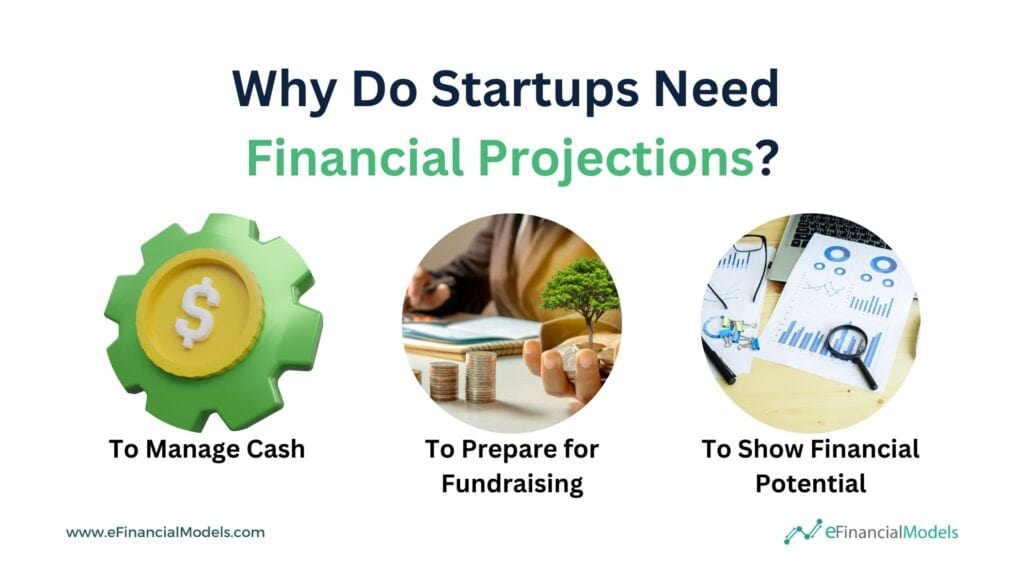
Startup financial projections are essential because they serve as a roadmap for the company’s growth. They provide a clear picture of the business’s direction and help founders make informed decisions. Projections are not just numbers; they show how the startup plans to achieve profitability and sustainability while managing risks. These forecasts instill confidence in investors, partners, and team members by demonstrating that the business has a solid financial plan.
- To Manage Cash: Financial projections help startups avoid running out of money by showing how much cash is needed and when. They outline the timing of expenses and income, helping founders spot potential shortfalls early. By forecasting cash flow, startups can plan for slow periods and ensure they have enough funds to keep the business running. This proactive approach minimizes surprises and allows startups to stay in control of their finances.
- To Prepare for Fundraising: Startup financial projections are crucial because they show investors how the startup will use its money to grow. A well-prepared financial projection demonstrates the business’s potential and builds trust with investors. It highlights key milestones, such as when the company expects to break even or reach profitability. These projections also help founders confidently answer tough questions, proving they’ve thought through every business detail.
- To Show Financial Potential: Investors and stakeholders want to see how a startup can scale. Financial projections provide that vision by highlighting revenue potential, profitability, and growth opportunities. They showcase how the business can succeed under different scenarios, offering a clear view of its upside. These forecasts help communicate the startup’s ambitions and make gaining support from those who believe in its vision easier.
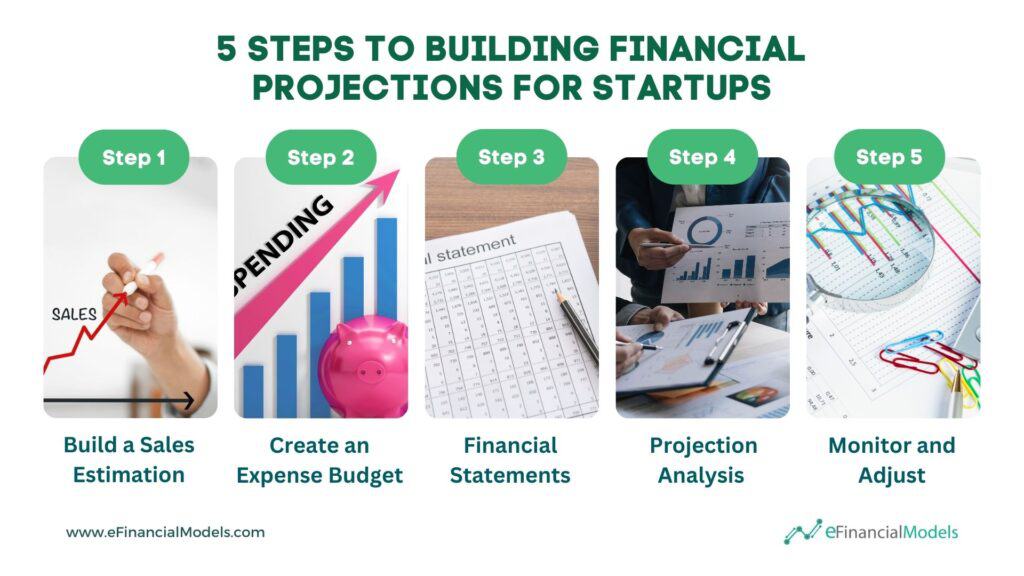
5 Steps to Building Financial Projections for Startups
Building financial projections for startups is critical to map out a clear path to success. A solid financial projection isn’t just numbers on a spreadsheet—it’s a powerful tool to show your startup’s potential and ensure you’re prepared for the challenges ahead. To create financial projections that are both detailed and practical, consider incorporating the following elements:
Step 1 – Build a Sales Estimation
Building a sales estimation is the foundation of building accurate financial projections for your startup. This step lets you predict how much revenue your business will generate, helping you make informed decisions about budgets, investments, and growth strategies. Without a clear sales estimate, it’s nearly impossible to gauge profitability or assess your startup’s potential. By understanding customer demand and market trends, you can set realistic revenue goals that align with your business objectives.
To perform a sales estimation, start by analyzing your target market. Identify your potential customers, their buying habits, and the pricing of your product or service. Research competitors and use historical data, if available, to benchmark your projections. For detailed insights, break down the numbers by product lines, customer segments, or sales channels. Finally, this data can be used to estimate monthly or yearly revenue. A solid sales estimation gives you a clear roadmap to navigate your startup’s financial future.
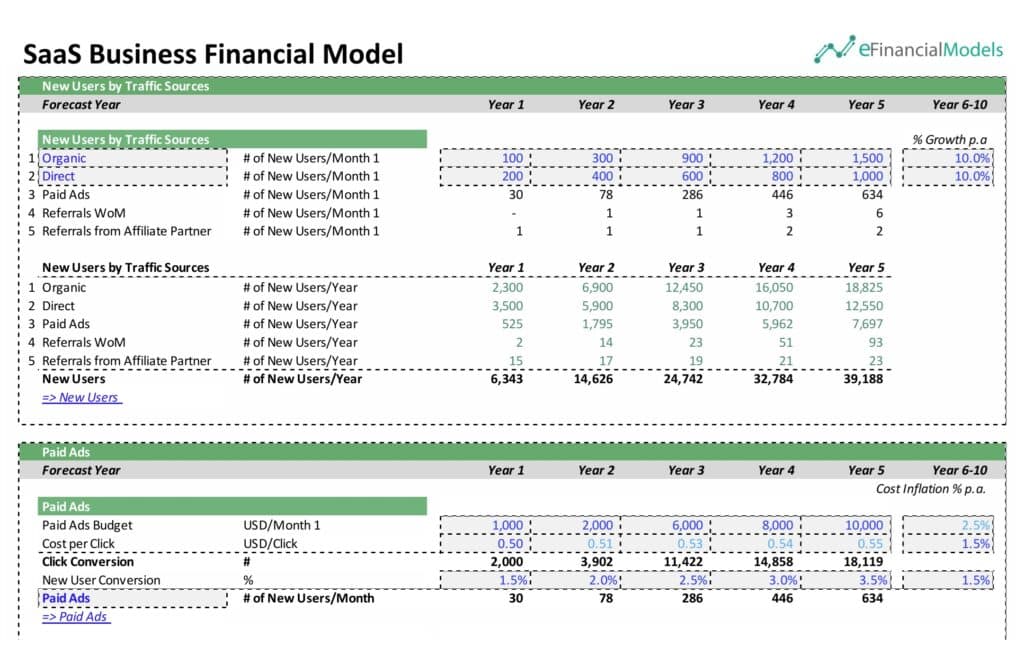
The chart above shows sales projections for a SaaS Business Financial Model. It outlines an approach to estimating sales by breaking down new user acquisition by traffic sources. Each source (organic, direct, paid ads, referrals, and affiliate partners) tracks new users monthly and yearly, showing growth trends and percentage increases. Paid ads are detailed further, calculating new users based on budget, cost per click, and conversion rates. This structured approach enables startups to predict revenue by analyzing specific acquisition channels, projecting user growth, and adjusting for factors like budget changes or conversion improvements over time.
Step 2 – Create an Expense Budget
After estimating sales, the next step in building startup financial projections is creating a detailed expense budget. This budget outlines your startup’s capital expenditures (CapEx), cost of goods sold (COGs), and operating costs. These categories capture the money required to build, sell, and maintain your business operations. Accurately estimating expenses ensures a clear view of your cash flow needs and helps avoid financial surprises.
- To estimate the capital expenditures (CapEx), list all major purchases needed to start or grow your business. These may include equipment, technology, infrastructure, or property. Research the market prices for these items and account for installation or setup costs. Factor in financing terms, like loans or leases, to calculate upfront payments and future obligations. Prioritize only essential investments to maintain a lean budget.
- Estimate the cost of goods sold (COGs) by breaking down the direct costs of producing your product or delivering your service. For physical goods, this includes raw materials, manufacturing, and packaging. For services, it may involve software, subscriptions, or labor. Use supplier quotes and industry benchmarks to refine your estimates. Adjust COGs based on sales volume; these costs typically scale with demand.
- Operating costs include salaries, rent, utilities, marketing, and software subscriptions—separate fixed costs, which stay consistent, from variable costs, which change with business activity. Identify all recurring expenses required to run your business. Use past expenses, market research, or industry data to create realistic estimates. Regularly review and adjust these numbers as your startup evolves.
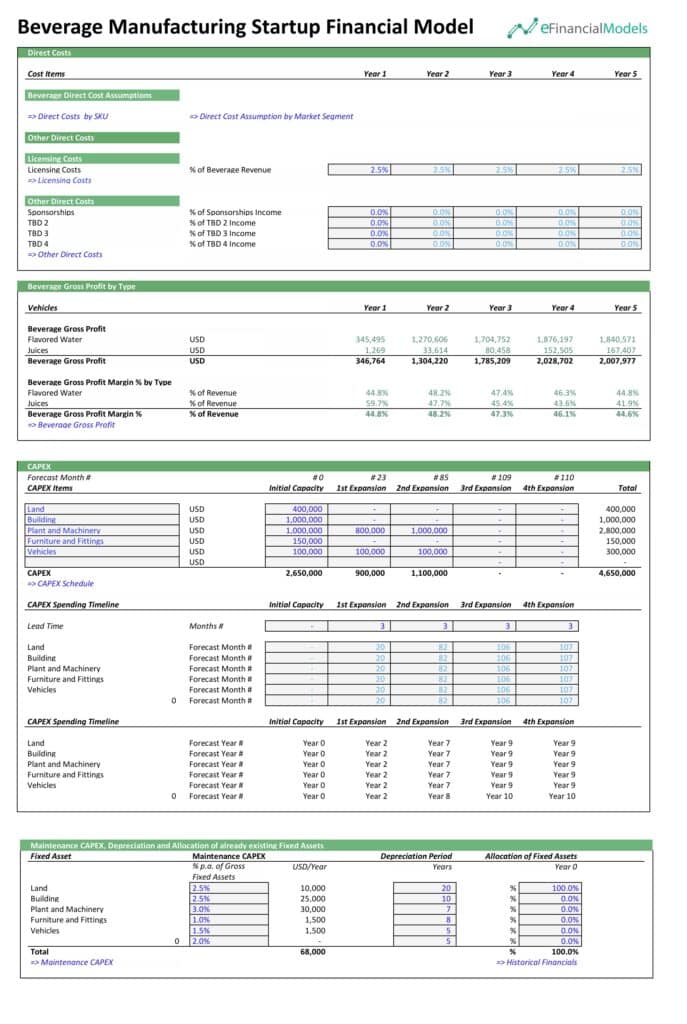
The chart above illustrates key expenses in a Beverage Manufacturing Startup, breaking them into CapEx, COGS, and operating costs. CapEx focuses on significant investments like land, machinery, and vehicles, which are planned over multiple phases to align with growth. COGS captures direct costs tied to production, such as materials and licensing fees, directly impacting profitability. Operating costs include ongoing maintenance and depreciation of assets, ensuring smooth operations. Estimating these expenses involves analyzing industry benchmarks, planning phased expansions, and evaluating fixed and variable costs to create accurate and actionable financial projections.















Step 3 – Generate Financial Statements
The next step in building startup financial projections is generating projected financial statements. These statements, including income statements, balance sheets, and cash flow statements, provide a complete picture of your startup’s financial health. They combine all your sales estimates, expense budgets, and other key financial assumptions into a structured format. This step ensures you can track profitability, manage resources, and demonstrate your startup’s potential to investors or stakeholders.
When generating projected financial statements, it’s essential to include specific financial metrics. Break down the gross margin by product line to assess profitability. Track sales increases by product line to measure growth and adjust forecasts. Account for interest rates on debts to reflect financing costs accurately. Finally, the applicable income tax rate is applied to project realistic net profits. These metrics create a comprehensive view of your startup’s financial performance.
Projected financial statements must also include detailed working capital and asset management plans. Create an accounts receivable collection plan to estimate cash inflows. Develop an accounts payable schedule to track outgoing payments. Include inventory turnover ratios to manage stock efficiently. Add depreciation schedules to account for the declining value of assets over time. These details ensure your financial projections are accurate and actionable.
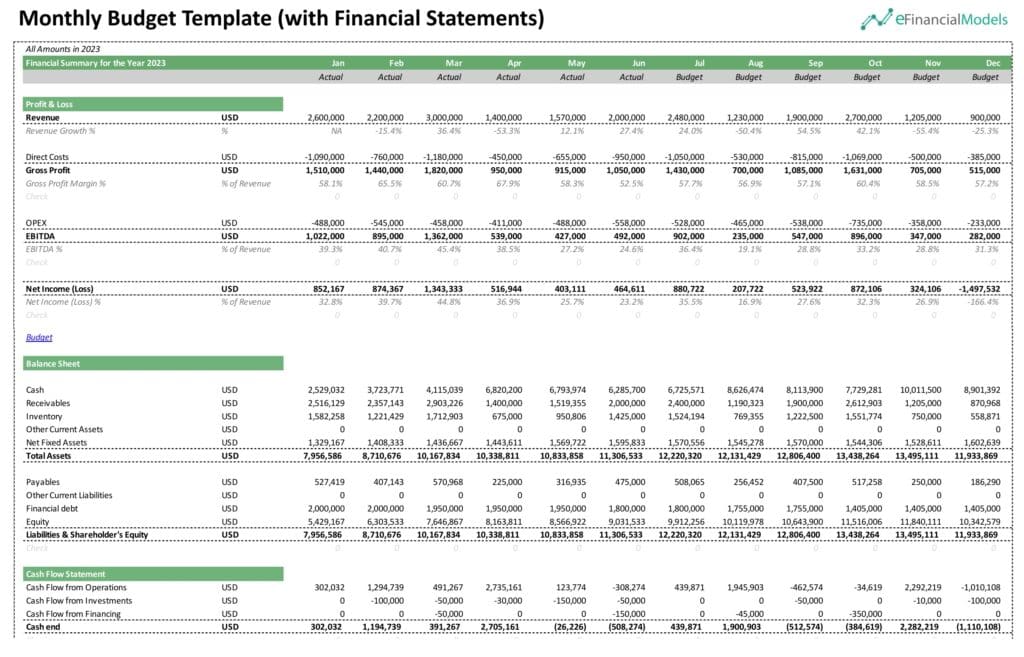
The above Monthly Budget Template provides a comprehensive overview of financial statements. It includes a profit and loss statement, balance sheet, and cash flow statement, offering monthly insights into revenue, direct costs, OPEX, and net income. The balance sheet tracks key assets, liabilities, and equity, while the cash flow statement highlights operating, investing, and financing activities. These detailed projections enable startups to monitor financial performance, assess liquidity, and plan for growth, ensuring informed decision-making and investor confidence.
Step 4 – Projection Analysis
Once you’ve created financial projections, use them as a foundation for strategic financial planning. These projections provide a clear roadmap for allocating resources, managing cash flow, and setting measurable goals. By analyzing projected revenues, expenses, and cash reserves, you can prioritize investments, prepare for potential shortfalls, and ensure your startup stays on track. Financial projections also help you identify risks and opportunities, allowing you to adjust your strategies in real-time as your business evolves.
Leverage these insights to make smarter hiring, scaling, and operational efficiency decisions. Use your projections to secure funding by demonstrating profitability and growth potential to investors or lenders. Regularly revisit and update your financial projections to reflect market changes, business growth, or unexpected challenges. This continuous planning ensures your startup remains financially stable and adaptable in a competitive environment.
Step 5 – Monitor and Adjust
Building financial projections for startups is not a one-time task; it requires continuous monitoring. Regularly reviewing your projections helps you track your startup’s financial performance and spot variances between your estimates and actual results. You can quickly identify trends, risks, and opportunities by monitoring key metrics like revenue, expenses, and cash flow. This proactive approach allows you to address challenges before they escalate and ensures your projections remain relevant as your business evolves.
Adjust your startup financial projections as new information becomes available. Update them to reflect market conditions, operational shifts, or unexpected events. Use the revised projections to fine-tune budgets, realign goals, or explore new strategies. Regular adjustments help maintain accuracy and clearly depict your startup’s financial health. Continuous monitoring and adaptation ensure your startup stays resilient and well-prepared for growth or challenges.
Simplify Startup Financial Projections Effortlessly
Creating startup financial projections is essential to convert an entrepreneurial vision into a practical roadmap for growth and success. These projections, encompassing sales estimates, expense budgets, and financial statements, provide a clear view of the startup’s financial health and potential. By including critical components like revenue forecasts, cost structures, and operational plans, founders can make informed decisions, secure investor confidence, and prepare for future challenges. Regular monitoring and updates ensure these projections remain relevant and actionable, enabling startups to adapt to market changes, manage resources effectively, and drive sustainable growth.
Simplify startup financial projections effortlessly by using financial projections templates. These templates provide a structured and user-friendly way to forecast revenue, expenses, and cash flow, saving time and reducing complexity. With ready-made formats and pre-built formulas, you can focus on refining assumptions and planning for growth. They help you create accurate, investor-ready projections while ensuring no critical detail is overlooked. Using financial projections templates is the easiest way to build confidence in your financial planning and set your startup on the path to success. Start Simplifying Your Projections Today!




























You might also like:
- 10 Main Elements of a Business Plan
- 10 Tips to Develop a First Class Business Valuation Report
- 5 Practical Tips to Help Raise Funds For Startups
- Financial Projections Templates – The Easy Way
- How to Make a Startup Financial Plan for Fundraising?
- Developing a 5 Year Financial Projection Template
- Startup Financial Models
- Understanding the Debt Service Coverage Ratio: An Essential Metric for Financial Analysis
- Business Valuation Service
- Finding a Valuation Model for Your Business
- How to Create Financial Projections for Startups
- Financial Modeling for Startups and Small Businesses
- How to Calculate Annual Recurring (ARR) Revenue for Sustainable Growth
- Why Financial Forecasting Models Are Vital for Your Business
- 10 Funding Sources for Businesses and Startups
- How to Secure Seed Financing?
- Financial Model for Simple Retail Chain Rollout
- Understanding What is Yield to Maturity and Why It Matters
- Understanding Debt Sizing & Project Finance Ratios
- The Purpose of a Financial Model
Tags: financial planning