
0 ITEMS

What is Negative Gearing in Real Estate?

Negative gearing is a common property investment strategy where expenses like mortgage interest and maintenance exceed rental income, creating a short-term loss.
- High-tax bracket income earners can offset these losses against their taxable income, reducing overall tax liability.
- Investors often rely on property value appreciation over time to turn negative cash flow into long-term gains.
- Financial modeling helps assess risks, optimize tax deductions, and evaluate property potential through tools like NPV and IRR.
- Regular property valuation and cash flow analysis ensure strategic decisions align with investment goals.
- Proper risk management, including scenario analysis, can balance potential rewards with financial safety.
This article covers how negative gearing works, its benefits for investors, and how to use financial models to maximize gains while managing risks.
How does Negative Gearing Work?
Negative gearing is a common property investment strategy. It involves borrowing money to buy an income-producing asset, such as real estate, where the cost of owning and managing the property, including loan interest and maintenance expenses, exceeds the income generated from the property. This results in a rental property negative cash flow for the investor.
For high-tax bracket income earners, negative gearing is a form of financial leverage where short-term losses can be beneficial to the owner’s tax bill in certain instances. In many countries, these losses can be used to offset other income, reducing the overall tax liability of the investor. It makes the practice attractive, especially for those seeking to minimize their taxable income. Countries that permit this tax deduction, albeit with certain restrictions, include:
- Australia
- Canada
- France
- Germany
- Japan
- New Zealand
- Sweden
- United States
It is essential to note that negative gearing only becomes profitable when the property is eventually sold through property value appreciation. Generally, investors aim to transition from negative to positive gearing within a timeframe that aligns with their overall investment strategy and financial goals. This period often spans 5-10 years but can vary significantly. The idea is that the property’s value will increase over time, and when it is sold, the capital gain will more than compensate for the accumulated losses. This long-term capital growth is essential for making negative gearing a worthwhile strategy, offering the potential for significant financial gains in the future.

How Negative Gearing Works as a Property Investment Strategy
Negative gearing is a powerful property investment strategy that can help you boost wealth by leveraging tax benefits and potential property value appreciation. Understanding how negative gearing works allows you to turn short-term financial losses into long-term gains, making it a popular choice among savvy investors.
Step 1: Borrowing Money to Purchase an Asset
Negative gearing starts with borrowing money to purchase an investment asset, such as a rental property. When you take out a loan to buy the property, you enter into a financial arrangement where you are responsible for repaying the principal amount and interest over time. The goal is often to invest in an asset with the potential property value appreciation, providing a return on investment (ROI) through rental income and property value appreciation. The borrowed funds allow you to leverage your investment, meaning you can purchase a more valuable property than you might be able to with just your funds.
For instance, let’s say you have $50,000 saved and approach a bank to borrow an additional $200,000 to purchase a rental property worth $250,000. By leveraging the bank loan, you can invest in a more expensive property, which may yield higher returns over time compared to what you could achieve by investing your $50,000 alone.
Step 2: Incurring Rental Property Negative Cash Flow
Understanding the concept of rental property negative cash flow is crucial for making informed investment decisions. It occurs when the income generated from the investment property (such as rent) is less than the expenses of owning and managing the property, including interest on the loan, maintenance costs, property management fees, and other related expenses. This situation results in a rental property’s negative cash flow, meaning you are effectively making a loss on the property each year. Despite this immediate financial loss, investors might still find negative gearing attractive due to potential tax benefits and the expectation of long-term capital gains through property value appreciation.
To continue our example, if your rental property generates $15,000 in annual rental income, but your total expenses (including loan interest, maintenance, and management fees) amount to $25,000, you incur a $10,000 yearly loss. This negative cash flow indicates that the property costs more to maintain than it earns in rental income, which is the core of negative gearing.
Step 3: Offsetting the Loss against Taxable Income
One of the main benefits of negative gearing is the ability to offset the financial loss from the investment property against your other taxable income, such as salary or business income. It can substantially reduce the overall tax liability of high-tax bracket income earners. High-tax bracket income earners are individuals whose income falls within the upper ranges of the tax scale, resulting in a higher percentage of their income being taxed. This is due to progressive tax systems, a tax structure in which the tax rate increases as the taxable income increases,. These earners typically pay a more significant portion of their income in taxes than those in lower tax brackets.
So in our example, if you earn $90,000 a year and incur a $10,000 loss from your negatively geared property, your taxable income will reduce to $80,000. If your marginal tax rate is 32.5%, this reduction in taxable income will save you $3,250 in taxes, partially offsetting your rental property loss.
Step 4: Property Value Appreciation Over Time
While negative gearing results in an annual financial loss, the strategy is often used with the expectation of property value appreciation over time. Property value appreciation refers to increased property’s market value due to location, demand, and overall economic conditions. If the property’s value increases substantially, the capital gains realized upon selling the property can more than offset the years of incurred losses. The combination of long-term capital gains and short-term tax benefits makes negative gearing an attractive strategy for some investors despite the inherent risks and ongoing financial losses. For instance, if you purchased the rental property for $250,000 and its property value appreciation over ten years is $400,000, you have realized a capital gain of $150,000. This appreciation can significantly outweigh the annual losses incurred from negative cash flow, making the investment not just profitable, but potentially highly lucrative in the long run. This long-term profitability is a key factor that makes negative gearing an attractive strategy for many investors.























































The Benefits of Negative Gearing Explained for High-Tax Bracket Income Earners
Negative gearing is an investment strategy that has garnered significant attention among high-tax bracket income earners due to its potential for tax reduction and long-term financial benefits.
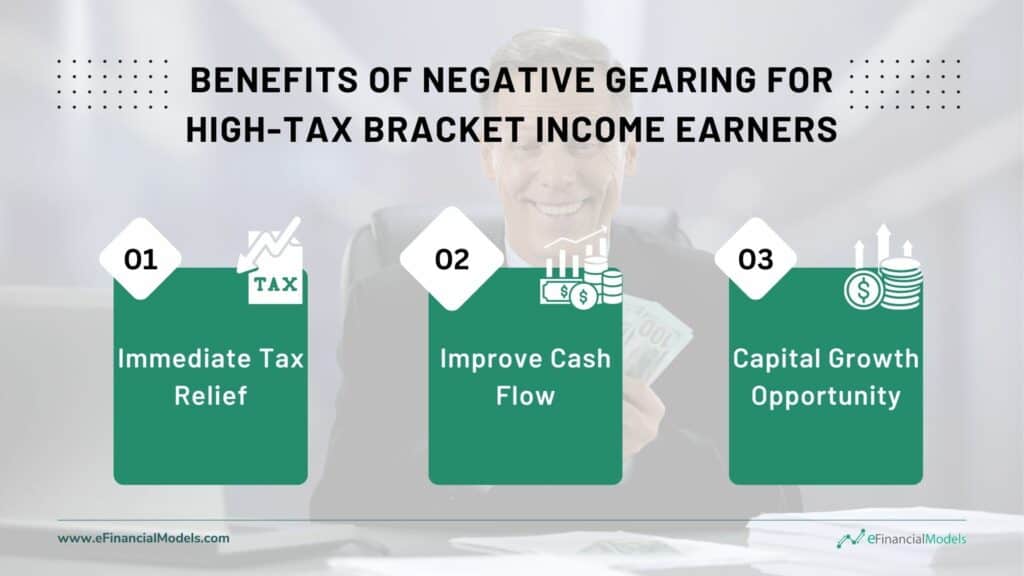
- Immediate Tax Relief: Negative gearing allows high-tax bracket income earners to claim immediate tax relief. When an investment property is negatively geared, the costs of owning the property, such as interest on the loan, maintenance, and other expenses, exceed the rental income generated by the property. This net loss can be deducted from the investor’s total revenue, reducing their taxable income. This deduction can result in significant tax savings for those in higher tax brackets. Essentially, the investor pays less tax due to offsetting rental losses against their other income, providing a form of financial relief. Negative gearing is not advisable for low-income earners because they may not benefit significantly from the tax deductions and might need help to cover the ongoing losses associated with maintaining the investment property.
- Improve Cash Flow: Despite the property operating at a loss, negative gearing can significantly improve an investor’s overall cash flow due to the tax savings it generates. It allows investors to offset the net rental losses of an investment property against their taxable income, lowering their overall tax liability. This reduction in tax payments can improve cash flow by providing additional funds that can be used to cover property expenses or reinvest in other opportunities. For high-tax bracket income earners, the improved cash flow can make the investment more sustainable and manageable, as the tax benefits help to offset the out-of-pocket costs of maintaining the property.
- Capital Growth Opportunity: Negative gearing is often pursued with the expectation of capital growth. High-tax bracket income earners invest in properties in desirable locations, anticipating property value appreciation over time. While the property may generate a loss in the short term, the potential for significant capital appreciation can outweigh these initial losses. When the property is eventually sold, the investor can realize a substantial profit from the increase in property value. This long-term capital gain can provide a considerable return on investment, making negative gearing an attractive strategy for those who can afford to absorb the short-term losses.
Overall, negative gearing offers immediate tax relief, improved cash flow, and potential for significant capital growth, making it a beneficial strategy for high-tax bracket income earners looking to maximize their investment returns. These benefits underscore the potential of negative gearing as a powerful property investment strategy.
Unlocking the Potential of Negative Gearing Through Financial Modeling
Financial modeling is a powerful approach for property investors aiming to maximize their returns through negative gearing. It plays a crucial role by providing detailed projections and scenarios that help investors understand the potential risks and returns associated with negative gearing. Through great financial models, investors can analyze cash flows, tax implications, and long-term growth prospects, allowing them to make informed decisions and optimize their investment strategies. This proactive financial planning ensures that investors can effectively leverage negative gearing to enhance their portfolio performance while mitigating potential downsides.
Balancing Risk and Reward
Negative gearing involves borrowing money to invest in property, where the income generated is less than the expenses incurred, resulting in a loss that can be offset against other income to reduce tax liability. Balancing risk and reward is crucial in this strategy. Financial modeling helps investors assess the potential risks and returns by simulating different scenarios, including changes in interest rates, property values, and rental income. By doing so, investors can make informed decisions and develop strategies to mitigate risks while maximizing potential rewards.
In negative gearing, where expenses exceed rental income, understanding the debt-to-income ratio helps investors ensure they do not overextend financially, mitigating the risk of default. A debt-to-income ratio analysis can significantly help balance risk and rewards in negative gearing by providing a clear picture of an entity’s financial health. This financial model can highlight the sustainability of leveraging additional debt to finance investments by assessing the proportion of income spent on debt repayments. It allows for a strategic evaluation of potential tax benefits and long-term capital gains, helping investors make informed decisions to optimize their investment returns while managing financial risks effectively.
Furthermore, a sensitivity analysis helps balance risk and rewards in negative gearing by evaluating how changes in key variables, such as interest rates, rental income, and property values, impact the investment’s financial performance. By simulating various scenarios, investors can understand the potential effects of market fluctuations and economic conditions on their cash flow and overall returns. This insight enables investors to anticipate adverse outcomes and adjust their strategies accordingly.
Choosing the Right Property
Selecting the right property is critical to the success of negative gearing. Investors should use financial modeling to evaluate properties based on location, growth potential, rental yield, and market trends. It involves analyzing historical data and future revenue projections to determine which properties will likely appreciate in value and generate steady rental income. A thorough analysis helps investors avoid properties that may perform poorly and focus on those with the best potential for capital growth and rental returns.
A Real Estate Investment Analysis Model can significantly aid in choosing the right property for negative gearing by providing a detailed financial assessment using Net Present Value (NPV) and Internal Rate of Return (IRR).
- NPV plays a key role in helping investors assess a property’s profitability. It does this by calculating the difference between the present value of cash inflows (such as rental income and future sale proceeds) and the present value of cash outflows (such as purchase price, maintenance costs, and loan repayments). A positive NPV indicates that the property is expected to generate more wealth than the initial investment, making it a viable option for negative gearing.
- On the other hand, IRR provides the annualized expected rate of return on the investment. By comparing the IRR of different properties, investors can identify which property offers the highest return relative to its cost. When considering negative gearing, a higher IRR suggests that the property is more likely to cover its costs and eventually turn profitable despite initial losses. This analysis enables investors to make informed decisions by focusing on properties that are likely to yield higher returns and align with their financial strategies and risk tolerance, ensuring a balanced and potentially lucrative real estate portfolio.
Maximizing Tax Deductions
Negative gearing offers significant tax benefits, as the losses incurred can be deducted from other income, reducing overall tax liability. To maximize these deductions, investors need to accurately track all deductible expenses, including interest on the mortgage, property management fees, maintenance costs, and depreciation. Financial modeling can assist in identifying all possible deductions and optimizing the timing of expenses to maximize tax benefits. Proper tax planning and modeling ensure that investors take full advantage of the tax benefits associated with negative gearing.
A tax impact analysis financial model can help maximize tax deductions in negative gearing by providing a detailed projection of an investment property’s potential tax benefits and economic outcomes. By analyzing various scenarios and understanding the full extent of deductible expenses, such as interest, depreciation, and repairs, investors can strategically manage their finances to enhance tax savings. This model enables investors to make informed decisions about property acquisition, financing options, and expense management to optimize their tax position and overall financial return.
Properly Managing Cash Flows
Effective cash flow management is essential when utilizing negative gearing, as investors need to cover the shortfall between rental income and property expenses. Financial modeling helps investors forecast cash flow needs, ensuring they have sufficient funds to cover ongoing costs and mortgage repayments. By projecting future income and expenses, investors can plan for any potential cash flow issues and take proactive measures to maintain financial stability. Proper cash flow management ensures investors can sustain their investments without financial strain.
A cash flow analysis is crucial for managing cash flows in negative gearing by providing a detailed and systematic way to project and monitor income, expenses, and net cash flow over time. This model allows investors to identify periods of potential cash shortfalls and plan accordingly, ensuring they have sufficient liquidity to cover loan repayments and other obligations. By simulating various scenarios, such as changes in interest rates or rental income fluctuations, investors can make informed decisions to mitigate risks. Additionally, the model aids in assessing the long-term viability of the investment, helping to balance short-term losses with potential capital gains.
Regular Property Valuation
Regular property valuation is essential to monitor the performance of the investment and make informed decisions about holding, selling, or refinancing the property. Financial modeling helps investors understand how changes in property value impact their overall investment strategy. By regularly updating property valuations and incorporating these into their financial models, investors can assess the performance of their portfolio, identify opportunities for refinancing to take advantage of lower interest rates or decide when it might be beneficial to sell a property. Regular valuation ensures that investors stay informed about the value of their assets and make decisions that align with their financial goals. A Discounted Cash Flow (DCF) model can significantly aid in regular property valuation by providing a detailed forecast of the property’s future cash flows, adjusted for the time value of money. By projecting the income and expenses associated with the property, investors can calculate its net present value (NPV) to determine its worth more accurately. This method helps optimize negative gearing strategies by highlighting the potential tax benefits and long-term profitability despite initial losses. By analyzing the DCF, investors can make informed decisions on property acquisitions and management, ensuring that the negative gearing approach maximizes overall returns and aligns with financial goals.
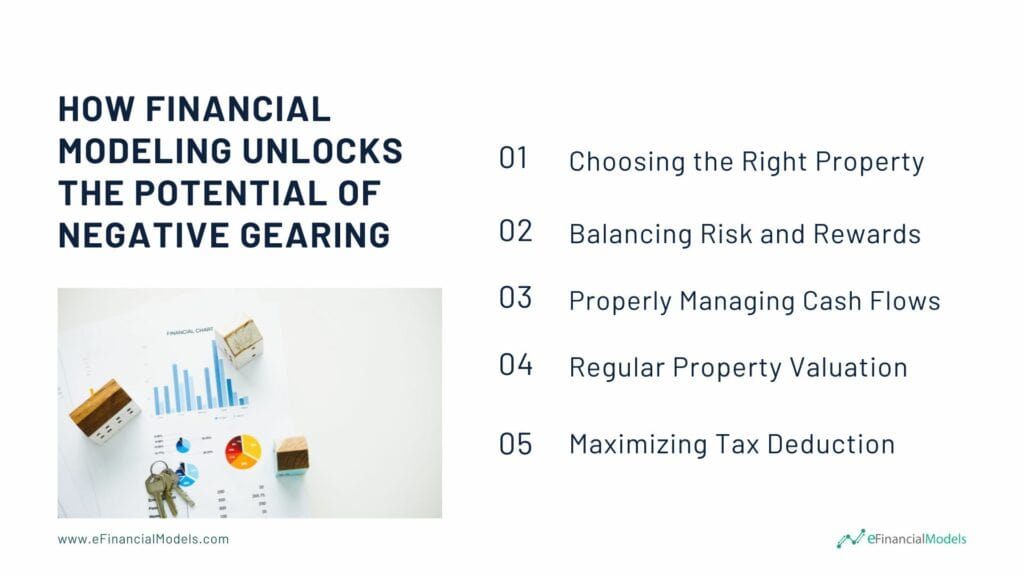
By leveraging financial modeling in these five areas, investors can effectively unlock the potential of negative gearing, balance risks, and rewards, make informed property choices, maximize tax benefits, manage cash flow efficiently, and track property values to optimize their investment strategy.
Real Estate Investors Turn Losses to Gains via Negative Gearing
Negative gearing is a property investment strategy where the costs of owning and managing an investment property exceed the rental income it generates. This results in a loss, which high-tax bracket income earners can use to offset their taxable income. Its immediate benefit to real estate investors is the tax deduction on the losses, which reduces the overall tax payable. Additionally, while the property might not be profitable in the short term, investors anticipate that the property’s value will appreciate over time, eventually leading to significant capital gains.
As you consider negative gearing a property investment strategy, remember it’s not without risks. While the potential tax benefits can be attractive, success depends on long-term capital growth outweighing short-term losses. Carefully assess your financial situation, risk tolerance, and investment goals before proceeding. Consult with financial advisors and tax professionals to ensure you fully understand the implications. With proper planning and execution, negative gearing can be a powerful tool for building wealth through property investment. By leveraging this strategy wisely, you can turn temporary losses into substantial long-term gains, setting yourself up for a more secure financial future.


















































You might also like:
- Understanding the Essential Elements of an Income Statement
- Exploring the Benefits of a Rental Property Excel Spreadsheet
- Finding Fair Market Value: A Quick Guide to Real Estate Valuation
- Real Estate Financial Modeling in Excel
- Cash Flow Analysis in Excel
- Financial Modeling for Startups and Small Businesses
- Real Estate Valuation
- Scenario Analysis
- Commercial Real Estate Properties
- Residential Properties
- Top 10 Mistakes in DCF Valuation Models
- The Valuation of a Business
- Understanding Insurance Policies: A Beginner’s Guide
- How to Calculate Net Present Value (NPV)?
- Creating a Business Plan for your Food Truck Business
- Real Estate Financial Model Templates Package
- Financial Planning
- Why Financial Forecasting Models Are Vital for Your Business
- The Essential Guide to Calculating the Cap Rate for Real Estate Valuations