
0 ITEMS

What Is a Good IRR for 5 Years?

Understanding IRR helps investors and business owners evaluate the profitability of investments over a five-year horizon.
- A good IRR typically exceeds your cost of capital, indicating value creation.
- High-growth investments often target IRRs between 20% and 30%, depending on risk.
- IRR calculations can be done manually with NPV formulas or quickly with Excel’s IRR function.
- Comparing IRR with industry benchmarks and risk profiles leads to smarter investment decisions.
- Both leverage and market timing significantly impact whether an IRR is considered attractive.
This article provides practical benchmarks and real-world examples to interpret IRR expectations over five years.
What is the Internal Rate of Return (IRR)?
The Internal Rate of Return (IRR) shows how fast your money grows in an investment. The rate makes future cash flows’ net present value (NPV) equal to the initial cost. In simple terms, IRR tells you the percentage return you earn yearly. The higher the IRR, the better the investment looks. It helps you compare projects and decide where to put your money.
Measuring IRR shows how fast your investment grows each year within a set time. It gives a clear, yearly return rate, helping you compare options quickly. Five years is long enough to spot trends but short enough to adjust plans if needed. This way, you can see if the project pays off or if your money works better elsewhere. IRR measures the return an investment is expected to generate over its entire life. It considers all cash inflows and outflows from start to finish.

Is a Higher or Lower IRR Better?
A higher IRR means your investment earns more each year. The faster your money grows, the better the return. A high IRR shows strong performance and helps you compare projects easily. If two options have similar risks, choose the one with the higher IRR. A lower IRR means slower growth. Your money takes more time to earn back. It could signal higher risk or weaker profits. If the IRR is lower than your target return, the investment might not be worth it.
Is a higher or lower IRR better? A higher IRR is better because it shows a stronger return on investment. This means that the project is expected to earn more money over time. Investors use IRR to compare opportunities—a higher IRR usually wins. But it’s important to check if the project’s risk and assumptions make sense too. A high IRR alone doesn’t guarantee success. Always check if the return justifies the risk.
How Is IRR Calculated?
To calculate IRR manually, set the Net Present Value (NPV) formula to zero and solve for the rate (r). The formula is:

Where:
- C₀ is the initial investment, shown as negative because money goes out. It represents your starting cost—what you spend to launch the project or investment. This amount sets the baseline for future returns.
- C₁ to Cn are the cash inflows you expect to receive in each future period. These numbers reflect the project’s earnings over time. They must be listed in order, year by year, to measure how profitable the investment becomes.
- (1+r)¹ is the discount factor for the first year. It adjusts the first year’s return to today’s value using the trial IRR (r). This step shows how much the future cash inflow is worth in present terms.
- (1+r)ⁿ is the discount factor for any later year (n). The longer you wait for cash, the more it loses value. This part of the formula reduces future returns to reflect time and risk.
This trial-and-error method helps find the rate that makes total cash inflows equal the upfront cost.
Alternatively, you can calculate the IRR using the built-in IRR function in Excel. List your cash flows in order, starting with the initial investment as a negative number, followed by positive returns. Then type =IRR(A1:A5) if your data is in cells A1 to A5. Excel quickly finds the rate that makes the Net Present Value (NPV) equal to zero. This method is fast, accurate, and avoids manual guesswork.
IRR, or Internal Rate of Return, can be calculated in two ways—levered or unlevered—based on the type of cash flows used. Unlevered IRR uses free cash flows before debt payments, showing the return on the overall business. Levered IRR, on the other hand, uses free cash flows after paying interest and debt, reflecting the return to equity investors. The key difference lies in whether or not financial debt is included in the cash flow analysis.






















































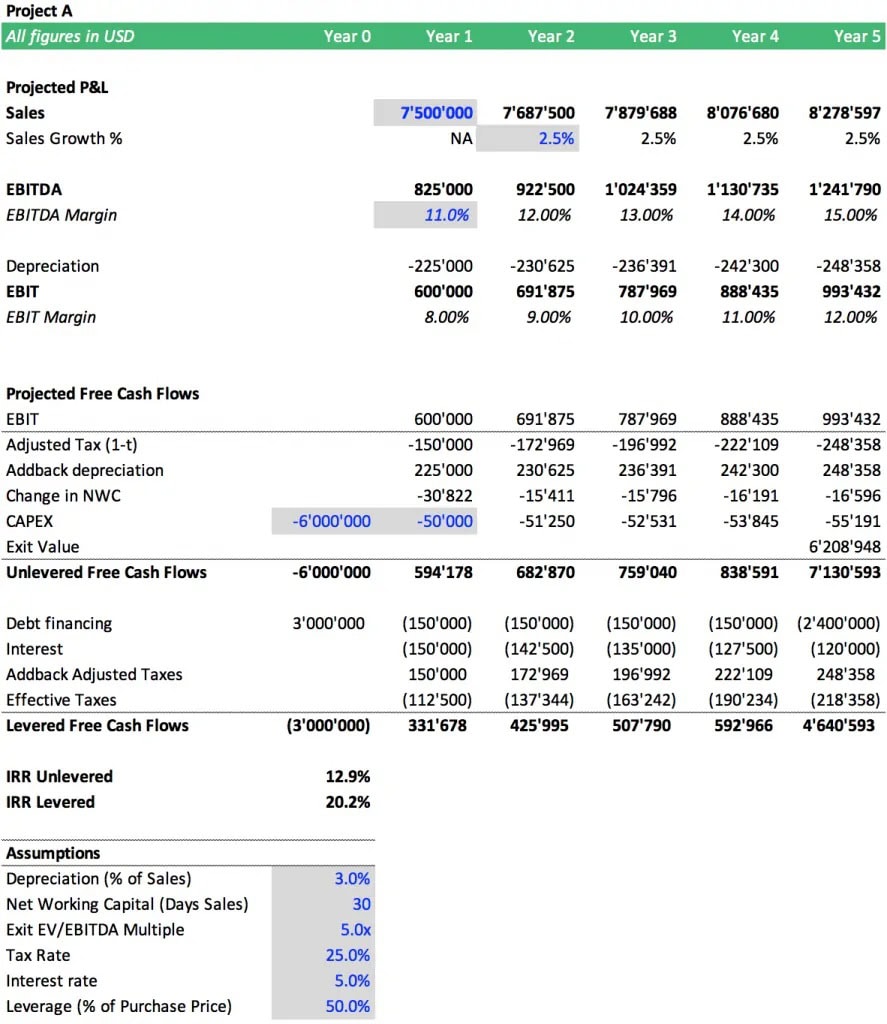
The table above shows that the unlevered IRR calculation focuses on the free cash flows available to all investors before any financing, shown in the “Unlevered Free Cash Flows” row. Starting from Year 0’s large capital outlay of -6,000,000, it adds future years’ cash inflows (Year 1 to 5), including the final exit value in Year 5. These cash flows reflect the project’s returns regardless of how it’s financed. On the other hand, a levered IRR calculation uses “Levered Free Cash Flows,” which include the effects of debt, such as adding debt financing upfront, deducting interest, and adjusting taxes. It shows the return for equity holders after debt payments. In this table, the project earns 12.9% unlevered IRR and a higher 20.2% levered IRR due to leverage amplifying returns on equity.
What Is Considered a ‘Good’ IRR for a 5-Year Investment?
Generally, a good IRR is higher than your discount rate or cost of capital. Since IRR shows the return earned over the full life of an investment, it only makes sense when you compare it to what it costs to fund the project. If the IRR beats the cost of capital, the investment adds value. If it’s lower, you lose money. So, there’s no “good” IRR in isolation—it’s only good if it clears your required return.
In reality, a 5-year IRR (Internal Rate of Return) shows the annual return you’d earn if you exited the investment in exactly five years. It’s a common benchmark for private equity and venture capital firms aiming to cash out within that timeframe. However, in real life, exits often take longer—sometimes seven or even ten years—because market conditions, company growth, or buyer interest can delay the sale. So, while the 5-year IRR gives a quick snapshot of potential returns, the timeline may stretch beyond that.
- A good IRR for a 5-year investment is around 20% if it’s a leveraged deal, which is the target for many private equity investors. Some aim for this return even within just 3 years. In reality, exits often take longer—sometimes 7 to 10 years. However, as long as they hit that 20% return on their invested capital, the exact timing doesn’t matter as much. What counts is reaching the return goal, not how long it takes.
- For venture capitalists, a good IRR for 5 years would be about 58% if they aim for a 10x return on their investment. That’s because they take big risks backing startups, so they expect high rewards. But in reality, building a successful company often takes longer than 5 years. Since quick exits are rare, VCs focus more on the MOIC—multiple on invested capital—looking for deals that can return 10 times their money. IRR helps show the annual return, but MOIC tells the full story over time.
What is a Good IRR for a 3-Year Investment?
A 20% IRR for a 3-year investment sounds great, but there’s a catch—you now need to find another investment that gives you the same return, and that’s not easy. Good deals take time, and your money might sit idle in between. That’s why investors often want a higher return for short-term investments. They’re not just looking at the numbers but factoring in the time and effort to reinvest. So, is a higher or lower IRR better? For short timeframes like 3 years, a higher IRR is better to make up for reinvestment risk and effort.
Is IRR the Only Metric I Should Consider When Evaluating Investments?
IRR is useful, but it’s not enough on its own. It shows how fast an investment might grow, but doesn’t tell you the full story. You should also check the Net Present Value (NPV) to see real dollar gains. Look at the payback period to know when you’ll get your money back. Consider cash flow timing, risk, and market conditions too. A high IRR can hide weak cash returns or high risk. Always use IRR with other metrics to make smarter investment decisions.
Check NPV with IRR to get the full picture. IRR shows the rate of return, but NPV shows how much value the investment adds in dollars. A high IRR can still mean a poor investment if the NPV is low or negative. NPV also considers your required return and the time value of money. It tells you if the project truly builds wealth. IRR and NPV help you see both the speed and size of returns, key for smart investment choices.
Check the payback period with IRR to see how fast you recover your money. IRR shows potential return, but not when cash comes back. A short payback means less risk and quicker reinvestment. Some projects may have high IRR but slow cash recovery. That delay can hurt your cash flow. Use both financial metrics to balance return and timing. It helps you spot investments that grow fast and pay back early.
IRR looks good on paper, but real success depends on more. Cash flow timing matters—you need to know when money comes in, not just how much. Risk shows how likely you are to get those returns. Market conditions can shift, changing your results fast. A project with a strong IRR but late cash, high risk, or weak market fit may fail. Combine these factors with IRR to see the full picture and make great investment decisions.
Model Your Way to a Strong IRR
A good IRR for a 5-year investment is usually above your cost of capital—around 20% is strong for private equity, while venture capital targets closer to 58% to reach a 10x return. But here’s the challenge: if you exit early with a great IRR, you still need to find another high-return deal fast, which isn’t easy. Good investments take time to find, so locking in strong returns over a longer horizon often proves more practical than chasing short bursts of high IRR. Is a higher or lower IRR better? In most cases, a higher IRR is better because it indicates stronger potential returns, but investors should still consider the risk and feasibility behind those numbers.
To achieve a solid five-year IRR, build detailed financial models. Test best- and worst-case scenarios. Include cash flows, timing, and exit strategies. Small changes in assumptions can shift your IRR significantly. A reliable model helps you plan, adjust, and focus on long-term gains.



























You might also like:
- IRR vs NPV in the Context of Financial Decision-Making
- IRR vs ROI Analysis – Which one should you choose when?
- Mastering the Art of IRR Calculation: A Comprehensive Guide for Investors
- How to Value a Business Using a Discounted Cash Flow Model
- Understanding the Levelized Cost of Energy Formula
- A Step-By-Step Guide to the Merger and Acquisition Process
- Cash Flow Analysis in Excel
- Top 5 Principles of Corporate Finance
- Financial Planning for Small Business Owners – Taking an SBA Loan
- 10-Step Financial Planning Checklist for Smart Executives
- Real Estate Financial Modeling in Excel
- Finding Fair Market Value: A Quick Guide to Real Estate Valuation
- 10 Tips to Develop a First Class Business Valuation Report
- How Contribution Margin Analysis Can Drive Your Business to Financial Success
- Financial Model Templates Easy to Use
- Developing a 5 Year Financial Projection Template
- Finding a Valuation Model for Your Business
- Business Valuation Service
- Understanding the Debt Service Coverage Ratio: An Essential Metric for Financial Analysis
- Monthly Annity Calculator