
0 ITEMS

How to Calculate IRR for Private Equity
Table of Content
- What is IRR for Private Equity?
- Steps to Calculate IRR in Private Equity Investments
- Sample IRR for Private Equity Calculation
- Limitations of Using IRR
- Alternative Performance Metrics Used by Private Equity Investors
- Why Do PE Investors Prefer IRR?
- Quickly Assess IRR for Private Equity Through Financial Modeling

Private equity funding can be a crucial source of capital for privately held businesses seeking to expand, restructure, or undertake other strategic initiatives that otherwise could not easily obtain capital. When approaching private equity investors, business owners and managers must understand certain key financial metrics, including the Internal Rate of Return (IRR), which are very relevant for Private Equity investors. IRR for Private Equity measures the cash-on-cash return on an investment during the investment period.
This article will discuss what is IRR in private equity, how its calculation works, and the key drivers that most impact IRR. It can interest Private Equity investors and parties seeking to obtain private equity funding and like to understand more. We’ll also review common pitfalls and tips for ensuring you get the most out of your private equity investments.
What is IRR for Private Equity?
Private equity (PE) is a term that, in this context, refers to professional investors, typically in the form of a fund, which focuses on investing in privately held companies. Private equity firms usually raise funding from limited partners interested in investing in another asset class, such as privately held companies, with the potential to generate attractive returns. These funds typically will have to be returned within 5 to 10 years to those investors, therefore requiring the private equity firm to exit their investments within 5 to 7 years.
IRR stands for “Internal Rate of Return.” It is a financial metric used to evaluate the profitability of an investment project. It represents the discount rate that equates an investment’s cash inflows’ present value with its cash outflows’ current value. It means that the cash flows’ magnitude and timing are included and impact the IRR private equity calculation.
The IRR in Private Equity measures the rate of return of an investment in a privately held company over its lifespan. It is calculated based on the expected cash flow implications for investors. Large cash inflows early on increase the IRR, while the same cash flows received later lead to a lower IRR, rewarding early cash receipts. IRR is typically calculated based on forward-looking cash flow estimations based on the expected cash in and outflows to investors. IRR is used by many private equity firms today to assess an investment opportunity’s potential profitability and viability.
Investor Cash Flows as Basis for IRR in Private Equity
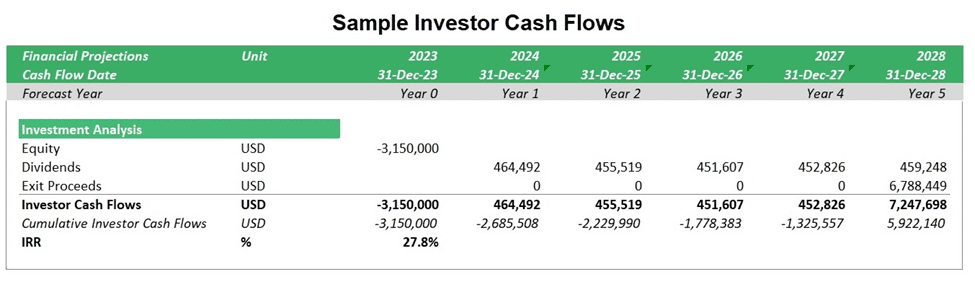
To determine the cash flow implications, the private equity investor must prepare financial projections about the target company and its expected financial performance and then add assumptions about the intended investment structure and the likely exit scenario. Calculating investor cash flows based on the company’s financial projections are clearer. These cash flows are calculated using a simple cash in cash out calculation and include the following:
- Investment: The investment costs, such as acquiring a stake in a company. The Private Equity investors
- Cash proceeds are to be obtained from the investment during the holding period. These can include dividends or interest and principal repayments of shareholder loans.
- Exit proceeds: The proceeds from the sale of the investment upon exit. In most cases, the exit scenario might focus on a trade sale of the equity stake to another buyer or the proceeds from an Initial Public Offering (IPO).
These three types of cash flows will now be plotted on a timeline so that the private equity investor can figure out when cash is going out and when cash is coming in.
Once we have defined the cash flows from the Private Equity Investors’ point of view, we can then calculate the expected IRR based on this cash flow stream. The IRR represents the discount rate at which the investor’s cash flows lead to a net present value (NPV) of zero. It means the IRR equals the annual percentage return of the investor’s cash flow. The IRR in Private Equity now makes understanding the return when investing easy.



















































Steps to Calculate IRR in Private Equity Investments
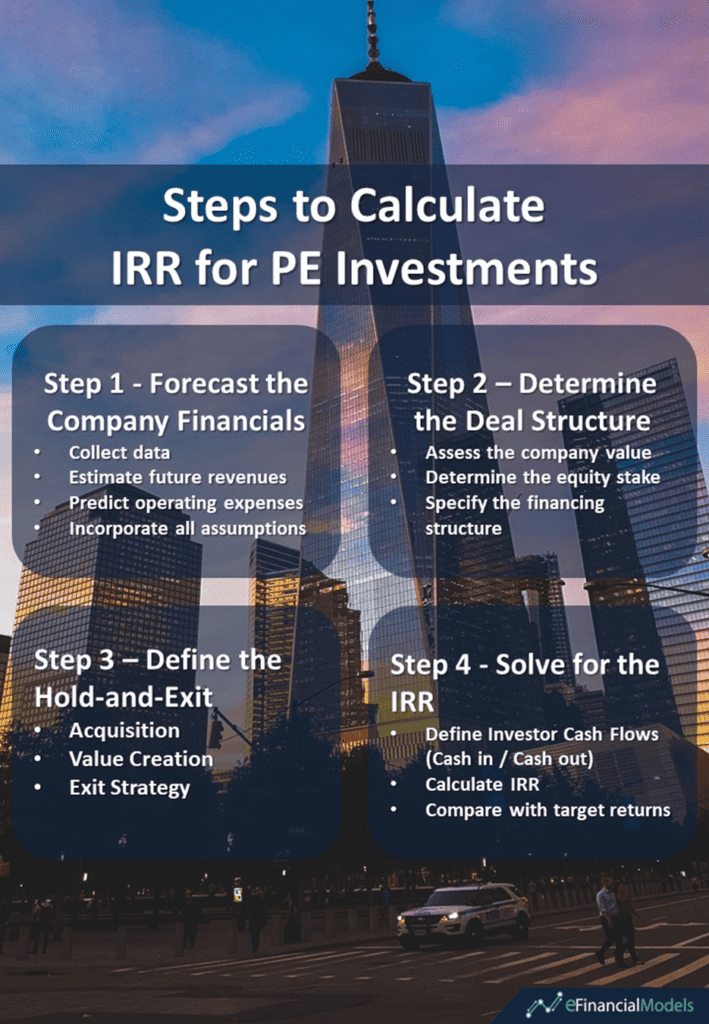
The internal rate of return (IRR) is a financial metric used to evaluate the profitability of private equity investments. It represents the discount rate at which an investment’s net present value (NPV) becomes zero. Here are the steps for the internal rate of return calculation:
Step 1 – Forecasting Company Financials
Forecasting financials in IRR private equity calculation refers to predicting future cash flows and estimating the financial performance of the investment over its lifespan. These forecasts are essential for determining private equity investments’ potential profitability and risk.
- Begin by collecting relevant data about the investment, including historical financial statements, market trends, industry analysis, and other pertinent information. This data will serve as the foundation for your financial projections.
- Estimate future revenues by considering market size, market share, competition, and pricing dynamics.
- Predict operating expenses, including labor, materials, marketing, and administrative costs. Consider any anticipated changes in cost structures, efficiency improvements, or potential economies of scale.
- Then, incorporate all these assumptions into revenue growth rates, operating expenses, capital expenditures, and working capital requirements. These should result in a comprehensive forecast of the target’s company financial statements, including forecasted Income statements, Balance sheets, and Cash Flow Statements.
The forecast of the company’s financials prepares the ground to forecast possible payouts in the form of dividends during the investment period and for coming up with a possible exit valuation at the end of the investment period.
Step 2 – Determining the Deal Structure
Determining the deal structure of private equity funding involves several factors and negotiations between the private equity firm and the company seeking funding.
- First, there’s a need to assess the value of the company seeking funding. This can be done through various valuation methods such as discounted cash flow (DCF), valuation by using the relevant valuation multiples from comparable company analysis, or asset-based valuation. From here, the private equity investor decides how much to be invested based on the company’s valuation and funding requirements.
- Second, the private equity investor determines the equity stake. It is the percentage of ownership or equity interest that the investor will hold in a company. When a private equity firm invests in a company, they typically acquire an equity stake in exchange for their investment. The equity stake represents the ownership rights and entitlement to a portion of the company’s profits and assets.
- Third, the private equity investor will assess the need and availability of appropriate debt financing required. Private equity deals often involve a combination of equity and debt financing. The specific amount of debt financing will depend on the company’s capital structure, the risk profile of the business, and the preferences of the private equity firm.
It’s important to note that the deal structure will vary depending on the specific circumstances and goals of the private equity firm and the company seeking funding. Each deal is unique and requires careful consideration of the investment’s financial, operational, and strategic aspects.
Step 3 – Defining the Hold-and-Exit Scenario
In private equity investments, the hold-and-exit scenario refers to acquiring and managing a portfolio company to sell or exit the company or project at a profit. This scenario typically involves several stages, including the acquisition, value creation, and eventual sale of the portfolio company.
- Private equity firms seek investment opportunities through industry contacts, investment banks, or proprietary deal sourcing. The initial phase involves identifying potential target companies, conducting due diligence, and negotiating the terms of the acquisition. It could include a leveraged buyout, where the private equity firm uses a combination of equity and debt to finance the purchase.
- Once the portfolio company is acquired, the private equity firm focuses on implementing strategic initiatives to enhance its value. It involves working closely with management teams to improve operational efficiency, optimize financial performance, and drive growth. The private equity firm may bring in industry experts, provide capital for expansion or acquisitions, and support the implementation of new business strategies. During the holding period, the private equity firm actively monitors the portfolio company’s performance, financial health, and compliance with agreed-upon targets. They may also assist in strengthening corporate governance, refining operational processes, and implementing cost-saving measures. Regular board meetings, performance reviews, and financial reporting are typical activities during this phase.
- Private equity firms aim to exit their investment after a certain period, typically between five to seven years. However, the timeframe can vary depending on market conditions and the specific investment thesis. The exit value of the investment represents the expected value at the end of the holding period and depends on the exit scenario. Most cases will be a trade sale; in other instances, an initial public offering (IPO).
It’s important to note that various external factors, including market conditions, industry dynamics, and regulatory changes, can influence the hold-and-exit scenario. Private equity firms carefully evaluate these factors throughout the holding period to optimize the timing and method of their exit strategy, aiming to maximize returns for their investors. Most private equity investments have a holding period of 5 to 7 years. They must exit after the holding period to pay the pooled investments from limited partners (LPs).
Step 4 – Solving for the IRR
Private Equity investors need to deliver attractive returns to their investors. Therefore, they must know what kind of return a private equity deal can offer. They do this by analyzing the IRR of the cash flows to be invested and received from this investment.
The internal rate of return calculation is the reverse of an NPV calculation as it identifies the discount rate that results in the NPV equal to zero. This discount rate is the firm’s implicit rate of return (IRR) or the return earned by the project under discussion.
The IRR formula can be mathematically expressed as follows:
NPV = 0 = -Initial Investment + (Cash Flow Year 1 / (1 + IRR)^1) + (Cash Flow Year 2 / (1 + IRR)^2) + … + (Cash Flow Year N / (1 + IRR)^N)
Where:
- NPV is the net present value of the Investment
- Initial Investment represents the initial cash outflow
- Cash Flow Year represents the cash flow generated in each period (e.g., year)
- IRR is the internal rate of return
To find the IRR, you need to solve the above equation for IRR. It involves determining the discount rate that sets the NPV of the investment to zero. In practice, this equation is solved by using the IRR or XIRR formula in Excel. To see an example of such calculation, download the Simple Private Equity Deal Template, which can offer a great tool for the initial analysis of a Private Equity investment and the corresponding internal rate of return calculation.
Important to note here is that Private Equity investors apply the IRR calculation to a cash-in / cash-out consideration – investor cash flows – and not cash flows at the company level. It is because Private Equity investors need to look at returns from their (own) investor perspective, not the company. It also means that ALL costs must be accounted for, including the PEs management fees or additional capital injections required.
The IRR represents the rate of return that the investment is expected to generate from Private equity investment. Private Equity investors typically target an IRR of 20% or higher. In contrast to stock market investors, Private Equity investments are illiquid and require time to source investment opportunities. As such, Private Equity investments should target returns higher than the stock market to compensate for such factors and to be attractive to investors. Therefore, when analyzing Private Equity investment opportunities, investors need to see that they can obtain their target return with the opportunity and target deal structure. If the IRR is higher than the desired rate of return, the investment is considered favorable. On the other hand, if the IRR is lower than the target return, the investment may be unattractive, and investors might skip the opportunity.

























Sample IRR for Private Equity Calculation
Investment & Deal Proceeds
Let’s assume a company’s enterprise value is $4.5 million. Historical data shows it is earning an annual revenue of $10 million. A PE investment firm considers providing the company with 100% private equity funding. With a 70% equity investment, the PE investor expects a revenue growth of 2.5% and a return multiple of 2.9x as it plans to exit in Year 5.

Now let us calculate the IRR, which results in 27.8% as per the calculation above.
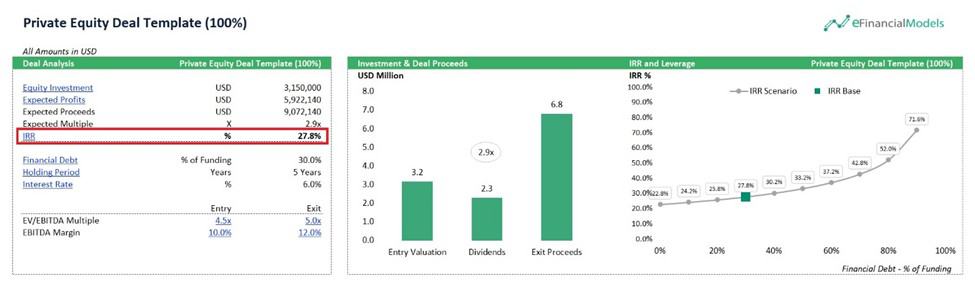
The figure above shows that the PE investment results in an IRR of 27.8%. It means that the private equity funding for the said company is a worthy investment. As mentioned, most PE firms target an IRR of 20% or higher. This would mean this would already be attractive to invest from a PE point of view.
Effects of Increasing the Revenue Growth
Using the same internal rate of return calculation assumptions, let us increase the average revenue growth rate to 5.0% during the forecast period and see what happens to the IRR.
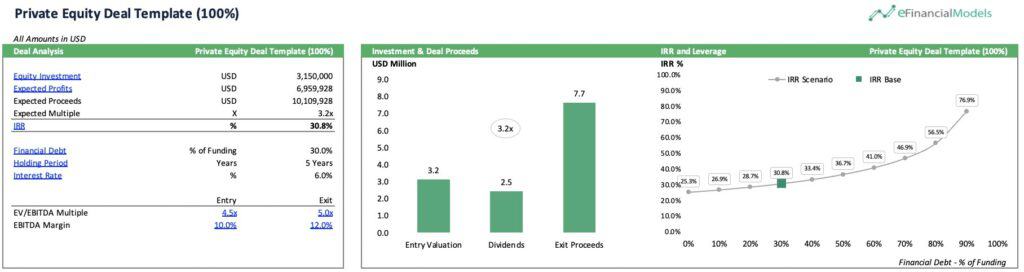
As you can see, increasing the revenue growth impacts the internal rate of return calculation considerably, increasing the IRR to the private equity firm to above 30%. The opposite will be true in case the company faces revenue growth. This means the revenue growth rate considerably impacts the PE investor’s IRR calculation.
Assuming a Higher Exit Multiple
Now let us change the scenario further. We keep a 5.0% average revenue growth during the forecast period, but now, we have changed the exit EV/EBITDA exit multiple from 5.0x to 6.0x.
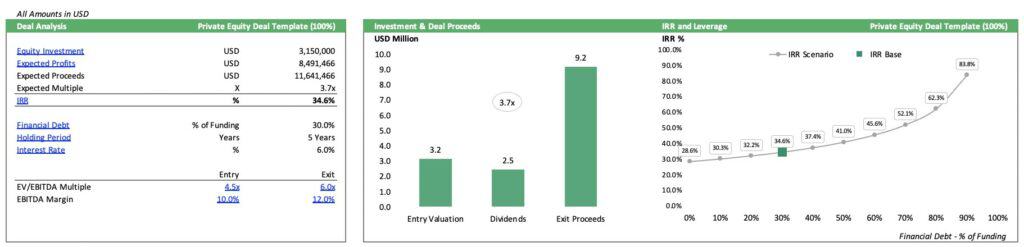
As you can see above, the IRR has increased further, now to 34.6%. Please remember that we assume to enter this investment at 4.5x EV/EBITDA. In this case, we actually assume some kind of multiple arbitrage. We assume that we can sell the company at a higher valuation than we entered, which in this case, positively impacts IRR. This would mean the PE investor assumes to buy cheap and sell expensive.
Sometimes, this assumption might not hold. Especially when analyzing a deal, it will be more prudent to avoid any assumption of possible multiple arbitrate and leave that as a potential upside for later on.
How Does Leverage Affect IRR?
As we calculate IRR from an investor’s perspective, our IRR will, in most cases, reflect a levered IRR since the deal might use debt financing.
Leverage refers to using borrowed funds to finance an investment or project. It involves using debt or other financial instruments to increase the potential returns of an investment. Please refer to this article to understand the difference between levered and unlevered IRRs. Now, let us see how leverage affects the internal rate of return calculation. Using the original cash flow statement assumptions, let us assume a 50/50 debt-to-equity ratio instead a 30/70 debt-to-equity ratio when financing this transaction. As you can see below, the IRR is positively impacted, resulting in 33.2% IRR instead of the 27.8% IRR of the original analysis.
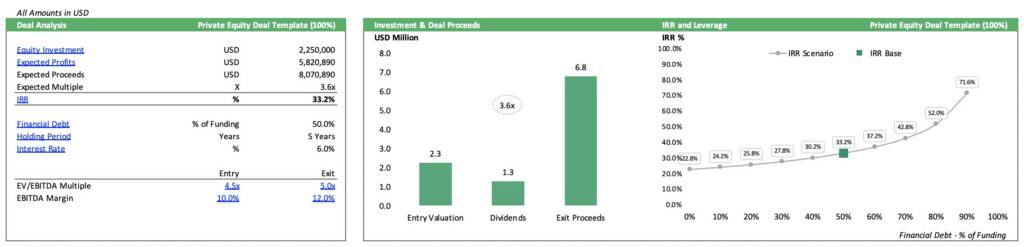
This means that using more leverage (or debt financing) positively impacts the IRR in private equity. Private Equity investors typically can enhance their returns when using more leverage.
While leverage can enhance returns, it also increases the risk associated with an investment. Borrowed funds come with interest payments and repayment obligations, which can be a burden if the investment does not generate sufficient returns. If the investment underperforms, the leverage can lead to significant losses or even bankruptcy. This demonstrates that using leverage comes with additional financial risk for IRR in private equity.
Therefore, leverage should be carefully considered in the potential risks and the ability to meet repayment obligations. You will also need to find a lender to give you a 50% debt in a company’s balance sheet. Most banks and lenders will thoroughly examine the company’s financial ratios to decide the amount of debt a company can afford to service.
Please note that the sample IRR calculations above are based on a simplified PE investment analysis template, assuming that the PE firm acquires 100% of the company. In reality, PE firms typically acquire 30% to 50% of company shares, only sometimes more.
Limitations of Using IRR
The Internal Rate of Return (IRR) is a commonly used financial metric in private equity, but it does have certain limitations. Here are some of them:
- Assumes Reinvestment: The standard IRR formula assumes that all positive cash flows generated from an investment can be reinvested at the same rate of return as the initial investment. It might prove unrealistic as Private Equity investors do not always have lined up the perfect reinvestment opportunities with the same return.
- Negative Cash Flow Patterns: The IRR calculation assumes that the cash flows generated by an investment are primarily positive. Suppose significant negative cash flows during the investment period, such as capital calls in private equity. In that case, the IRR formula, for technical reasons, may not accurately allow calculating an accurate reflection of investor returns or, in case of changing cash flow patterns, might even lead to two inconclusive calculation results.
- Ignores Deal Size: The IRR does not differentiate between Private Equity deals of different sizes. Sometimes a Private Equity investment opportunity might need to be bigger to generate attractive profits in absolute terms despite attractive IRRs.
- Subjective Estimates: The calculation of IRR relies on subjective estimations of the future financial performance of a company and expected investor cash flows. Such forecasts are inherently subjective, uncertain, and subject to estimation error. The IRR for Private Equity is sensitive to the accuracy of these estimates, and small changes in cash flow projections can result in significant variations in the calculated IRR. Individuals may have different assumptions and estimates, leading to subjective interpretations of the IRR.
Considering these limitations when using the IRR for private equity performance measurement is important to be aware. Alternative metrics, such as the Modified Internal Rate of Return (MIRR) or multiple cash flow-based measures like the cash-on-cash return, can complement a thorough financial analysis providing a more comprehensive evaluation of an investment’s potential.
Alternative Performance Metrics Used by Private Equity Investors
When assessing private equity investments, several other financial metrics can be used in addition to the internal rate of return (IRR). These metrics provide additional perspectives on the expected investment’s performance and help to better evaluate its attractiveness and risks. Here are some commonly used metrics:
- Cash-on-Cash Return (CoC) measures the annualized return on the actual cash investment made in a private equity deal. It compares the cash distributions received over a specific period to the initial cash investment. CoC return is useful for evaluating the asset’s ongoing cash flow, making it very suitable when looking into buy and hold instead of buy and sell scenarios.
- Multiple of Invested Capital (MOIC) measures the total return on the original investment. It is calculated by dividing the total distributions received (including dividends, interest, and sale proceeds) by the total investment made. MOIC helps assess the investment’s overall profitability. A private equity investor often has a target to multiply its investment by 2.0x or 3.0x to justify all the effort spent on an opportunity.
- Public Market Equivalent (PME) compares the performance of a private equity investment to an equivalent investment in the public markets. It calculates the ratio of the value of the private equity investment to the value of a hypothetical public market investment with the same cash flows. PME is useful for benchmarking private equity returns against public market returns.
- Return on Investment (ROI) compares the gain or loss from an investment relative to the cost of the investment. It is calculated by dividing the net profit (or loss) by the investment cost and expressing it as a percentage. ROI is a straightforward metric that shows the profitability of the investment.
Remember, no single metric can provide a complete picture of an investment’s performance. It is essential to consider a combination of these metrics and conduct thorough due diligence to assess a private equity investor’s potential risks and rewards.

Why Do PE Investors Prefer IRR?
Private equity investors commonly use the internal rate of return calculation as a critical metric to evaluate the potential profitability of their investments. IRR measures the annualized rate of return generated by an investment over its holding period. It considers the timing and magnitude of cash flows, including capital contributions and distributions. Private equity investors prefer the internal rate of return calculation for several reasons:
- Allows Comparison of Different Opportunities: The IRR is a standardized metric that enables investors to compare the relative attractiveness of different investment opportunities. Since PE investors typically evaluate multiple potential investments simultaneously, IRR allows them to assess and rank the projects based on their expected returns. By comparing IRRs, investors can decide which investments have the highest potential for generating superior returns.
- Determining a Hurdle Rate Maximizes Return: The IRR helps investors set a minimum acceptable rate of return, known as the hurdle rate or required rate of return. The hurdle rate represents the minimum IRR that an investment must achieve to justify the associated risks. PE investors often have a specific threshold for expected returns, considering the illiquid nature of their investments and the risks involved. Using IRR helps determine the hurdle rate and ensure that their investments meet or exceed this target, maximizing the likelihood of generating attractive returns.
Private equity investors often seek to achieve a minimum 20% or higher target IRR in their private equity investments as compensation for the risk they take. A 20% target IRR is considerably higher than the return on the stock market (e.g., 7% – 10% per year on a diversified portfolio). Such a return target compensates the private equity investors for illiquidity, long investment horizons, and higher risk associated with private equity investments compared to other asset classes.
- Main Decision-Making Tool: The IRR for Private Equity serves as a primary decision-making tool for PE investors. It considers the magnitude of cash flows throughout the investment period. By calculating the IRR, investors can assess the feasibility and profitability of an investment opportunity. They can evaluate the potential risks and rewards associated with the investment, considering the cash inflows and outflows over time. The IRR provides a comprehensive picture of the investment’s performance and guides investors in making sound investment decisions.
While the IRR has its advantages, it is important to note that it also has limitations. Therefore, PE investors must consider other financial metrics and thoroughly analyze them before making investment decisions.

Quickly Assess IRR for Private Equity Through Financial Modeling
The internal rate of return calculation for private equity investments involves determining the discount rate that equates the present value of the cash inflows with the present value of the cash outflows over the life of the investment. If the IRR is higher than the investor’s required rate of return or hurdle rate, the investment may be considered attractive. It’s important to note that calculating the IRR for private equity investments can be complex due to the nature of cash flows and the absence of a public market for valuation. Therefore, it’s recommended to use IRR in conjunction with other financial metrics and consider its limitations.
Investors and business owners can quickly assess how investments will perform over time using financial models to calculate IRR. These can help them accurately identify investments that are likely to have higher returns on average. They can also use this information to compare various investment options and evaluate their ability to generate long-term positive returns.
Download the Simple Private Equity Deal Template to obtain a better understanding of what the IRR of your next Private Equity deal might be.














































Tags: IRR for Private Equity