
0 ITEMS

What are the Main Drivers of Business Valuations?
Table of Content
- A Short Primer on Business Valuation
- What are Key Value Drivers?
- How to Use Sensitivity Analysis to Understand Valuation Drivers
- Which Key Value Drivers Most Impact the Result of a Business Valuation

Understanding the key drivers that impact business valuation is essential for making informed financial decisions.
- Revenue growth rate predicts how quickly a company’s sales are increasing and influences valuation through models like discounted cash flow (DCF).
- Profit margin indicates how efficiently a business converts sales into profit and affects its cash flow and investor appeal.
- Capital requirements measure the funds needed for operations and growth, impacting a company’s financial stability and valuation multiples.
- The discount rate reflects the risk of future cash flows and determines the present value in valuation methods such as DCF.
- Market multiples, derived from comparable companies, help estimate terminal value and compare relative business worth.
These factors are core to assessing a company’s true value and guiding strategic planning, so continue to examine how each driver influences valuation outcomes.
A Short Primer on Business Valuation
Business valuation is the process of determining the economic value of a business or company. It serves as a forecast of expected future company outcomes. It is crucial to various business transactions, including mergers and acquisitions, sales, and financial reporting.
Business valuation methods estimate what a business is worth, considering its assets, liabilities, financial performance, market conditions, and other relevant factors. The most appropriate approach depends on the business’s nature and the valuation’s purpose.
Three of the most common business valuation methods are the cost/asset-based, income-based, and market-based approaches.
- The cost/asset approach calculates the value of a business by considering its net asset value. It considers the value of the business’s tangible assets (such as property, equipment, and inventory) and intangible assets (such as intellectual property, goodwill, and brand value).
- The income approach focuses on the expected future cash flows the business generates. It involves discounting the projected cash flows to their present value using a discount rate that reflects the risk associated with the investment.
- The market approach compares the business to similar companies that have recently been sold or are publicly traded. It is a type of valuation using multiples as market indicators.
It’s important to note that business valuation methods are complex processes. They require expertise in finance, accounting, and market analysis. Professional valuation experts or appraisers are often engaged to conduct a thorough analysis and provide an accurate valuation. For more information, please refer to this article: 10 Tips to Develop a First Class Business Valuation Report.
What are Key Value Drivers?
According to Wall Street Oasis, key value drivers or valuation drivers are “internal factors of a company that help expand its valuation.” These variables significantly impact the value or worth of an asset, business, or investment. Key value drivers give the company a certain edge and quality by increasing profits, stabilizing cash flows, lowering risk, etc. These factors favorably impact a company’s expansion, effectiveness, and value. Each firm has its valuation drivers, which should be applied correctly to provide an accurate depiction. In the end, a valuation driver aids in raising the market capitalization and market share of the business, whether private or public.
Key value drivers are important in business valuation because they significantly impact a company’s intrinsic value and are considered crucial in various income-related business valuation methods and models. Valuation drivers are the key factors that influence a business’s financial performance and prospects. By analyzing these drivers, investors, analysts, and appraisers can assess the company’s current and future earning potential and estimate its intrinsic value.
Among the top six key value drivers of business valuation are:
- Revenue Growth Rate
- Profit Margin
- Capital Requirements
- Discount Rate
- Market Multiples for Terminal Value
- Capital Structure
These key value drivers are important because they significantly affect a company’s financial performance and comparative position. Analyzing these drivers helps determine the value of a business and supports investment decision-making processes.
























































1. Revenue Growth Rate
The growth rate measures the percentage increase or decreases in a company’s projected revenues, typically annually or per the defined period. The growth rate is a crucial value driver, especially for companies that are not profitable yet and need to obtain a certain size so that their revenues can cover all costs fully.
The growth rate is often measured as the yearly percentage change of a company’s revenues. With more revenues, the size of the business can grow. The revenue growth rate can be decomposed by analyzing how much of that growth is attributed to growth in volumes and prices.
How to Estimate the Revenue Growth Rate
Estimating the revenue growth rate involves analyzing various factors that impact sales volumes and prices. Here’s a step-by-step guide to help you estimate revenue growth:
Analyzing Volumes:
- Collect historical sales data, market demand, supply information, and data on competitors. Ensure you have a comprehensive understanding of the sources of revenue and the products or services contributing to your sales. These include product sales, royalties, services, subscriptions, etc.
- Evaluate past sales volumes to identify patterns and trends. Look for seasonal variations, growth rates, and any significant changes in sales over time. It will give you insights into the historical performance of your business.
- Examine the current market dynamics, including demand and supply trends. Identify factors that could impact future demand, such as changes in consumer preferences, economic conditions, or technological advancements.
- Understand the competition in your industry. Identify existing and new competitors, market share, and growth rates. Understanding your competitive landscape will help you assess how much market share you can gain.
Make informed projections for future volume growth based on your analysis of historical sales volumes, market demand, and competitor performance. Consider internal factors (e.g., marketing strategies, product improvements) and external factors (e.g., industry trends, economic conditions) that may influence your sales volumes.
With the volume growth expectations in mind, estimate how much market share you can realistically capture. This estimation should consider your competitive advantages, market positioning, and the effectiveness of your growth strategies.
Analyzing Prices
- Examine historical prices for each source of revenue and understand the reasons behind price changes. Factors like inflation, changes in production costs, competition, and consumer demand can all impact pricing. Identify the drivers behind price fluctuations to predict future pricing trends.
- Project future prices by identifying drivers for your products or services. This projection will be instrumental in calculating revenue growth.
Once you have estimated the volume growth and the corresponding price projections, multiply these figures to calculate the expected revenue growth rate for each source of revenue. Perform sensitivity analysis to account for uncertainties and variations in your assumptions. Assess how changes in variables like volume growth, market share, and prices would impact the overall revenue growth rate. Regularly monitor actual performance against your projections and adjust your estimates as new data becomes available.
How Does the Growth Rate Impacts Business Valuations?
The growth rate has a significant impact on business valuations, and it influences various valuation methodologies. Here’s how growth rate affects business valuations in different methods:
- Discounted Cash Flow DCF) Analysis: In DCF analysis, a business’s projected future cash flows are discounted back to the present value using a discount rate (usually the weighted average cost of capital, WACC). Growth rate plays a crucial role in this method. Profitable growth in revenues and cash flows leads to a larger business size, which contributes positively to the present value of the business. For businesses with negative profitability growth, increasing revenue might lead to larger losses, potentially reducing the present value of the business. The terminal value component in DCF analysis, which represents the value of the business beyond the explicit forecast period, heavily relies on the growth rate assumption. Higher revenue growth leads to a higher terminal value, increasing the overall DCF valuation.
- Multiples Valuations: In Multiples Valuations, businesses are valued by comparing their financial metrics (such as revenues, EBITDA, or earnings) to similar companies in the market or based on recent comparable transactions. Businesses with higher growth rates are considered more valuable because of their potential for higher earnings. As a result, they may be assigned higher valuation multiples compared to businesses with lower growth rates.
- Venture Capital (VC) Method: Venture capitalists often use the VC method to value early-stage startups. Projections of key financial figures (e.g., revenues or EBITDA) are projected for the next 5 to 10 years, and the business valuation is estimated based on these projections. The growth rate assumption significantly influences the valuation result. A higher revenue growth rate will lead to a higher valuation in the future, resulting in a higher VC valuation.

2. Profit Margin
Profit margin is a financial metric that measures the profitability of a business by indicating how much profit it generates relative to its revenue or sales. It represents the percentage of each dollar of revenue converted into profit. In other words, profit margin is the profit earned per sales unit.
Profit margin is an essential key valuation driver that measures a company’s profitability and efficiency in generating profits from its revenue. It is calculated by dividing a company’s net profit (after all expenses, taxes, and interest) by its total revenue.
It’s important to note that profit margins can vary significantly across industries. For instance, industries with higher production costs (e.g., manufacturing) may have lower profit margins than those with lower operating costs (e.g., software). Therefore, when evaluating profit margins, it is essential to consider industry benchmarks and trends.
Which Profit Margin to Use?
We have different definitions of profit and which type of costs you deduct from revenues:
- Gross Profit Margin measures the profit generated after deducting the cost of goods sold (COGS) from revenue. It indicates how much profit is left after deducting all direct costs needed to deliver products and services. Gross Profit typically increases in proportion to revenues. The formula is Gross Profit Margin = (Revenue – COGS) / revenue.
- EBITDA Margin measures the operating profit generated from the business’s core operations before deducting depreciation and amortization. The formula for EBITDA margin is EBITDA/Revenues. It is obtained after deducing the cost of goods sold and all cash-related operating expenses (such as salaries, rent, utilities, etc.) from revenues. EBITDA (Earnings before Interest, Taxes, Depreciation, and Amortization) shows the profitability of the business operations by deducting all cash expenses.
- EBIT Margin is the same as the EBITDA margin without considering depreciation and amortization (D&A). Please note that D&A is often based on subjective estimates about the useful life of certain assets and, therefore, subject to manipulation by management. EBIT margin is more commonly used in industries with relatively stable capital structures and consistent accounting practices, such as manufacturing or retail.
- Net Profit Margin measures the overall profitability of a business by deducting all expenses, including taxes and interest. It reflects the final profitability after all expenses are accounted for. Please note that here we have costs that depend on our decision on how to finance a company (debt instead of equity which leads to interest expenses) and the choice of jurisdiction, which tax incentives we are entitled to, and our legal setup (which determines the income tax rate). The formula is Net Profit Margin = Net Profit / Revenue.
For key value driver analysis, we need a profit definition related to the core of the business and which is less likely subject to manipulation. Often this will be the EBITDA margin.
Why Does Profit Margin Matter to Business Valuation?
Profit margin is a critical factor in business valuation for several reasons:
- Cash Flows: Profit margin directly impacts a company’s ability to generate cash flows. Higher profit margins mean more money is left over after deducting expenses, which leads to stronger cash flow generation. It is because they can be re-invested in the business later on. Businesses with high-profit margins can better turn revenues into cash flows. Businesses with small profit margins might need more funding, especially if they require investment in net working capital or fixed assets to grow their business.
- Financial Health: Profit margin is an essential indicator of a company’s financial health. A healthy profit margin implies that a business effectively manages the costs and pricing of its products or services. It shows that the company generates a reasonable return on its investments and is likely to avoid financial difficulties. A consistently improving or stable profit margin suggests a strong foundation for future growth and provides a buffer in case things go wrong.
- Investor Attraction: Investors and potential buyers often consider profit margin when evaluating a company’s attractiveness for investment or acquisition. A higher profit margin indicates a more lucrative and financially stable business, making it more appealing to investors seeking better investment returns.
- Performance Assessment: Profit margin is a key metric for assessing a company’s operational efficiency and profitability. It measures the profit generated from the business’s core operations. It helps gauge a company’s performance compared to its competitors or industry standards. Consistently strong profit margins suggest that the business is well-managed and can outperform its peers, which boosts confidence in its long-term viability.

3. Capital Requirements
Capital requirements are a crucial business valuation driver that assesses the funds necessary for a company to maintain and expand its operations effectively. It represents the amount of capital or financial resources a business needs to achieve its strategic objectives and generate sustainable profits.
An investment typically needs CAPEX and net working capital requirements to obtain profits.
- CAPEX stands for capital expenditures. These are the funds that a company or organization invests in acquiring, upgrading, or maintaining physical assets such as property, equipment, buildings, or infrastructure that are expected to provide long-term benefits and value to the business.
- Net Working Capital Requirements include the funds needed to cover day-to-day operations, such as purchasing inventory, paying suppliers, and managing accounts receivable and payable. A company with higher working capital needs may require more capital to operate efficiently and maintain its operations, which can impact its valuation.
Having less CAPEX and working capital requirements can benefit valuation for several reasons. When a business requires less capital to operate, it can generate higher profits because it doesn’t need to allocate as much money to cover operational expenses. Higher profitability is generally seen as a positive indicator of a company’s financial health and can lead to a higher valuation. Lower capital requirements mean the business is less reliant on external funding sources, such as debt or equity financing. This reduced dependency on external funds can lower the overall financial risk associated with the business and make it more attractive to potential investors.
How to Determine Capital Requirements
Here are some methods to find the capital requirements in business valuation:
- Asset-Based Approach: This method involves assessing the tangible and intangible assets of the business, such as property, equipment, inventory, and intellectual property. The capital requirements can be calculated by estimating the additional funds needed to acquire or maintain these assets to support the business’s planned growth.
- Cash Flow Projections: One of the most common methods is to project the business’s future cash flows. It involves estimating the revenues and expenses over a specific period (usually 3-5 years) and discounting these cash flows back to their present value using an appropriate discount rate. The capital requirements can then be determined by analyzing the net cash flow needed to support the projected growth and business operations.
- Debt Analysis: Analyzing the company’s current debt structure, including outstanding loans and interest rates, helps determine its debt service obligations. High debt burdens may necessitate additional capital to service debt and ensure financial stability.
- Working Capital Analysis: Assessing the business’s working capital needs is essential. Working capital represents the funds required to cover day-to-day operations, including inventory, accounts receivable, and accounts payable. A thorough analysis of working capital can reveal the short-term capital requirements of the business.
Why Capital Requirements Matter to Business Valuation
Capital requirements are crucial in business valuation because they directly influence a company’s financial health and operational capabilities.
- Financial Stability: Capital requirements indicate the amount of capital a business needs to operate efficiently and meet its financial obligations. A well-capitalized business is more likely to weather economic downturns and unexpected challenges, making it a more stable and reliable investment.
- Growth Opportunities: Capital is essential for business expansion, research and development, and investment in new projects. A company with sufficient capital is better positioned to seize growth opportunities and stay competitive in the market.
- Leverage and Debt Capacity: Capital requirements impact a company’s ability to take on debt. A well-capitalized business is more likely to have access to financing and may have a higher debt capacity, enabling it to invest in growth initiatives without becoming overleveraged.
- Risk Assessment: Investors and stakeholders evaluate the level of risk associated with a business. A company with high capital requirements may be riskier, as it might need help raising sufficient funds to support its operations or repay debts.




















4. Discount Rate
The discount rate is crucial in business valuation, particularly when using discounted cash flow (DCF) analysis. The discount rate considers the opportunity cost of capital, which adds a hypothetical cost for using the capital measured by how much return can be generated elsewhere for an investment in a similar risk.
It represents the rate of return required by an investor to justify the investment’s risk and potential reward. The discount rate calculates the present value of future cash flows, bringing them back to their current value. Finding the appropriate discount rate involves considering various factors, including the risk profile of the investment, the opportunity cost of capital, and the expected return on similar investments. In finance and investment analysis, the discount rate is a crucial valuation driver, representing the rate of return an investor requires to invest in a particular project, business, or asset. It is also known as the “required rate of return” or the “hurdle rate.”
The discount rate typically comprises two main components:
- Risk-Free Rate: This is the rate of return on a risk-free investment, such as government bonds, considered to have minimal risk. It serves as the baseline return an investor could achieve without taking any risk.
- Risk Premium: This represents the additional return investors require to compensate for the higher risk associated with a specific investment. The risk premium can vary depending on factors like the industry, country, economic conditions, and the riskiness of the particular investment.
As a key valuation driver, the discount rate directly impacts the present value of future cash flows, affecting the overall valuation of an asset, business, or investment opportunity. A higher discount rate will lower present value, making an investment less attractive. A lower discount rate will increase the present value and make the investment more appealing. Consequently, understanding and accurately determining the appropriate discount rate is essential for making informed investment decisions.
How to Determine the Discount Rate
- Weighted Average Cost of Capital (WACC) Approach: This approach combines the cost of equity and debt to determine the overall cost of capital. It involves calculating the required rate of return on equity (using methods like the Capital Asset Pricing Model) and the cost of debt (interest rate on borrowed capital). The weights of equity and debt in the company’s capital structure are used to calculate the weighted average cost of capital (WACC), which serves as the discount rate.
- Build-up Method (e.g., Risk-Free Rate Plus Risk Premium): In this method, the risk-free rate, typically represented by the yield on government bonds, serves as the foundation. An additional risk premium is added to account for the specific risk associated with the investment. The risk premium varies depending on industry, company size, growth prospects, and country-specific risks.
Why Do the Discount Rate Matter to Business Valuation
- Accounts for the Time Value of Money: The discount rate is essential in business valuation because it accounts for the time value of money and the risk associated with future cash flows. A higher discount rate reflects a higher level of risk and results in a lower present value of future cash flows. Conversely, a lower discount rate implies lower risk and increases the present value.
- Assess Intrinsic Value: Business valuation techniques can assess a company’s or investment opportunity’s intrinsic value by discounting future cash flows. This information is crucial for decision-making, such as determining whether to invest in a company, acquire it, or compare different investment options.

5. Market Multiples for Terminal Value Calculation
Market multiples are a key valuation driver commonly used in estimating the terminal value of a company. In finance and investment analysis, terminal value calculation is an essential concept used to estimate the value of an investment at the end of a specific period, typically beyond the explicit forecast period (e.g., 5 or 10 years). Also known as valuation multiples or trading multiples, market multiples are ratios that compare the market value of a company’s equity or enterprise value to a specific financial metric (e.g., earnings, revenue, cash flow, etc.). These multiples are derived from the market prices of comparable publicly-traded companies. When using market multiples for terminal value calculation, analysts apply a selected multiple to a financial metric of the company under consideration to estimate its terminal value.
The most commonly used market multiples for terminal value calculation are the EV/Revenue and EV/EBITDA.
- The Enterprise Value to Revenue Multiple (EV/Rev), is a financial metric used to evaluate a company’s valuation relative to its revenue. It measures how much investors will pay for each dollar of a company’s revenue. The formula for calculating the EV/Revenue multiple is EV/Revenue Multiple = Enterprise Value (EV) / Total Revenue. Enterprise Value (EV): A higher EV/Revenue multiple suggests that investors are willing to pay more for each dollar of the company’s revenue, indicating that the company may be perceived as having higher growth prospects, strong profitability, or strategic value. Conversely, a lower EV/Revenue multiple indicates that investors are willing to pay less for each dollar of revenue, which suggests a lower growth outlook, less profitability, or undervaluation.
- The Enterprise Value to Earnings Before Interest, Taxes, Depreciation, and Amortization (EV/EBITDA) Multiple is a financial metric used to assess the relative valuation of a company. It is commonly used in investment analysis and is particularly popular for valuing businesses with substantial debt or varying capital structures. The formula to calculate the EV/EBITDA multiple is EV/EBITDA = Enterprise Value (EV) / Earnings Before Interest, Taxes, Depreciation, and Amortization (EBITDA). The EV/EBITDA multiple is used to compare the valuation of one company to another in the same industry or sector. A higher EV/EBITDA multiple suggests that the company is relatively expensive compared to its EBITDA, while a lower multiple indicates a potentially cheaper valuation. Investors often use this multiple to determine if a company is overvalued or undervalued compared to its peers.
Market multiples are valuable valuation tools because they allow analysts and investors to compare companies across industries and sizes quickly. However, using multiples thoughtfully is essential, as they may not always capture the full picture of a company’s financial health and potential risks.
How to Find Market Multiples
- Comparable Transaction Analysis: In this method, recent transactions involving the sale or acquisition of similar companies are analyzed to determine the market multiples. The transaction values, such as the purchase price or enterprise value, are divided by the relevant financial metrics (e.g., revenue, EBITDA) to calculate the multiples. These multiples can then be applied to the financial metrics of the company being valued.
- Industry Reports and Databases: Various industry reports and databases provide market multiples for different sectors and industries. These resources collect and aggregate data on comparable companies and transactions, offering a range of multiples based on different financial metrics. Researchers and valuation professionals can access these reports and databases to find relevant market multiples for their valuation analysis.
- Investment Bank Research: Investment banks often publish research reports that include market multiples for specific industries or sectors. These reports provide valuable insights into the valuation metrics used by market participants. These multiples can be used as a reference point or benchmark for valuing similar companies.
- Peer Group Analysis: This approach involves selecting a group of peer companies that are similar to the company being valued in terms of industry, size, growth prospects, and financial characteristics. Financial metrics and multiples of these peer companies are then analyzed to derive a set of market multiples that can be applied to the valued company.
Why Market Multiples Matter in Business Valuation
- Benchmarking: Market multiples serve as benchmarks or standards for business valuation. They provide a common language and reference point for investors, analysts, and lenders when discussing the value of a company.
- Market Efficiency: Market multiples reflect market participants’ collective wisdom and expectations. They incorporate market sentiments, investor perceptions, and overall market conditions. By using market multiples, you can benefit from the efficiency of the market in reflecting the value of similar companies.
- Quick Valuation Estimates: Market multiples provide a quick and straightforward way to estimate the value of a company. Once you have the relevant financial data and comparable multiples, you can apply the average or median multiple to the financial metric of the valued company to estimate its value.
- Relative Valuation: Market multiples provide a relative valuation approach, allowing you to compare the value of the company being evaluated with similar companies in the market. This approach helps assess whether a company is overvalued or undervalued compared to its peers.














































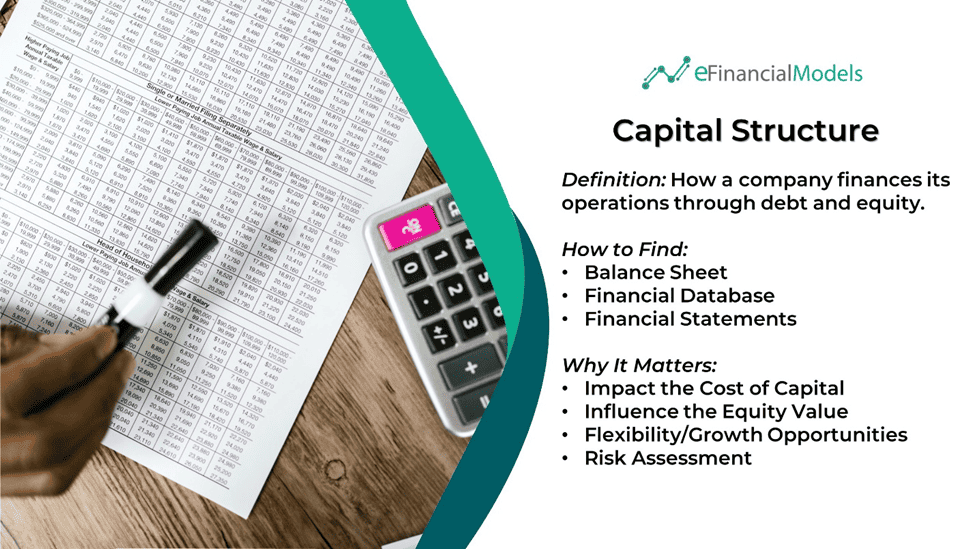
6. Capital Structure
Capital structure definition involves how a company finances its operations through debt and equity. It represents the mix of different sources of funds a company uses to finance its activities. Equity capital represents the ownership interests in the company and is obtained by issuing shares to shareholders. Debt capital, on the other hand, involves borrowing funds from various sources, such as banks, bondholders, or other lenders. This borrowed money must be repaid over time, usually with interest.
Understanding a company’s capital structure definition is important for assessing its financial health, risk profile, and business valuation. It influences a company’s cost of capital. The cost of capital is the overall rate of return that a company must earn on its investments to maintain the current value of its stock. It consists of the cost of equity (required return by shareholders) and the cost of debt (interest rate on borrowed funds). The overall cost of capital is crucial in determining a company’s valuation because it directly impacts its future cash flows’ net present value (NPV). In simple terms, the higher the cost of capital, the lower the valuation of the company, and vice versa. Therefore, achieving an optimal capital structure is essential for maximizing the firm’s value.
Using leverage creates better returns for shareholders: It means using debt capital alongside equity capital to finance a company’s operations and investments. When a company takes on debt, it can magnify its returns on equity, leading to the concept of financial leverage. This leverage effect can create better returns for shareholders under certain conditions. These include amplified returns, lower capital costs, and tax advantages.
How to Find a Company’s Capital Structure
- Balance Sheet: The balance sheet is a financial statement that provides a snapshot of a company’s financial position at a specific time. It includes information about a company’s assets, liabilities, and shareholders’ equity. The balance sheet can identify the components of a company’s capital structure, such as long-term debt, short-term debt, and equity.
- Financial Databases: Various financial databases and services, such as Bloomberg, Reuters, and S&P Capital IQ, provide access to detailed financial information about companies, including their capital structure. These platforms aggregate data from multiple sources, making analyzing a company’s financials easier.
- Financial Statements: Companies must disclose their financial statements, including the income statement, balance sheet, and cash flow statement, in their annual reports. These statements provide detailed information about a company’s financial performance and position, including its capital structure.
Why Do Capital Structure Matter to Business Valuation
- Impact the Cost of Capital: Capital structure impacts a company’s cost of capital, which is the return investors require to provide funds to the company. A company’s cost of capital depends on the mix of debt and equity in its capital structure. Debt generally costs less than equity due to tax advantages and lower risk. By analyzing the capital structure, investors can assess the cost of capital and its impact on the company’s overall valuation.
- Influence the Equity Value: The capital structure influences the equity value, determining the proportion of shareholders’ ownership in the company. A higher level of debt increases the financial risk and reduces the residual value available to equity shareholders. Conversely, a lower level of debt and higher equity provide greater potential for value creation for equity shareholders. Analyzing the capital structure helps understand the potential returns for equity investors and estimate the company’s valuation.
- Flexibility and Growth Opportunities: The capital structure affects a company’s flexibility and ability to pursue growth opportunities. Heavy reliance on debt may limit a company’s ability to borrow more funds or invest in new projects. On the other hand, a more balanced capital structure with a reasonable mix of debt and equity provides the company with financial flexibility and better access to capital for growth initiatives. Evaluating the capital structure helps understand the company’s capacity to fund future growth and its potential valuation impact.
- Risk Assessment: A company’s capital structure is crucial in assessing its risk profile. A high level of debt in the capital structure increases financial risk, as the company needs to make regular interest payments and repay principal amounts. On the other hand, a higher proportion of equity provides a cushion to absorb losses and reduces the risk of bankruptcy. Understanding the capital structure helps evaluate the risk of investing in a business.
How to Use Sensitivity Analysis to Understand Valuation Drivers
Sensitivity analysis is a valuable tool for understanding valuation drivers by examining how changes in key variables impact the overall valuation of a business or asset. By conducting sensitivity analysis, you can assess the sensitivity of your valuation model to different inputs and identify the key drivers that significantly influence the value.
Here’s a step-by-step guide on how to use sensitivity analysis to understand valuation drivers:
- Identify the Valuation Model: Determine the valuation model you are using. The valuation model should reflect the specific characteristics of the business or asset you are valuing.
- Determine Key Valuation Inputs: These are the key value drivers in your valuation model. Based on the results of your sensitivity analysis, prioritize the valuation drivers that have the most substantial impact on the overall value. Focus on understanding the underlying factors influencing these drivers and gather additional information or data to refine your analysis.
- Define a Range of Scenarios: Establish a range of scenarios by varying the identified key inputs. For example, you could create scenarios with optimistic, base, and pessimistic assumptions for each variable. Consider both upside and downside cases to capture the potential range of outcomes.
- Adjust One Input at a Time: Start with one key variable and modify its value while keeping all other inputs constant. Analyze the impact of this change on the overall valuation output. For example, increase the revenue growth rate by 10% and observe how it affects the valuation. You can also perform combined sensitivity analysis by adjusting multiple variables simultaneously to analyze their combined effect on the valuation.
Sensitivity analysis allows you to evaluate the impact of changes in valuation inputs, helping you assess the risk and uncertainty associated with your valuation. It enables you to identify potential areas of vulnerability or sources of uncertainty in your valuation model. Use the insights gained from sensitivity analysis to refine your valuation model. Incorporate additional information, adjust assumptions, or enhance the model structure to improve the accuracy and robustness of your valuation.

Which Key Value Drivers Most Impact the Result of a Business Valuation
Business valuation is a complex process considering various factors and key value drivers. While the specific drivers may vary depending on the industry and the unique characteristics of the business being valued, several key value drivers commonly influence the result of a business valuation. These include revenue growth rate, profit margin, capital requirements, discount rate, market multiples, and capital structure.

It’s important to note that these key value drivers do not operate in isolation, and their impact on business valuation can vary depending on the specific circumstances. Valuation is a comprehensive process that considers a combination of financial, qualitative, and contextual factors to determine the fair value of a business. So, every business needs a thorough analysis to clearly identify the key value driver relevant to its valuation. It allows businesses to understand better how to create and increase value positively.

















You might also like:
- 10 Tips to Develop a First Class Business Valuation Report
- 12 BUSINESS VALUATION METHODS
- Business Valuation
- Financial Modeling for Startups and Small Businesses
- How to Value a Business Using a Discounted Cash Flow Model
- Key Financial Ratios
- Finding a Valuation Model for Your Business
- Understanding Debt Sizing & Project Finance Ratios
- Commercial Real Estate Valuation Methods: Helping Investors in Taking Informed Decisions
- Discover the Power of Financial Modeling for Fundraising
- 10 Main Elements of a Business Plan
- Planning for a Successful Acquisition: Business Valuation Techniques
- 5 Practical Tips to Help Raise Funds For Startups
- Valuation Services
- How to Make Smart Decisions with 6 Key Financial Metrics?
- Top 5 Tips For a Good Financial Due Diligence
- Mastering Business Finance: The Three-Statement Financial Model
- How to Create a Price Comparison Template?
- Financial Model – Valuation of Tax Loss Carryforwards
Tags: business valuation