
0 ITEMS

A Pocket Guide to Total Cost Calculation

Every dollar counts when you’re running or funding a business. That’s why knowing how total cost calculation works is key. It helps you see the full picture—what it really costs to create, deliver, and scale. From direct costs to indirect expenses, total cost calculation tells you where your money goes. For entrepreneurs, it sharpens pricing and profit strategies. When you understand your total cost, you price better, cut waste, and plan confidently. For investors, it reveals how efficiently a business operates. It’s not just math—it’s your strategy map.
In this guide, we will cover the following:
- What Is Total Cost in Business? It refers to the complete sum of all direct and indirect expenses incurred in producing goods or delivering services.
- How to Calculate Total Cost? Total cost is calculated by adding direct costs (like materials and labor) to indirect costs (like rent and utilities), providing a clear picture of overall business expenses.
- Direct vs. Indirect Costs: Direct costs are tied to specific products or services, while indirect costs support operations without being linked to a single output.
- Why Calculate Total Cost ? Total cost calculation is crucial for business success because it enables accurate profitability assessment, attracts investors, supports smart investment decisions, ensures competitive yet profitable pricing, and supports budget planning & control.
Discover how mastering total cost calculation can boost profits and guide smarter business decisions—read on to learn more!
Total Cost Meaning: Breaking Down Business Expenses
The total cost meaning refers to the sum of all costs involved in producing a product, delivering a service, or completing a project. It includes materials, labor, rent, tools, and other expenses. This number shows how much you really pay from start to finish. Businesses typically calculate total cost over a set period—monthly, quarterly, or annually. The chosen time frame depends on the company’s size, goals, and reporting needs. Monthly tracking helps manage cash flow, while annual totals support long-term planning and tax reporting.
The total cost meaning is the full amount a business spends to run operations. OpEx, or operating expenses, are the ongoing business costs. They include both direct and indirect costs. Direct costs are expenses tied to production, like raw materials and labor. Indirect costs support operations but don’t link to a specific product, such as rent, utilities, and administrative salaries. Unlike Capital Expenditures (CapEx), OpEx covers short-term expenses that keep operations smooth. In total cost calculation, OpEx is a key part of daily spending. Managing OpEx wisely helps businesses improve cash flow and boost profits. Cutting unnecessary OpEx without hurting efficiency can create a stronger financial position. Furthermore, it includes Capital Expenditures (CapEx) indirectly. These long-term costs, like equipment or buildings, show up through depreciation. Instead of paying all at once, the expense spreads over time. This lets businesses reflect asset use in their total cost.
It is also essential to note that the total cost calculation does not cover external costs. An external cost happens when someone’s actions—like making or using a product—harm others who aren’t part of the deal. These costs, like pollution, traffic jams, or secondhand smoke, don’t show up in prices, so people ignore them. Since society bears the burden, economists often support taxes or rules to ensure those causing the harm help pay for it.
Furthermore, total cost calculation focuses on aspects other than the total cost of ownership and buy/lease costs. Total cost calculation covers all direct and indirect business operations costs. Total cost of ownership looks at the lifetime cost of owning something, including purchase, maintenance, and disposal. Buy/lease costs compare the financial impact of purchasing versus leasing an asset. We focus on total cost calculation to help businesses understand the full scope of costs involved in operating efficiently.
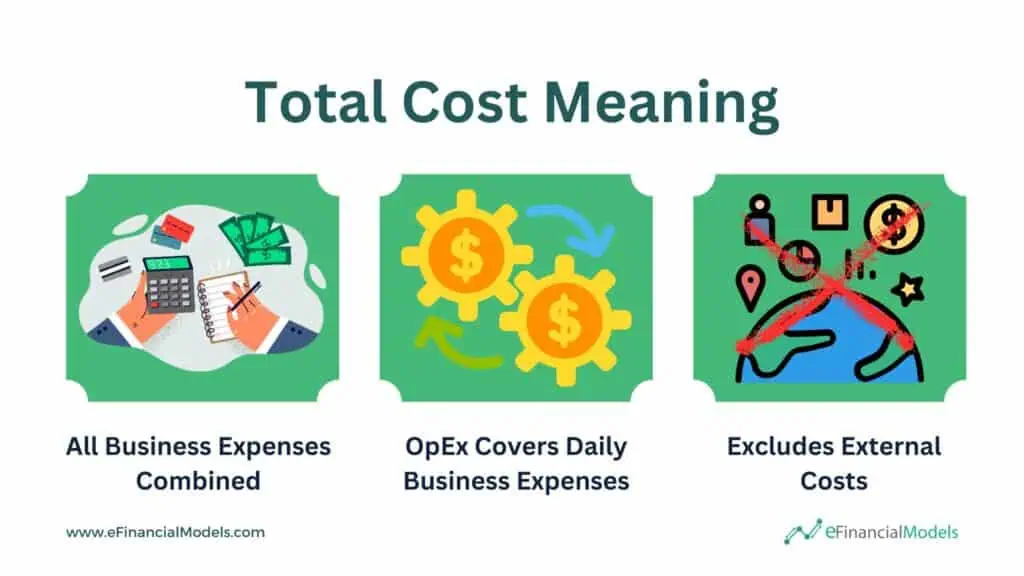
The Basic Formula for Total Cost Calculation
Total cost calculation involves summing up direct and indirect costs.
- Direct costs include expenses tied to production, like materials and labor.
- Indirect costs cover overhead, such as rent and utilities.
Adding both gives the total cost, helping businesses set prices and track profitability.

Direct Costs Examples
Direct costs are expenses directly linked to production. Another term for direct costs is the cost of goods sold (COGS). These costs change with production volume. More output means higher direct costs. Here are 10 common direct costs examples:
- Raw materials – Essential components used in production.
- Direct labor – Wages for workers making the product.
- Manufacturing supplies – Tools and consumables used in production.
- Packaging materials – Boxes, labels, and wrapping for finished goods.
- Freight-in costs – Shipping expenses for raw materials.
- Machine usage costs – Depreciation and maintenance for production equipment.
- Commission on sales – Fees paid to salespeople per unit sold.
- Product-specific utilities – Electricity or fuel used in manufacturing.
- Custom parts – Special components made for a specific product.
- Direct software costs – Licensing fees for tools used in product development.
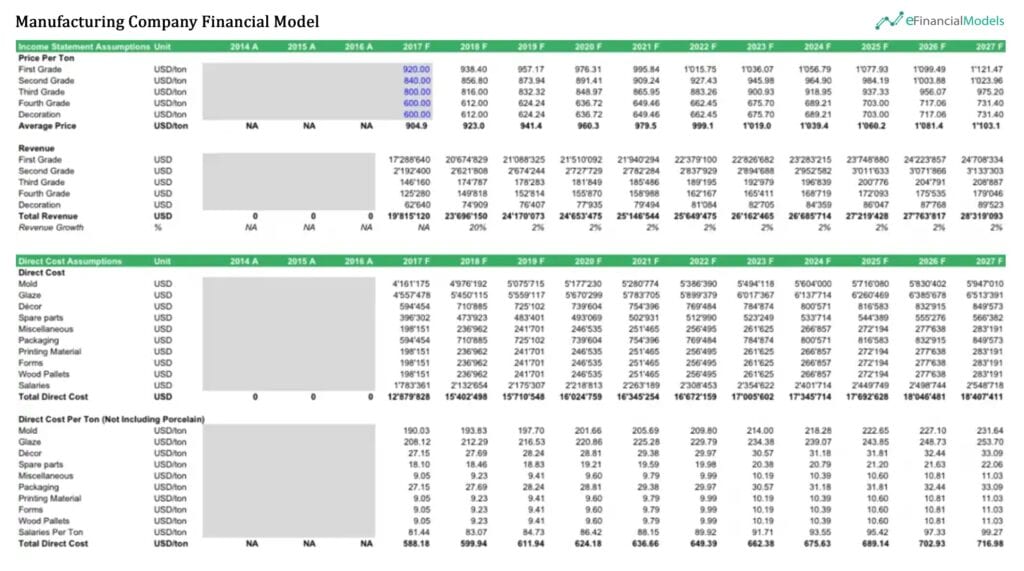
Direct cost examples are essential in a Manufacturing Company’Financial Model. The chart above highlights key cost drivers like mold, glaze, décor, spare parts packaging, and salaries—each tracked yearly and per ton. These figures help managers calculate accurate unit costs, control expenses, and boost profit margins. For instance, in 2027, salaries per ton rise to USD 91.98, and glaze cost reaches USD 253.70 per ton—insights like these guide smart pricing and cost-reduction strategies. The model ensures better decisions and financial planning by breaking down each item.
Indiirect Costs Examples
Indirect costs support business operations but are not linked to a specific product. These costs stay the same regardless of production volume. Another term for indirect costs is operation and maintenance (O&M) expenses. Here are 10 common indirect costs examples:
- Rent – Cost of office or factory space.
- Utilities – Electricity, water, and internet bills.
- Office supplies – Paper, pens, and printer ink.
- Administrative salaries – Pay for managers and office staff.
- Depreciation – Loss of value in equipment over time.
- Insurance – Coverage for property, liability, and employees.
- Marketing expenses – Advertising, promotions, and branding.
- Legal fees – Costs for contracts, compliance, and disputes.
- Accounting services – Fees for bookkeeping and financial reports.
- IT support – Maintenance and software for business operations.
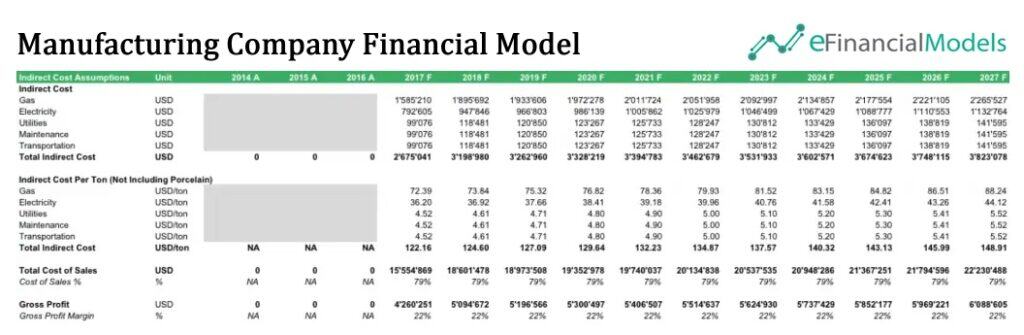
Indirect cost examples are vital in a Manufacturing Company’Financial Model because they reveal hidden expenses that impact profitability. The image outlines key indirect costs like gas, electricity, utilities, maintenance, and transportation—each tracked by year and per ton. For example, electricity costs rise steadily from USD 36.20 per ton in 2017 to USD 44.12 in 2027. These numbers help businesses plan better, manage overhead, and keep gross profit margins steady at 22%. Ignoring these costs risks underpricing products and eroding profits. By including indirect costs, the model gives a full picture of production economics and sharpens financial decision-making.

Why Does Every Business Need to Calculate Total Costs?
Regardless of size or industry, every business must calculate total costs to ensure financial sustainability and strategic decision-making. The total cost calculation provides a comprehensive view of all expenses incurred in producing a product or delivering a service. Companies risk setting unrealistic prices, misallocating resources without a clear understanding of all expenses, and jeopardizing profitability.
Profitability Assessment
Total cost calculation is key to knowing if a business truly makes money. To assess profitability, you must know your total costs. These include everything from materials to overhead. You can calculate key metrics like gross margin, operating margin, and net profit with total costs. Each shows a different layer of your business’s financial health. Without this data, it’s hard to measure real performance.
Understanding your costs is the first step toward boosting profit. It adds up every expense, so profits aren’t just guesses—they’re real. Clear cost data helps set the right prices and control spending. To measure profit the right way, you need a total cost calculation. Investors and managers use it to judge performance. It also keeps reports accurate and honest.
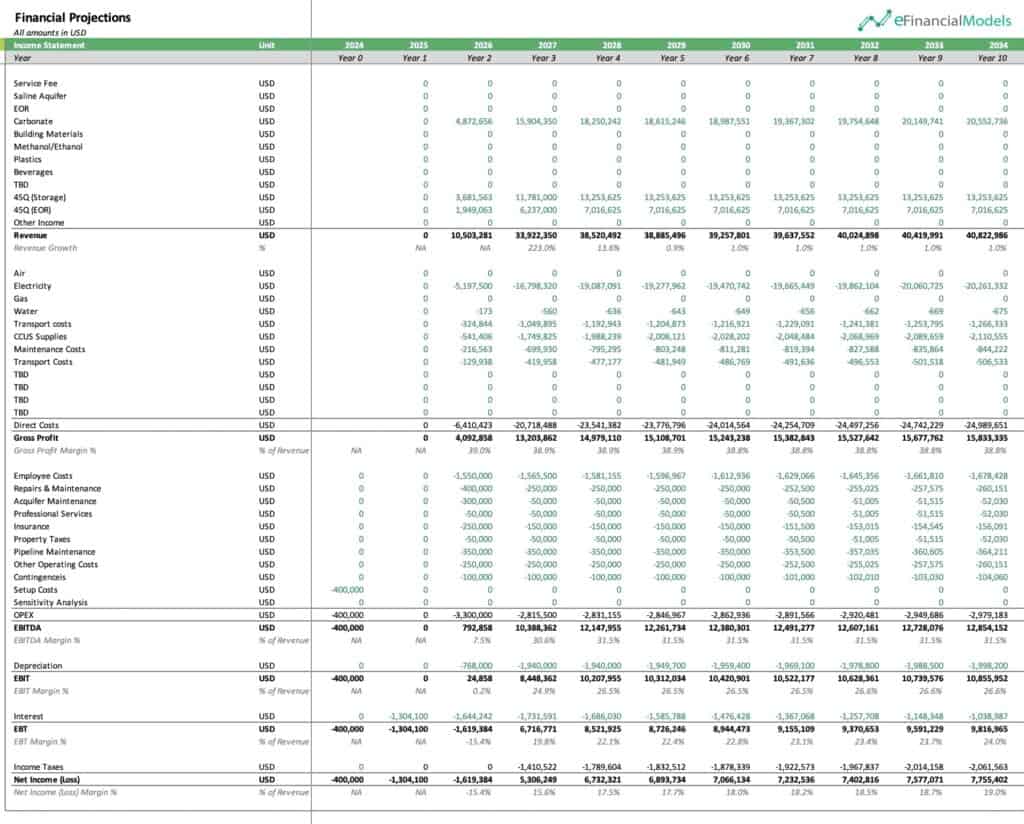
Profitability assessment is essential in Carbon Capture and Sequestration (CCS) Project Analysis because it shows whether the business can cover high operational and infrastructure costs while generating enough revenue to sustain and grow. The above total cost calculation helps by clearly outlining revenue streams like carbonate and storage sales, and subtracting detailed expenses—from electricity to maintenance and employee costs—to reveal gross profit, EBITDA, and net income. This full breakdown allows investors to spot when the project turns profitable, identify financial risks, and decide if the returns justify the investment.
Raising Capital
When raising capital, investors look closely at your total cost structure. Banks, capitalists, and investors need to see where the money goes. Clear details help them judge your burn rate and how long you can operate without more funding. It also shows if your business can survive and grow. Your pitch deck should typically include a clear breakdown of Customer Acquisition Cost (CAC) and Cost of Goods Sold (COGS). These numbers show how much it costs to gain a customer and deliver your product. Investors use them to gauge efficiency and profit potential. Simple, honest figures help build confidence and support your funding goals.
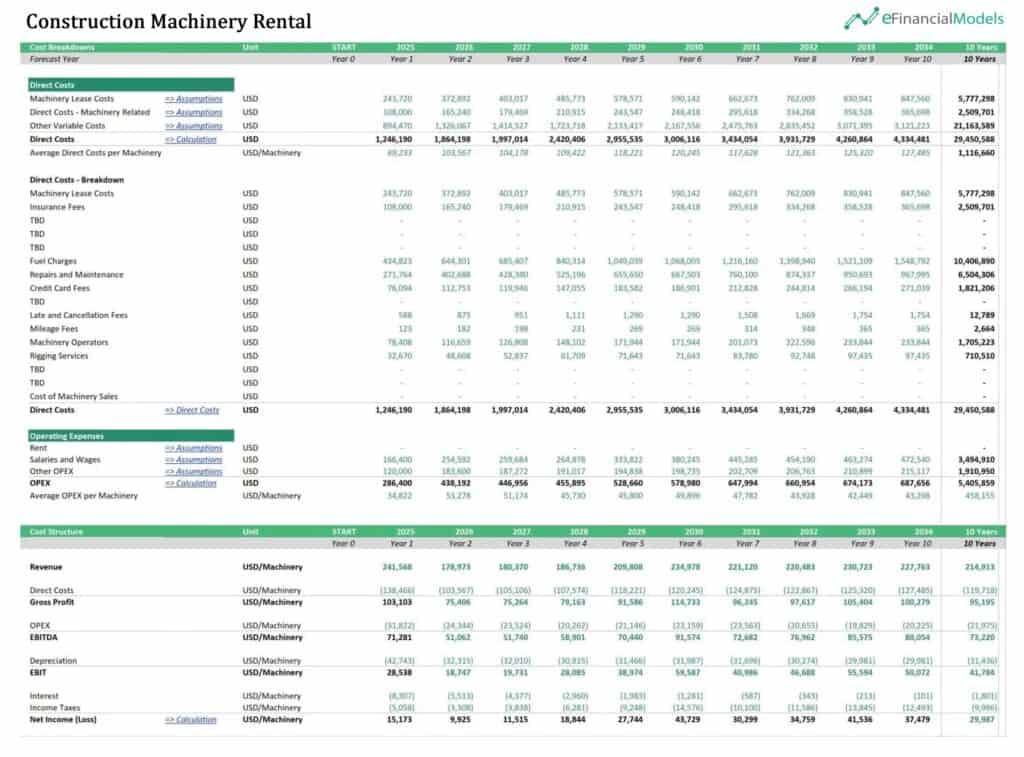
When raising capital, total cost calculation is essential for a Construction Machinery Rental Company because investors want clear insight into where the money goes and how efficiently the business runs. The table above breaks down costs into direct costs, operating expenses, and overall cost structure per machine, year by year. It highlights how expenses like machinery lease fees, salaries, insurance, and repairs increase as the business grows. This clarity helps prove profitability over time, with EBIT and net income improving yearly. Showing this level of detail builds investor confidence by demonstrating control over margins, smart capital use, and long-term returns.
Investment Decisions
Clear cost forecasts help guide investment decisions. Investment decisions rely on clear financial data. Investors want to see costs, profits, and growth potential. They assess risk by reviewing margins, cash flow, and spending patterns. Strong numbers through total cost calculation make your case more convincing. Solid financials turn interest into action.
Smart planning shows you understand the demands of scaling. Growth drives up costs like logistics, staffing, and infrastructure. Investors need to see how you plan for this. Businesses with well-documented cost structures are more likely to make informed expansion decisions. It also proves you can manage growth without losing control.
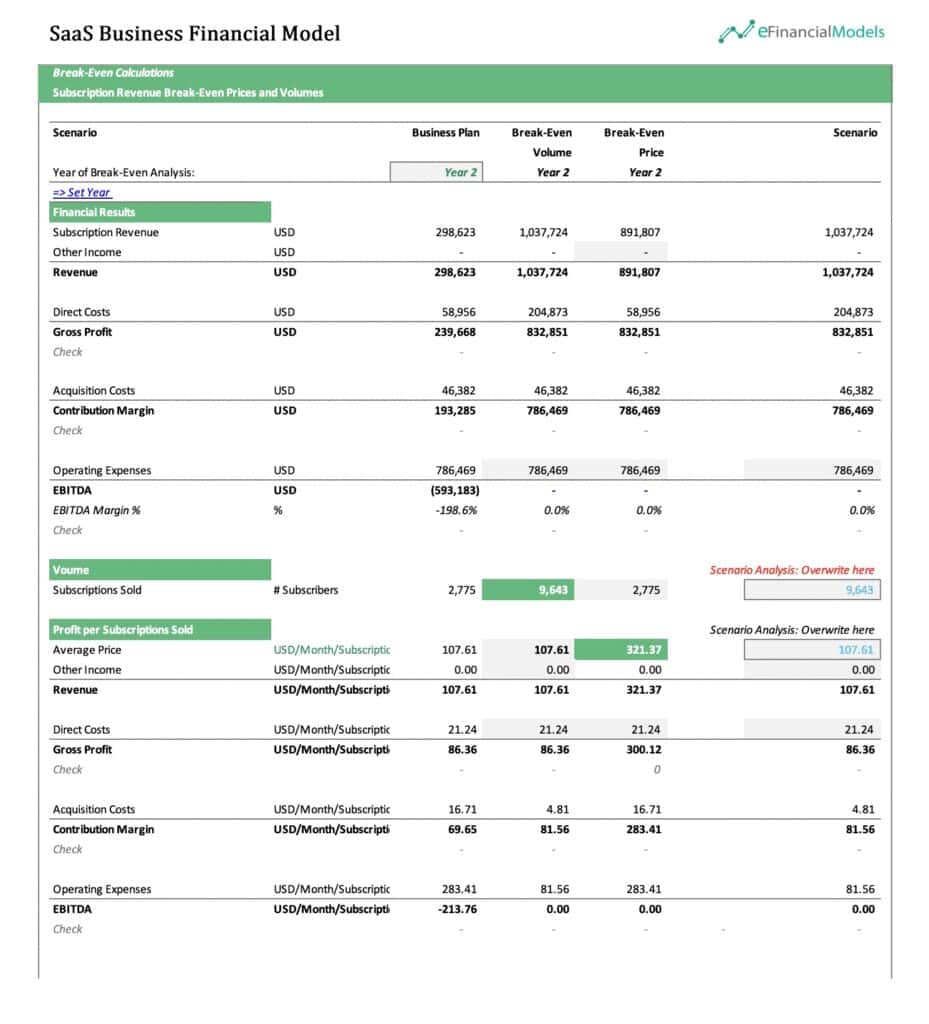
The total cost calculation in the above SaaS Business Financial Model supports investment decisions by clearly showing what it takes to break even. It breaks down all cost components—direct costs, acquisition costs (considered indirect), and operating expenses—to determine how many subscribers or what price is needed to stop losing money. For example, in Year 2, the business plan shows 2,775 subscribers at $107.61 per month, which results in a loss. However, it needs 9,643 subscribers or a much higher price of $321.37 to break even. Acquisition costs—often overlooked—are indirect costs that significantly affect profitability. At $16.71 per subscriber, they influence both the contribution margin and EBITDA.
A break-even analysis involving total cost calculation supports investment decisions by showing exactly when a business will start making a profit. It compares total fixed and variable costs against expected revenue, helping investors see how much must be sold to cover all expenses. This clarity reduces risk by revealing whether sales targets are realistic and the business can sustain itself.
Competitive Pricing Strategy
An accurate total cost calculation enables businesses to price their offerings competitively while maintaining profitability. You can only price your product right if you know your costs. Without this knowledge, you risk undercharging or overcharging. Total cost calculation helps you stay profitable and competitive. It shows what you spend and where. This makes it easier to set prices that cover expenses and earn profit. Know your costs—price smarter.
Knowing your total cost helps you set smart prices. It shows the lowest you can charge while staying profitable. This lets you compete without losing money. A clear cost breakdown also reveals where to cut expenses to offer better deals. Strong cost control gives you an edge in pricing strategy.
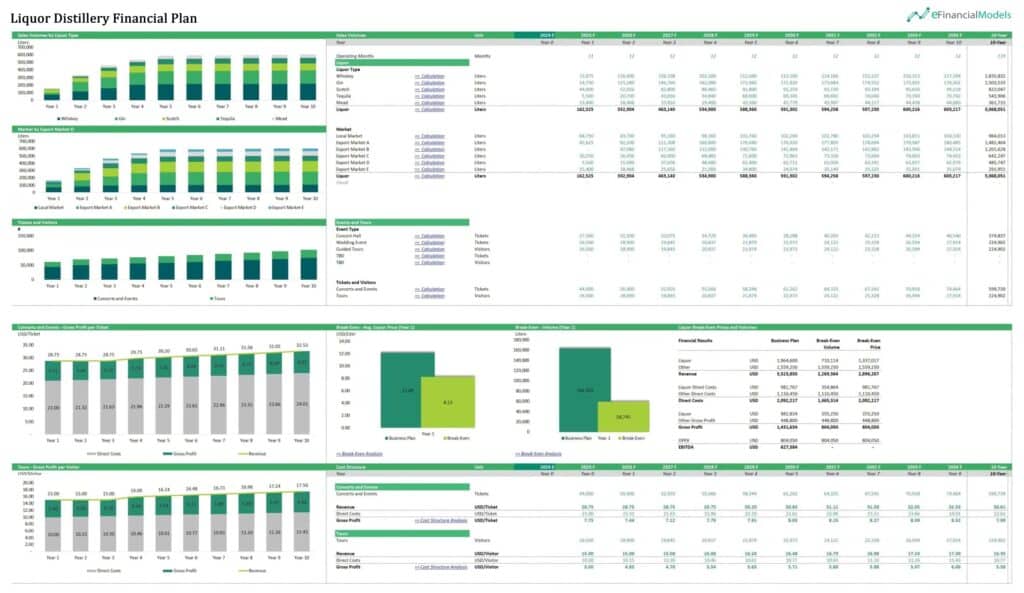
Understanding total cost calculation is crucial for a Liquor Distillery Financial Plan because it shapes a strong pricing strategy that keeps you profitable and competitive. The table shows detailed breakdowns of liquor sales volumes, event ticket sales, and visitor metrics, alongside revenue, direct costs, and gross profit across ten years. For example, concerts and tours generate varying profits per ticket or visitor, and each liquor type and market adds different cost structures. By tracking how much it costs to produce and sell each product or service, the distillery can set prices above break-even points—like $8.23 for liquor in Year 1—to ensure long-term success while staying ahead of competitors.
Budget Planning and Control
Total cost calculation keeps your budget on track. It shows what you spend and where. With this clarity, you can set realistic limits and avoid overspending. It also helps you adjust plans when costs change. Knowing your total cost gives you better control and smarter budgeting.
Reliable budgets need a clear view of all costs. Total cost calculation shows both recurring and one-time expenses. This helps you plan accurately and avoid surprises. It also lets you track spending and spot issues early. With full-cost insight, you stay in control and make better financial decisions.
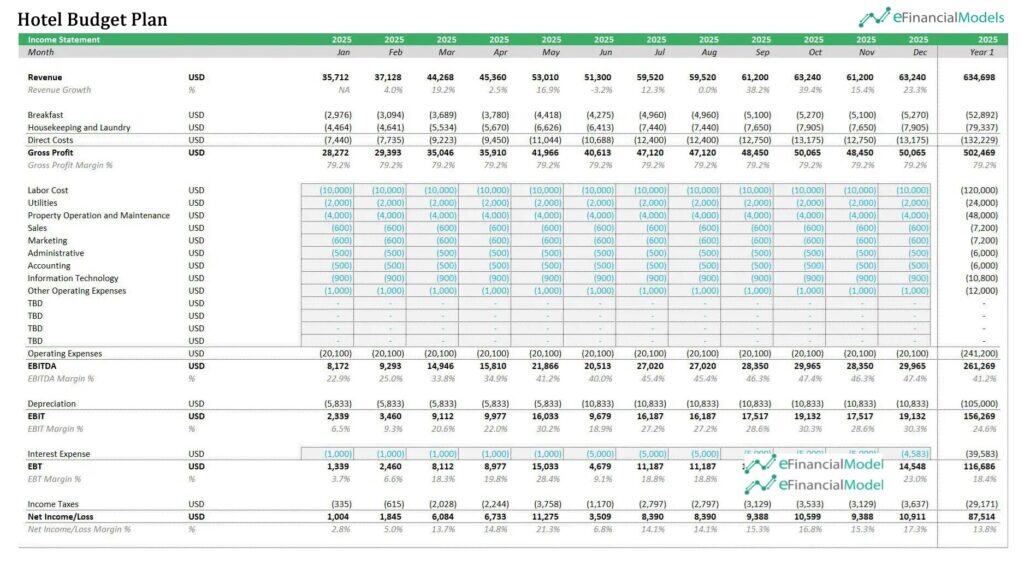
Calculating total costs is essential in a Hotel Budget Plan because it shows where money is spent and helps control expenses. The table above breaks down direct costs like breakfast and housekeeping and operating costs such as labor, utilities, and maintenance. These expenses are summed monthly to calculate gross profit and EBITDA, key performance indicators. Tracking each cost category allows hotel managers to spot trends, adjust spending, and avoid budget overruns.







































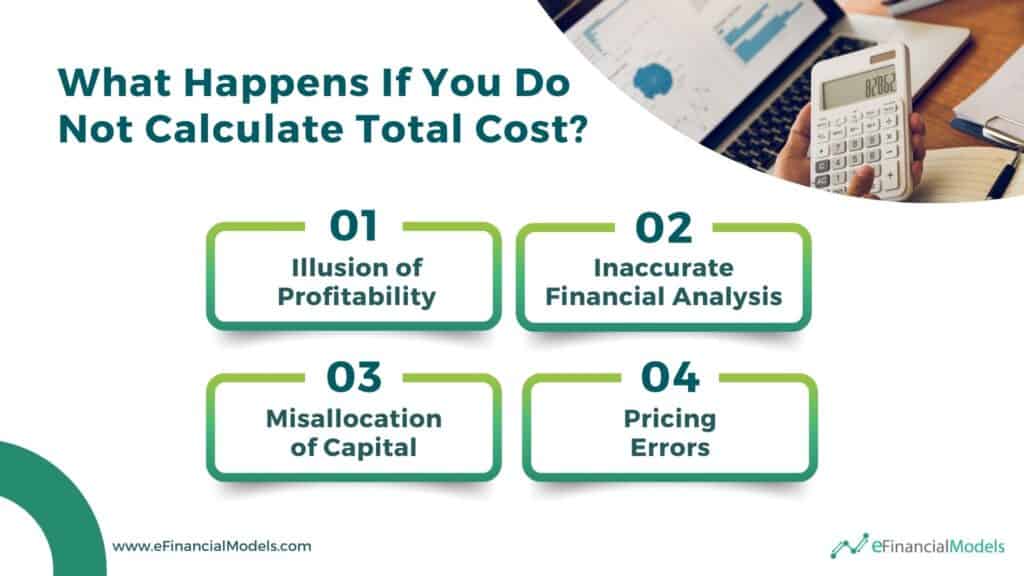
What Happens If You Do Not Calculate Total Cost?
Not calculating total cost can lead to serious issues that distort financial decision-making and harm your business in the long run. Here’s a breakdown of the key consequences:
- Illusion of Profitability: Failing to include all costs can make a business appear profitable when it is actually operating at a loss. For instance, revenue may exceed direct costs, but profits vanish once overhead, depreciation or opportunity costs are considered. This false sense of profit may encourage expansion or further investment, deepening the financial hole.
- Inaccurate Financial Analysis: A miscalculation of total cost gives a distorted picture of the break-even point, gross margin, net profit, and return on investment. This can result in poorly informed decisions by management or investors.
- Misallocation of Capital: Capital will likely be misallocated toward unprofitable or low-return projects. Specifically, resources may be diverted from high-margin offerings to loss-generating ventures. Budgeting and forecasting become unreliable. Strategic planning may fail due to incorrect assumptions.
- Pricing Errors: Without understanding total cost, pricing strategies might be flawed. Prices may be too low to cover all costs, triggering long-term losses. Discounts and promotions may undercut profitability. Businesses that don’t grasp their total cost structure cannot compete on price intelligently.
In summary, neglecting total cost calculations undermines your entire financial strategy, leading to decisions that can erode value and even threaten the survival of your business. Always account for every cost—seen and unseen—to maintain a clear and honest picture of performance.
Excel in Total Cost Calculation with Financial Modeling
To keep a business profitable, calculating total costs is essential. Total cost combines direct costs, like raw materials and labor, with indirect costs, like rent and utilities. Understanding these costs helps businesses set competitive prices, optimize budgets, and maximize profits. Accurate cost tracking improves financial planning, pricing strategies, and investment decisions. By managing expenses wisely, businesses can boost efficiency and stay competitive.
Calculating total costs is essential for every business because it reveals how much you really spend to operate. It helps you measure profits, plan budgets, and price your products to compete. Investors and lenders also want clear cost data before providing funds. When you know your total costs, you can make smarter choices, avoid surprises, and grow with confidence.
Mastering total cost calculation with financial modeling gives businesses a clear financial roadmap. Spreadsheets help track direct and indirect costs, identify savings, and improve pricing. With the right model, companies can forecast expenses, optimize budgets, and boost profits. A well-structured financial model turns data into smart decisions, ensuring long-term success.























You might also like:
- 10 Main Elements of a Business Plan
- 10 Tips to Develop a First Class Business Valuation Report
- Understanding the Debt Service Coverage Ratio: An Essential Metric for Financial Analysis
- How Do Startup Funding Rounds Work?
- Financial Modeling for Startups and Small Businesses
- Financial Statements – Definition, Uses, Contents and Templates
- Personal Finance
- Cost Calculation
- Financial Model Templates Easy to Use
- How to Secure Seed Financing?
- Balance Scorecard
- Building a Monthly Budget – Using Monthly Budget Templates
- Monthly Budget Template (with Financial Statements)
- How to Make a Startup Financial Plan for Fundraising?
- Understanding What is Yield to Maturity and Why It Matters
- 5 Best Practices for Managing Days Receivables
- 5 Tips for Effective Cost Calculation in Business
- Startup Model Templates in Excel that can help your Business Grow
- How to Review a Financial Model?
- Food & Beverages)