
0 ITEMS

Gift Shop Financial Model Excel Template
The Gift Shop Financial Model helps users build a structured financial forecast for a retail gift store without starting from a blank spreadsheet. It gives entrepreneurs, founders, consultants, analysts, and business owners a practical way to estimate revenue potential, startup costs, operating expenses, payroll needs, inventory costs, cash flow, profitability, and funding requirements. The template is designed for gift shops selling categories such as home decor, personal accessories, gourmet foods, stationery, souvenirs, and seasonal items, while remaining flexible enough to adapt to different store concepts, locations, customer profiles, and pricing strategies. This financial model template is useful for anyone preparing a business plan, investor presentation, loan application, internal budget, or expansion analysis. Users can adjust revenue assumptions such as daily foot traffic, conversion rate, average order value, repeat customer behavior, and product mix, then see how those assumptions affect sales, margins, cash balances, and profit over time. The model also helps organize launch costs, operating expenses, staffing assumptions, and cost of goods sold so users can understand the total capital required before opening and the ongoing cost structure needed to keep the store running. Instead of relying on guesswork, users can evaluate the financial logic of a gift shop through connected projections and investor-friendly outputs. The model supports decision-making by showing how different operating choices may influence cash flow, profitability, break-even timing, and return expectations. It helps answer practical questions such as whether the store can cover rent and payroll, how much inventory investment is needed, when the business may become profitable, and which assumptions have the biggest impact on results. Built for usability and customization, the Gift Shop Financial Model can be edited in Excel or Google Sheets and reused for different planning scenarios. It is suitable for first-time retail founders, existing shop owners considering a second location, consultants building client forecasts, and analysts testing retail assumptions. With pre-built formulas, professional formatting, dashboards, financial reports, and scenario analysis, the template saves time while giving users a clearer view of the financial path from launch to sustainable operations.
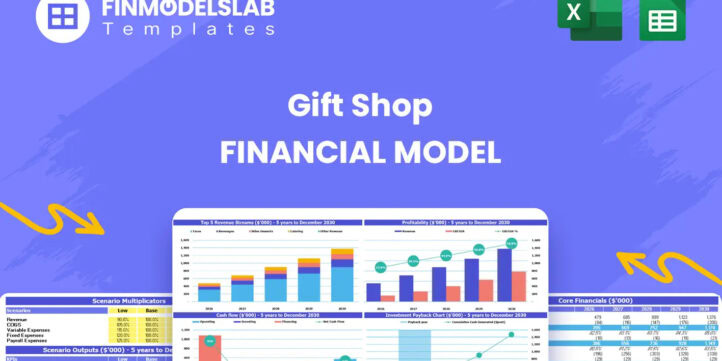


Financial Model Overview
The Gift Shop Financial Model is a ready-to-use financial model template built to help users plan, evaluate, and present the economics of a retail gift shop. It brings together the key financial assumptions that matter for this type of business, including visitor traffic, conversion rates, repeat purchases, product categories, cost of goods sold, staffing, startup investment, operating expenses, cash flow, and profitability. For a gift shop, financial planning is especially important because revenue depends on a combination of location quality, seasonal demand, merchandising, customer experience, and inventory management. This template gives entrepreneurs, business owners, consultants, analysts, and founders a structured way to replace rough estimates with a connected forecast that can support business planning, funding discussions, budgeting, and decision-making. The model is editable, professionally formatted, compatible with Excel and Google Sheets, and designed to help users understand how a gift shop may perform over a multi-year planning period.
All-in-One Dashboard
The all-in-one dashboard gives users a central view of the most important inputs and outputs in the Gift Shop Financial Model. It is designed to summarize the core assumptions that drive the forecast, such as daily visitors, visitor-to-buyer conversion rate, average order value, repeat customer activity, revenue mix, gross margin, payroll, operating expenses, and startup investment. It also helps users review major outputs such as revenue, EBITDA, net profit, cash position, return metrics, and funding needs without moving through every worksheet in detail. For a gift shop owner or founder, this dashboard is useful because it connects operational decisions to financial outcomes in one place. If the user changes assumptions about foot traffic, product pricing, staffing, or inventory cost, the dashboard can quickly show how those decisions influence the broader financial picture. This makes the template easier to use during planning sessions, investor conversations, lender discussions, and internal reviews, especially for users who need a high-level summary before exploring detailed worksheets.
Low, Base, and High Scenario Analysis
The low, base, and high scenario analysis component helps users test how the gift shop performs under different business conditions. A retail store can be affected by many uncertain factors, including customer foot traffic, local competition, conversion rates, seasonal demand, tourism patterns, supplier pricing, and average purchase size. This section allows users to compare conservative, expected, and optimistic forecasts by adjusting the assumptions that have the greatest impact on revenue, margins, and cash flow. In a low case, the model may reflect slower customer growth, lower conversion, reduced average order values, or higher costs. In a base case, it can represent the most realistic plan based on current expectations. In a high case, it can test stronger demand, better merchandising results, or improved repeat customer behavior. This component is valuable for decision-making because it helps users see not only a single forecast, but a range of possible outcomes. Investors and lenders often want to know how resilient a business is if performance is weaker than expected, and this scenario structure helps users prepare for those conversations with a more complete financial view.
Professional Charts
The professional charts component converts the financial forecast into presentation-ready visuals that are easier to interpret and share with stakeholders. Gift shop financial projections can involve many connected assumptions, including multiple revenue streams, cost categories, payroll, inventory costs, cash balances, and profitability measures. Charts help simplify this information by showing trends over time, such as revenue growth, margin development, expense movement, EBITDA progression, cash flow, and profit improvement. This section is especially useful for business plans, investor decks, bank meetings, advisor reviews, and internal strategy sessions because it turns spreadsheet outputs into visual insights. Users can quickly identify whether revenue is increasing at a healthy pace, whether costs are growing faster than sales, whether cash reserves are sufficient, and whether profitability improves as the store scales. For a gift shop, visual reporting can also help explain the effect of seasonality, product mix, and customer growth in a way that is easier for non-financial stakeholders to understand. Instead of relying only on rows of numbers, users can present a clear story about how the store is expected to launch, grow, and move toward sustainable profitability.
ROE Components and DuPont Analysis
The ROE components and DuPont analysis section helps users understand the drivers behind return on equity rather than viewing return as a single isolated number. This component breaks financial performance into underlying factors such as profitability, asset efficiency, and leverage, helping users evaluate how the gift shop generates returns from the capital invested in the business. For a retail gift shop, return performance can be influenced by gross margins, expense control, inventory turnover, store setup costs, debt structure, and the pace at which revenue grows. By using a DuPont-style analysis, the model helps users see whether returns are limited by low net margins, inefficient use of assets, high startup investment, or an underperforming revenue base. This is useful for founders, owners, and investors because it gives a more diagnostic view of performance. If return on equity is weaker than expected, users can explore whether the issue is pricing, cost of goods sold, payroll, rent, inventory management, or capital structure. This component supports better strategic decisions by showing which levers may improve investor returns and long-term financial efficiency.
Revenue Inputs
The revenue inputs component is where users define the commercial assumptions that drive the gift shop forecast. This section may include assumptions for daily foot traffic, visitor conversion rate, average order value, repeat customer frequency, customer growth, pricing, product category mix, and sales ramp-up over time. Since a gift shop often earns revenue from several merchandise categories, the template gives users a structured way to model sales across areas such as home decor, personal accessories, gourmet foods, stationery, souvenirs, seasonal products, or other custom categories. The value of this component is that it links day-to-day retail activity to projected financial results. Users can test what happens if the store attracts more visitors, improves the percentage of visitors who buy, increases average basket size through bundles, or develops repeat purchases through loyalty programs. These assumptions flow through to revenue forecasts, gross profit, cash flow, and profitability, making this one of the most important areas of the model. For business planning and funding documents, a clear revenue input section also makes the forecast more credible because stakeholders can see exactly how projected sales are being built.
Bank-Ready Reports
The bank-ready reports component organizes the financial outputs in a format suitable for lenders, investors, advisors, and other professional stakeholders. When seeking a business loan, lease financing, investor capital, or partner support, a gift shop owner needs more than a revenue estimate. Stakeholders typically want to review financial statements, cash flow projections, profit and loss summaries, assumptions, funding needs, repayment capacity, and key performance metrics. This section helps present the forecast in a clean, structured way so that decision-makers can quickly understand the business model and evaluate risk. The reports may include summaries of projected revenue, cost of goods sold, gross profit, operating expenses, EBITDA, net profit, cash balances, and financing requirements. For a gift shop, lender-friendly reporting is particularly useful because startup costs often include leasehold improvements, retail fixtures, initial inventory, deposits, and working capital reserves. By presenting these needs clearly, the model helps users explain how much capital is required, how funds may be used, and how the business expects to generate enough cash to support operations over time.
Revenue Breakdown
The revenue breakdown component provides a detailed view of the gift shop’s sales streams so users can understand where revenue is expected to come from and how each category contributes to total performance. Rather than treating all sales as one general number, this section separates revenue by product type, merchandise category, or sales channel. For example, users can model categories such as home decor, personal accessories, gourmet foods, stationery, local artisan goods, greeting cards, seasonal items, and other customized product lines. Each stream can be tied to assumptions such as percentage of sales, pricing, gross margin, customer demand, or growth rate. This level of detail is important for a gift shop because product mix has a major effect on profitability. Some categories may generate higher margins but lower volume, while others may sell frequently but require tighter inventory control. The revenue breakdown helps users identify the most important contributors to sales, understand how changes in category mix affect gross profit, and refine merchandising strategy. It also supports better inventory planning, purchasing decisions, pricing strategy, and investor communication by showing the commercial logic behind the total revenue forecast.
KPI Dashboard
The KPI dashboard component gives users a focused view of the key performance indicators that matter most for a gift shop. These may include revenue growth, gross margin, EBITDA margin, net profit margin, average order value, conversion rate, repeat customer activity, cash runway, inventory-related metrics, break-even progress, and return measures. The purpose of this dashboard is to help users monitor the financial health and operational performance of the business at a glance. For a retail gift shop, KPIs are essential because small changes in traffic, conversion, product margin, or payroll efficiency can significantly affect profitability. The dashboard can also help users compare forecasted performance against retail benchmarks or internal targets, making it easier to identify areas that need attention. If gross margin is too low, the user may need to revisit supplier pricing or product mix. If conversion is weak, the issue may be store layout, customer service, merchandising, or local marketing. If cash runway is tight, the user may need to adjust spending or secure additional working capital. This component is useful for ongoing management, funding preparation, and strategic decision-making because it turns complex financial outputs into actionable performance signals.
Startup Cost and Launch Budget Planning
The startup cost and launch budget planning component helps users estimate the amount of capital required before the gift shop begins generating stable revenue. A gift shop typically needs upfront investment for leasehold improvements, store design, fixtures and displays, point-of-sale systems, signage, licenses, deposits, initial inventory, packaging, launch marketing, professional fees, and working capital reserves. This section organizes those costs so users can build a realistic opening budget and understand the full financial commitment required to launch. It also helps separate one-time setup costs from recurring operating expenses, which is important for funding requests and cash flow planning. For entrepreneurs and business owners, this component reduces the risk of underestimating launch capital, one of the most common problems in retail planning. It can also help users compare different launch strategies, such as opening a smaller boutique store, selecting a higher-traffic location with more expensive rent, or investing more heavily in initial inventory and visual merchandising. By clarifying startup funding needs, the model supports better conversations with lenders, investors, landlords, and partners.
Cash Flow and Break-Even Forecast
The cash flow and break-even forecast component helps users understand when the gift shop may become self-sustaining and whether cash reserves are sufficient during the early operating period. Revenue growth and accounting profit do not always mean the business has enough cash, especially in retail, where money can be tied up in inventory, rent deposits, payroll, supplier payments, and seasonal stock purchases. This section projects cash inflows and outflows over time, helping users identify low cash points, potential shortfalls, and the funding buffer needed to operate with confidence. The break-even analysis estimates when cumulative revenue and gross profit are enough to cover startup costs and ongoing expenses, giving users a clear milestone for evaluating business viability. Inputs may include revenue assumptions, gross margins, fixed costs, payroll, rent, marketing, financing costs, capital expenditures, and working capital requirements. For decision-making, this component is valuable because it shows whether the business model can support its cost structure and how long it may take before the store becomes profitable. It also helps users test improvements such as increasing conversion rates, raising average order value, controlling fixed expenses, or improving inventory turnover to reach break-even sooner.
File types:
Excel – Single-User: .xlsx
Excel – Multi-User: .xlsx
Similar ProductsOther customers were also interested in...


 HenrySheykin
Greeting Cards Store Financial Model Excel Templat...
The Greeting Card Business Financial Model helps entrepreneurs and planners turn a creative card con... Read more

 JILL LIU
Subscription Meal Kit Financial & DCF Valuatio...
We are glad to present our new integrated, dynamic and ready-to-use Subscription Meal Kit Financial ... Read more

 Giorgos
Barber Shop – 5 Year Financial Model
5-year financial model for a barber shop providing revenue forecasts, cost analysis, and profitabili... Read more

 Eastwich Advisors
Cannabis Grow, Manufacturing and/or Dispensary Pro...
The Cannabis Grow, Manufacturing and Dispensary Pro-Forma Model is a comprehensive financial tool de... Read more

Tattoo Parlor – 5 Year Financial Model
5-year financial model for a tattoo parlor providing revenue forecasts, cost analysis, and profitabi... Read more
 CFO Templates
Retail Business Financial Model
The Retail Financial Plan is an all-inclusive financial planning template for the retail industry. W... Read more
 anthony
Bundle – Business Financial Forecasting Mode...
The purpose of this Bundle of Business Forecasting and Financial Models is to assist Business Owners... Read more
Grocery Store Financial Model Excel Template
The Grocery Store Financial Model helps entrepreneurs, founders, consultants, analysts, and retail b... Read more
Candy Store Financial Model Excel Template
The Candy Store Financial Model helps entrepreneurs and planners turn a retail confectionery concept... Read more
Flower Shop Financial Model Excel Template
The Flower Shop Financial Model helps entrepreneurs, florists, business owners, consultants, and ana... Read more
You must log in to submit a review.