
0 ITEMS

A Step-By-Step Guide to the Merger and Acquisition Process

In the late 1990s, the energy industry was on the brink of a seismic shift. Two giants, Exxon and Mobil, were at the forefront of this change, and their merger reshaped the global oil and gas industry landscape. In November 1999, after months of negotiations, Exxon and Mobil officially announced their $80 billion merger, creating the largest oil company in the world at that time. Today, the Exxon-Mobil merger and acquisition is a testament to the enduring spirit of innovation and adaptability in the energy sector.
Mergers and acquisitions are key strategies companies use to grow, reshape markets, and increase competitiveness.
- Mergers involve two companies of similar size joining to create a new entity, with shared control and ownership.
- Acquisitions happen when one company buys another, gaining full control and often integrating it into its operations.
- Different types of mergers include horizontal, vertical, conglomerate, and concentric, each serving unique strategic purposes.
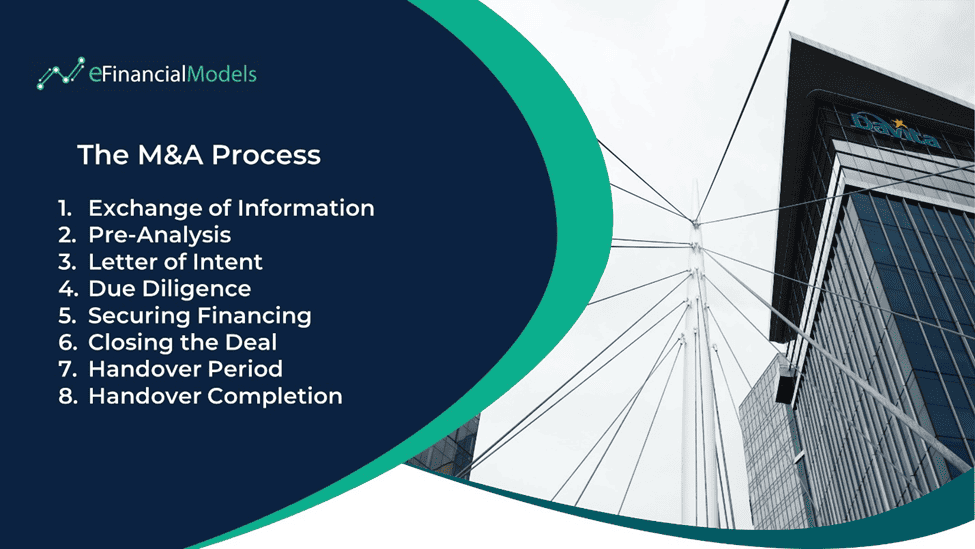
- The M&A process involves several stages: information exchange, pre-analysis, due diligence, securing financing, and deal closing.
- Using financial models during these stages helps evaluate potential synergies, risks, and the true value of targets.
Understanding these core concepts can streamline M&A planning and improve deal success, so continue reading for detailed insights.



























































Merger: Joining Forces to Shape the Future
A merger is a strategic business combination in which two companies of roughly equal size come together to form a new, single entity. A merger creates a new entity, resulting in the dissolution of ownership for participating companies. Instead, the shareholders of both companies become shareholders in the new combined entity. A merger’s control and decision-making power are often more evenly distributed between the merging companies, as they are considered equals.
Mergers can take various legal forms, including a merger of equals (where both companies merge to form a new one) or a subsidiary merger (where one company becomes a subsidiary of the other). The most common types of mergers include:
- Horizontal Merger: Involves companies operating in the same industry and at the same stage of the production process, typically to gain market share, reduce competition, or achieve cost synergies. A famous example of a horizontal merger is the unification of Facebook, WhatsApp, and Instagram, where these social media platforms were already operating in the same industry (social networking).
- Vertical Merger: Occurs between companies in the same supply chain but at different stages of production or distribution. It’s often done to improve efficiency, control costs, or secure a more stable supply chain. Ikea’s vertical merger with the Conservation Fund ensured sustainable wood and other materials sourcing.
- Conglomerate Merger: Involves companies from entirely different industries or business areas. These mergers are often driven by diversification or seeking new growth opportunities. Amazon has expanded into the health food and grocery industry by conglomerating with Whole Foods Market. Today, the conglomerate merger resulted in 585 brick-and-mortar Fresh and Go stores.
- Concentric Merger: When companies operate in related industries or have complementary products or services. The goal is often to achieve synergies through cross-selling or combining expertise. Heinz and Kraft’s concentric merger complemented each other’s food and beverage industry product portfolios.
- Reverse Merger: This is a unique type of merger where a private company acquires a publicly traded company. It allows the private company to go public more quickly and with less regulatory scrutiny. Burger King’s reverse merger with Justice Holdings enabled Burger King to become a publicly traded company without undergoing a traditional initial public offering (IPO).

Acquisition: A Strategic Power Move
An acquisition, also known as a takeover, occurs when an acquiring company purchases another company (the target company) and gains control over its assets, operations, and management. In an acquisition, the acquiring company takes complete ownership and control of the target company, and the target company often ceases to exist as a separate entity. The acquiring company usually has a dominant say in decision-making, owning most or all of the target company’s shares.
Acquisitions can take various forms, including asset acquisitions (buying specific assets of the target company) or stock/share acquisitions (buying the ownership shares of the target company). The most common types of acquisitions include:
- Friendly Acquisition: It is a type of corporate acquisition in which the acquiring company (the buyer) and the target company (the seller) agree to the terms of the deal through negotiation and cooperation. Both parties typically work together to ensure a smooth transition. Vodafone’s acquisition of Mannesmann AG in 2000 was a friendly acquisition. Vodafone and Mannesmann negotiated the terms, and the deal was mutually agreed upon, resulting in a successful merger.
- Hostile Takeover: It is an acquisition attempt in which the acquiring company seeks to purchase the target company’s shares without the target’s consent or cooperation. This type of acquisition is often met with resistance and may involve aggressive tactics to gain control. Sanofi-Aventis’ attempted purchase of Genzyme Corporation in 2011 was initially hostile. Sanofi-Aventis pursued the acquisition without Genzyme’s approval, which led to a contentious process before eventually reaching a deal.
- Leveraged Buyout (LBO): A financial transaction in which a group of investors, often including a private equity firm, acquires a company primarily using borrowed funds (debt) with a relatively small portion of equity. The acquired company’s assets and cash flow are typically used as collateral for the debt. Kohlberg Kravis Roberts (KKR) completed an LBO of Safeway, a grocery store chain, in 1986. KKR and other investors acquired Safeway by borrowing significant money to finance the purchase.

How is a Merger Different from Acquisition
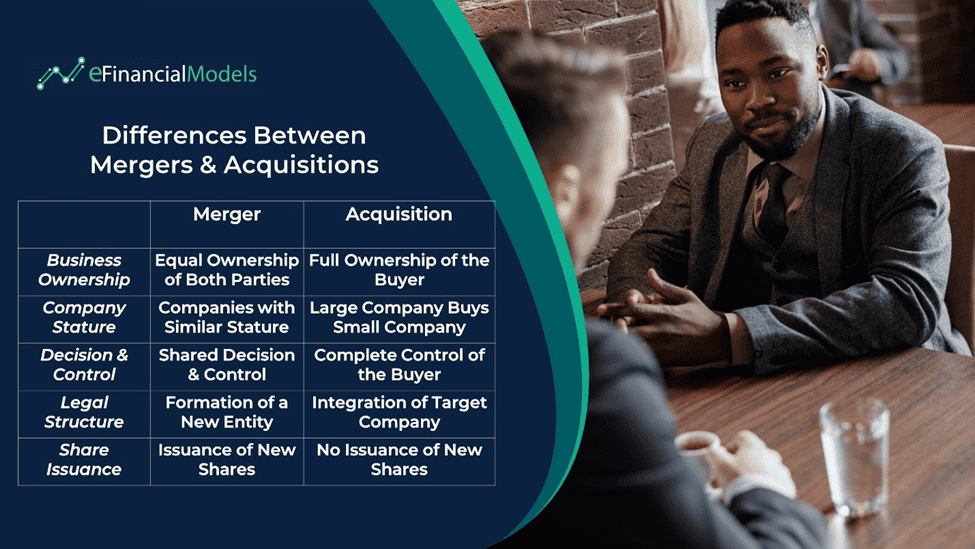
Merger and acquisition deals are corporate restructuring strategies but differ in their fundamental nature and outcome.
Business Ownership
In a merger, two roughly equal-sized companies come together to form a new entity. It’s often described as a “merger of equals,” and the new company’s ownership is typically shared between the two merging firms. In an acquisition, one company (the acquiring company) purchases another (the target company). The acquiring company gains ownership and control of the target company.
Company Stature
Mergers usually involve companies of similar size and stature in the industry. Acquisitions typically involve a larger, more established company (the acquirer) buying a smaller or less established company (the target).
Control
Mergers often result in shared control between the merging entities, each contributing to decision-making. In acquisitions, the acquiring company gains complete control over the target company, making decisions without input from the target’s management.
Legal Structure
Mergers can take different legal structures, such as a merger of equals (where a new entity is formed) or a subsidiary merger (where one company becomes a subsidiary of the other). Acquisitions typically involve one company buying the assets or shares of another company, resulting in the target company becoming a wholly-owned subsidiary or being integrated into the acquiring company.
Share Issuance
In a merger, both companies’ shareholders usually receive shares in the new combined entity in exchange for their existing shares in their original companies. In an acquisition, the target company’s shareholders may receive a combination of cash, stock, or other assets in exchange for their shares, depending on the terms negotiated.
In summary, mergers involve the combination of equals, shared ownership, and forming a new entity. In contrast, acquisitions involve purchasing one company from another, with the acquiring company gaining complete control over the target.
















































The M&A Process
Mergers and Acquisition strategies are complex and involve numerous steps, each carrying challenges and opportunities. The primary goal of merger and acquisition deals is to create synergy, increase shareholder value, and achieve strategic objectives. On average, the merger and acquisition process can last from as short as six months to as long as several years.
Step 1 – Exchange of Information
The initial stage involves exchanging information between the acquiring and target companies. Both parties share non-sensitive data to explore the potential fit between them. This stage frames the rest of the process. It is a critical phase for building trust and alignment. There are usually two ways to contact target companies: directly or via a middleman. In this step, you can evaluate the target firm owner’s interest in selling or merging and acquire a basic sense of their expectations regarding valuation.
Step 2 – Merger and Acquisition Pre-Analysis
Once basic information is exchanged, a detailed pre-analysis or preliminary evaluation is conducted. It involves assessing the companies’ compatibility, and a valuation range for the target is often proposed. A thorough pre-analysis prevents both parties from entering a transaction that could harm them. Firms often leverage financial models to analyze synergies and valuation metrics.
Various business valuation methods assess the target company’s worth during the pre-analysis stage of merger and acquisition strategies. The choice of method depends on the nature of the business, the availability of data, and the specific circumstances of the M&A transaction. Two standard methods are Discounted Cash Flow (DCIF) and Capitalization of Earnings:
- Discounted Cash Flow (DCIF): The discounted cash flow analysis estimates a company’s present value by projecting its future cash flows and discounting them to their current value. This method involves forecasting a company’s expected cash flows over a specific period and applying a discount rate to those cash flows. The goal is to determine the net present value (NPV) of these cash flows, which represents the estimated intrinsic value of the business. It is considered a more comprehensive and flexible approach as it assumes the timing and risk associated with future cash flows.
- Capitalization of Earnings: The capitalization of earnings method is a simplified approach that values a company based on its current or expected earnings. It divides the company’s earnings (typically net income or EBITDA) by a capitalization rate. The capitalization rate is determined by considering factors such as the company’s risk profile, industry benchmarks, and prevailing interest rates. The resulting value represents the estimated worth of the business as of the valuation date. Businesses use the capitalization of earnings method when there’s a stable and predictable earnings history.
Step 3 – Letter of Intent (LOI)
The Letter of Intent is a formal document that outlines the primary terms and conditions of the transaction. It is issued at this juncture because it moves the transaction from a general interest phase to a serious commitment. It also sets the expectations for the forthcoming due diligence stage. Issuing the LOI later could lead to inefficient use of resources, as significant time and effort may be spent on negotiations and due diligence without a formal commitment from both sides. An LOI acts as a ‘soft’ agreement that reassures parties of the other’s interest, justifying allocating more extensive resources in the subsequent stages.
Pro-tip: During M&A transactions, utilizing a Letter of Intent (LOI) template ensures clarity, streamlines negotiations, and sets a professional tone, paving the way for a smoother due diligence process and successful deal closure.
Step 4 – Due Diligence
The due diligence process is an exhaustive phase where the acquiring company investigates the target company’s assets, liabilities, operations, and other relevant aspects. It is crucial to verify the assumptions and projections made during the pre-analysis. It is also essential for identifying potential red flags or deal-breakers. The timescale of the due diligence process (usually 30 to 60 days) should be approximated in the letter of intent (LOI), while the exact timetable will differ based on the firm.
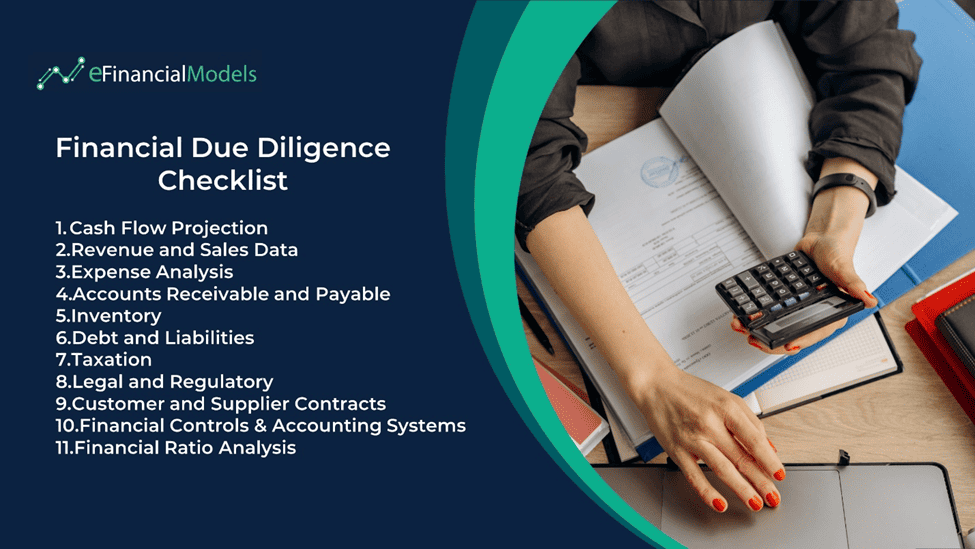
Due diligence in M&A refers to the assessments you carry out to make sure everything is in place before you complete a purchase. At this point, the buyer should develop operational and financial models and evaluate how well the two companies’ cultures mesh. A financial due diligence checklist must include the following:
- Cash Flow Projection: This involves collecting financial statements from the last 3 to 5 years, including income statements, balance sheets, and cash flow statements to estimate future cash flows.
- Revenue and Sales Data: This means analyzing revenue trends over the past 3 to 5 years to look for growth rates, seasonality, and significant changes.
- Expense Analysis: A process of identifying major cost drivers and expense trends.
- Accounts Receivable and Payable: Reviewing accounts receivable aging to assess the quality of accounts receivable and potential bad debt issues. Furthermore, analyzing accounts payable helps understand payment terms and supplier relationships.
- Inventory: This involves evaluating the inventory turnover ratios and aging and assessing depreciation methods and schedules to determine the impact on asset values.
- Debt and Liabilities: It involves analyzing the company’s debt structure and examining any covenants or restrictions associated with debt agreements.
- Taxation: The process includes determining the company’s effective tax rate, deferred tax assets or liabilities, and pending tax disputes.
- Legal and Regulatory: Identifying any pending or historical legal issues, lawsuits, or regulatory compliance concerns to assess potential legal and regulatory risks.
- Customer and Supplier Contracts: Review key customer contracts, including pricing terms, contract duration, and renewal options for pricing stability.
- Management and Personnel: Evaluating the qualifications and experience of the company’s management team.
- Financial Controls and Accounting Systems: The process includes assessing the quality of the company’s banking relationships, cash management, financial controls, and internal accounting systems.
- Financial Ratio Analysis: This is the most critical part of the financial due diligence checklist. It involves analyzing and calculating key financial ratios, including leverage ratios (debt to equity, interest coverage), liquidity ratios (current ratio, quick ratio), and profitability ratios (gross margin, operating margin, net profit margin).
This final financial due diligence checklist assessment report includes findings, recommendations, and valuation results. It summarizes the risks identified in the above areas and assesses their potential impact on the company’s financial performance and valuation. It’s important to note that the specific items on the checklist may vary depending on the nature of the transaction, the industry, and the particular goals of the due diligence process. Additionally, it’s often advisable to involve financial experts, such as accountants, financial analysts, and legal advisors, to conduct a thorough financial due diligence review.
Step 5 – Securing Financing
This phase involves arranging the finances needed to complete the transaction. Financing merger and acquisition deals involve various choices. These may include assets, cash, debt, equity, or stocks. The mezzanine or special purpose vehicle (SPV) types are unique financing structures for M&A transactions. The choice of financing depends on factors such as the financial situation of the acquiring company, the target company’s value, the strategic goals of the deal, and the economic environment. It’s also typical for merger and acquisition deals to involve a combination of financing methods to achieve the desired financial structure.
Step 6 – Closing the Merger and Acquisition Deal
It is the phase where all the contracts are signed, and the transaction is legally and officially completed. Closing is the culmination of all previous efforts and marks the legal commencement of the merged entity or the acquisition.
Step 7 – Handover Period
Also called post-merger integration is a transitional period where the target company is integrated into the acquiring company. The success of the M&A often rests on how effectively the two companies can be integrated. Strategies to realize operational and financial synergies are implemented during this period.
Step 8 – Handover Completion
Completion marks the end of the transition period, signaling that the companies have been fully integrated. Successfully completing the handover implies that the objectives of the M&A transaction have been achieved, and the new entity can now operate as a unified organization.
Simplify Your Deal Using M&A Financial Models
The role of financial modeling in facilitating merger and acquisition strategies is pivotal, acting as the linchpin that can either make or break such complex transactions.
A three-statement financial model interlinks the income statement, balance sheet, and cash flow statement. By aligning these three financial statements, stakeholders can assess the business’s operational efficiency, liquidity, and solvency. A capitalized earnings business valuation model uses its prospective earnings to determine its present value. This method presents a snapshot of what the company might be worth today. A discounted cash flow valuation model, often seen as the gold standard in valuation, calculates the present value of all future cash flows. It gives stakeholders a more detailed understanding of a company’s intrinsic value, factoring in elements like the time value of money and various risks associated with future cash flows.
In merger and acquisition strategies, understanding the worth and financial health of the target company is paramount. A comprehensive Mergers and Acquisitions (M&A) Financial Model serves this purpose by simulating various scenarios a combined entity would face. It analyzes both balance sheets, aligns differing accounting practices, and forecasts the future financial situation of the merged entity.
At eFinancialModels, we provide comprehensive and sophisticated financial model templates tailored to meet the needs of parties involved in merger and acquisition deals. Our templates and services epitomize the highest level of professionalism and competence, preparing you to make superior financial decisions.














You might also like:
- 10 Tips to Develop a First Class Business Valuation Report
- 10 Main Elements of a Business Plan
- 12 BUSINESS VALUATION METHODS
- 5 Practical Tips to Help Raise Funds For Startups
- Financial Modeling for Startups and Small Businesses
- Cash Flow Analysis in Excel
- Finding a Valuation Model for Your Business
- Best in Class Property Appraisal Methods and What to Look Out for
- Financial Ratios Analysis and Its Importance
- How to Value a Business Using a Discounted Cash Flow Model
- How to Write a Business Plan Step-by-Step
- How to Grow an Event Organizer Business
- How to Optimize the Average Selling Price: Strategies for Higher Profits
- Financial Projections Templates – The Easy Way
- Revenue Model Templates and their Characteristics
- Investment
- Business Valuation
- 10-year Financial Projections
- Financial Model for Mobile App | Mobile App Business Plan
- Simple Fundraising Model