
0 ITEMS

How Are Valuation Multiples Determined

Understanding valuation multiples is essential for assessing a company’s worth and making informed investment decisions.
- Valuation multiples compare a company’s value to key financial metrics like sales, EBITDA, or earnings.
- They help determine if a stock is undervalued or overvalued within its industry.
- Industry-specific multiples, such as EV/EBITDA or P/E, vary based on capital structure and growth prospects.
- Lower multiples generally indicate better investment opportunities, but must be viewed in context.
- Applying these multiples in combination with other valuation methods improves accuracy.
Continuing, this article explains how valuation multiples are calculated and used in different scenarios.
What Are Valuation Multiples?
Valuation multiples, also known as financial multiples or value multiples. They are key financial ratios used to assess the relative value of a business. There are different valuation multiples by industry. But the basic formula for calculating them is:
Valuation Multiple = Value Measure/Value Drivers
Where:
Value Measure = Enterprise Value or Equity Value
Value Drivers = financial or operating metric, i.e., book value, cash flow, EBIT, EBITDA, sales, stock price.
Valuation multiples by industry differ due to varying capital structures and growth prospects. Some are more relevant to a certain industry or type of business than others. So, it is essential to note that they should not be used in isolation but as part of a comprehensive analysis.
The idea behind valuation multiples is that you determine a company’s market value. Firms can use different key financial metrics in different valuation multiples methods. By dividing one or more important business measures by the estimated values of comparable companies, they will likely arrive at fair enterprise or equity value multiples. By comparing multiples, investors can get insights into how the market values a company’s assets, earnings potential, or financial performance relative to its peers. As such, valuation multiples are valuable tools for investors and analysts. They provide a quick and straightforward way to compare companies within the same industry or sector.
























































What Are the Different Types of Valuation Multiples?
There are several ways to calculate the value of a company. Hence there are various sorts of valuation multiples methods. For example, you may determine the market cap of a publicly traded business by multiplying its stock price by the number of outstanding shares. However, they may be less helpful for privately held businesses. Private businesses must adopt different valuation multiples methods than publicly traded ones.
Valuation multiples are financial key ratios used to assess a company’s enterprise or equity value. They are commonly employed in the valuation process to compare companies across different sectors or within the same industry. Valuation multiples methods can be classified into two main categories: Enterprise Value multiples and Equity Value multiples.
Enterprise Value Multiples
Enterprise Value multiples are financial metrics used to value a company as an alternative to traditional price-based metrics. These financial multiples are unlevered metrics because they consider a business’s value based on its capital structure. They provide a more comprehensive valuation after a business has met all financial obligations, including debt and equity.
The most commonly used enterprise value multiples are:
- Enterprise Value/Sales (EV/Sales): Enterprise Value/Sales multiple compares a company’s total enterprise value (TEV) to its total revenue (sales). It helps investors understand how much they pay for each dollar of sales the company generates.
- Enterprise Value/EBITDA (EV/EBITDA): Enterprise Value/EBITDA multiple compares a company’s total enterprise value (TEV) to its Earnings Before Interest, Taxes, Depreciation, and Amortization (EBITDA). EBITDA measures a company’s operating performance and overall profitability.
- Enterprise Value/EBIT (EV/EBIT): Similar to EV/EBITDA, this multiple compares a company’s total enterprise value to its Earnings Before Interest and Taxes (EBIT). EBIT excludes depreciation and amortization from EBITDA and measures operating profitability.
Lower Enterprise Value multiples are generally more attractive than higher ones for several reasons. Lower EV multiples can be seen as a bargain – the company’s stock may be undervalued compared to its fundamental performance. It can also be considered a safer investment since it offers a margin of safety.

Equity Value Multiples
Equity value multiples, also known as levered metrics, are financial key ratios used to evaluate the value of a company’s equity or market capitalization. These metrics incorporate the company’s debt or leverage in their calculations.
The most commonly used equity value multiples as levered metrics include:
- Price/Earnings Ratio: The P/E ratio is a popular metric that compares a company’s stock price to its earnings per share (EPS). Considering the company’s leverage, the earnings used in the denominator should be adjusted for interest expense and taxes. A higher P/E ratio generally suggests that investors are willing to pay a premium for the company’s earnings, indicating higher growth expectations. However, it could also mean the stock is overvalued. A lower P/E ratio might indicate a potential undervaluation but could also signal lower growth prospects or higher risk.
- Price/Book Value Ratio: The Price/Book Value ratio compares a company’s stock price to its book value per share. The book value per share is the net asset value of the company’s equity. When calculating the Price/Book Value ratio, the book value per share is adjusted for the impact of debt and other liabilities. A P/B ratio greater than 1 suggests that the stock is trading at a premium to its book value, while a ratio below one may indicate that the stock is undervalued compared to its net assets. A lower P/B ratio is often considered more attractive to value investors seeking undervalued stocks.

How Do Valuation Multiples Work
Business valuation methods can be divided into three main categories. These include the market-based approach, income-based approach, and asset-based approach. Valuation multiples methods are under the market-based approach. Such an approach assumes that the soundest way to determine a company’s value is by comparing it to similar businesses. Let’s go through a sample calculation for each of the valuation multiples methods:
Sample Calculations for Enterprise Value Multiples
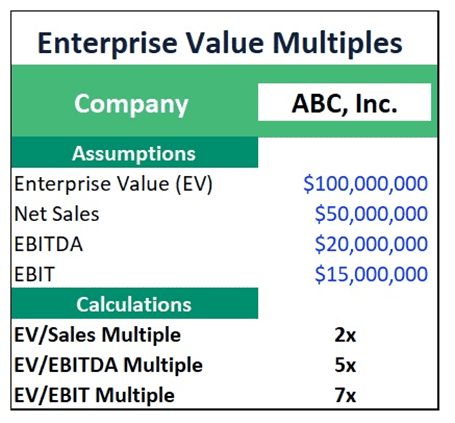
The sample calculation above shows a fictional company called ABC Inc. with the following assumptions:
Enterprise Value (EV) = $100 million
Net Sales = $50 million
EBITDA = $20 million
EBIT = $15 million
Upon calculation, the resulting Enterprise Value Multiples for ABC, Inc. are as follows:
EV/Sales Multiple = 2x
EV/EBITDA Multiple = 5x
EV/EBIT Multiple = 7x
Let us have another example – another fictional company called XYZ, Inc., with the following assumptions:
Enterprise Value (EV) = $100 million
Net Sales = $20 million
EBITDA = $10 million
EBIT = $5 million
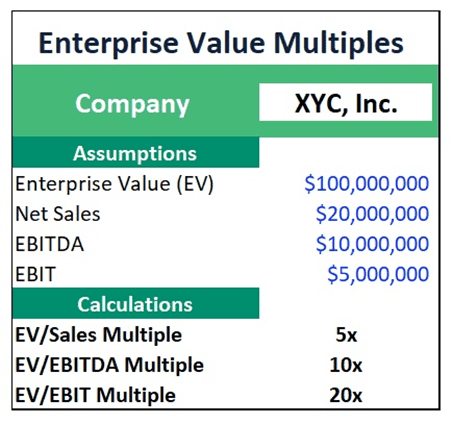
Upon calculation, the resulting Enterprise Value Multiples for XYZ, Inc. are as follows:
EV/Sales Multiple = 5x
EV/EBITDA Multiple = 10x
EV/EBIT Multiple = 20x
A good EV/Sales Multiple is generally between 1x to 3x. At the same time, a good EV/EBITDA Multiple or EV/EBIT Multiple is below 10x. Looking at the above figures, investors may find Company ABC Inc. attractive and Company XYZ Inc. risky.














































Sample Calculations for Equity Value Multiples
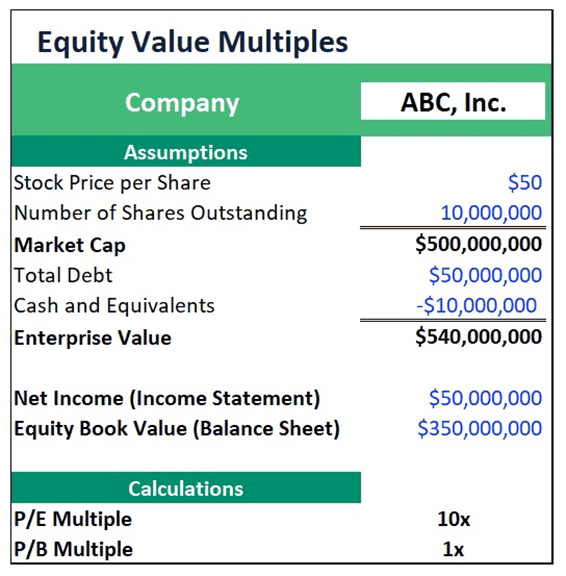
The sample calculation above shows a fictional company called ABC Inc. with the following assumptions:
Stock Price Per Share = $50
Number of Shares Outstanding = 10 million
Total Debt = $50 million
Cash and Equivalents = $10 million
Net income (Income Statement) = $50 million
Equity Book Value (Balance Sheet) = $10 million
Upon calculation, the resulting Equity Value Multiples for ABC, Inc. are as follows:
P/E Multiple = 10x
P/B Multiple = 1x
Let us have another example – another fictional company called XYZ, Inc., with the following assumptions:
Stock Price Per Share = $100
Number of Shares Outstanding = 10 million
Total Debt = $50 million
Cash and Equivalents = $10 million
Net income (Income Statement) = $50 million
Equity Book Value (Balance Sheet) = $10 million
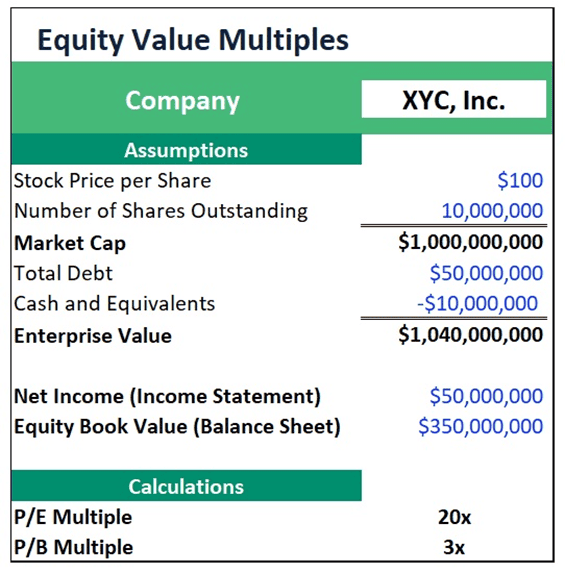
Upon calculation, the resulting Equity Value Multiples for XYZ, Inc. are as follows:
P/E Multiple = 20x
P/B Multiple = 3x
A good P/E Multiple is generally between 20x to 25x. At the same time, a good P/B Multiple is between 1x to 3x. Anything below such values is typically desirable to investors. Looking at the above figures, investors may find Company ABC Inc. more attractive than Company XYZ, Inc.
The sample calculations above are intended to serve as examples for understanding the calculation of valuation multiples. Please note that valuation multiples by industry vary. Other factors, like capital structure, growth rate, market risks, etc., may also affect what is a good valuation multiple for a specific company.
Understand Your Business Better Using Valuation Multiples
Valuation multiples play a crucial role in determining the value of a business. They are used by entrepreneurs, financial analysts, and investors alike. By exploring enterprise value multiples such as EV/Sales, EV/EBITDA, and EV/EBIT, and equity value multiples like P/E and P/B, you can better understand how businesses are valued in the market.
Acceptable valuation multiples can vary depending on the industry, market conditions, and other factors. These may include capital structure, company size, industry growth prospects, characteristics, profits, etc. So, it is vital to consider these factors and use a combination of valuation methods to arrive at a well-rounded assessment of a company’s value.















You might also like:
- 10 Tips to Develop a First Class Business Valuation Report
- 12 BUSINESS VALUATION METHODS
- Finding a Valuation Model for Your Business
- What are the Main Drivers of Business Valuations?
- Understanding the Debt Service Coverage Ratio: An Essential Metric for Financial Analysis
- How to Value a Business Using a Discounted Cash Flow Model
- Commercial Real Estate Valuation Methods: Helping Investors in Taking Informed Decisions
- The EV/EBITDA Multiple – The Preferred Choice for Professional Investors
- The Potential of Carbon Capture and Sequestration
- Financial Modeling for Startups and Small Businesses
- How to Calculate Net Present Value (NPV)?
- Simple Private Equity Deal Template
- Startup Financial Models
- Financial Projections – The Easy Way
- Private Equity vs. Venture Capital: Which is Right for You
- 10 Main Elements of a Business Plan
- Top 10 Mistakes in DCF Valuation Models
- How to Make Smart Decisions with 6 Key Financial Metrics?
- How to Start a Distillery Business: What You Need to Know?
- Discounted Cash Flow Valuation Model: Free Excel Template
Tags: business valuation