
0 ITEMS

How Do Accrued Expenses Work?
Accrued expenses are a key part of financial reporting that reflect obligations to pay for goods or services received but not yet settled.
- They are recorded as liabilities on the balance sheet under current liabilities, typically paid within a year.
- Examples include wages, interest, utilities, rent, taxes, and employee bonuses.
- Accrued expenses differ from accounts payable, where invoices have been received but not paid, while accrued expenses are incurred but not invoiced yet.
- Proper calculation and recording of accrued expenses ensure accurate financial statements, compliance, and better management decisions.
This article provides practical guidance for managing accrued expenses effectively in financial models and accounting practices.
What Is an Accrued Expense?
An expense recorded on the books before it is paid is called an accrued expense. It has to be recorded during the accounting period it has been incurred to ensure that a company’s financial statements accurately reflect its financial position and performance for a given period.
An accrued expense is a liability a company has incurred but has yet to pay. It represents an obligation to make a future payment for goods or services received or consumed, but the actual payment has yet to be made by the end of the accounting period. Accrued expenses are recorded on a company’s financial statements to accurately reflect its financial position and ensure that expenses are matched with the revenue they generate, following the accrual accounting method. These expenses will be paid in the future, and until they are settled, they are considered a part of the company’s outstanding obligations.

Accrued Expenses Examples
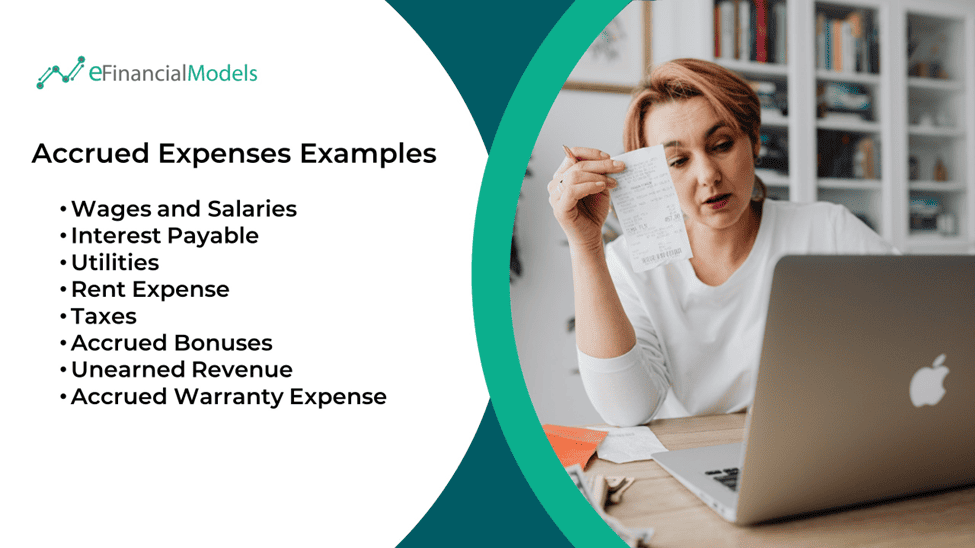
Here are some common accrued expenses examples:
- Wages and Salaries: These are often accrued at the end of a pay period, especially if the pay period does not coincide with the end of the accounting period.
- Interest Payable: Interest incurred on loans or credit lines that have not been paid by the due date.
- Utilities: Bills for utilities like electricity, gas, and water that have been incurred but have yet to be paid at the end of the accounting period.
- Rent Expense: If rent is paid in advance, the portion of rent expense that relates to the period after the payment date is accrued.
- Taxes: Taxes such as income, sales, or property taxes that are accrued but still need to be paid.
- Accrued Bonuses: If a company has a bonus program, bonuses that employees have earned but have yet to pay out.
- Unearned Revenue: While this might seem counterintuitive, unearned revenue is a liability that represents payments received in advance for goods or services that still need to be provided. As the services are delivered, the liability is reduced, and revenue is recognized.
- Accrued Warranty Expense: If a company offers warranties on its products, it may need to accrue for expected warranty costs that have not yet been incurred but are likely to be in the future.
These are just some accrued expenses examples. The specific types of accrued expenses examples can vary from one company to another, depending on their industry, accounting methods, and business operations.
Is Accrued Expenses an Asset or Liability?
Accrued expenses examples represent obligations to pay for goods or services received in the past or for which invoices have been received but have not settled. You can find them on the balance sheet under the current liabilities list, typically alongside other short-term obligations like accounts payable and short-term loans. Item under the current liabilities list is normally expected to be settled within the next accounting period or less than a year.
Are Accrued Expenses Part of Accounts Payable?
Accrued expenses are not the same as accounts payable, although they are related financial concepts. Both accrued expenses and accounts payable are liabilities on a company’s balance sheet, but they represent different types of liabilities and are recorded at different times.
Accounts payable typically refers to the amounts a company owes to its suppliers or vendors for goods or services that have been received but have yet to be paid. They are recorded when suppliers receive invoices but have yet to be paid. On the other hand, accrued expenses represent expenses that have been incurred but have yet to be paid or recorded in the company’s accounting records. They are registered as a liability on the balance sheet once they are incurred, even if the actual payment is to be made in the future.
In summary, both accounts payable and accrued expenses are liabilities. Over time, accrued expenses may be recognized as accounts payable when the payment is due.













































How to Calculate Accrued Expenses?
Accurate calculation of accrued expenses is essential for financial reporting and managing a company’s financial health. Here are the steps to accurately calculate accrued expenses:
Step 1 – Identify the Expense
- Determine the nature of the expense that needs to be accrued. Common examples of accrued expenses include salaries and wages, rent, utilities, interest, and taxes. Here are some of the best ways to identify accrued expenses:
- Analyze financial statements from your vendors and suppliers to ensure all outstanding invoices and bills are accounted for.
- Check your bank and credit card statements for transactions that represent expenses that still need to be paid.
- Review your company’s expense reports and invoices. Look for any expenses that have been incurred but have not been paid.
Step 2 – Determine the Accrual Period
The accrual period refers to the time frame over which revenues and expenses are recognized in financial statements, regardless of when the actual cash transactions occur. Decide on the time period for which you need to accrue the cost. It could be a day, a week, a month, or any other time frame that aligns with your financial reporting.
- Check when expenses are incurred based on the accrual accounting concept. It typically occurs when goods or services are received or obligations are fulfilled, regardless of when the payment is made.
- Determine when revenue is earned by considering factors like the completion of a service, the delivery of goods, or the satisfaction of performance obligations as per applicable accounting standards.
Consistency in applying the accrual period is crucial for accurate financial reporting. Avoid frequently changing your accounting methods, leading to inconsistencies and distorting financial performance.
Step 3 – Calculate the Accrual Amount
The accrual amount is the estimated expense that needs to be recognized for the selected accrual period. There are two main methods for calculating the accrual amount:
- Straight-Line Accrual: It is used in accounting to distribute the recognition of revenue or expenses evenly over a specified period of time, typically for long-term contracts or assets. The formula for straight-line accrual naturally divides the total annual expense by the number of accrual periods in a year to get the monthly accrual amount.
- Actual Usage Accrual: Determine the amount incurred during the selected period. It may involve estimating or prorating expenses based on usage or contractual terms. The general formula is “Rate x Actual Usage.” Rate is the rate at which the expense or cost is accrued per unit of usage. Actual Usage is the actual quantity or usage of the resource or service for which you want to calculate the accrual.
Sample Calculations
Straight-Line Method
Calculating accrued expenses using the straight-line method involves spreading the expense evenly over a designated period. Let’s say a company has an annual rent expense of $12,000, and they accrue this expense every month. So, we have the following assumptions:
- Total Annual Expense = $12,000
- Number of Accrual Periods in a Year = 12
Now, we can calculate the accrued expenses using the straight-line method:
Accrued Expenses = Total Annual Expense / Number of Accrual Periods in a Year
Accrued Expenses = $12,000 / 12 months = $1,000 per month
Your accrued rental expenses is $1,000 per month.
Actual Usage Accrual
Let’s say you have an office lease expense that accrues at a monthly rate of $1,500. Your actual office space usage for the month was 1,000 square feet. So, we have the following assumptions:
- Monthly Rate = $1,500
- Actual Usage = 1000 square feet
Let us now calculate the accrued expenses via the actual usage method.
Accrued Expenses = Rate x Actual Usage
Accrued Expenses = $1,500 x 1,000 = $1,500,000
The actual usage accrual for the office lease expense for the month would be $1,500,000 based on the given rate and actual usage. It represents the amount you should recognize as an accrued rental expense on your financial statements for that period.
In practice, accrued expenses can be more complex, and the specific accounting treatment may vary based on accounting standards and company policies. It involves timing, estimation, compliance with accounting standards, potential variability, and tax considerations. Companies must carefully manage these complexities to accurately reflect their financial position and performance in their financial statements. So, consulting with an accountant or financial professional is essential to ensure accurate accrual accounting.
How Accrued Expenses are Recorded
Accrued expenses are recorded in accordance with the matching principle of accounting, which is a fundamental concept. The matching principle of accounting dictates that expenses should be recognized in the same accounting period as the revenue they help generate. These types of expenses represent costs incurred in one period but only paid in a subsequent period as a reversing journal entry. Recording them in the period they are incurred ensures that expenses match the revenues they helped generate, providing a more accurate portrayal of a company’s profitability.
An accrued expense journal entry is separate from the income statement. Instead, an accrued expense journal entry is recorded as a liability in the balance sheet. But it impacts the expenses reported in the income statement. As a debit to an expense account, an accrued expense journal entry increases the expenditure on the income statement, reflecting the cost incurred. A reversing journal entry is recorded once an actual payment is made to an accrued expense journal entry. It is made to reverse a previous accrual or deferral entry, simplifying the subsequent period’s accounting process. A reversing journal entry reduces the accrued liability and decreases the expense on the income statement.
Furthermore, recording accrued expenses based on the matching principle of accounting enhances the transparency of a company’s financial reporting. It provides stakeholders, including investors, creditors, and regulators, a clearer understanding of the company’s financial obligations, even if the actual cash outflows have yet to occur.
Sample Accrued Expense Journal Entry
Let’s say a company has a monthly electricity bill of $1,000. The financial reporting period is a calendar month. The billing cycle ends on the 30th of each month, and the company pays the bill on the 5th of the following month.
The company consumes electricity from the 1st to the 30th of July 2022. It is the period when the expense is “incurred” or earned. Even though the company hasn’t received the bill or paid the $1,000, it must recognize the expense in its financial statements for the month it was incurred (e.g., on the 30th of that month). So, on the 30th of July 2022, the company would book an accrued expense journal entry as a debit utility expense and credit accrued expense for $1,000. They are the journal entries for the first accounting period (2022).
The company received and paid the bill on the 5th of August, 2023. The company then makes a reversing journal entry of a debit accrued expense and a credit cash for $1,000. They are the journal entries for the second accounting period (2023).
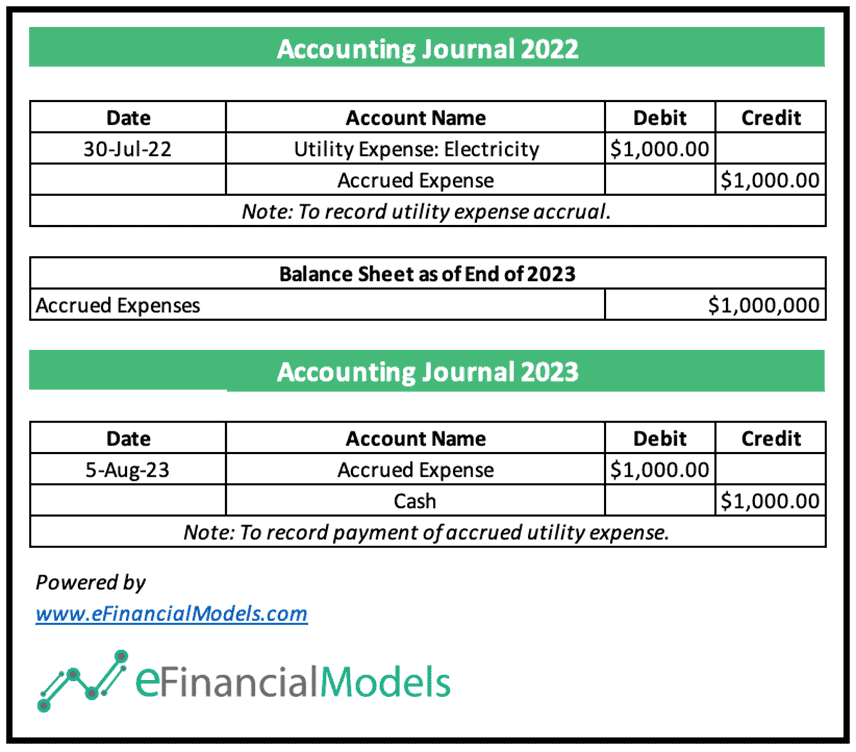
In the above example, the key is to recognize the accrued expense journal entry on the period they are incurred and match the accrued expenses examples with a reversing journal entry as the payment occurs later. The accrued expense journal entry ensures that financial statements accurately reflect the company’s financial performance for a specific period.















































Why Record an Accrued Expense Journal Entry?
Journal entry is a fundamental concept in bookkeeping and accounting. It is a record-keeping method used to document financial transactions within a business. These entries are typically recorded in a company’s general ledger and help maintain a systematic and organized record of financial activities. The basic principle of double-entry accounting is applied in journal entries, where there must be an equal and opposite credit for every debit.
In accrual accounting, expenses are recognized when they are incurred, not necessarily when they are paid. An accrued expense journal entry is a bookkeeping entry used to record such an expense. To record the accrued expense, a journal entry is created with two parts:
- Debit: An increase in an expense account, which reflects the expense incurred.
- Credit: An increase in a liability account, typically labeled as “Accrued Expenses” or “Accounts Payable.” It reflects the obligation to pay the expense in the future.
- Subsequent Adjustment: When the company eventually pays the expense, it will reverse the accrued expense entry by debiting the liability account (reducing the amount owed) and crediting the cash or bank account (reflecting the actual payment).
Recording accrued expenses is an essential accounting practice for several reasons:
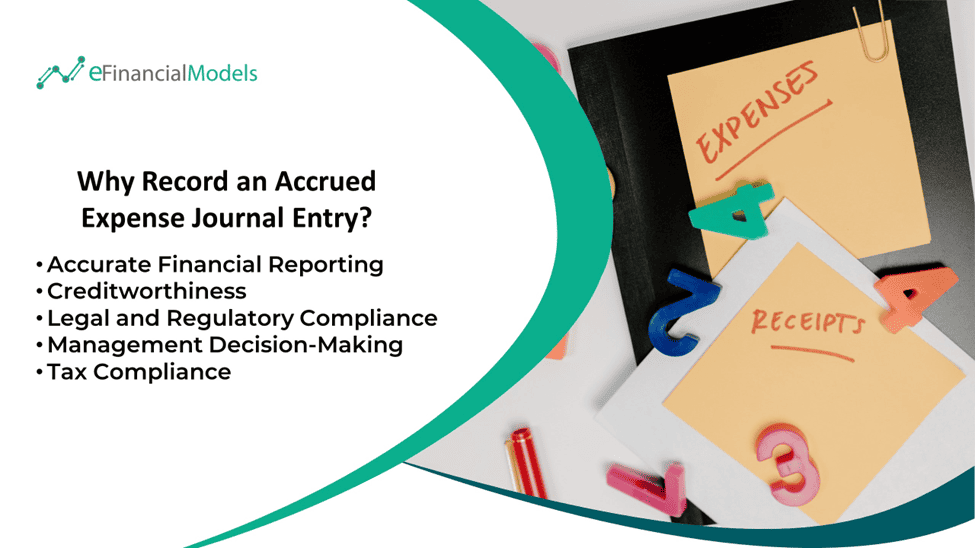
- Accurate Financial Reporting: An accrued expense journal entry should be recognized in the financial statements to reflect the company’s actual financial position. It is essential to trace accrued expenses to avoid understating expenditures and overestimating profits, which can mislead investors and stakeholders.
- Creditworthiness: Lenders and creditors often assess a company’s financial statements to determine its creditworthiness. Tracing accrued expenses helps provide a more accurate representation of a company’s financial health, which can affect its ability to secure funding and favorable credit terms.
- Legal and Regulatory Compliance: Accurate financial reporting, including accrued expenses, is often required by law and regulations in many jurisdictions. Companies must undergo periodic audits to ensure compliance with accounting standards and regulations. Accrued expense tracking is critical during audits to demonstrate compliance with accounting principles. Failure to trace these expenses can result in legal and regulatory penalties.
- Management Decision-Making: Accurate financial statements, including accrued expenses examples, are vital for making informed decisions. Tracing these expenses can bring a clear picture of a company’s current financial obligations, helping management plan for cash flow management and budgeting.
- Tax Compliance: Accrued expenses can impact a company’s taxable income. Tracing these expenses allows a company to accurately report its financial position for tax purposes, potentially reducing its tax liability and avoiding penalties for inaccurate reporting.
Manage Accrued Expenses and Current Liabilities List Easily
Financial modeling is a crucial linchpin in managing accrued expenses and current liabilities lists accurately and efficiently. The meticulous tracking of accrued expenses through journal entries in the balance sheet is a significant, albeit often overlooked, component. Leveraging sophisticated financial models can automate and improve this process, enhancing the accuracy of financial statements and lending more credence to analyses based on them.
High-caliber financial model templates, such as those provided by eFinancialModels, come equipped with dedicated sections to track such accruals, automatically adjusting the balance sheet and related financial reports. This real-time updating fosters a dynamic approach to financial planning, enabling key decision-makers to access timely and accurate information for strategic initiatives.






















You might also like:
- 10 Tips to Develop a First Class Business Valuation Report
- 10 Main Elements of a Business Plan
- Understanding the Debt Service Coverage Ratio: An Essential Metric for Financial Analysis
- How to Raise Series A Funding?
- Financial Statements – Definition, Uses, Contents and Templates
- Financial Ratios Analysis and Its Importance
- How to Start a Distillery Business: What You Need to Know?
- How Contribution Margin Analysis Can Drive Your Business to Financial Success
- Finding Fair Market Value: A Quick Guide to Real Estate Valuation
- Cash Flow Analysis in Excel
- Financial Planning for Small Business Owners – Taking an SBA Loan
- Business Valuation
- Investing
- Debt Amortization
- 5 Steps to Create a Drop Down List Using Data Validation in Excel
- Financial Modeling for Startups and Small Businesses
- Budget
- 10-Step Financial Planning Checklist for Smart Executives
- How to Build a Capitalization Table
- Understanding What is Yield to Maturity and Why It Matters